

OT most commonly means “off topic” in chats, “overtime” at work, or “out of town” in street slang—context decides which one applies.
Why This Term Confuses People
You’re scrolling through Discord and someone drops “OT but…” before their comment. Or your coworker texts about “pulling OT this weekend.” Maybe you saw a TikTok caption with “gone OT” and people are commenting fire emojis like it’s something totally different.
OT shifts meaning based on who’s saying it and where you see it. A K-pop fan, a nurse, and a drill rapper all use these same two letters—but they’re talking about completely different stuff.
Breaking Down What “OT” Actually Means
In chat rooms and forums, people use “OT” like a verbal hand raise: “Hey, I know we’re talking about video games, but…” It’s a polite way to acknowledge you’re about to derail things.
At work, especially in healthcare or manual labor jobs, OT means those extra hours that mess up your sleep schedule but boost your paycheck. It’s just workplace shorthand.
In music and street culture, “going OT” means leaving your city to handle business. It started as code in UK drill music to avoid police attention in texts, then became mainstream slang through TikTok.
For fan communities—especially K-pop—OT plus a number shows loyalty. “OT7” means you support all seven original members. It sounds sweet until people weaponize it to exclude members they don’t like.
Tone Shifts Everything Here
A coworker texting “doing OT again 😭” is venting about exhaustion. But “doing OT again 💰” shows they’re happy about the money. Same situation, opposite emotions.
When a friend comments “OT but you look good” under your post about a bad day, that’s them trying to cheer you up. But if a random guy slides into your DMs with “OT but you’re gorgeous,” that’s… weird. The intimacy level matters.
In fan culture, “OT8” can be neutral (just stating a preference) or vicious (pointedly excluding someone after a scandal). You’d need to read the room—check if people are arguing in the replies.
Big warning: If you see “gone OT” with car or money emojis from someone you don’t know well, don’t assume it’s innocent travel plans. In certain communities, that’s code for illegal activity. Context clues matter—are they also posting about “trapping” or “the grind”? Yeah, not a vacation.
The dangerous part about text-based slang is you can’t hear someone’s voice. A playful “OT I know” in person sounds different than the same phrase in a tense group chat where people are already annoyed.
You also like it: AYO Meaning: What Does AYO Mean in Text?
Skip Using “OT” in These Situations
Professional emails: Don’t open with “OT but can we discuss the budget?” Your boss will think you don’t understand formal communication. Say “On a related note” or “Separately” instead.
Serious personal conversations: If your friend just told you something heavy and you respond “OT but did you see that show?” you look heartless. Some moments need your full attention, not random topic switches.
With people over 40: Unless they’re extremely online, “OT” will confuse them or sound like you’re being lazy with typing. Spell it out.
In job applications or school essays: Never use chat slang in anything that affects your future.
When you’re already annoying people: If the group chat is already irritated with your constant tangents, adding “OT” before another random thought doesn’t make it better.
Public social media: Using drill slang like “going OT” when you’re actually just going to the suburbs for brunch? Cringe. People will either think you’re trying too hard or genuinely confused about what words mean.
Say It Different Ways
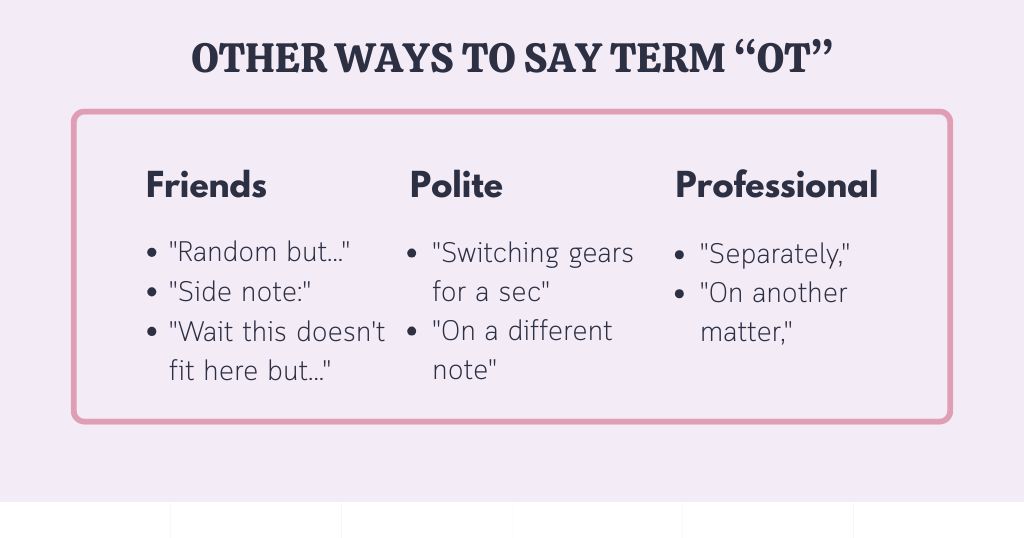
Casual with friends:
- “Random but…”
- “Side note:”
- “Wait this doesn’t fit here but…”
Polite in group settings:
- “Switching gears for a sec”
- “On a different note”
Professional:
- “Separately,”
- “On another matter,”
Playful:
- “Okay random thought incoming”
- “Nobody asked but…”
Pick based on who you’re talking to. Your best friend gets “random but I’m starving.” Your study group gets “switching topics—anyone done the homework?”
How It Looks in Real Messages
Discord gaming server: “OT but does anyone else’s game keep crashing since the update?”
Work group chat: “Can anyone cover my OT shift Saturday? I’ll owe you”
Twitter fan account: “I’m OT13 I don’t care what anyone says, they all deserve to be here”
TikTok comment section: “OT but where’d you get that lamp in the background lol”
Text from friend: “OT have you talked to Sarah lately? She seems off”
Instagram story reply: “This is so OT but I think we had class together in 2019?”
Snapchat from coworker: “Boss got me doing OT all week I’m dead 💀”
Each Platform Uses It Differently
Reddit and old-school forums stick hard to “off topic” because that’s where the term got popular. Moderators even have OT tags for threads.
TikTok and Instagram lean toward street slang meanings, especially among younger users. If someone under 25 posts “OT tonight,” there’s a good chance they mean physically going somewhere.
Work apps like Slack or Teams obviously use the overtime definition most. Though I’ve seen tech workers playfully use “off topic” in work channels when they share memes.
K-pop Twitter has basically claimed OT + number as their own language. They’ll fight you in the replies if you don’t respect their OT9 vs OT8 distinctions.
UK drill music and that whole scene owns the “out there” meaning. It spread through YouTube, then TikTok, and now even people who don’t listen to drill know what “going OT” implies.
Age splits matter too. If you’re texting someone Gen X or older, they probably think OT means overtime and nothing else. Gen Z will recognize multiple meanings immediately.
You also like it: What Does “ND” Mean in Text? It’s Not Always What You Think
Common Mix-Ups Explained
The number attached to OT throws people off, especially if they’re not used to fandom language.
Work culture vs internet culture don’t overlap. Nurses talking about “picking up OT” and teenagers commenting “that’s so OT” are living in completely different linguistic worlds.
The street slang version makes people nervous. When someone who looks clean-cut posts about “going OT,” friends might worry they’re involved in something shady. Usually they just picked up slang from music without knowing the full weight behind it.
Questions People Keep Asking About Term “OT”
Is it rude to use OT in group chats?
Not if you’re genuinely about to say something unrelated and you’re acknowledging it. It’s actually more polite than just barging in with random thoughts. But if you do it constantly, people will get annoyed anyway—the label doesn’t fix the behavior.
Can OT be sarcastic?
Absolutely. Someone might comment “OT but the sky is blue” to mock how obvious something is. Or use it sarcastically when their comment is actually perfectly on topic, just unpopular.
Does it mean the same thing everywhere?
Not even close. Geography, age, and subculture all shift the meaning. A London teenager, a Seoul fan account, and a Chicago nurse will give you three completely different definitions.
What if someone uses OT and a number but it’s not K-pop?
Could be gaming (original team of players), sports (referring to specific roster years), or even friend groups (their core squad). Numbers after OT don’t exclusively belong to music fans.
Should I use it at work?
Only for overtime. Don’t use “OT” to mean off-topic in professional settings unless your workplace is extremely casual and everyone else does it first.
What does it mean when a girl texts OT?
Same things it means when anyone else texts it—depends entirely on context. There’s no secret girl-specific meaning. Check what you were talking about before and after.
Final Thoughts
OT is one of those terms doing like five different jobs at once. Most of the time, context makes it obvious—overtime at work is overtime, off-topic in forums is off-topic, fan loyalty is fan loyalty.
The confusion happens when worlds collide. When street slang hits mainstream social media, or when professional shorthand gets used casually, or when you’re just not part of the subculture that uses it daily.
Your best move? Pay attention to who’s saying it and what they’re talking about around it. Check for numbers (fandom), emojis (street slang), or workplace context (overtime). And if you’re still unsure, it’s totally fine to just ask “wait, what do you mean by OT?” Most people are happy to clarify.

I’m Hazel, and I studied BSC English at GCUF. I focus on explaining word meanings in simple, clear language that anyone can understand. My goal is helping readers grasp everyday English, confusing terms, and slang used in real conversations and social media. I believe language learning works best when definitions connect to actual life situations. Through careful research and straightforward explanations, I make vocabulary accessible for students, learners, and anyone curious about how English really works in daily use.