

“Thicc” describes someone with a curvy, full body—especially wide hips, thick thighs, and a fuller butt. It’s basically a compliment that celebrates curves and shape.
You’re Probably Confused for a Good Reason
You saw someone comment “thicc 👀” under a photo, or maybe a friend texted it about someone’s gym progress. You’re thinking, “Wait, is that the same as calling someone fat?” Nope. That’s exactly why people get confused—the spelling looks weird, and the meaning isn’t what you’d guess from the regular word “thick.”
If you’re unsure whether it’s nice or rude, you’re not alone. Even people who use internet slang daily sometimes pause before using this one, because the line between compliment and creepy comment is thinner than you’d think.
Breaking Down What It Really Means
When someone says “thicc,” they’re pointing out that a person’s body has noticeable curves—but in a way that’s meant to sound attractive and confident. It’s not about being overweight. It’s about having shape in specific places, like your hips and thighs, while still having definition.
The feeling behind it? Appreciation. It’s celebratory. People use “thicc” when they want to say someone looks good specifically because of their curves, not in spite of them. That’s the big difference from older body language that treated curves as something to hide or fix.
The double “c” instead of “ck” makes it slang—it signals you’re being playful and modern, not clinical or rude. If someone just said “thick,” it could mean lots of things (a thick book, thick fog, thick accent). “Thicc” only means one thing: body curves that stand out.
Where You’ll Actually See It
You’ll see “thicc” most often in:
Text conversations where friends are hyping each other up about outfit photos or progress pics from the gym. Someone posts a mirror selfie, and the replies come in: ‘okay thicc 🔥’ or ‘ayo 👀'”
Social media comments, especially on Instagram, TikTok, or Twitter. It’s shorthand for “you look really good and your body shape is working for you.” People use it on their own posts too—like captioning a photo with “felt thicc, might delete later” as a joke.
Group chats when talking about celebrities, characters from shows, or even friends. “Did you see her new post? She’s looking thicc” is a common way to bring it up.
Memes and jokes about cartoon characters, video game characters, or even pets. You’ll see people joking about “thicc Pikachu” or calling a chubby cat “an absolute thicc boy.” That’s the playful side—it’s not always about humans.
The key thing? It’s almost always typed, not spoken out loud. Saying “thicc” in real life sounds awkward unless you’re being really ironic.
Reading the Room Matters a Lot
Here’s where things get tricky. “Thicc” can sound like a genuine compliment or a gross comment depending on who says it and where.
Between friends? Totally normal. If your friend’s been working out and posts their results, “looking thicc!” is supportive. You’re celebrating their effort.
From a stranger online? Can feel creepy fast. A random person commenting “so thicc” on your public photo reads less like a compliment and more like objectification. The intimacy of the word matters—it’s focused on body parts, not the whole person.
At work or in professional settings? Absolutely not. Even if you mean it kindly, it’s way too focused on physical appearance. You wouldn’t tell your coworker they’re “thicc” any more than you’d comment on other specific body features.
Warning about tone loss: In text, you can’t hear someone’s voice. “Thicc” without context or emojis can land wrong. If you’re not close with someone, they might read it as you reducing them to their body. Adding context helps—like “your outfit looks amazing, you’re looking thicc lately!” is better than just “thicc.”
Example of tone mattering: Your gym buddy texts you their deadlift PR with a flexing photo. You reply “thicc gains bro!” That’s hype. But if you comment “looking thicc” on a casual photo of them at a family dinner? That’s weird. Same word, totally different vibe.
You may also like it: DKM Meaning: What It Actually Stands For in Texting
Skip Using It Here
Skip “thicc” in these situations:
Professional emails or work messages. Even if your workplace is casual, this isn’t professional language. It’s too informal and too body-focused.
Talking to or about family members. Just… don’t. It’s meant for peers and feels inappropriate across generations or family relationships.
First conversations with someone new. You don’t know how they’ll take it. What feels like a compliment to one person feels like unwanted attention to another.
Public comments on someone’s post if you’re not close. This is how you end up in someone’s “look at this creepy DM” screenshot. If you wouldn’t say it to their face in front of other people, don’t type it.
Formal or serious discussions. If someone’s talking about body image struggles, health concerns, or feeling insecure, “thicc” trivializes it. That’s not the moment for slang.
Describing someone to their face in a mixed group. Singling someone out about their body—even positively—can make them uncomfortable in front of others.
Use polite alternatives instead: “You look great,” “That outfit is fire,” “You’ve been crushing it at the gym.” You can compliment someone without making it about specific body parts.
Say This Instead (Depends on the Vibe)
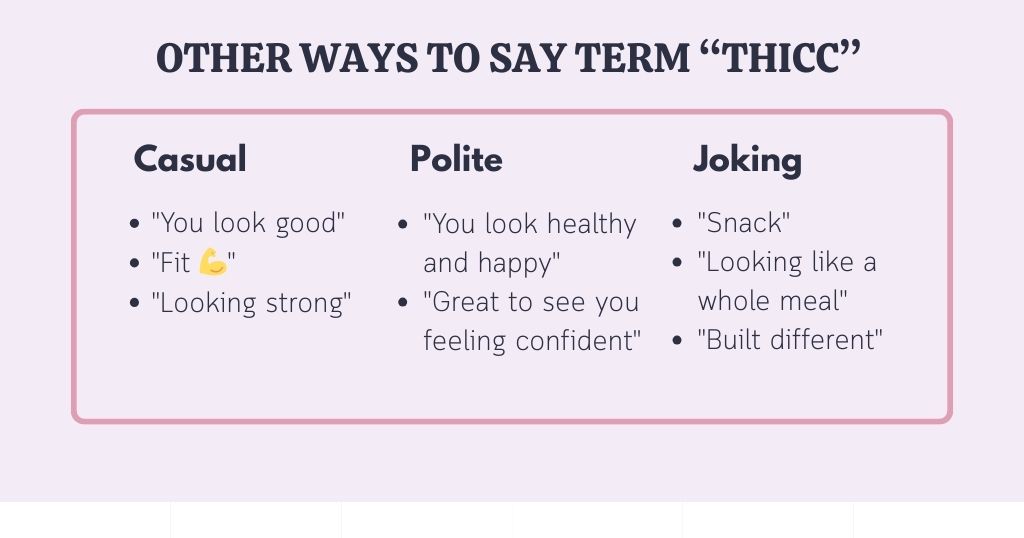
Casual / friendly:
- “You look good”
- “Fit 💪”
- “Looking strong”
Polite / professional:
- “You look healthy and happy”
- “Great to see you feeling confident”
Playful / joking:
- “Snack” (also slang, but less body-specific)
- “Looking like a whole meal”
- “Built different”
Messages People Actually Send
Friend’s gym progress photo: “‘Yooo you’re getting thicc! Squats paying off’ or ‘yhu look good!‘”
Commenting on someone’s outfit: “That dress makes you look thicc in the best way”
Joking in a group chat: “Why is Bowser from Mario so thicc tho 😭”
Hyping up a friend: “She posted and I had to comment, she’s looking thicc lately”
Ironic use about food: “This milkshake is thicc, can barely get it through the straw”
Talking about a pet: “My cat’s a thicc boy, vet says he needs a diet lol”
Self-deprecating post caption: “Thicc thighs save lives or whatever”
Gaming chat: “That character model is thicc for no reason”
Different Crowds Use It Differently
“Thicc” exploded on Twitter and Instagram first, around 2015-2016, then spread to TikTok and everywhere else. On TikTok, you’ll see it in fitness content a lot—people showing off their workout results or doing transformation videos.
Younger people (Gen Z, younger Millennials) use it way more than older generations. If you say “thicc” to someone over 40, there’s a decent chance they’ll think you mean “fat” and get confused or offended. The generational gap is real.
Black internet culture and hip-hop communities used this term first, celebrating curvy body types that mainstream media used to ignore or criticize. When it went mainstream, it kept that celebratory energy but sometimes lost the cultural context.
On platforms like Reddit or gaming forums, “thicc” gets used ironically more—joking about fictional characters with exaggerated proportions. It’s less personal there.
The term has shifted slightly since 2020. It’s less shocking now, more normalized. But that also means it can feel overused or less special when everyone’s saying it about everything.
Mistakes People Make With This Word
“Thicc = fat”: This is the biggest confusion. “Fat” is often used negatively. “Thicc” is specifically positive and refers to shape and curves, not overall size. Someone can be slim and thicc (narrow waist, wide hips). Someone can be plus-size and not fit the “thicc” description if their body shape is different.
Thinking it’s always a compliment: Context is everything. Between friends? Yes. From strangers? Can feel gross. The same word changes meaning based on who says it and why.
Overusing it makes it meaningless: Some people throw “thicc” at everything. When you call a pizza thicc, a notebook thicc, and three different people thicc in one conversation, the word loses its punch. It starts sounding like you don’t have other words.
Mixing up spelling = mixing up meaning: “Thick” and “thicc” aren’t interchangeable. If you spell it the regular way, you’re just describing density or width. The slang spelling carries all the cultural meaning.
Assuming everyone’s okay with body comments: Even positive attention about someone’s body can be unwanted. Some people don’t want their appearance discussed at all, compliment or not. If someone doesn’t respond well to “thicc,” don’t push it.
Questions You’re Probably Wondering About “Thicc”
Is thicc rude or disrespectful?
Not usually, but it depends on your relationship and the setting. Friends use it to hype each other up. Strangers using it can seem invasive. It’s never appropriate professionally.
Can guys be called thicc too?
Yep. For guys, it usually means muscular with bulk—like thick arms, thick legs, or a solid build. Think rugby player or bodybuilder shape. It’s less common than using it for women, but it happens.
Does thicc mean the same thing everywhere?
The core meaning is consistent, but the vibe changes. In fitness communities, it’s about muscle. In meme culture, it’s ironic. Among friends, it’s supportive. The word adapts to the group using it.
Can thicc be sarcastic?
Sometimes, yeah. Just like other texting slang, the tone completely depends on context and who’s saying it. If someone’s making fun of unrealistic beauty standards or mocking thirst comments, they might use “thicc” sarcastically. But usually, you can tell from context and other words around it.
What’s the difference between thicc and slim thicc?
“Slim thicc” is a specific subset—it means curvy in the hips and thighs but with a small waist and overall lean frame. Regular “thicc” is more about having substantial curves without necessarily being slim elsewhere.
Is it okay to call myself thicc?
Absolutely. Lots of people use it in their own captions or bios as a confidence thing. Reclaiming body language for yourself is different from someone else labeling you.
Final Thoughts on Using It Right
“Thicc” is slang that celebrates curves, but it’s not a free pass to comment on anyone’s body whenever you want. Between friends, in the right context, with the right tone? It’s hype. It’s positive. It’s fun.
But the second you cross into stranger territory, professional spaces, or situations where someone hasn’t invited body comments, it stops being a compliment and starts being uncomfortable.
Use it when you’re genuinely supporting someone, when you know they’ll take it well, and when the vibe is already casual and playful. Skip it when you’re unsure, when it’s formal, or when you don’t actually know the person.
That’s really all there is to it. The word itself is simple—it’s the reading-the-room part that takes practice.
More Educational Articles:

I’m Hazel, and I studied BSC English at GCUF. I focus on explaining word meanings in simple, clear language that anyone can understand. My goal is helping readers grasp everyday English, confusing terms, and slang used in real conversations and social media. I believe language learning works best when definitions connect to actual life situations. Through careful research and straightforward explanations, I make vocabulary accessible for students, learners, and anyone curious about how English really works in daily use.