

“Wig” is internet slang for when something shocks or amazes you so much that it feels like your wig flew off your head. People say it when they’re blown away by talent, drama, or something unexpectedly cool.
Why This Word Confuses Everyone
You probably saw “wig” in a comment section and thought, “Wait, are they talking about actual hair?” It’s confusing because someone will post a stunning performance, and the replies are just “WIG” with no other explanation. Or maybe you heard it on a talent show and the judges screamed it like they’d witnessed magic. The word doesn’t make obvious sense if you’re hearing it for the first time—there’s no hair involved, and nobody’s head is actually flying off.
Here’s the thing: “wig” started in communities where everyone already knew what it meant. Then it jumped to mainstream apps where millions of people had zero context. That’s why you’re here trying to figure out if it’s good, bad, or just weird.
The Real Feeling Behind It
When someone says “wig,” they’re reacting to something that genuinely shocked or impressed them. It’s the kind of moment that makes you stop scrolling or replay a clip. The metaphor exaggerates the reaction — like even a wig couldn’t stay on your head.
People use it instead of typing “wow” because it feels bigger and more dramatic. It signals exaggerated excitement — not quiet appreciation. You save it for moments that genuinely surprise or impress you.
Where You’ll Actually See It
Most people type “wig” as a standalone comment. Someone posts a makeup transformation video, and the replies are filled with “WIG,” “wig flew,” or “wig snatched.” It’s a quick reaction that doesn’t need a full sentence.
In group chats, you’ll see it when someone shares unexpected news. Your friend announces they got the job they wanted? “Wig.” Someone sends a photo of their new haircut that looks incredible? “WIG.” It works as both celebration and shock.
On reaction threads, people stack it for emphasis: “wig wig wig” or pair it with emojis like the bald head emoji or the exploding brain emoji. The repetition makes it funnier and shows they’re really losing it over whatever just happened.
Sometimes people use longer versions like “my wig flew to Mars” or “wig? snatched.” These add personality but mean the same thing—total amazement.
Reading the Room (This Part Matters)
Here’s where things get tricky. “Wig” sounds positive 99% of the time, but context changes everything.
Between friends, it’s pure hype. You’re supporting each other and celebrating wins. The energy is genuine excitement.
With strangers online, tone gets blurry. If someone’s performance was actually bad and comments say “wig,” it might be sarcasm. Some people use it mockingly, like they’re pretending to be impressed when they’re actually making fun of something. You can usually tell from other comments—if everyone’s piling on with jokes, “wig” might not be a compliment.
Warning about professional spaces: If your boss shares a presentation in the work chat, don’t reply “wig.” It sounds too casual and might seem like you’re not taking them seriously. Even if you mean it positively, slang like this can read as immature in offices or formal settings.
Caps change the tone. “WIG” feels louder and more dramatic than lowercase “wig.” “wig…” with dots might be sarcastic or doubtful.
The biggest risk is using it for serious topics. If someone shares sad news or a personal struggle, “wig” is completely wrong. It’s for fun moments, not emotional support.
You also like this slang: Bando Meaning: What Does This Street Slang Actually Mean?
Situations Where It Sounds Wrong
Don’t use “wig” in:
Work emails or Slack with managers. Save it for casual coworker friends you text outside of work, not company channels. Your professionalism takes a hit when you type slang in business conversations.
Responding to serious life updates. If someone tells you about a health scare, family problem, or tough breakup, “wig” makes you look tone-deaf. They need real words, not meme language.
Talking to people over 40 who aren’t online much. They’ll think you’re talking about actual wigs or hairpieces. You’ll have to explain it, which kills the moment and makes everything awkward.
First messages to someone new. Whether it’s a dating app or a new friend, starting with slang can make you seem like you’re trying too hard. Let them set the tone first.
Comments on sensitive topics. Politics, tragedies, social issues—none of these need “wig” reactions. It trivializes serious stuff and makes you look careless.
Anywhere that requires clear communication. Customer service chats, medical forms, school assignments. If there’s any chance of confusion, skip the slang.
Better alternatives for professional settings: “That’s impressive,” “Great work,” “Really well done,” or just a simple “Wow, nice job.”
Other Ways to Say the Same Thing
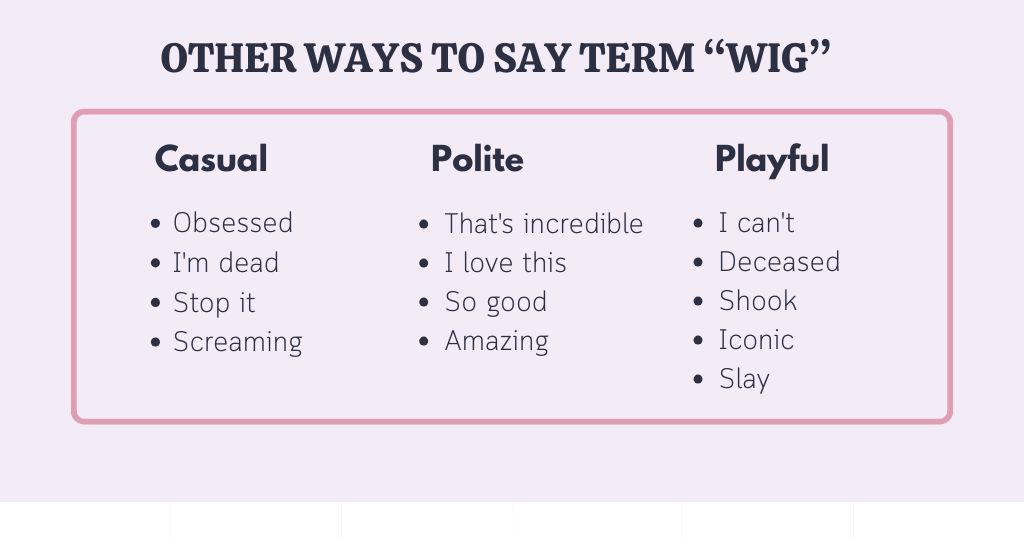
Casual with friends:
- Obsessed
- I’m dead
- Stop it
- Not you doing THAT
- Screaming
Polite but still excited:
- That’s incredible
- I love this
- So good
- Amazing
Playful and over-the-top:
- I can’t
- Deceased
- Shook
- Iconic
- Slay
When you want to sound normal:
- Wow
- No way
- That’s wild
- Seriously?
You also like these versions of slangs like YHU and DKM meaning in texts.
Examples That Feel Real
Text between friends: “Did you see her Halloween costume??” “WIG”
Comment on a cooking video: “that cheese pull just snatched my wig”
Reply to good news: “I passed my driving test!” “wig flew to another dimension”
Group chat reaction: [someone shares they got concert tickets] “WIG WIG WIG 😭”
Sarcastic use (be careful): [someone posts a clearly filtered selfie] “wig I guess”
TikTok comment: “the way she hit that note… wig”
Response to drama: “wait he said WHAT to her” “my wig is orbiting the sun rn”
Supportive friend mode: “finally finished my painting” “WIG it looks so good!!”
Different Vibes on Different Apps
“Wig” feels most at home on TikTok and Twitter (X). Instagram uses it too, but less frequently. If you’re on Facebook, you’ll barely see it except from younger users.
The term peaked around 2018-2019 when Katy Perry said it on American Idol and everyone lost their minds. A contestant named Noah Davis used it, she asked what it meant, and suddenly millions of people who’d never heard it started saying it. That moment pushed “wig” from niche queer and Black culture into mainstream meme territory.
In drag and LGBTQ+ spaces, “wig” carries history. It comes from ballroom culture in the 80s and 90s, where performers would “snatch” each other’s wigs during competitions—either literally or metaphorically through fierce performances. When RuPaul’s Drag Race got huge in the 2010s, phrases like “wig snatched” spread beyond queer communities. Some people know this history, many don’t.
By 2024-2026, “wig” isn’t as dominant as it was. It still appears but competes with newer slang. People cycle through phrases fast online, so what’s everywhere one year becomes old-school the next.
Mistakes People Make With This Word
People think it’s always positive. Not true. Sarcasm exists, and “wig” can be a joke at someone’s expense if the context is mocking.
They assume everyone knows it. Outside internet-heavy spaces, tons of people have never heard this word used this way. You’ll get blank stares from anyone who doesn’t spend time on social media.
They don’t realize it has cultural roots. Treating “wig” like just another random meme erases the Black and queer communities who created it. It’s not rude to use it, but knowing where it comes from adds respect.
Overusing it kills the impact. If you type “wig” on every single post, it stops meaning anything. It becomes filler, like adding “lol” to texts out of habit.
Tone gets lost in text. You can’t hear someone’s voice, so “wig” might read flat or sarcastic when you meant it excitedly. If you’re worried about that, add emojis or extra words to clarify.
Some people still think you’re talking about hairpieces. Especially older relatives or people learning English. They’ll picture a literal wig flying off someone’s head and get very confused.
Read Also: KOOK MEANING: What It Really Means (And When You’ll Sound Ridiculous Using It)
Quick Questions People Actually Ask
Is saying “wig” rude or disrespectful?
Not if you use it genuinely. It becomes disrespectful when you’re mocking someone or using it sarcastically to tear them down. Also, using slang from Black and queer culture without basic respect for its origins can feel off to people from those communities.
Can you use it in real-life conversations or just online?
You can say it out loud, but it sounds weirder than typing it. Most people keep “wig” to texts and comments. If you do say it, it’ll probably come out like “oh my god, wig!” in an exaggerated voice. It’s not a natural spoken word for most people.
Does “wig” mean the same thing everywhere?
Mostly, yeah. But in the UK, some people use “wig” differently—like “use your wig” means “use your brain.” That’s not the mainstream slang meaning though. In the US, it’s almost always the shock/amazement reaction.
Is it outdated now?
It’s not dead, but it’s not brand-new either. People still use it, just not as obsessively as in 2018-2019. Slang has a lifespan, and “wig” is in its comfortable middle-age phase.
What if someone uses it on my post and I don’t get it?
Just say thanks or react positively. They’re complimenting you. Don’t overthink it or ask them to explain unless you’re genuinely close friends.
Is it connected to the Whig political party?
No. That’s spelled W-H-I-G and it’s a totally different word from history. People confuse them in searches sometimes, but they have nothing in common.
“Wig” is one of those words that sounds ridiculous until you see it used right. Then it clicks, and you get why people love it. It’s fast, it’s dramatic, and it captures that specific internet energy where everything’s turned up to 11. You don’t have to use it yourself—plenty of people don’t—but at least now you won’t be lost when you see it everywhere. Use it when something genuinely blows your mind, skip it in serious situations, and you’ll be fine.
Confused about “wig” slang? Learn what it really means, where it came from, and when to use it (or skip it). Real examples, zero fluff—explained like a human.

I’m Hazel, and I studied BSC English at GCUF. I focus on explaining word meanings in simple, clear language that anyone can understand. My goal is helping readers grasp everyday English, confusing terms, and slang used in real conversations and social media. I believe language learning works best when definitions connect to actual life situations. Through careful research and straightforward explanations, I make vocabulary accessible for students, learners, and anyone curious about how English really works in daily use.