

OTP usually means “One True Pairing” when talking about favorite couples, “On The Phone” when someone’s busy calling, or “One-Time Password” for login codes.
Why This Gets Confusing
You might see someone comment “they’re my OTP!” on a post, get a bank text asking for an OTP, then receive “can’t talk, OTP” from a friend — all in the same day. Same three letters, completely different meanings depending on context.
It’s not your fault for being confused. OTP completely changes meaning depending on who’s saying it and where you see it. A bank code, a fandom comment, and a friend texting mid-call have nothing to do with each other — even though they use the same letters.
The trick is recognizing the context — once you do, it clicks.
Three Letters, Three Totally Different Vibes
One True Pairing is the emotional one. When someone calls two people their OTP, they’re saying “these two belong together, period.” It comes with feelings—usually strong ones. People get attached to their OTPs the way some people get attached to sports teams. It’s about believing in a connection so much that no other pairing compares.
On The Phone is the practical one. It’s basically shorthand for “I’m talking to someone right now, so I can’t properly text you back.” People use it when they need to signal they’re unavailable without typing out a full explanation. It’s a time-saver, not an emotion.
One-Time Password is the security one. There’s zero emotion here—it’s just a temporary code that proves you’re really you. Banks and apps send these to make sure nobody else is trying to get into your accounts. You type it in once, then it’s useless.
The reason people stick with “OTP” instead of spelling things out? Speed and vibe. Typing “One True Pairing” feels too formal when you’re hyped about a couple. Saying “I’m currently engaged in a telephone conversation” sounds ridiculous when “OTP” does the job in three letters.
Read More: OTT Meaning: What It Really Means in Texts, Streaming, and Everyday Life
Everyday Situations Where You’ll See It
In fandom spaces and social media, OTP shows up when people are talking about relationships—real or fictional. Someone posts a photo of two celebrities hugging, and the comments fill up with “OTP!” A friend group chat debates which Harry Potter pairing makes the most sense, and someone declares their OTP. It’s also used for real-life couples: “You two are such an OTP” means “you’re perfect together.”
In quick text conversations, the “On The Phone” version pops up as an excuse or explanation. Your roommate texts asking where you are, you shoot back “OTP with my mom, be there soon.” It’s not rude—it’s informative. You’re letting them know you’re mid-conversation and can’t give them your full attention yet.
In login screens and security texts, you’ll see “Enter OTP” or “Your OTP is 749302.” This version never shows up in casual conversation between friends. It’s always technical, always about verification. If someone randomly asks you to send them an OTP code, that’s a huge red flag—they’re probably trying to hack an account.
The context tells you everything. Fandom post? It’s about a pairing. Text from a friend? They’re on a call. Message from a company? It’s a security code. Mix these up and you’ll confuse yourself and everyone else.
Context Changes Everything (Pay Attention Here)
Here’s where people mess up: they forget that OTP’s meaning completely shifts based on the situation and relationship.
Between friends talking about shows or couples, calling something an OTP is always positive. It’s a compliment, a stamp of approval, a “yes, THIS is the one.” If your friend says “you and Jake are my OTP,” they’re rooting for you. But if you barely know the person saying it, that same comment can feel weird or invasive, like they’re too invested in your business.
In a regular text exchange, if someone replies “OTP” and you think they’re calling you their soulmate, you’re about to embarrass yourself. They mean they’re on the phone. Check what you just asked them. Did you ask a question that needs a real answer? Then “OTP” is them saying “give me a minute.”
When it comes to security codes, tone doesn’t exist. This is purely functional. But here’s the warning: if someone you matched with on a dating app or a “friend” you just met online asks you to send them “the OTP from your text messages,” stop. That’s a scam. Real companies never ask you to forward these codes to another person. They’re trying to break into your account by using your code.
The biggest misinterpretation happens when someone uses OTP in a busy moment. You text your crush something flirty, and they reply “OTP.” You might panic thinking it means something about relationships. It doesn’t. They’re just on another call. Don’t spiral—just wait for them to finish and text you properly.
Sarcasm can sneak in too. If someone ironically says “wow, you and that burrito are my OTP,” they’re joking about how much you love that food. It’s playful teasing, not a serious statement about relationships.
Times to Skip the Abbreviation
At work or in professional emails, stick to full words. “I’m currently on a call” sounds way better than “OTP rn.” If you’re talking to a boss, client, or anyone in a formal setting, abbreviations like OTP make you sound too casual or unclear. They might not even know what you mean.
When talking to people over 40, there’s a good chance they’ll only recognize OTP as the security code version. If you say “they’re my OTP” to your mom, she might think you’re talking about a password. It’s not worth the confusion—just say “favorite couple” instead.
In serious or sensitive conversations, don’t use slang. If a friend is going through something tough and texts you, responding with “can’t talk, OTP” feels cold and dismissive. Take the extra two seconds to say “I’m on a call with family, can I call you back in 20?”
On public platforms where strangers will see it, be careful with the “One True Pairing” usage. Posting “these two are my OTP” about real people you don’t know can come across as intrusive or like you’re shipping strangers, which some people find creepy. Fictional characters? Go wild. Real humans? Read the room.
If you’re in a new relationship and someone calls you two “OTP” right away, that can feel like pressure. Some people don’t want their relationship hyped up publicly or labeled before they’re ready. It’s kind, but it can be too much.
Say It Another Way (By Situation)
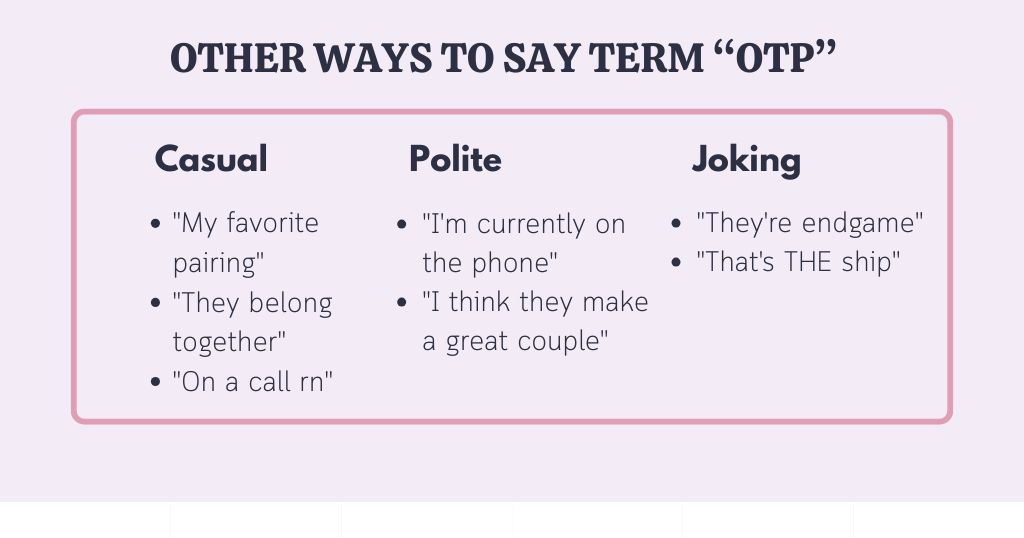
Casual or friendly:
- “My favorite pairing”
- “They belong together”
- “On a call rn”
- “Talking to someone, text you soon”
Polite or professional:
- “I’m currently on the phone”
- “I think they make a great couple”
- “Please enter the verification code”
Playful or joking:
- “They’re endgame”
- “That’s THE ship”
- “Can’t chat, phone’s glued to my ear”
Pick what feels natural to you and the person you’re talking to. If “OTP” doesn’t fit, just say the thing in regular words. Also, more acknowledge on other related slangs terms like OT Meaning in Chat.
Example of Messages That Actually Sound Real
Fandom/Pairing Examples:
“Hermione and Ron? Nah. Harry and Hermione are my OTP.”
“I know they broke up in season 3 but they’re still my OTP, I don’t care.”
“You guys are literally OTP goals, when’s the wedding?”
On The Phone Examples:
“Can’t talk rn, OTP with my sister.”
“OTP, call you back in 10?”
“Sry for the late reply, was OTP”
Security Code Examples:
“Your OTP for Chase Bank is 583921. Do not share this code.”
“Enter the 6-digit OTP we sent to your email.”
Different Spaces, Different Rules
On TikTok and Instagram, the “One True Pairing” version dominates. People comment it on couple videos, edits, or posts about fictional characters. If you see it in a comment section there, it’s almost always about relationships.
On Snapchat, “OTP” in a direct message usually means “On The Phone.” People use Snap for quick, real-time updates, so it makes sense they’d use the busy-signal version more than the fandom one.
In texts from banks or apps, you’ll only see “One-Time Password.” This version is universal and doesn’t change across platforms.
Age matters here. People under 25 are way more likely to use the “One True Pairing” version regularly. If you’re talking to someone older, they might not know this meaning exists. They’ll default to thinking you’re talking about a security code or just be confused.
Younger users also tend to use OTP more ironically—calling random things their OTP as a joke, like “me and my bed are OTP” or “coffee and I are the real OTP.” It’s an exaggeration for humor.
In gaming communities, there’s also “One-Trick Pony,” which means someone who only plays one character or uses one strategy. This version is pretty niche and mostly stays inside gaming conversations. If you’re not talking about video games, you won’t run into it.
Mix-Ups That Happen All the Time
The biggest mix-up is thinking someone’s calling you their soulmate when they’re just explaining they’re on a phone call. It happens because “OTP” has such different emotional weight depending on the meaning. If you’re unsure, look at the context of the conversation. Were you talking about relationships or shows? Then it’s probably “One True Pairing.” Did you just ask them a question and they replied with only “OTP”? They’re on the phone.
People often assume OTP means the same thing everywhere, but it doesn’t. In fandom spaces it’s about pairings, in texts it depends on context, and in messages from banks it’s always a security code.
Some people overuse “OTP” and it loses meaning. If someone calls every couple they see “OTP,” it stops feeling special. The term is supposed to signal THE pairing, not just any random couple you kind of like.
Tone gets lost in text, so people sometimes read emotion that isn’t there. If someone says “OTP” about your relationship and you can’t tell if they’re being genuine or sarcastic, you can’t really know without more context. Look at your history with that person. Do they usually joke around? Then it might be playful. Do they seriously follow celebrity couples or ship TV characters? Probably genuine.
Asking someone to “send the OTP” always sounds suspicious unless you’re talking about a shared account or helping them troubleshoot a login. If a stranger asks for it, they’re trying to scam you. This confuses people because the term sounds so casual, but security codes should never be casual.
Questions People Actually Ask
Can OTP be sarcastic?
Yes, especially the “One True Pairing” version. People jokingly say things like “me and my dog are OTP” or “pizza and I are endgame OTP.” It’s a way of exaggerating how much you love something by using relationship language.
Does it mean the same thing everywhere?
Not at all. Context is everything. On social media, it’s usually about favorite couples. In text messages, it could mean someone’s on the phone. In security settings, it’s always a password. The location and situation tell you which meaning applies.
Is it rude to use OTP?
Not in casual settings with friends or online communities. But in professional situations, yes—it’s too informal. And if you use the “On The Phone” version without any other explanation when someone needs you, it can feel dismissive.
Do guys and girls use it differently?
Not really. The meaning doesn’t change based on gender. Some people think guys are more likely to use it ironically or that girls use it more emotionally, but that’s just stereotypes. Anyone can use OTP however they want, regardless of gender.
What if someone uses OTP and I don’t know which meaning they mean?
Just ask. Say “wait, do you mean you’re on a call or are you talking about a couple?” It’s way less awkward than guessing wrong and responding to the wrong meaning.
Is “One True Pairing” still popular?
Very. It’s been around since the early 2000s in online fandom spaces and it’s not going anywhere. Younger people still use it constantly, especially on TikTok and in fan communities.
Can I use OTP for real-life couples?
Absolutely. People say things like “my parents are my OTP” or call their friends’ relationships OTP all the time. It works for both fictional and real pairings.
Bottom Line
Once you know which version of OTP someone’s using, it’s actually pretty simple. Watch for clues—are they talking about people who belong together, explaining why they can’t text right now, or asking you to verify your identity? That tells you everything. And if you’re still not sure, there’s nothing wrong with asking. It’s better to check than to respond to the wrong meaning and confuse everyone involved.
Related More Guides:

I’m Hazel, and I studied BSC English at GCUF. I focus on explaining word meanings in simple, clear language that anyone can understand. My goal is helping readers grasp everyday English, confusing terms, and slang used in real conversations and social media. I believe language learning works best when definitions connect to actual life situations. Through careful research and straightforward explanations, I make vocabulary accessible for students, learners, and anyone curious about how English really works in daily use.