

RT usually means “Retweet” when sharing posts online, or “Real Talk” when someone’s being honest with you in a message.
Why This Gets Confusing
You’re scrolling through comments and someone drops “RT” under a video. Or a friend texts you “RT” after you complain about Monday morning. If you didn’t grow up on Twitter, this probably looks like random letters.
The tricky part? RT changes meaning depending on where you see it. What works in a TikTok comment might sound weird in a work chat. And if someone sends it to you privately, you might wonder if they’re agreeing, being lazy, or just don’t know what else to say.
Breaking Down What “RT” Actually Means
When someone types RT, they’re usually doing one of two things: sharing something they agree with, or signaling ‘same energy’—that what you said already says it all.
People use RT because it’s quick and shows agreement without overexplaining. It’s the text version of snapping your fingers in agreement or doing that knowing look when someone gets it.
It’s similar to how people use FR in chat to emphasize they’re being serious, or IHH to show excitement—quick slang that carries specific energy without needing full sentences.
Spotting “RT” in Your Daily Messages
You’ll see RT pop up when someone wants to signal agreement fast. In group chats or comment sections, it replaces ‘yes,’ ‘same,’ or ‘me too’—a quick way to say something’s relatable without adding a full response. Someone posts about forgetting their charger for the third time this week, and the comments fill up with “RT” from everyone who’s done the same thing.
In private texts, RT works as a conversation shortcut. Your friend vents about their boss, and you reply “RT” to show you’ve been there too. It’s validating without getting too deep. Some people use it when they’re multitasking—they want to respond but can’t type out a whole thing right now.
On Instagram stories, you might see “RT this if you care about…” which is asking people to repost something. On Snapchat or TikTok, it’s usually showing up as agreement or relatability in comments and messages.
Reading the Room: Why Tone Changes Everything
Here’s where people mess up: RT can sound super supportive or totally dismissive depending on who sends it and when.
If your friend just told you something exciting—like they got accepted to college or met someone special—and you just reply “RT,” that’s going to feel cold. They shared big news and you gave them two letters. It reads like you barely care.
But if someone’s ranting about traffic or complaining about the weather, RT fits perfectly. You’re matching their casual energy with a casual response.
Watch out for this: When a guy or girl you’re talking to keeps responding with just “RT” in private messages, they might not be that interested in the conversation. It’s a low-effort reply. If every response is RT or one-word answers, that’s usually a sign they’re not invested.
RT can also come off sarcastic if used wrong. Someone shares a genuine struggle and you reply “RT” without explanation—they might think you’re mocking them or not taking it seriously. Tone doesn’t travel well through text, so RT can easily be misread as snarky when you meant it as supportive.
When someone texts “RT” followed by their own opinion, like “RT, we need to stop pretending everything’s fine,” they’re using it as “Real Talk.” That version means they’re about to be brutally honest with you. It’s a warning that what comes next is unfiltered.
Read More: What Does OY Mean When Someone Texts You?
Times to Skip “RT” Completely
Skip RT in professional emails or formal work messages. Your boss emails about quarterly goals and you reply “RT”? That’s a bad look. It comes across as unprofessional and lazy, like you couldn’t be bothered to write actual words.
Don’t use it when someone shares personal news—good or bad. Got engaged, lost a pet, dealing with family stuff—these moments need real responses. RT makes it seem like you’re treating their life update like a random tweet.
Avoid it with older relatives or people who aren’t online much. They won’t get it, and explaining internet slang mid-conversation kills the moment. Just say what you mean.
In serious arguments or emotional conversations, RT can make you look like you’re not listening. If someone’s genuinely upset and trying to work through something with you, responding with slang shortcuts suggests you’re checked out.
Public comments on professional pages—like LinkedIn or someone’s business post—aren’t the place for RT either. It reads as too casual and doesn’t add value to the conversation.
Better Ways to Say It (When “RT” Doesn’t Fit)
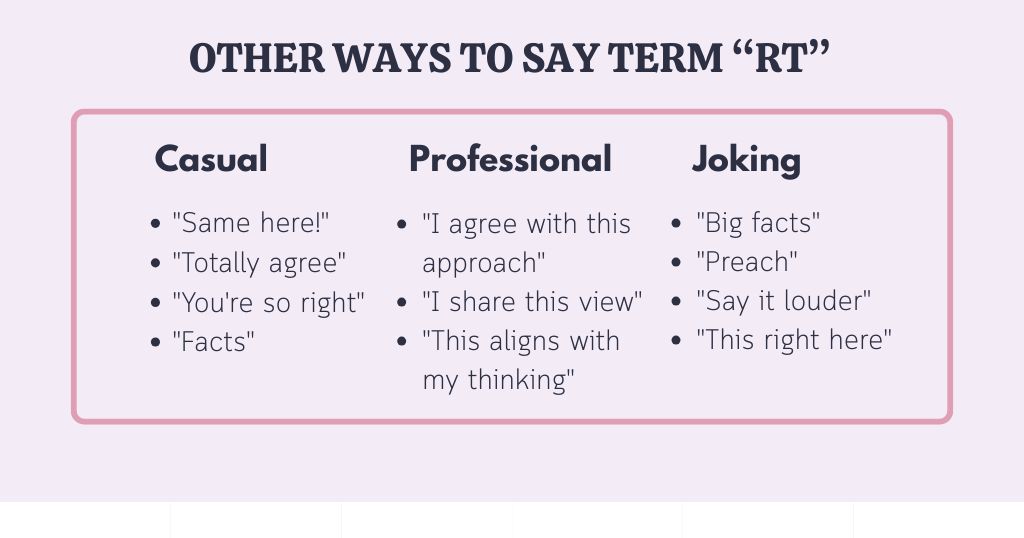
For casual but warmer:
- “Same here!”
- “Totally agree”
- “You’re so right”
- “Facts”
For professional settings:
- “I agree with this approach”
- “I share this view”
- “This aligns with my thinking”
- “Well said”
For showing real support:
- “I feel you on this”
- “That makes total sense”
- “I’ve been through that too”
- “This is so true”
For being playful:
- “Big facts”
- “Preach”
- “Say it louder”
- “This right here”
If you’re still learning text slang, terms like YHU (a casual “you”), AYO (getting someone’s attention), or ND (short for “and”) work in similar casual contexts where RT fits.
Real Conversations Where “RT” Shows Up
Text 1: “Ugh, my alarm didn’t go off and I missed my bus” “RT, happened to me yesterday”
Text 2: “Does anyone actually read terms and conditions?” “RT lol”
Text 3: “Just saw someone walking three dogs that were all pulling different directions” “RT that’s my life in one image”
Text 4: “We should normalize leaving parties without saying goodbye to everyone” “RT, Irish goodbye is the only goodbye”
Text 5: “Why do we have meetings about meetings?” “RT, this is torture”
Text 6: “I think pineapple on pizza is actually good” [Response using RT here would be supporting the controversial opinion]
Text 7: “Real talk, I don’t think I’m ready for this exam” [Here RT is used as Real Talk to introduce honesty]
Different Apps, Different Vibes
On Twitter/X, RT is still the official retweet function, but people also type it in replies when they agree. The button does the work, but the letters carry weight in comments.
TikTok comments are flooded with RT on relatable videos. It’s basically replaced “same” or “me too.” You’ll see it hundreds of times under any video about forgetting what you walked into a room for.
Instagram uses RT less in captions, more in DMs and story reshare requests. Someone might post “RT if you support this cause” on their story, asking followers to share it forward.
Snapchat sees RT occasionally, usually in messages rather than on snaps themselves. It’s not as common there since Snapchat’s more visual and temporary.
WhatsApp groups sometimes use RT when sharing forwarded messages. People will type “RT” at the start to show they’re passing along something they got from somewhere else, not claiming it as their own words.
Gaming chats might use RT for “real-time” when coordinating moves, like “RT status?” meaning “What’s happening right now?”
Beyond Texting: “RT” in Jobs and Tech
Outside texting, RT has completely different meanings that can cause confusion if you’re searching online.
In hospitals and medical settings, RT stands for Respiratory Therapist—someone who helps patients with breathing problems. Nursing students and healthcare workers use this all the time, which is why searches for “RT meaning” can pull up job descriptions instead of slang explanations.
In business or travel, RT means “round trip” for flights and tickets. You’ll see it on booking sites next to prices.
Tech people use RT for “real-time” when talking about systems that need instant responses—like real-time chat or gaming. Graphics card discussions might mention ray tracing as RT, which is about how light looks in video games.
This overlap is why context matters so much. If you’re in a medical group chat, RT definitely doesn’t mean someone’s retweeting.
Misreading “RT” (And How to Avoid It)
Thinking it always means retweet: In personal texts, RT rarely means you’re actually reposting anything. It’s just agreement. People carry the Twitter meaning into places where there’s nothing to retweet.
Using it as a conversation ender by accident: If you keep replying with just RT, the other person might think you want the conversation to stop. It doesn’t leave room for back-and-forth unless you add something else.
Mixing up Real Talk vs Retweet: When someone starts a message with “RT,” they usually mean they’re about to be honest (Real Talk). When they reply with just “RT” to what you said, they’re agreeing (like retweeting). Same letters, different energy.
Overusing it until it loses meaning: Some people RT everything. When you do that, it stops feeling like genuine agreement and starts looking like you’re just filling space.
Missing the “dry texter” red flag: If someone you’re getting to know only responds with RT and other short slang, they’re probably not putting in effort. It’s fine occasionally, but if that’s their whole texting style, they’re giving you the minimum.
This same pattern shows up with other short responses too. If someone only replies with NN or SFLR without adding anything else, it might signal they’re not fully engaged in the conversation.
Quick Questions People Actually Ask About “RT”
Can RT be rude or sarcastic?
Yes, especially if the timing’s off. Using RT for serious news or emotional moments comes across as dismissive. It can also read as sarcastic if someone’s being genuine and you respond with just two letters—feels like you’re mocking them.
Does it mean the same thing on every app?
Not really. Twitter/X made it famous as a sharing term, but on TikTok and Instagram it’s more about relating. In texts it’s pure agreement or honesty. Medical and business folks use it for completely different things. Context shifts happen with lots of texting shortcuts—DKM changes tone depending on the situation, just like RT does.
Is saying “Big RT” different?
Yep. “Big RT” means you agree extra hard. It’s emphasizing that you don’t just relate—you REALLY relate. It adds more energy and shows you’re not being a lazy texter.
What if I use RT and someone doesn’t get it?
Older people and folks who aren’t on social media much probably won’t know it. If you have to explain slang, just use regular words instead. Not worth the confusion.
Does RT from a guy mean something specific?
Not really. It’s the same meaning whether a guy or girl sends it. The context and conversation matter way more than who’s typing. If someone’s giving you one-word or two-letter responses constantly, that’s about effort level, not gender.
Can I use RT at work?
Only in very casual work environments where everyone’s young and chats like friends. For actual work communication—emails, Slack with management, client messages—skip it. Stick to professional language.
The Bottom Line
RT is one of those terms that traveled from one corner of the internet into everyday texting, but it didn’t keep the same job. It started as Twitter’s sharing feature and turned into a quick way to say you agree or relate without typing a whole response.
Use it when you want to show support casually, agree with something relatable, or signal you’ve been through the same thing. Skip it when someone needs a real response—especially with big news, emotional moments, or professional conversations. And if you’re talking to someone who might not know internet slang, just say what you mean in plain words.
The key is reading the room. RT works great with friends who text the same way, but it falls flat when the situation needs more than a shortcut.

I’m Hazel, and I studied BSC English at GCUF. I focus on explaining word meanings in simple, clear language that anyone can understand. My goal is helping readers grasp everyday English, confusing terms, and slang used in real conversations and social media. I believe language learning works best when definitions connect to actual life situations. Through careful research and straightforward explanations, I make vocabulary accessible for students, learners, and anyone curious about how English really works in daily use.