
BOT usually means someone’s acting fake, robotic, or unskilled. It can also mean “Back On Topic” when a conversation goes off track. Sometimes it refers to automated software programs.
You’re Not Alone in Being Confused
You just got called a “bot” in a group chat and you’re sitting there like… wait, what? Or maybe you saw someone comment “bot behavior” under a TikTok and you’re not sure if it’s an insult or a joke. The confusing part is that “bot” means totally different things depending on who’s saying it and where. Your gaming friend uses it one way, your coworker might mean something else, and your little cousin is definitely using it as Gen Z slang. It’s one of those words that jumped from tech jargon into everyday texting, and now it’s everywhere with like five different meanings.
Breaking Down What People Really Mean
When someone calls you a bot in casual conversation, they’re usually saying you’re acting a bit… off. Like your brain buffered for a second. Maybe you gave a super dry response, did something clumsy, or just weren’t paying attention. It’s that moment when you walk into a room and forget why you’re there—that’s peak bot energy.
The feeling behind it is usually “you’re glitching” or “you’re on autopilot right now.” People reach for this word instead of saying “you’re being weird” because it’s faster and honestly funnier. It captures that specific vibe when someone’s just not fully present or acting mechanical.
In texting specifically, if your replies are really basic—like just “ok” or “cool” over and over—someone might joke that you’re a bot. It’s their way of saying “are you even reading what I’m sending?”
Spotting “BOT” in Your Daily Texts
You’ll see “bot” pop up when someone’s reactions feel scripted. Like if your friend posts the exact same type of selfie with the exact same caption every single time, someone might comment “bot account fr.” It’s not that they think it’s literally a robot—they’re saying it feels fake or repetitive.
In group chats, “BOT” (all caps) sometimes means “Back On Topic.” Someone uses it when the conversation got completely derailed. Your group’s talking about where to eat, then someone brings up their ex, then you’re somehow discussing conspiracy theories, and finally someone types “BOT—so where are we eating?” to snap everyone back.
When you’re texting and someone takes forever to respond with something really boring, you might joke “are you a bot rn?” It’s gentler than saying “wow, boring,” but the message is clear.
People also use it for that friend who keeps making the same mistakes. Plans something, forgets, plans again, forgets again—”why are you being a bot about this?”
Reading the Room: Why Context Is Everything
Here’s where things get tricky. Between close friends, calling someone a bot can be pure teasing. You both laugh because they just did something goofy. But if a stranger or someone you barely know says it, especially in gaming or on social media, it’s usually meant to sting a little.
The relationship changes everything. Your best friend saying “lmao you’re such a bot” after you trip over nothing? That’s affection. A random person in your comments saying “bot behavior”? They’re being rude.
Warning about misinterpretation: If someone seems genuinely frustrated or annoyed and calls you a bot, don’t brush it off as a joke. They might actually be saying you’re being too predictable, boring, or not really engaging with them. The playful version comes with laughing emojis or “lol.” The serious version doesn’t.
In dating apps or texting someone new, be really careful. If they call you a bot, it probably means your messages feel generic or like you’re not actually interested. That’s not playful—that’s them checking out of the conversation.
Another warning: In gaming lobbies, “bot” is straight-up trash talk. It’s not friendly. It means you’re playing terribly and everyone can tell. Don’t use it on teammates unless you want to start drama.
The tone shifts based on how well you know someone and what you’re doing. A quick “omg bot moment” between friends is fine. “You’re acting like a bot” to your boss? Absolutely not.
Times to Keep This Word “BOT” to Yourself
Don’t use “bot” in work emails or professional chats. Your manager will not appreciate being called a bot because they sent a generic meeting reminder. Just… no.
Avoid it when someone’s genuinely upset or stressed. If your friend is having a bad day and seems out of it, calling them a bot will make things worse. It sounds like you’re mocking them for struggling.
Never use it when someone’s English isn’t their first language or when they’re still learning internet slang. They might think you’re actually calling them a robot or accusing them of being fake, and that’s just mean.
Don’t say it to older relatives who won’t get the reference. Your grandma doesn’t need to know you think she texts like a bot. She’s doing her best.
In serious conversations—like someone opening up about their feelings or sharing something personal—keep “bot” out of it. It makes you sound dismissive.
Polite alternatives for professional settings:
- “Let’s get back on track” (instead of BOT)
- “Could you elaborate a bit more?” (instead of calling someone’s response bot-like)
- “I’d love to hear your thoughts” (when someone seems disengaged)
Say “BOT” in a Different Way
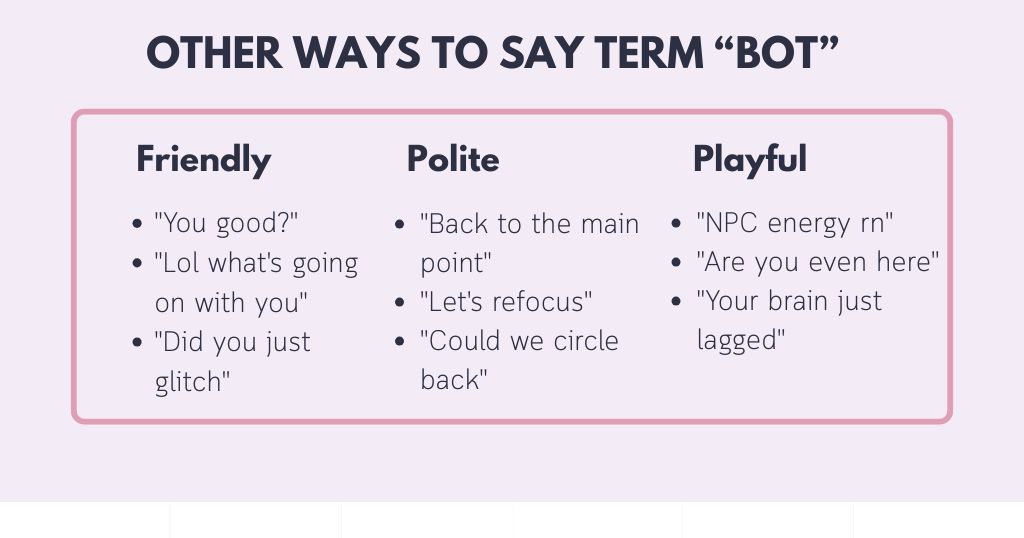
Casual / friendly:
- “You good?” (when someone’s being repetitive)
- “Lol what’s going on with you”
- “Did you just glitch”
Polite / professional:
- “Back to the main point”
- “Let’s refocus”
- “Could we circle back”
Playful / joking:
- “NPC energy rn”
- “Are you even here”
- “Your brain just lagged”
Messages People Actually Send
Friend group chat: “Wait did Jake just suggest pizza for the third time this week” “He’s malfunctioning” “Full bot mode”
Texting someone who’s being dry: “Why are you texting like a bot today”
Gaming: “That guy just walked straight into a wall twice, certified bot”
Getting a conversation back on track: “Okay but BOT—are we meeting at 7 or 8?”
TikTok comment on someone doing a trend badly: “Bot movements 💀”
Dating app: “If I get one more ‘hey what’s up’ I’m gonna assume it’s a bot account”
Calling out a friend’s weird moment: “Did you really just ask me what my name is? We’ve been friends for 5 years. Bot behavior.”
Social media reply: “This take is so generic it sounds like a bot wrote it”
You also like it: What Does TBC Mean? A Simple Guide to Using It Right
Where You’ll See This Most
TikTok and Twitter/X use “bot” way more than Facebook. It’s become Gen Z’s go-to word for calling out fake-seeming behavior. You’ll see it in comments constantly.
Gaming culture is where the insult version really lives. Fortnite, Call of Duty, Valorant—all these communities use “bot” to mean a terrible player. It started because games add actual AI bots to fill lobbies, and those bots play horribly, so calling a real person a bot means they’re playing at that level.
Younger people (under 25) use it more loosely and playfully. They’ll call themselves bots when they do something dumb. Older people might only know it as the technical term for software programs, so there’s definitely a generational gap.
On dating apps, “bot” usually refers to fake accounts or catfishes. But in texting about dating, it means someone with zero personality or charm. Two different uses, same word.
The “Back On Topic” version is less common now. Most people don’t even know that’s a thing. It’s almost old internet slang at this point.
Mistakes Everyone Makes
People think “bot” and “NPC” mean the same thing, but they don’t. NPC is about someone being irrelevant or just existing in the background. Bot is about someone being unskilled, repetitive, or mechanical. NPC is “you don’t matter,” bot is “you’re messing up.”
Some people hear “bot” and think it’s always about actual robot accounts on social media. But when someone says “you’re being a bot,” they’re talking about human behavior, not accusing you of being fake AI.
The biggest misunderstanding is not catching when it’s playful versus mean. Without tone of voice or face-to-face context, “bot” in text can sound harsher than intended. That’s why emojis and “lol” matter so much with this word.
Another mix-up: thinking “bot” is always an insult. Sometimes people call themselves bots when they mess up. “I just locked myself out of my car, I’m such a bot today.” That’s self-deprecating humor, not someone attacking you.
Questions You’re Probably Wondering About “BOT”
Is calling someone a bot always rude?
Not always. Between friends, it’s usually just teasing. But from strangers or in competitive situations, yeah, it’s meant to be rude.
What should I say if someone calls me a bot?
If it’s playful, lean into it: “My programming is glitching today.” If it seems mean, you can call it out: “That’s not really fair” or just ignore it.
Does “bot” mean the same thing in every country?
The gaming insult is pretty universal anywhere people play online games in English. The slang usage is strongest in the US and among English-speaking internet communities.
Can I use BOT to mean “Back On Topic” with anyone?
It’s safer to just say “back to the topic” or “anyway.” Most people won’t recognize BOT as that acronym anymore.
Is it worse than calling someone dumb?
Not really. It’s more about being unskilled or robotic than actually being unintelligent. It’s still an insult in the wrong context, but it’s not as harsh.
When did people start using “bot” as slang?
It picked up in gaming communities around 2017-2018, then spread to general social media by 2020. Gen Z really ran with it.
One Last Thing to Remember
Look, “bot” is one of those words that started in one place (tech and gaming) and exploded into everyday slang with like ten different meanings depending on context. The key is reading the room—or the chat. If someone says it with laughing emojis and you’re close, it’s probably just banter. If it comes out of nowhere from someone you don’t know well, it might be time to check if your messages are coming across as boring or fake. And if you’re the one saying it, make sure the other person will actually get the joke. Words hit different in text than they do out loud.
Read More English Articles:

I’m Hazel, and I studied BSC English at GCUF. I focus on explaining word meanings in simple, clear language that anyone can understand. My goal is helping readers grasp everyday English, confusing terms, and slang used in real conversations and social media. I believe language learning works best when definitions connect to actual life situations. Through careful research and straightforward explanations, I make vocabulary accessible for students, learners, and anyone curious about how English really works in daily use.