

IIRC means “If I Remember Correctly” or “If I Recall Correctly.” It’s shorthand people use when sharing something from memory that might not be 100% accurate.
You Saw It and Got Confused: Here’s Why
You saw “IIRC” in a Reddit thread, a Discord chat, or maybe someone’s reply on Twitter, and you weren’t sure what they meant. Or maybe you knew it was about memory but couldn’t tell if they were being helpful or low-key calling you out. The confusing part? Sometimes it sounds polite, sometimes it sounds like someone’s proving a point, and the comma placement makes it even weirder.
The Real Story Behind IIRC
When someone types IIRC, they’re basically saying “my brain says this is true, but I haven’t double-checked, so don’t quote me on it.” It’s a shield. You’re offering information while admitting you could be wrong. That’s the whole point—it lets you contribute without sounding like a know-it-all.
People use it instead of typing out “I think” or “I’m pretty sure” because it’s faster and sounds less wishy-washy. Saying “I think the movie came out in 2018” feels uncertain. Saying “The movie came out in 2018, iirc” feels like you probably know but you’re just being honest about not checking IMDb first.
The vibe changes depending on how you write it. Lowercase “iirc” feels chill and conversational. All caps “IIRC” can sound more formal or, in some cases, pointed—like you’re emphasizing that you definitely remember something and the other person should too.
Where You’ll Actually See People Type This
You’ll see IIRC pop up when someone’s:
- Answering a question in a group chat without googling first
- Sharing a date, price, or fact they’re not totally sure about
- Bringing up something from an old conversation
- Gently correcting someone without sounding rude
- Backing up their opinion with a detail they remember
It shows up in comments sections, work Slack channels, gaming forums, and casual texts. The context matters more than the platform. If you’re discussing something that happened weeks ago or recalling trivia, IIRC fits naturally.
Same Letters, Totally Different Vibe Depending on the Situation
Here’s the thing: IIRC can sound completely different depending on who’s saying it and why.
When it’s polite: “The meeting’s at 3, iirc—let me confirm” sounds helpful and humble.
When it’s sarcastic: “IIRC, I sent you that file three times already” sounds like a receipt. You’re not unsure—you’re reminding them you remember perfectly and they dropped the ball.
The passive-aggressive version is real, kind of like how GG Meaning in Text can sound sincere or sarcastic depending on context. If someone says “IIRC, you said you’d handle this last week,” they’re not hedging. They’re calling you out while pretending to be polite.
Misinterpretation warning #1: If you use IIRC in a serious or emotional conversation, it can sound like you don’t care enough to remember clearly. Saying “You told me you were fine with it, iirc” during an argument might make the other person feel dismissed.
Misinterpretation warning #2: Overusing it makes you sound unsure about everything, even when you’re right. If every other sentence has “iirc” in it, people might stop trusting your input.
Misinterpretation warning #3: In work settings, some people read IIRC as you covering yourself legally, like you’re avoiding responsibility. That’s not the intent, but tone gets lost in Slack.
Times When IIRC Just Doesn’t Fit
Skip IIRC when:
- Writing formal emails to clients, professors, or your boss
- Discussing something serious where accuracy actually matters (medical advice, legal stuff, safety instructions)
- You’re supposed to know the answer for your job
- Talking to someone who doesn’t use internet slang—they’ll just be confused
- The stakes are high and “I think” isn’t good enough.
- Same goes for terms like OTG or CS Mean in Text? if they don’t know abbreviations, spell it out.
If you’re in a professional setting and need to express uncertainty, try “I believe” or “From what I recall” instead. Save IIRC for casual digital spaces where abbreviations are normal.
Don’t use it when someone’s already upset with you. “IIRC, I told you about this” will make things worse, not better.
Other Ways to Say the Same Thing (Without the Acronym)
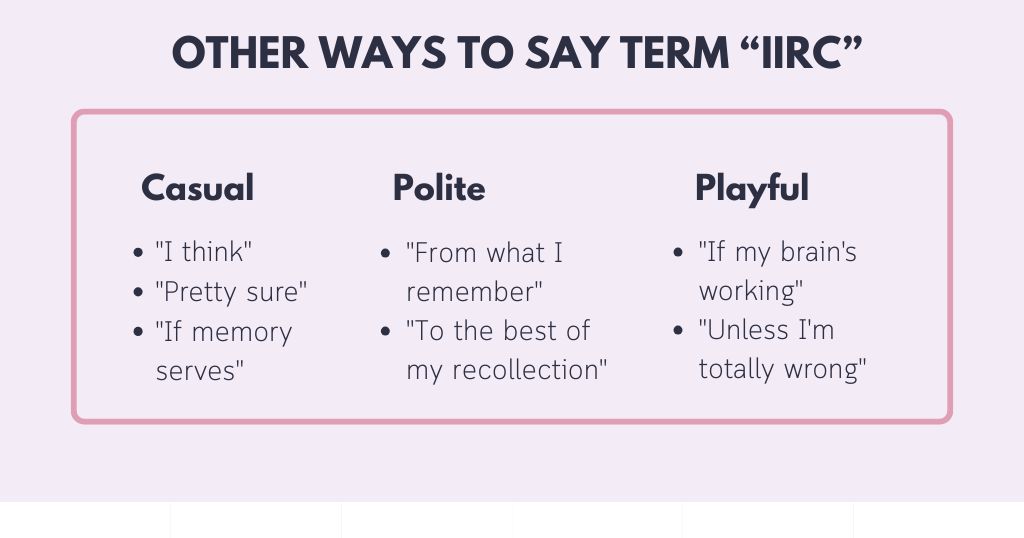
Casual / friendly:
- “I think”
- “Pretty sure”
- “If memory serves”
Polite / professional:
- “From what I remember”
- “I believe”
- “To the best of my recollection”
Playful / joking:
- “If my brain’s working”
- “Unless I’m totally wrong”
- “Don’t hold me to it, but”
You don’t need to swap IIRC for these every time. Just match the situation to the tone you want.
What IIRC Looks Like in Actual Messages
In a group chat: “Didn’t Sarah say she’s moving to Portland? Or was it Seattle, iirc Portland though”
On Reddit: “That episode aired in season 2, iirc, but the timeline’s all messed up anyway”
Work Slack: “The client approved the design last Thursday, iirc—check the email thread to confirm”
Sarcastic correction: “IIRC, you were the one who said this would only take an hour”
Casual question: “The restaurant closes at 10, iirc? We should leave soon”
Gaming chat: “That weapon got nerfed in the last patch, iirc”
Someone asking for facts: “iirc the book came out before the movie but I could be mixing it up with something else”
Old conversation callback: “You mentioned wanting to try that place, iirc—still interested?”
Who Uses It and Where It Shows Up Most
IIRC started in the ’90s on old-school internet forums and chat rooms (IRC—Internet Relay Chat—is actually where the letters came from, which is kind of perfect). It’s not new slang. Your older coworkers or tech-savvy relatives might use it more than teenagers.
Gen Z tends to say “lowkey,” “I think,” or “tbh” instead. They’re more likely to use SUS meaning in text or other newer slang that feels less ’90s internet. IIRC feels more millennial or Gen X, the same crowd that still says “lol” unironically. It’s not outdated, just not trendy.
You’ll see it more on Reddit, Discord, and tech forums than on TikTok or Instagram. It fits text-heavy spaces where people are discussing details, not just reacting.
Things People Get Wrong About IIRC
“Is IIRC the same as AFAIK?” Not quite. AFAIK means “As Far As I Know”—you’re talking about what you currently understand based on available info. IIRC is about pulling something from memory. One’s about knowledge, the other’s about recall.
“Does lowercase mean I’m being rude?” No. Lowercase is just casual internet style. ALL CAPS can feel louder or more formal, but neither is rude on its own. Context decides that.
“Can I use it to avoid being wrong?” Technically yes, but people will notice if you’re always hedging. IIRC isn’t a free pass to throw out bad info and blame your memory. It’s meant to be honest, not a shield for laziness.
“Why do people say it sounds passive-aggressive?” Because tone doesn’t translate in text. If you’re already in a tense conversation, IIRC can sound like “I know I’m right and you’re wrong, but I’ll pretend I’m unsure to be polite.” Intention matters less than how it lands.
Knowing How to React When Someone Sends You IIRC
If they’re being casual: Just take it at face value. “Oh cool, thanks!” or “I’ll double-check that” works fine.
If they’re correcting you politely: Acknowledge it without getting defensive. “Oh yeah, you’re right” or “Good catch, I forgot about that.”
If it feels sarcastic: Either address it directly (“Did I miss something?”) or let it go if it’s not worth the fight.
If you’re not sure what they mean: Ask. “Wait, are you sure or just guessing?” clears it up fast. It’s better to clarify than assume, especially with abbreviations like TFTI where tone matters a lot.
Wait: IIRC Meaning in Business and Sustainability?
Here’s where it gets weird. IIRC also stands for International Integrated Reporting Council, a group that used to set standards for how companies report on sustainability and financial performance. If you’re reading about corporate responsibility or ESG (environmental, social, governance) topics, that’s probably what it means.
The organization merged into something bigger in 2021, so if you see “IIRC” in a work document or business article, it’s not about someone’s memory—it’s about reporting frameworks. Context will make it obvious which one people mean.
There’s also a technical use in computer science—something called an “Incomplete Information Reading Comprehension” dataset for training AI. Unless you’re deep in research papers, you won’t run into this one.
Questions People Actually Ask About This Term
Is it okay to use IIRC in a work email?
Only if your workplace is casual and uses abbreviations regularly. If you’re unsure, spell it out.
Can IIRC sound rude?
Yes, if the situation’s already tense or if you’re correcting someone in a way that feels pointed. Plenty of casual terms can flip rude in the wrong context like NP Mean in Text is another example where ‘no problem’ sometimes feels dismissive.
Do people still use it or is it outdated?
People definitely still use it, especially in forums and chats. It’s not as common with younger users, but it’s far from dead.
What if I’m actually sure but don’t want to sound cocky?
Then IIRC isn’t the right fit. Just state the fact or say “I’m pretty confident” instead of fake-hedging.
Does it work in texts or just online?
Both. It’s more common online, but plenty of people use it in texts with friends who get it.
Final Thoughts on Using IIRC in Text
IIRC is one of those terms that’s simple on the surface but loaded with context underneath. It’s useful when you want to share what you remember without pretending you’re certain. Just watch the tone, know your audience, and don’t overdo it. If you’re typing it out and it feels off, trust that instinct—sometimes “I think” is just clearer.

I’m Hazel, and I studied BSC English at GCUF. I focus on explaining word meanings in simple, clear language that anyone can understand. My goal is helping readers grasp everyday English, confusing terms, and slang used in real conversations and social media. I believe language learning works best when definitions connect to actual life situations. Through careful research and straightforward explanations, I make vocabulary accessible for students, learners, and anyone curious about how English really works in daily use.