

YW is a quick way to say “you’re welcome” when someone thanks you. It’s a casual response that keeps conversations moving without typing out the full phrase.
You’re Staring at “yw” and Wondering What Just Happened
You got a text back that just said “yw” and you’re sitting there wondering if that’s polite or cold. Maybe someone responded to your “thanks!” with two lowercase letters and now you’re overanalyzing whether they’re annoyed with you. Or you saw it in a Snapchat reply and you’re not sure if you should keep the conversation going or if that’s the end of it.
It happens all the time. Someone sends you this tiny response and you’re left reading into it way too much. Short replies don’t carry facial expressions or voice tone, so people often start guessing what the other person meant.
Breaking Down What YW Really Signals
At its core, YW is just acknowledgment. It’s someone saying “I see that you thanked me, and I’m letting you know it’s all good.”
If your friend thanks you for sending them a meme, full sentences feel weird and overly formal. YW fits the vibe better—it’s light, quick, and doesn’t make the interaction feel bigger than it is.
Most of the time, it’s genuinely friendly. It’s the text version of a casual nod or a quick smile. People aren’t trying to be rude—they’re just matching the energy of a low-stakes conversation. It’s in the same family as FR or NM—short responses that keep things casual without much effort.
Where You’ll Actually See YW Pop Up
YW shows up constantly in casual texting. Your friend asks to borrow your charger, you say yes, they thank you later, and you hit them with “yw.” Clean and simple.
It’s all over social media too. Someone comments “thanks for posting this!” under your Instagram story, and you reply with “yw” to keep things breezy. In group chats, if someone thanks the group for planning something, one person might drop a “yw” to represent everyone.
Gaming spaces love it because speed matters. If you’re playing Roblox or any multiplayer game and someone thanks you for helping them out, you can’t stop to write a paragraph. You type “yw” and get back to the game. Just like gamers use GG after a match, YW is part of that same quick-response culture.
The pattern is always the same: someone expresses gratitude, you want to respond politely without overthinking it, so you send those two letters.
Read Also: What Does IGH Mean in Text? (It’s Not What You Think)
Reading Between the Lines: YW’s Hidden Meanings
Here’s where people mess up: YW doesn’t always feel the same.
If you and your friend have been texting back and forth with emojis and exclamation points, and then they suddenly reply with just “yw”—no emoji, no punctuation—it can feel off. That shift makes you wonder if something changed. It’s not that YW is rude, but the contrast in energy makes it seem that way.
Capitalization changes things too. “YW” in all caps can feel more enthusiastic, like you really mean it. Lowercase “yw” reads more chill, but sometimes too chill—like the person is half paying attention or slightly irritated.
Timing matters. If someone takes three hours to reply to your thank you with just “yw,” it might feel dismissive. But if they respond right away, it’s just efficient.
Warning: Some people do use “yw” sarcastically to mean “yeah, whatever.” If the conversation was tense or someone’s being passive-aggressive, that tiny response might be their way of brushing you off without starting a fight. You’ll usually know from context—if things were already awkward, “yw” probably isn’t warm and fuzzy. If you’re unsure whether someone’s being genuine or sarcastic, check out how tone works in other abbreviations like OTP where context is everything.
Another warning: If you’re talking to someone who doesn’t text much or isn’t comfortable with abbreviations, they might not even know what YW means. Your mom or your boss might think you made a typo.
Times When YW Is the Wrong Move
Don’t send YW to your professor after they help you with an assignment extension. Don’t use it in work emails, especially if you’re replying to a client or your manager. In those settings, it looks lazy or disrespectful. Just type “You’re welcome” or “Happy to help.”
Skip it in serious conversations. If someone thanks you for being there during a tough time or for doing them a major favor, “yw” feels too light. It makes it seem like you’re downplaying what happened or rushing past the moment.
Avoid it with people you don’t know well. If you’re texting a new coworker, someone from class you barely talk to, or a person you just met, stick with the full phrase. YW works best when there’s already a casual relationship in place.
And don’t use it if the other person is clearly putting effort into their messages. If they’re writing thoughtful replies with proper punctuation and you hit them back with “yw,” the mismatch feels rude.
Other Ways to Say You’re Welcome (Without Typing YW)
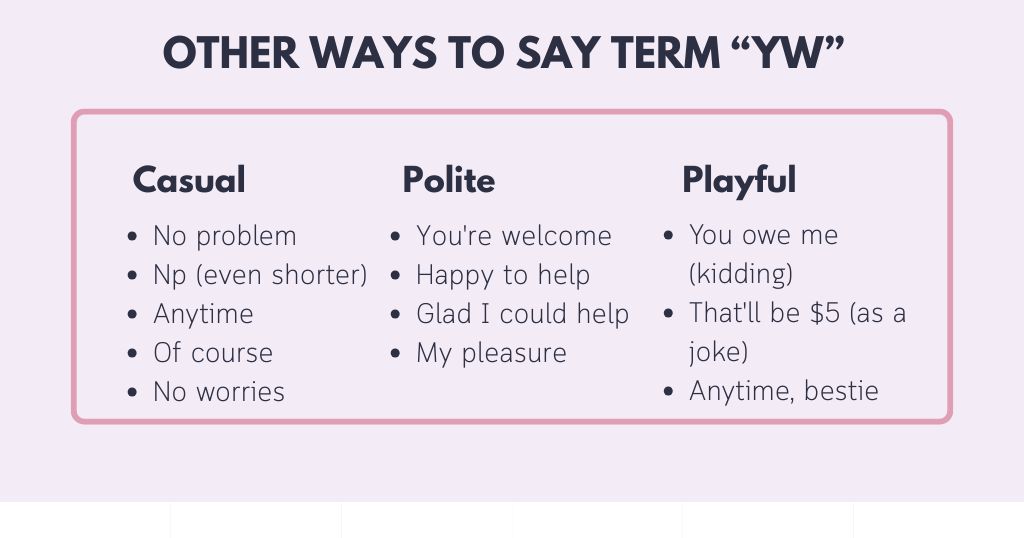
Casual / Friendly:
- No problem
- Np (even shorter)
- Anytime
- Of course
- No worries
- Got you
Polite / Professional:
- You’re welcome
- Happy to help
- Glad I could help
- My pleasure
Playful / Joking:
- You owe me (kidding)
- That’ll be $5 (as a joke)
- Anytime, bestie
- 😊 or 💙 (just an emoji works too)
Pick based on who you’re talking to and what feels natural for that relationship.
What YW Looks Like in Actual Conversations Examples
Example 1: Friend: “Thanks for grabbing my mail while I was gone!” You: “yw! it was right on my way”
Example 2: Someone on Instagram: “thank you for the rec, just ordered it” You: “yw, hope you love it”
Example 3: Teammate in a game: “thx for the backup” You: “yw gg”
Example 4: Sibling: “thanks for covering for me with mom” You: “yw but you owe me”
Example 5: Classmate: “appreciate you sending the notes!” You: “yw, anytime”
Example 6: Person you barely know: “Thanks for the info” You: “You’re welcome” (not “yw”—too casual here)
Read More: CD Meaning Decoded: Why This Abbreviation Confuses Everyone
Does YW Hit Different on Snapchat vs. Texts?
YW feels most natural on Snapchat, Instagram DMs, and iMessage. These are places where people expect quick, casual responses.
On TikTok or Twitter, you might see it in replies to comments, but it’s not as common because those platforms are more about public performance than personal conversation.
Younger people (Gen Z and younger) sometimes prefer “np” over “yw” because “you’re welcome” can sound slightly formal or even self-congratulatory, like you’re making a big deal out of helping. “No problem” keeps things more humble.
Gaming communities across all platforms use it constantly because every second counts when you’re mid-match. It’s universal gamer language at this point.
If you’re texting with someone over 40, there’s a decent chance they either don’t use YW or don’t recognize it. Age gaps show up a lot with abbreviations.
The Confusion Around YW That Nobody Talks About
“Is this person mad at me?” Not usually. If someone sends you “yw” and nothing else, they’re probably just done with that part of the conversation. It’s a period, not an insult. People get anxious about short responses, but most of the time it’s not personal.
“Does lowercase mean they don’t care?” Not really. Some people just type everything in lowercase because that’s their style. It’s more about their general texting habits than their feelings toward you. If they always type in lowercase, “yw” isn’t different from anything else they send.
“Are they being sarcastic?” Only if the conversation was already weird. If you thanked them for something obvious or annoying, then yeah, “yw” might be sarcastic. But in normal situations, it’s just polite shorthand.
“Should I respond to YW?” You don’t have to. YW is usually a conversation ender. If you want to keep talking, you can send an emoji or start a new topic, but there’s no social rule that says you need to reply to it. Similar to how SFLR acknowledges a delayed reply, YW closes the loop on gratitude without needing follow-up.
Read Also: What Does DBL Mean in Text? From Girls, Snapchat & Real Conversations
FAQs
Can YW sound rude even if I don’t mean it that way?
Yes, if the situation is serious or the person expects more warmth. If someone’s genuinely thanking you for something meaningful, a two-letter response can feel cold. Match the energy they’re giving you.
Is YW the same as NP?
Basically, but NP (no problem) sounds a bit more humble. YW is just the shorthand for ‘you’re welcome,’ while NP (‘no problem’) emphasizes that the favor wasn’t a big deal. Some people prefer one over the other for that reason. If you want the full breakdown on when to use ND instead of YW, that’s worth checking out since they’re not exactly identical twins.
Does YW mean something else besides “you’re welcome”?
Rarely. In some very specific contexts, people use it to mean “yeah, whatever” as a sarcastic or dismissive response. But 95% of the time, it’s just “you’re welcome.” If you’re unsure, look at the rest of the conversation.
Can I use YW on Snapchat and Instagram the same way?
Yeah, it works the same on both. People use it to reply to thanks in DMs, comments, or even story replies. It’s a fast way to acknowledge someone without opening a whole conversation.
What if someone doesn’t know what YW means?
Just spell it out. Not everyone lives in the same texting world. If you’re talking to someone who might not get it, stick with “you’re welcome” to avoid confusion.
Is typing YW in all caps different from lowercase?
Kind of. All caps (YW) can feel more enthusiastic or definite. Lowercase (yw) feels more casual, sometimes even careless. It’s subtle, but people do pick up on it.
Wrapping It Up
YW is one of those terms that seems simple until you start overthinking it. Most of the time, it’s just a polite, low-effort response that keeps things moving. It’s not deep. It’s not rude. It’s just efficient.
The trick is paying attention to who you’re talking to and what the situation calls for. If it’s your best friend, “yw” is perfect. If it’s your boss, maybe not. If someone just thanked you for something huge, maybe add a little more warmth. That’s it.
Don’t stress about it. If you’re being genuine and matching the vibe of the conversation, you’re doing it right.

I’m Hazel, and I studied BSC English at GCUF. I focus on explaining word meanings in simple, clear language that anyone can understand. My goal is helping readers grasp everyday English, confusing terms, and slang used in real conversations and social media. I believe language learning works best when definitions connect to actual life situations. Through careful research and straightforward explanations, I make vocabulary accessible for students, learners, and anyone curious about how English really works in daily use.