

GFYS usually stands for “Go F*** Yourself”—a harsh, angry way to tell someone off or end a fight. It’s blunt, confrontational, and rarely meant as a joke unless you know the person really well.
Why Your Brain Just Hit the Brakes on This One
You’re scrolling through comments on a heated post, and someone drops “gfys” in the replies. Or maybe you got it in a text after an argument. Your brain pauses. Is this person seriously that angry? Are they joking? Should you respond or just block them?
The confusion makes sense. Unlike terms that have one clear meaning, this one carries real bite. It’s not something people throw around lightly, and getting it wrong—either by using it or misreading it—can torch a conversation fast.
Breaking Down What “GFYS” Actually Says
When someone types “gfys,” they’re done talking
- Not “let’s take a break” done
- Not “we’ll figure it out” done
They’re ending the conversation completely. They’re burning the bridge and walking away.
Why people use it:
- Typing the full phrase feels too extreme
- Saying nothing feels weak
- So this becomes the fast, aggressive middle ground
Once “gfys” lands in your inbox. There’s usually no conversation left
More Post: What Does TOTM Mean in Text? It’s Not What You’d Guess
Where This Acronym Shows Up in Your Daily Scroll
You’ll mostly see this in texts or DMs when things have already gone south. Someone’s been pushing your buttons, you’ve had enough, and “gfys” becomes the period at the end of that conversation.
It shows up in gaming chats after trash talk gets too personal. In social media arguments when strangers keep coming at you. In group texts when someone crosses a line and won’t back off.
Sometimes (rare), friends use it jokingly:
Example: Your friend gets lucky in a game
You reply: “oh gfys 😂”
👉 This only works with strong friendship context
Tone & Context: “GFYS Meaning Changes Depending on Who’s Typing
Here’s the trap: tone doesn’t travel well in text.
The same “gfys” can land completely differently depending on who sends it.
- Stranger or argument → real anger
- Close friend → joking or teasing
👉 The meaning doesn’t change
👉 The intent does
⚠️ Warning: Don’t assume people will read your tone correctly
Even with emojis, this can easily come off as hostile
Real example: Someone sent “gfys 😂” to a coworker after a disagreement
- It didn’t feel like a joke
- It turned into an HR issue
Read Also: SKID Meaning in Text: Why This Gaming Insult Stings So Hard
Situations Where “GFYS” Will Absolutely Backfire on You
Skip this one entirely if you’re texting:
- Anyone at work, even if you’re friendly
- Someone you’re not super close with
- A family member you’re actually mad at (it’ll make things worse)
- Anyone in a professional group chat
- People who might screenshot and share it
Don’t use it in public comments where your name’s attached. Don’t send it to someone going through a rough time, even as a joke. Don’t type it when you’re genuinely angry—you can’t unsend it, and it stays there like evidence.
If you’re about to use it and you pause to think “wait, should I?”—the answer’s no. That pause is your brain protecting you.
Better professional alternatives:
- “I think we should agree to disagree”
- “I’m stepping away from this conversation”
- “Let’s drop it”
Saying What You Mean Without the “GFYS” Risk
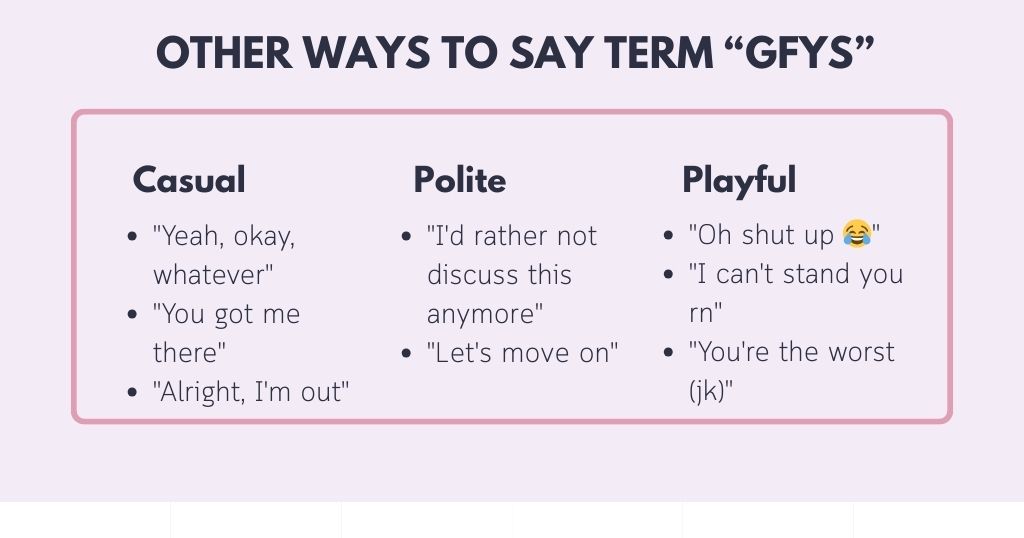
Casual with friends:
- “Yeah, okay, whatever”
- “You got me there”
- “Alright, I’m out”
Polite shutdown:
- “I’d rather not discuss this anymore”
- “Let’s move on”
- “I don’t think we’ll agree here”
Playful teasing:
- “Oh shut up 😂”
- “I can’t stand you rn”
- “You’re the worst (jk)”
When you’re actually done:
- “I’m not doing this”
- “We’re not talking about this again”
- Just stop replying
Strong reactions like ‘no way‘ work better when you need to push back without the hostility”
Real-Life Examples of Using GFYS Meaning in Action
In an online argument: “Your political takes are embarrassing” “gfys, blocked”
Gaming chat (hostile): “You’re trash at this game lol” “GFYS camper”
Between close friends (joking): “Bro I just pulled the legendary skin on my first try” “gfys I’ve been trying for weeks 💀”
From someone you’re dating (serious red flag): “Can we talk about last night?” “gfys I don’t owe you anything”
Stranger in comments: “Maybe you should educate yourself before posting” “gfys random internet person”
Friend group after playful roasting: “Your haircut looks like you lost a bet” “gfys it’s called style”
Different Corners of the Internet Treat “GFYS” Differently
This term hit its peak on gaming platforms and Reddit-style forums where anonymous fighting is common. It’s less common on Instagram or TikTok because people want their profiles to look chill, not hostile.
Younger users (teens, early twenties) sometimes throw it around more casually, treating it like “shut up” with extra spice. Older people tend to see it as genuinely harsh and rarely use it, even jokingly.
On Twitter, it’s combative. In private texts, it’s personal. The platform changes how public your anger becomes.
Read More: OOP Meaning in Text: Guide Nobody Actually Explains Right
Ways People Get “GFYS” Completely Wrong
People think adding emojis makes it friendly. Not really. A middle finger emoji next to “gfys” doesn’t soften it—it doubles down. Even a laughing emoji might not save you if the other person’s already upset.
Some folks mix it up with “GFY” meaning “Good For You.” This causes disasters. That alternate meaning is super rare and mostly outdated. If you use “gfy” thinking you’re being supportive, the other person will probably think you’re being sarcastic or mean.
Overusing it makes you look immature. If you’re the person who says “gfys” in every argument, people start seeing you as the problem, not them.
The biggest misread happens when someone sends it during a normal disagreement. The receiver thinks the relationship just ended. The sender thought they were just being dramatic. Both people walk away confused and hurt.
Questions People Actually Ask About GFYS Meaning in Text
Is GFYS always rude?
Pretty much, yeah. Even when friends use it as a joke, the rudeness is part of the joke. It’s playing at being mean. With strangers or acquaintances, there’s no playing—it’s just mean.
Can girls use it differently than guys?
Not really. Anger doesn’t have a gender. If a girl sends “gfys,” she’s telling you off just like anyone else would. Don’t read extra meaning into it based on who sent it.
What if someone sends GFYSB?
That’s worse. The B at the end adds an insult. It’s deliberately more aggressive. If you get that, the person’s beyond mad—they’re trying to hurt you.
Is there ever a polite version?
Some self-help corners of the internet tried pushing “Go Find Yourself” as a positive spin. It didn’t catch on. If someone actually means that, they’ll just type it out fully so there’s no confusion.
Should I respond if someone sends me this?
Usually no. Responding keeps a toxic conversation alive. If it’s a friend and you think they’re joking, a quick “lol you’re annoying” might work. Otherwise, let it die.
Does GFYS mean the same thing everywhere?
The core meaning stays the same, but how seriously people take it varies. In competitive gaming, it’s almost background noise. In a work Slack? Career suicide.
Last Thoughts on Keeping This Text Slang in Check
Look, “gfys” isn’t complicated—it’s just risky. It means what you think it means, and it hits harder than people expect. If you’re on the fence about using it, that fence is there for a reason.
Save it for your closest friends who get your sense of humor, or don’t use it at all. There are cleaner ways to exit a conversation or call someone out. Your future self will thank you for keeping this one in your pocket instead of firing it off when you’re mad.

I’m Hazel, and I studied BSC English at GCUF. I focus on explaining word meanings in simple, clear language that anyone can understand. My goal is helping readers grasp everyday English, confusing terms, and slang used in real conversations and social media. I believe language learning works best when definitions connect to actual life situations. Through careful research and straightforward explanations, I make vocabulary accessible for students, learners, and anyone curious about how English really works in daily use.