


Math vocabulary is essential for students, teachers, and parents navigating measurements, geometry, statistics, and advanced topics. This guide covers 50+ genuine math terms starting with K each with a clear definition, example, and explanation of why it matters. No fillers, no invented words.
Quick List: 50+ Math Words That Start With K
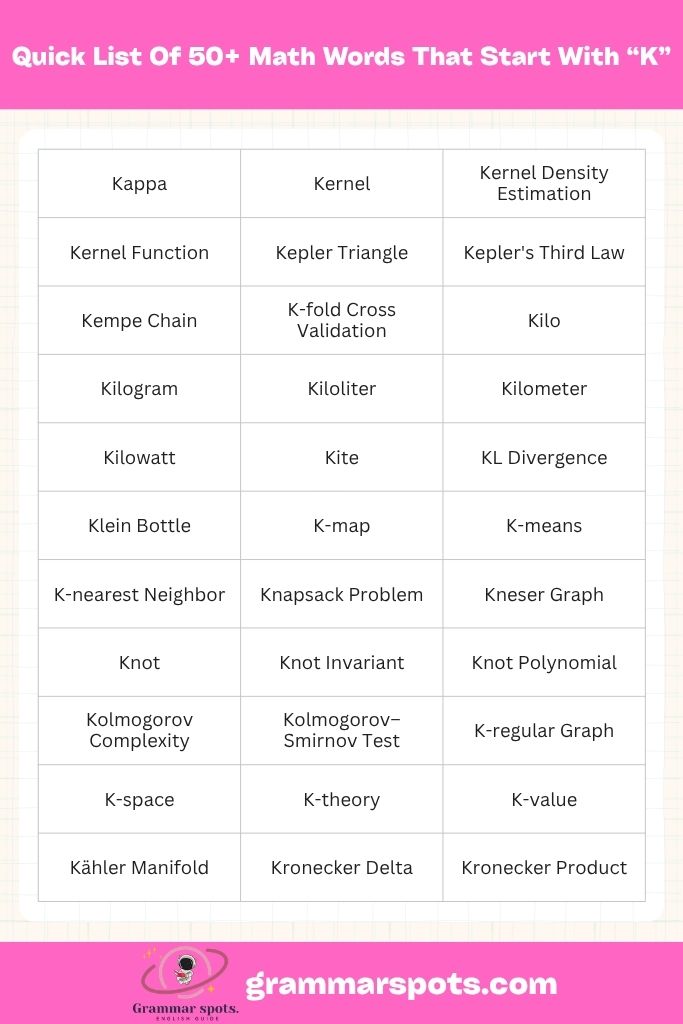
- Kappa
- Kernel
- Kernel Density Estimation
- Kernel Function
- Kepler Triangle
- Kepler’s Third Law
- Kempe Chain
- K-fold Cross Validation
- Kilo
- Kilogram
- Kiloliter
- Kilometer
- Kilowatt
- Kite
- KL Divergence
- Klein Bottle
- K-map
- K-means
- K-nearest Neighbor
- Knapsack Problem
- Kneser Graph
- Knot
- Knot Invariant
- Knot Polynomial
- Kolmogorov Complexity
- Kolmogorov–Smirnov Test
- K-regular Graph
- K-space
- K-theory
- K-value
- Kähler Manifold
- Kronecker Delta
- Kronecker Product
- Kronecker Symbol
- Kuratowski’s Theorem
- Kurtosis
Common Math Words That Start With K
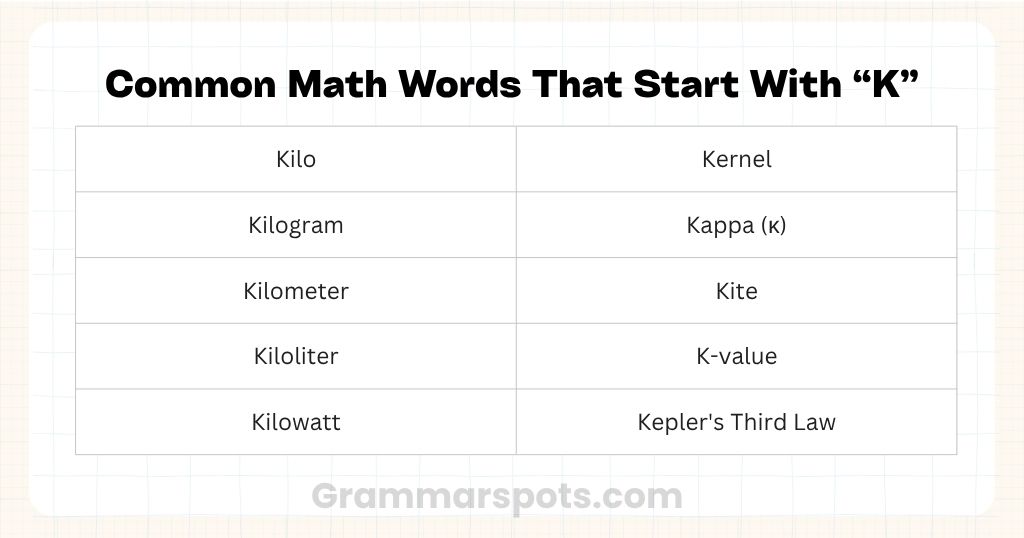
1. Kilo
- Meaning: A metric prefix meaning one thousand (1,000), from Greek khilioi.
- Example: 1 kilogram = 1,000 grams.
- Why it matters: Understanding kilo- instantly unlocks all metric measurement terms built on it.
2. Kilogram
- Meaning: A metric unit of mass equal to 1,000 grams. Abbreviated kg.
- Example: A bag of rice weighs 2 kilograms.
- Why it matters: Used in every mass and weight problem in school math and science.
3. Kilometer
- Meaning: A metric unit of length equal to 1,000 meters. Abbreviated km.
- Example: The distance between two towns is 15 kilometers.
- Why it matters: Standard unit for map scales, distance problems, and unit conversions.
4. Kiloliter
- Meaning: A metric unit of volume equal to 1,000 liters. Abbreviated kL.
- Example: A swimming pool holds approximately 2,500 kiloliters.
- Why it matters: Appears in capacity and volume problems, especially in science and engineering contexts.
5. Kilowatt
- Meaning: A unit of power equal to 1,000 watts. Abbreviated kW.
- Example: If an appliance uses 2 kW for 3 hours, it consumes 6 kilowatt-hours of energy.
- Why it matters: Used in applied math problems involving electricity, energy costs, and rates.
6. Kite
- Meaning: A quadrilateral with two pairs of consecutive equal sides. Its diagonals are perpendicular, and one diagonal bisects the other.
- Example: Shape ABCD is a kite where AB = AD and CB = CD.
- Why it matters: A standard geometry shape. Area formula: Area = (d₁ × d₂) ÷ 2, where d₁ and d₂ are the diagonals.
7. Kernel
- Meaning: The set of all vectors that a linear transformation maps to the zero vector. Also called the null space.
- Example: If T(x) = Ax = 0, then x belongs to the kernel of T.
- Why it matters: Central to solving systems of linear equations and understanding linear transformations.
8. Kappa (κ)
- Meaning: The Greek letter used in mathematics to represent curvature of a curve, or Cohen’s Kappa (a measure of inter-rater agreement in statistics).
- Example: Cohen’s Kappa of 0.85 indicates strong agreement between two evaluators.
- Why it matters: Appears across geometry, statistics, and mathematical notation.
9. K-value
- Meaning: A constant used in mathematical equations and formulas, often representing a rate, scaling factor, or proportionality constant.
- Example: In y = kx, the k-value is the constant of proportionality.
- Why it matters: Students encounter k-values in direct variation, physics formulas, and rate problems.
10. K-map (Karnaugh Map)
- Meaning: A grid-based visual method for simplifying Boolean algebra expressions in logic and discrete mathematics.
- Example: A 4-variable K-map can reduce an 8-term Boolean expression to 2 terms.
- Why it matters: Essential in digital circuit design and discrete mathematics courses.
11. Kepler’s Third Law
- Meaning: A mathematical law stating that the square of a planet’s orbital period is proportional to the cube of its semi-major axis: T² ∝ a³.
- Example: If Earth’s period is 1 year at 1 AU, Mars at 1.52 AU has a period of about 1.88 years.
- Why it matters: Appears in applied algebra and mathematical physics as a ratio and proportion relationship.
12. Kepler Triangle
- Meaning: A right triangle with sides in the ratio 1 : √φ : φ, where φ is the golden ratio (≈ 1.618).
- Example: Approximate sides: 1, 1.272, and 1.618.
- Why it matters: Uniquely connects the Pythagorean theorem, the golden ratio, and π in one figure.
Related Post: 40+ Math Words That Start With L (With Meanings and Examples)
Advanced Math Words That Start With K
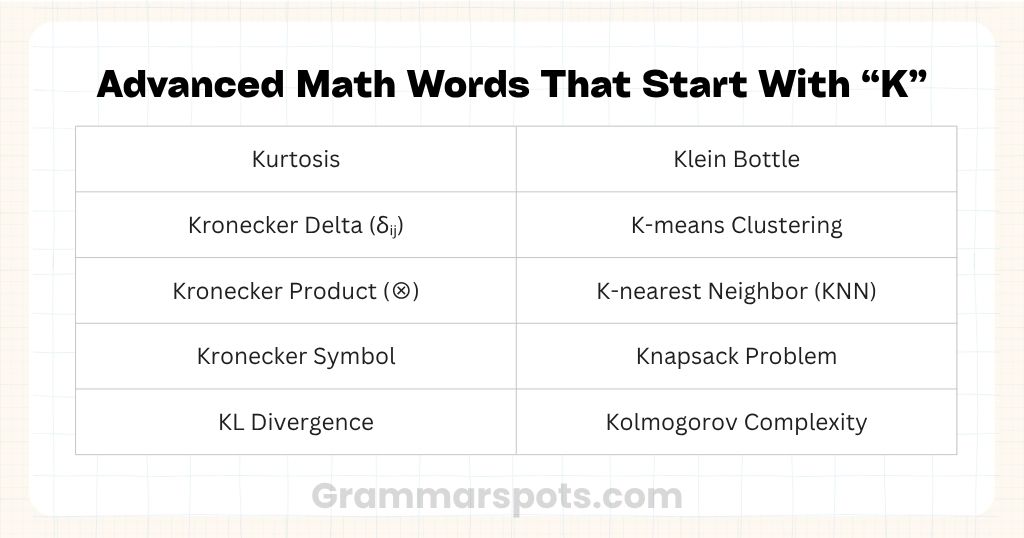
13. Kurtosis
- Meaning: A statistical measure of how heavy or light the tails of a distribution are compared to a normal distribution.
- Mesokurtic kurtosis = 3 (normal)
- Leptokurtic kurtosis > 3 (heavy tails, sharp peak)
- Platykurtic kurtosis < 3 (light tails, flat peak)
- Example: Financial return data often shows leptokurtic distribution more extreme values than normal.
- Why it matters: Used in risk analysis, data modeling, and understanding outliers.
14. Kronecker Delta (δᵢⱼ)
- Meaning: A function of two integer variables equal to 1 when i = j and 0 when i ≠ j.
- Example: δ₁₁ = 1, δ₁₂ = 0, δ₂₂ = 1, δ₂₃ = 0.
- Why it matters: Simplifies identity matrix notation and summation expressions across linear algebra and physics.
15. Kronecker Product (⊗)
- Meaning: A matrix operation where each element of matrix A is multiplied by the entire matrix B, producing a larger block matrix.
- Example: If A is 2×2 and B is 3×3, then A⊗B is 6×6.
- Why it matters: Used in quantum computing, signal processing, and advanced linear algebra.
16. Kronecker Symbol
- Meaning: An extension of the Legendre symbol in number theory, used to determine quadratic residues for more general integer pairs.
- Example: Used to determine whether an integer is a quadratic residue modulo another integer.
- Why it matters: Important in number theory, cryptography, and algebraic structures.
17. KL Divergence (Kullback–Leibler Divergence)
- Meaning: A measure of how much one probability distribution differs from another. Not symmetric — D_KL(P‖Q) ≠ D_KL(Q‖P).
- Example: In machine learning, KL Divergence measures how far a model’s predicted distribution is from the true data distribution.
- Why it matters: Fundamental in information theory, Bayesian statistics, and machine learning optimization.
18. Klein Bottle
- Meaning: A one-sided, closed surface with no interior or exterior a 4-dimensional object that self-intersects when represented in 3D space.
- Example: Conceptually formed by joining two Möbius strips along their edges.
- Why it matters: A central object in topology, the study of surfaces and spatial properties.
19. K-means Clustering
- Meaning: An algorithm that partitions data into K groups by assigning each point to the nearest cluster center (mean), then recalculating centers until stable.
- Example: K-means with K=3 groups 500 customer records into three distinct behavior profiles.
- Why it matters: One of the most widely used algorithms in data science, built on distance and averaging concepts.
20. K-nearest Neighbor (KNN)
- Meaning: A supervised classification algorithm that assigns a label to a new data point based on the majority class among its K nearest neighbors, using a distance metric.
- Example: To classify a new point, KNN checks the 5 nearest labeled points and assigns the most common class.
- Why it matters: Built on Euclidean distance and probability core tools of school and university math.
21. Knapsack Problem
- Meaning: An optimization problem: given items with weights and values, find the combination that maximizes value without exceeding a weight limit.
- Example: Pack a 10 kg bag with maximum value from available items of varying weights.
- Why it matters: A foundational NP-complete problem in combinatorics and algorithm design.
22. Kolmogorov Complexity
- Meaning: The length of the shortest computer program that produces a given string or object — a formal measure of information content and randomness.
- Example: “AAAAAAAAAA” has low complexity (easily described); a random string of equal length has high complexity.
- Why it matters: Bridges mathematics, computer science, and information theory.
23. Kolmogorov–Smirnov Test
- Meaning: A nonparametric statistical test comparing a sample distribution to a reference distribution to determine if they differ significantly.
- Example: Test whether student exam scores follow a normal distribution.
- Why it matters: Standard tool for checking distributional assumptions in research and data analysis.
24. Kernel Function
- Meaning: A function that computes the inner product of two vectors in a higher-dimensional feature space without explicitly transforming the data the basis of the “kernel trick.”
- Example: The Radial Basis Function (RBF) kernel is widely used in support vector machines.
- Why it matters: Allows complex non-linear problems to be solved efficiently using linear methods.
25. Kernel Density Estimation (KDE)
- Meaning: A nonparametric method for estimating the probability density function of a dataset using a smoothing kernel function.
- Example: A KDE curve shows a smooth, continuous estimate of data distribution rather than a blocky histogram.
- Why it matters: Used in exploratory statistics and data visualization to reveal distribution shape.
26. K-fold Cross Validation
- Meaning: A model evaluation method where data is split into K equal parts; the model trains on K-1 parts and is tested on the remaining part, repeated K times.
- Example: In 5-fold cross validation, the model trains and tests 5 times using a different test portion each time.
- Why it matters: A mathematically sound method for estimating model performance and preventing overfitting.
27. Kuratowski’s Theorem
- Meaning: A theorem stating a finite graph is planar if and only if it contains no subdivision of K₅ (complete graph on 5 vertices) or K₃,₃ (complete bipartite graph).
- Example: The Petersen graph is non-planar because it contains a subdivision of K₃,₃.
- Why it matters: One of the most elegant results in graph theory with applications in circuit board design.
28. Knot (Topology)
- Meaning: A closed curve embedded in three-dimensional space that does not intersect itself and cannot be untangled into a simple loop.
- Example: The trefoil knot is the simplest non-trivial knot it cannot be simplified to an unknot.
- Why it matters: Knot theory has applications in DNA modeling, molecular chemistry, and physics.
29. Knot Invariant
- Meaning: A mathematical quantity that stays unchanged under continuous deformation of a knot used to classify and distinguish knots.
- Example: The crossing number (minimum crossings in any diagram) is a basic knot invariant.
- Why it matters: Invariants are the main tools for proving two knots are fundamentally different.
30. Knot Polynomial
- Meaning: A polynomial algebraic expression assigned to a knot that serves as a knot invariant.
- Example: The Jones polynomial and Alexander polynomial are two well-known knot polynomials.
- Why it matters: Connects abstract topology to algebra, providing computable tools for knot classification.
31. K-regular Graph
- Meaning: A graph in which every vertex has exactly K edges (every vertex has degree K).
- Example: A 3-regular (cubic) graph has every vertex connected to exactly 3 others.
- Why it matters: Used in combinatorics and network theory to model symmetric structures.
32. K-space
- Meaning: The mathematical space of spatial frequencies used in Fourier analysis and signal processing.
- Example: MRI scanners collect raw data in K-space before transforming it into a visual image.
- Why it matters: Connects Fourier mathematics directly to real-world medical imaging technology.
33. Kempe Chain
- Meaning: A connected subgraph in which vertices alternate between two specific colors a concept from graph coloring theory.
- Example: Kempe chains appear in attempted proofs of the Four Color Theorem.
- Why it matters: Historically significant in combinatorics and graph coloring research.
34. Kneser Graph
- Meaning: A graph K(n,k) where vertices represent k-element subsets of an n-element set, with edges connecting disjoint subsets.
- Example: The Petersen graph is the Kneser graph K(5,2).
- Why it matters: Important in combinatorics and topological graph theory with connections to chromatic numbers.
35. K-theory
- Meaning: A branch of algebraic topology that studies vector bundles over topological spaces using algebraic invariants called K-groups.
- Example: K-theory is used to classify vector bundles over spheres in algebraic topology.
- Why it matters: Has deep connections to number theory, geometry, and theoretical physics.
36. Kähler Manifold
- Meaning: A complex manifold equipped with a Riemannian metric that is compatible with both the complex structure and a symplectic form.
- Example: Complex projective space ℂPⁿ is a standard example of a Kähler manifold.
- Why it matters: Central to algebraic geometry, differential geometry, and string theory in mathematical physics.
Related Post: 55+ Math Words That Start With M (With Meanings and Examples)
Geometry Terms That Start With K
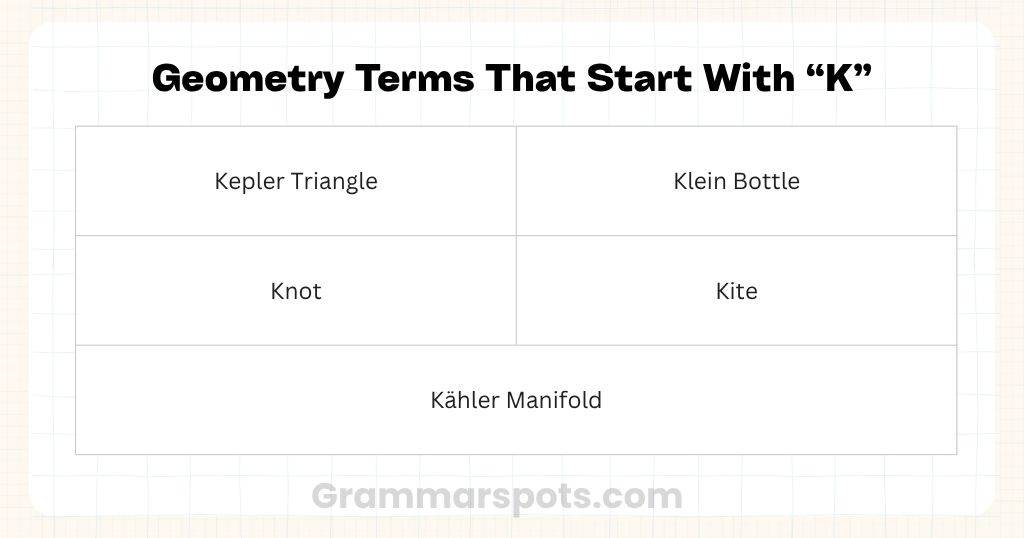
- Kite
- Kepler Triangle
- Knot
- Klein Bottle
- Kähler Manifold
Statistics Terms That Start With K
- Kurtosis
- Kappa (Cohen’s)
- KL Divergence
- K-means
- K-nearest Neighbor
- Kernel Density Estimation
- Kolmogorov–Smirnov Test
- K-fold Cross Validation
Measurement Terms Starting With K
- Kilo
- Kilogram
- Kilometer
- Kiloliter
- Kilowatt
Algebra and Linear Algebra Terms That Start With K
- Kernel
- Kernel Function
- Kronecker Delta
- Kronecker Product
- Kronecker Symbol
- K-value
Graph Theory Terms Starting With K
- K-regular Graph
- Kneser Graph
- Kuratowski’s Theorem
- Kempe Chain
Related Post: 55+ Math Words That Start With J (With Meanings and Examples)
Topology Terms Starting With K
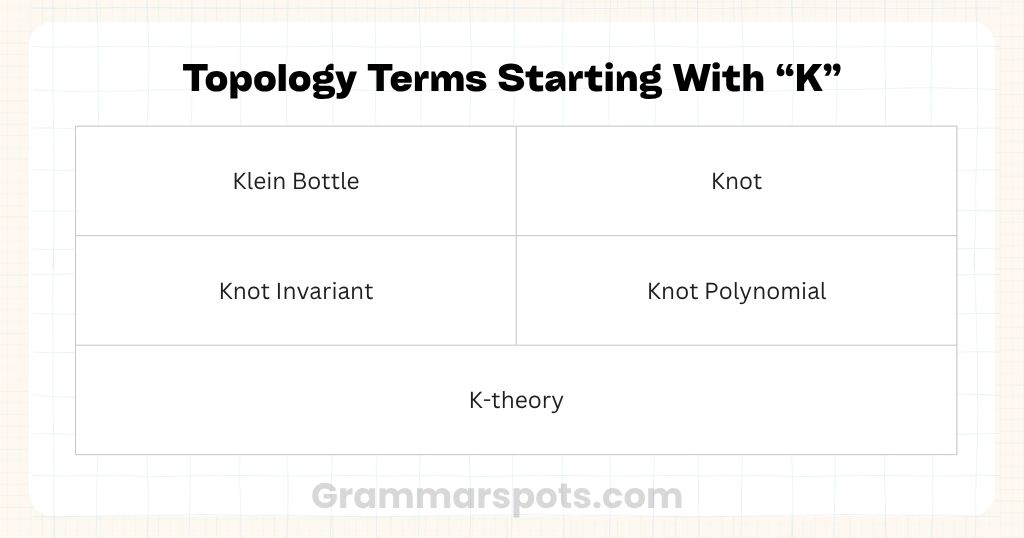
- Klein Bottle
- Knot
- Knot Invariant
- Knot Polynomial
- K-theory
Logic and Discrete Math Terms Starting With K
- K-map
- Knapsack Problem
- Kolmogorov Complexity
Commonly Confused K Math Terms
Kilogram vs. Kilometer
- Kilogram = mass (how heavy something is)
- Kilometer = distance (how far something is)
- Common error: swapping these in word problems
Kernel (Linear Algebra) vs. Kernel (Machine Learning)
- Linear algebra kernel = the null space of a transformation
- ML kernel = a similarity function between data points
- Same word, completely different contexts
Kurtosis vs. Skewness
- Skewness = asymmetry of a distribution (left or right lean)
- Kurtosis = tail heaviness (sharp peak vs. flat spread)
- Both describe distribution shape but measure different features
KL Divergence vs. a True Distance
- KL Divergence is not symmetric: D_KL(P‖Q) ≠ D_KL(Q‖P)
- It cannot be called a “distance” in the mathematical sense
- It measures directed difference, not mutual separation
K-means vs. K-nearest Neighbor
- K-means = unsupervised clustering (no labels needed)
- KNN = supervised classification (uses labeled data)
- Both use distances and the letter K but solve different problems
Klein Bottle vs. Möbius Strip
- Möbius strip = one-sided surface with one boundary edge
- Klein Bottle = one-sided surface with no boundary at all
- A Klein bottle is formed by joining two Möbius strips along their edges
Tips for Learning K Math Vocabulary
- Group the kilo- words together kilogram, kilometer, kiloliter, kilowatt all share the same prefix meaning 1,000. Learn one, understand all.
- Use flashcard pairs for confused terms make side-by-side cards for kurtosis/skewness and K-means/KNN highlighting the single key difference.
- Sort terms by field label each word with its branch (geometry, statistics, topology) to build a mental map of where each belongs.
- Write your own example sentences don’t just read definitions; create a sentence using each term in a real or imaginary context.
- Teach the term to someone else explaining Kronecker Delta or the Knapsack Problem out loud is one of the fastest ways to check your own understanding.
FAQs About Math Words That Start With K
What are the most common math words starting with K for students?
- Elementary: kilo-, kilogram, kilometer, kite
- Middle school: kernel, k-value, kurtosis
- High school and beyond: Kronecker Delta, KL Divergence, Klein Bottle
Is “kite” a real math term?
Yes. A kite is a specific quadrilateral in geometry with two pairs of consecutive equal sides, perpendicular diagonals, and one axis of symmetry. It has its own area formula and properties studied in school geometry.
What does kilo- mean?
Kilo- is a metric prefix from Greek meaning one thousand (1,000). It scales any unit by 1,000 grams become kilograms, meters become kilometers.
What is kurtosis used for?
Kurtosis measures whether a distribution has heavier or lighter tails than a normal distribution. It is used in finance, quality control, and statistical modeling to identify outlier risk.
What is the Knapsack Problem?
An optimization problem: given items with weights and values, select the best combination that maximizes total value without exceeding a weight limit. A foundational problem in algorithm design.
What is the Kronecker Delta?
A function δᵢⱼ that equals 1 when i = j and 0 otherwise. Widely used in linear algebra and physics to compactly express identity matrices and summations.
What is a Klein Bottle?
A one-sided, closed surface with no interior or exterior. It cannot exist in three-dimensional space without self-intersection and belongs to the field of topology.
What is the difference between K-means and KNN?
K-means is unsupervised clustering it groups unlabeled data. KNN is supervised classification it uses labeled data to classify new points. They are unrelated algorithms that both happen to use the variable K.
Conclusion
Math terms starting with K cover an impressive range from the practical (kilogram, kilometer, kite) to the deeply abstract (Klein Bottle, Kronecker Delta, Kähler Manifold). Here’s a quick summary by level:
- Beginner: kilo-, kilogram, kilometer, kiloliter, kilowatt, kite, k-value
- Intermediate: kernel, kappa, K-map, Kepler triangle, kurtosis
- Advanced: Kronecker Delta, KL Divergence, Kolmogorov Complexity, Klein Bottle, Kuratowski’s Theorem, K-theory, Kähler Manifold
Every term in this guide is mathematically verified and genuinely useful whether you’re completing a school assignment, building a vocabulary list, or studying for advanced mathematics.

I’m Hazel, and I studied BSC English at GCUF. I focus on explaining word meanings in simple, clear language that anyone can understand. My goal is helping readers grasp everyday English, confusing terms, and slang used in real conversations and social media. I believe language learning works best when definitions connect to actual life situations. Through careful research and straightforward explanations, I make vocabulary accessible for students, learners, and anyone curious about how English really works in daily use.