

Math vocabulary is the backbone of every subject in mathematics from basic arithmetic to advanced calculus. Whether you’re a student building your glossary, a teacher preparing lessons, or a parent helping with homework, this guide covers every important math word starting with L, explained clearly and accurately.
Quick List: 40+ Math Words That Start With L
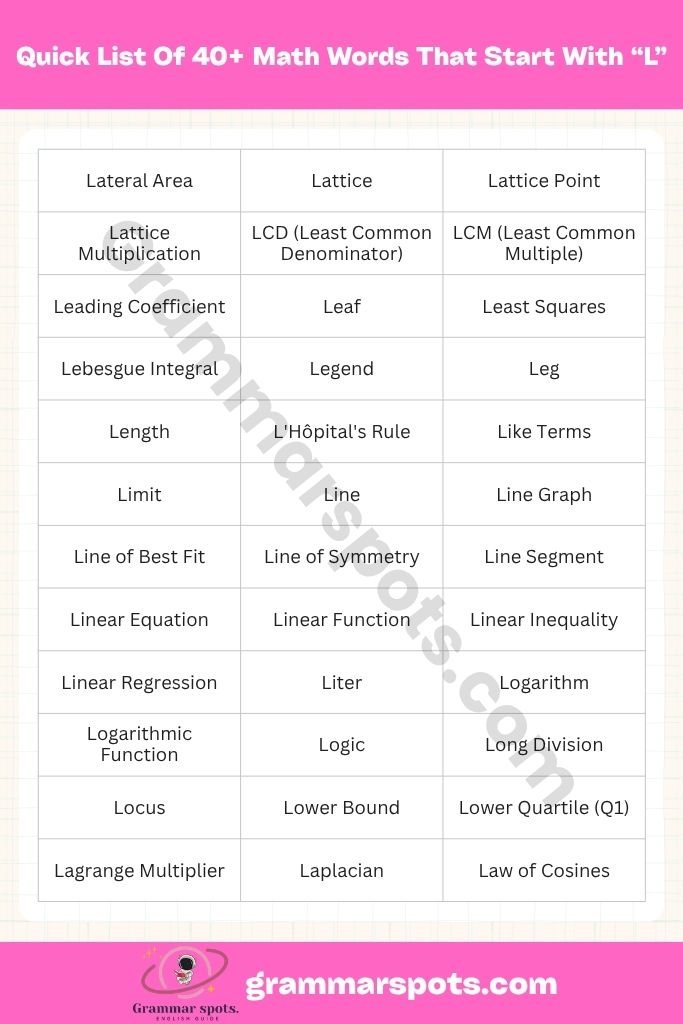
- Lateral Area
- Lattice
- Lattice Point
- Lattice Multiplication
- LCD (Least Common Denominator)
- LCM (Least Common Multiple)
- Leading Coefficient
- Leaf
- Least Squares
- Lebesgue Integral
- Legend
- Leg
- Length
- L’Hôpital’s Rule
- Like Terms
- Limit
- Line
- Line Graph
- Line of Best Fit
- Line of Symmetry
- Line Segment
- Linear Equation
- Linear Function
- Linear Inequality
- Linear Regression
- Liter
- Logarithm
- Logarithmic Function
- Logic
- Long Division
- Locus
- Lower Bound
- Lower Quartile (Q1)
- Lagrange Multiplier
- Laplacian
- Law of Cosines
- Law of Sines
- Legendre Symbol
- Lipschitz Condition
- L-Function
- Lucas Numbers
Common Math Words That Start With L
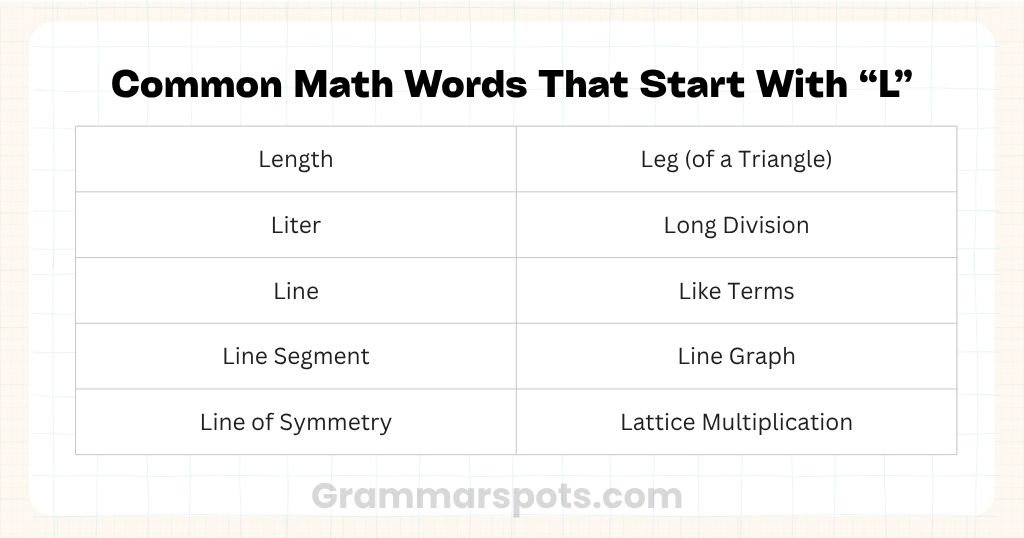
1. Length
- Meaning: The measurement of distance from one end of an object to the other.
- Example: The length of the table is 120 centimeters.
- Why It Matters: Used in perimeter, area, and volume formulas across all levels of geometry.
2. Liter
- Meaning: A metric unit of volume equal to 1,000 milliliters.
- Example: The bottle contains 2 liters of water.
- Why It Matters: Essential in measurement and unit conversion problems in math and science.
3. Line
- Meaning: A straight, one-dimensional figure with no endpoints that extends infinitely in both directions.
- Example: Line AB passes through two points and never ends.
- Why It Matters: The foundation of geometry used in angles, shapes, slope, and coordinate systems.
4. Line Segment
- Meaning: A part of a line with two definite endpoints and a measurable length.
- Example: The line segment from A to B is 7 cm long.
- Why It Matters: Used in polygon construction, distance problems, and geometric proofs.
5. Line of Symmetry
- Meaning: An imaginary line that divides a shape into two identical mirror-image halves.
- Example: A square has four lines of symmetry.
- Why It Matters: Core to understanding reflections, transformations, and geometric properties.
6. Leg (of a Triangle)
- Meaning: Either of the two sides forming the right angle in a right triangle.
- Example: In a 3-4-5 right triangle, the legs are 3 and 4.
- Why It Matters: Legs are the values used in the Pythagorean theorem: a² + b² = c².
7. Long Division
- Meaning: A step-by-step method to divide large numbers by breaking the process into smaller operations.
- Example: 846 ÷ 6 = 141, solved using long division.
- Why It Matters: Builds number sense and is the foundation for polynomial division in algebra.
8. LCD Least Common Denominator
- Meaning: The smallest number that serves as a common denominator for two or more fractions.
- Example: The LCD of 1/3 and 1/4 is 12.
- Why It Matters: Required to add or subtract fractions with different denominators.
9. LCM Least Common Multiple
- Meaning: The smallest positive integer that is a multiple of two or more numbers.
- Example: The LCM of 4 and 6 is 12.
- Why It Matters: Used in fraction operations, scheduling problems, and number theory.
10. Like Terms
- Meaning: Algebraic terms that share the same variable(s) raised to the same power.
- Example: In 5x + 3x − 2, the terms 5x and 3x are like terms; combined they give 8x − 2.
- Why It Matters: Combining like terms is the core skill for simplifying algebraic expressions.
11. Line Graph
- Meaning: A chart that displays data points connected by straight lines to show change over time.
- Example: A line graph tracks monthly rainfall across a year.
- Why It Matters: One of the most common tools for data visualization in statistics and science.
12. Legend (Graph)
- Meaning: A key on a chart or graph explaining what each color, symbol, or line represents.
- Example: The legend shows that the blue line represents 2024 sales and red represents 2025.
- Why It Matters: Reading any graph accurately requires understanding its legend.
13. Lattice Multiplication
- Meaning: A grid-based visual method for multiplying multi-digit numbers using diagonal cells to organize partial products.
- Example: To find 23 × 47, draw a 2×2 lattice grid, fill partial products in each cell, then add diagonally.
- Why It Matters: Helps students who struggle with the standard algorithm by making place value visible.
Related Post: 55+ Math Words That Start With M (With Meanings and Examples)
Intermediate Math Words That Start With L
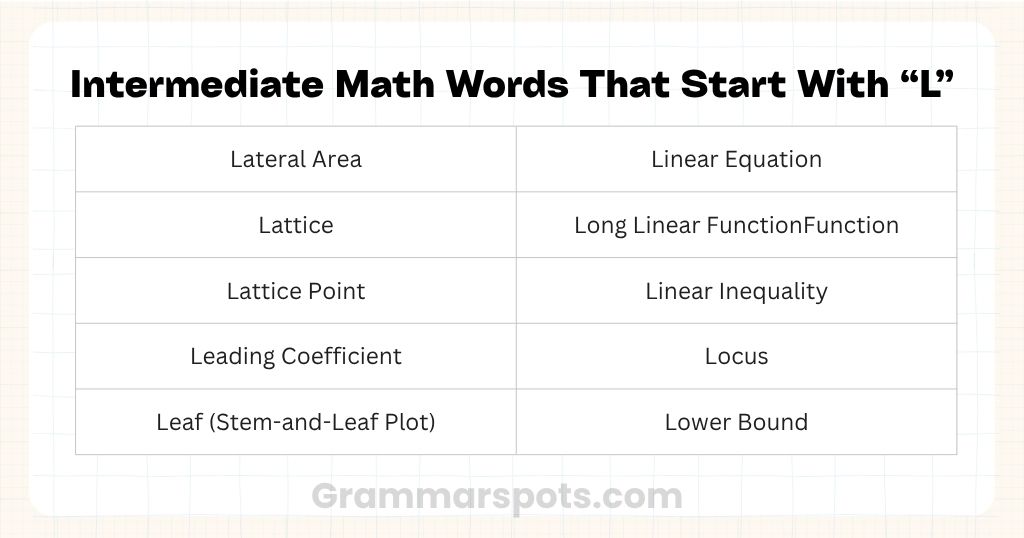
14. Lateral Area
- Meaning: The surface area of only the side faces of a 3D solid, excluding the bases.
- Example: Lateral area of a cylinder = 2πrh.
- Why It Matters: Used in real problems like calculating how much material wraps around a can.
15. Lattice
- Meaning: A regular grid of evenly spaced points in a plane or space.
- Example: In the coordinate plane, the lattice is the set of all points with integer coordinates.
- Why It Matters: Appears in coordinate geometry, number theory, and abstract algebra.
16. Lattice Point
- Meaning: A point in the coordinate plane where both x and y are integers.
- Example: (3, −2) is a lattice point; (1.5, 3) is not.
- Why It Matters: Used in Pick’s Theorem, counting problems, and integer solution problems.
17. Leading Coefficient
- Meaning: The coefficient of the highest-degree term in a polynomial.
- Example: In 4x³ − 2x + 7, the leading coefficient is 4.
- Why It Matters: Determines the end behavior of a polynomial’s graph and guides factoring strategies.
18. Leaf (Stem-and-Leaf Plot)
- Meaning: The final digit(s) of a data value in a stem-and-leaf plot, displayed beside the stem.
- Example: For 47, the stem is 4 and the leaf is 7.
- Why It Matters: Lets students see the full shape of a data set while keeping actual values intact.
19. Linear Equation
- Meaning: An equation where variables appear only to the first power, always graphing as a straight line.
- Example: 3x + 5 = 14 → x = 3.
- Why It Matters: The most fundamental structure in algebra; models constant-rate real-world situations.
20. Linear Function
- Meaning: A function in the form f(x) = mx + b, where m is slope and b is the y-intercept.
- Example: f(x) = 2x + 1 produces a straight line with slope 2.
- Why It Matters: Describes constant rates of change and is the entry point to function analysis.
21. Linear Inequality
- Meaning: A mathematical statement comparing a linear expression using <, >, ≤, or ≥.
- Example: 2x + 3 > 7 → x > 2. The answer is a range of values.
- Why It Matters: Models real constraints like budget limits, weight restrictions, and capacity thresholds.
22. Locus
- Meaning: The complete set of all points that satisfy a given geometric condition.
- Example: All points equidistant from a fixed center form a circle that set of points is the locus.
- Why It Matters: Every standard curve circle, parabola, ellipse is defined as a locus.
23. Lower Bound
- Meaning: A value that is less than or equal to every element in a given set.
- Example: For the set {5, 8, 12}, any number ≤ 5 is a lower bound.
- Why It Matters: Used in analysis, optimization, and algorithm complexity theory.
24. Lower Quartile (Q1)
- Meaning: The median of the lower half of a data set, equal to the 25th percentile.
- Example: In {2, 4, 6, 8, 10, 12, 14}, Q1 = 4.
- Why It Matters: Part of the five-number summary; used in box plots and identifying outliers.
25. Line of Best Fit
- Meaning: A straight line drawn through a scatter plot that best represents the overall data trend.
- Example: A line of best fit through study hours vs. test scores shows a positive trend.
- Why It Matters: The visual foundation of linear regression and data prediction.
26. Logic (Mathematical Logic)
- Meaning: The formal system of reasoning involving statements, truth values, and rules of inference.
- Example: “If a number is divisible by 4, then it is divisible by 2” is a logical conditional.
- Why It Matters: Underpins every mathematical proof; essential for geometry and higher mathematics.
Related Post: 45+ Math Words That Start With N (With Meanings and Examples)
Advanced Math Words That Start With L
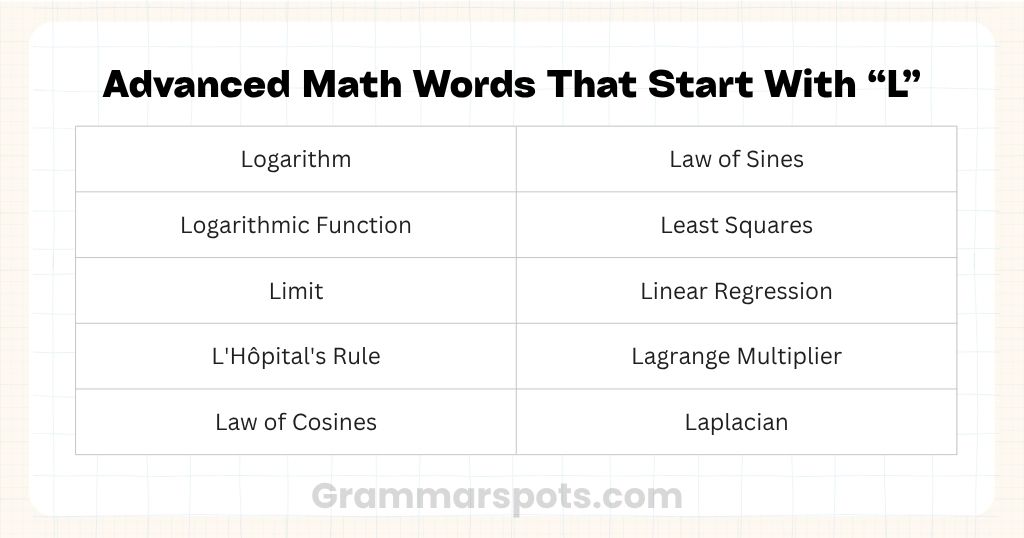
27. Logarithm
- Meaning: The exponent to which a base must be raised to produce a given number. If bˣ = y, then log_b(y) = x.
- Example: log₂(8) = 3, because 2³ = 8.
- Why It Matters: Used to measure earthquakes, sound intensity, and pH; fundamental to computer science and calculus.
28. Logarithmic Function
- Meaning: A function of the form f(x) = log_b(x); the inverse of an exponential function.
- Example: f(x) = log₁₀(1000) = 3, since 10³ = 1000.
- Why It Matters: Models phenomena that grow rapidly then level off population, learning curves, radioactive decay.
29. Limit
- Meaning: The value a function or sequence approaches as the input gets closer to a specific point.
- Example: As x → 0, the limit of sin(x)/x = 1.
- Why It Matters: The formal foundation of calculus; every derivative and integral is built on limits.
30. L’Hôpital’s Rule
- Meaning: A calculus rule for evaluating limits in indeterminate forms (0/0 or ∞/∞) by differentiating numerator and denominator separately.
- Example: lim(x→0) sin(x)/x → differentiate top and bottom → cos(x)/1 = 1.
- Why It Matters: Solves limit problems that are otherwise impossible to evaluate directly.
31. Law of Cosines
- Meaning: A formula for any triangle: c² = a² + b² − 2ab·cos(C).
- Example: With a = 5, b = 7, C = 60°, solve for side c.
- Why It Matters: Generalizes the Pythagorean theorem to all triangles; used in navigation and engineering.
32. Law of Sines
- Meaning: In any triangle: a/sin(A) = b/sin(B) = c/sin(C).
- Example: If A = 30°, a = 5, B = 45°, find b using the ratio.
- Why It Matters: Used when the Pythagorean theorem doesn’t apply; essential in surveying and astronomy.
33. Least Squares
- Meaning: A method that finds the best-fit line by minimizing the total of squared differences between observed and predicted values.
- Example: Fitting a trend line to scattered data points using least squares reduces overall error.
- Why It Matters: The mathematical backbone of linear regression and statistical modeling.
34. Linear Regression
- Meaning: A statistical method that models the relationship between variables using a linear equation.
- Example: Predicting exam scores from study hours using a regression equation.
- Why It Matters: One of the most widely used tools in data science, economics, and research.
35. Lagrange Multiplier
- Meaning: A technique in multivariable calculus for optimizing a function subject to a constraint, using an extra variable λ.
- Example: Maximize f(x, y) = xy subject to x + y = 10 → solution: x = y = 5.
- Why It Matters: Used in economics, physics, and engineering to optimize under real-world constraints.
36. Laplacian
- Meaning: A differential operator equal to the sum of all second-order partial derivatives of a function, written ∇² or Δ.
- Example: For f(x, y): Laplacian = ∂²f/∂x² + ∂²f/∂y².
- Why It Matters: Appears in the heat equation, wave equation, and models of fluid flow and electric potential.
Related Post: 50+ Math Words That Start With K (With Meanings and Examples)
Rare and Specialized Math Terms Starting With L
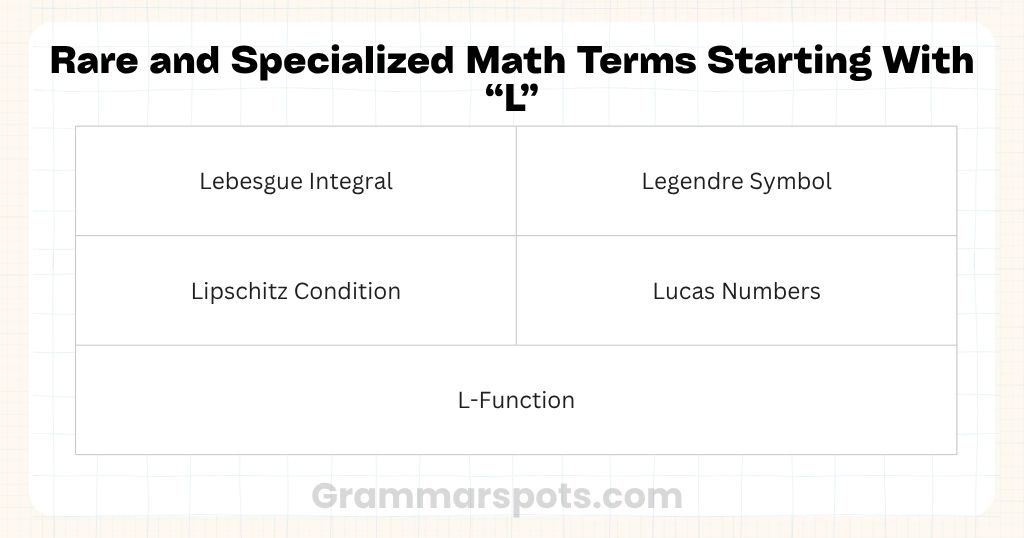
37. Lebesgue Integral
- Meaning: An advanced form of integration that works with a broader class of functions than the standard Riemann integral by measuring the “size” of sets of outputs rather than summing input intervals.
- Example: The Lebesgue integral can integrate functions that the Riemann integral cannot handle.
- Why It Matters: Foundational to modern real analysis, probability theory, and functional analysis.
38. Legendre Symbol
- Meaning: A number theory notation written (a/p) indicating whether a is a quadratic residue modulo prime p; the value is +1, −1, or 0.
- Example: (3/7) = 1 means 3 is a perfect square modulo 7.
- Why It Matters: A key tool for determining whether equations have solutions in modular arithmetic.
39. Lipschitz Condition
- Meaning: A function satisfies this condition if the change in output is always bounded by a constant multiple of the change in input: |f(x) − f(y)| ≤ K|x − y|.
- Example: f(x) = 2x satisfies the Lipschitz condition with K = 2.
- Why It Matters: Guarantees functions behave predictably; used to prove solutions to differential equations exist and are unique.
40. L-Function
- Meaning: A class of complex functions in analytic number theory that generalize the Riemann zeta function, used to study properties of prime numbers and number fields.
- Example: The Riemann zeta function is the simplest L-function.
- Why It Matters: Central to some of the deepest unsolved problems in mathematics, including the Generalized Riemann Hypothesis.
41. Lucas Numbers
- Meaning: A sequence following the same rule as Fibonacci (each term = sum of previous two) but starting with 2 and 1: 2, 1, 3, 4, 7, 11, 18, 29 …
- Example: The 5th Lucas number is 7 (2, 1, 3, 4, 7).
- Why It Matters: Appears in number theory and has deep connections to Fibonacci numbers and prime testing.
Geometry
- Lateral Area
- Lattice
- Lattice Point
- Leg
- Line
- Line of Symmetry
- Line Segment
- Locus
Algebra
- Leading Coefficient
- Like Terms
- Linear Equation
- Linear Function
- Linear Inequality
- Logarithm
- Logarithmic Function
Statistics & Data
- Leaf
- Least Squares
- Legend
- Line Graph
- Line of Best Fit
- Linear Regression
- Lower Bound
- Lower Quartile (Q1)
Measurement
- Length
- Liter
Arithmetic
- Lattice Multiplication
- LCD
- LCM
- Long Division
Calculus
- L’Hôpital’s Rule
- Lagrange Multiplier
- Laplacian
- Limit
Trigonometry
- Law of Cosines
- Law of Sines
Foundations & Number Theory
- L-Function
- Lebesgue Integral
- Legendre Symbol
- Lipschitz Condition
- Logic
- Lucas Numbers
Real-World Applications
Measurement: Length and liter are used daily in construction, cooking, medicine, and science.
Navigation & Engineering: The Law of Sines and Law of Cosines let pilots, surveyors, and engineers find distances and angles in non-right triangles.
Data & Prediction: Least squares and linear regression power scientific research, economics, and machine learning models.
Technology: Logarithms underpin computer algorithm efficiency (binary search runs in O(log n) time). Logic drives every program ever written.
Physics: The Laplacian and limits model heat flow, wave behavior, fluid dynamics, and electromagnetic fields.
Economics: Lagrange multipliers optimize decisions under real constraints, like maximizing output within a budget.
Tips for Remembering Math Words Words That Start With L
- Group by subject Learn geometry L-words together, then algebra, then statistics. Mixing all 41 at once is overwhelming.
- Use etymology “Locus” means “place” in Latin. “Log” comes from “logos” (ratio). Word roots make definitions stick.
- Draw geometry terms Sketch a line, line segment, locus, and leg. Visual memory is powerful.
- Write your own examples Don’t copy textbook examples. Invent your own sentences for each term.
- Keep a vocabulary journal Add each new term with its definition, a drawing if possible, and one example sentence.
- Solve real problems The fastest way to remember “lower quartile” or “line of best fit” is to actually use it in a problem.
Commonly Confused Terms
Line vs. Line Segment vs. Ray
A line has no endpoints and extends infinitely both ways. A line segment has two endpoints and is measurable. A ray has one endpoint and extends infinitely in one direction only.
LCM vs. LCD
Same calculation, different context. LCM is the general concept for any numbers. LCD applies that concept specifically to fraction denominators.
Logarithm vs. Exponent
Inverse operations. If 2⁴ = 16, then log₂(16) = 4. Exponentiation raises a base to a power; a logarithm asks what power was used.
Linear Equation vs. Linear Function
A linear equation is solved for one answer (2x + 3 = 11 → x = 4). A linear function maps every input to an output (f(x) = 2x + 3 works for all x).
Lower Bound vs. Minimum
A lower bound is any value ≤ every element in a set — there can be many. The minimum is the actual smallest element. Every minimum is a lower bound, but not vice versa.
Lateral Area vs. Surface Area
Lateral area covers only the sides of a 3D shape, not the bases. Surface area covers everything. For a cylinder: lateral area = 2πrh; total surface area = 2πrh + 2πr².
Law of Sines vs. Law of Cosines
Use the Law of Sines when you know two angles and a side (AAS/ASA) or two sides and a non-included angle (SSA). Use the Law of Cosines when you know three sides (SSS) or two sides and the included angle (SAS).
Frequently Asked Questions
What math words starting with L do elementary students most need?
Length, line, line segment, line of symmetry, liter, LCD, LCM, and long division are the most essential at that level.
What L-words appear most in middle school math?
Like terms, linear equation, linear function, linear inequality, locus, lower quartile, line of best fit, and leading coefficient are the key ones.
What does “limit” mean in calculus?
It’s the value a function approaches as input gets infinitely close to a specific point without necessarily reaching it. Every derivative and integral depends on this concept.
Is liter a math word or a science word?
Both. It appears identically in math (measurement and conversion problems) and science (chemistry, physics, biology).
When do students first learn logarithms?
Typically in Algebra 2 or Pre-Calculus, around 10th or 11th grade.
How is the Law of Cosines related to the Pythagorean Theorem?
When angle C = 90°, cos(90°) = 0, so c² = a² + b² − 2ab(0) simplifies to c² = a² + b². The Law of Cosines is the generalized version that works for all triangles.
What are Lucas Numbers?
A sequence 2, 1, 3, 4, 7, 11, 18 … following the Fibonacci rule (each term is the sum of the previous two) but starting from different values. They appear in number theory and prime-number testing.
What is the Lipschitz Condition used for?
It guarantees that a function doesn’t change too wildly, which is used in real analysis to prove that differential equations have unique solutions.
Conclusion
From the everyday use of length and line to the advanced power of limits, logarithms, and the Laplacian, math words starting with L span every level and branch of the subject. Knowing these terms precisely not just approximately helps students read problems clearly, solve them confidently, and build the mathematical fluency that makes the subject genuinely useful both in school and beyond.

I’m Hazel, and I studied BSC English at GCUF. I focus on explaining word meanings in simple, clear language that anyone can understand. My goal is helping readers grasp everyday English, confusing terms, and slang used in real conversations and social media. I believe language learning works best when definitions connect to actual life situations. Through careful research and straightforward explanations, I make vocabulary accessible for students, learners, and anyone curious about how English really works in daily use.