


The Core Framework: DataEndure’s 4 Risk Management Strategies Explained
Understanding DataEndure’s 4 risk management strategies and the fundamental approaches to risk is the first step toward building robust business continuity and operational resilience. These approaches, often referred to as risk treatment strategies, define how an organization decides to handle each identified risk. The goal is not to eliminate all risks—an impossible feat—but rather to manage them effectively, ensuring that any residual risk aligns with the organization’s acceptable levels.
The four core risk management strategies provide a structured framework for decision-making:
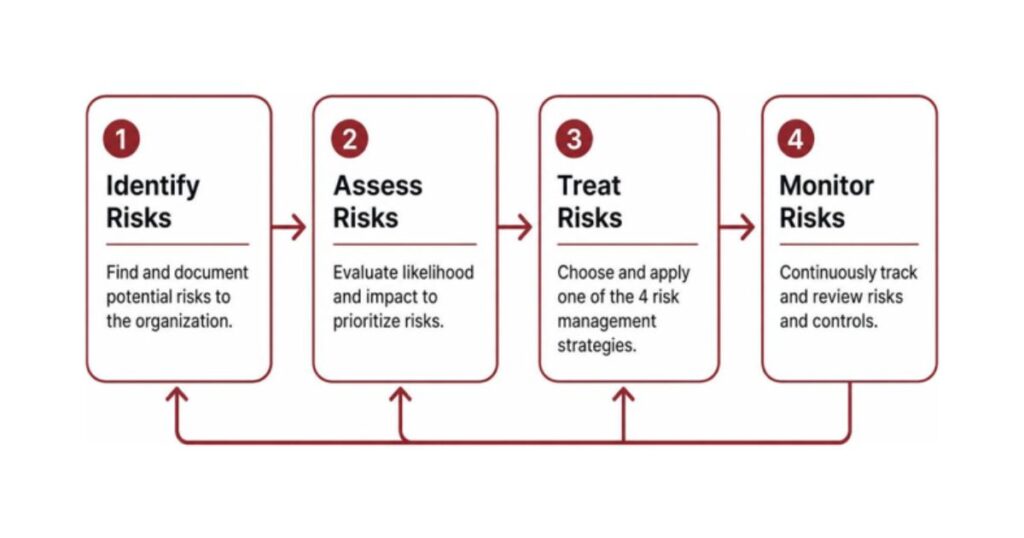
- Risk Avoidance: Eliminating the activity that gives rise to the risk.
- Risk Reduction (or Mitigation): Implementing controls to decrease the likelihood or impact of a risk.
- Risk Transfer (or Sharing): Shifting the financial burden or responsibility of a risk to another party.
- Risk Acceptance (or Retention): Deliberately choosing to bear the consequences of a risk.
These strategies are recognized across various international standards, including ISO 31000:2018 and COSO ERM. They serve as the foundational responses that organizations apply after identifying and assessing potential threats.
Implementing DataEndure’s 4 Risk Management Strategies: Avoidance and Reduction
When confronted with a risk, our initial thought might be to make it disappear entirely. This is the essence of risk avoidance. It involves making a conscious decision to refrain from engaging in an activity that carries an unacceptable level of risk. For example, a company might choose not to enter a politically unstable foreign market to avoid geopolitical and operational disruptions. Similarly, decommissioning a legacy system that poses significant cybersecurity vulnerabilities, rather than attempting to patch it indefinitely, is a form of risk avoidance. While effective in eliminating specific threats, avoidance can sometimes mean foregoing potential opportunities or revenue streams. It’s a strategic choice, often reserved for risks deemed catastrophic with no cost-effective mitigation.
More commonly, organizations employ risk reduction, also known as mitigation. This strategy focuses on implementing controls and measures to lower either the likelihood of a risk occurring or the impact if it does. This is often the most practical and frequently used approach for ongoing operational risks. For instance, to reduce the risk of data breaches, organizations invest in robust cybersecurity measures like firewalls, intrusion detection systems, multi-factor authentication, and regular employee training. Running consistent security tests on computer software helps reduce hacking risks. In the physical realm, implementing safety protocols, conducting regular maintenance on machinery, and establishing emergency procedures with off-site data backups are all forms of risk reduction. These are preventive controls designed to minimize exposure and limit damage when an incident occurs.

The effectiveness of risk reduction hinges on a thorough understanding of the risk and the implementation of appropriate, well-maintained preventive controls and incident response plans. For instance, the average global cost of a data breach in 2024 reached $4.88 million, a 10% increase from the previous year. This escalating cost underscores the critical need for proactive risk reduction strategies, especially in cybersecurity.
Expanding DataEndure’s 4 Risk Management Strategies: Transference and Acceptance
Beyond avoiding or reducing risks, organizations can also choose to shift them. Risk transference involves moving the financial burden or responsibility of a risk to a third party. The most common form of transference is purchasing insurance, such as cyber liability insurance to cover potential losses from data breaches, or business interruption insurance to protect against revenue loss during unforeseen disruptions. Another powerful mechanism is contractual risk transfer, where legal agreements are used to assign responsibility. For example, in construction projects, contracts often stipulate that builders assume risks associated with faulty work. Outsourcing functions to skilled, vetted third-party suppliers can also transfer some operational risks, though it’s crucial to remember that ultimate accountability for data security and reputational damage typically remains with the original organization. Thoroughly vetting third-party suppliers to ensure their certifications and experience back their knowledge of industry practices is a critical actionable step here.
Finally, risk acceptance, also known as risk retention, is the deliberate decision to bear the consequences of a particular risk. This strategy is often employed when the cost of avoiding, reducing, or transferring a risk outweighs the potential impact of the risk itself. For example, an organization might accept the risk of minor system downtimes if the cost of implementing a high-availability infrastructure is prohibitive for a non-critical application. There are two forms: passive acceptance, where a risk is simply ignored, and active acceptance, where the organization acknowledges the risk and develops a contingency plan in case it materializes. Active acceptance is the preferred approach, as it involves a conscious decision and preparedness. Risk retention is often the default for risks that are so catastrophic they are uninsurable, such as war, or for small risks where the cost of insurance would be greater over time than the total losses sustained. Risks that are not actively avoided or transferred are retained by default, making it a strategy every organization already uses, whether consciously or not.
How to Select and Evaluate the Right Risk Treatment Strategy
Choosing the most appropriate risk treatment strategy is a nuanced process that moves beyond simple definitions. It requires a deep understanding of the organization’s risk profile, its strategic objectives, and its capacity to absorb potential losses. This selection process is guided by the organization’s defined risk appetite and tolerance thresholds, ensuring that decisions align with overall business goals and regulatory mandates.

A critical component of this selection is a robust cost-benefit analysis. We must weigh the financial implications of implementing a strategy (e.g., the cost of new security controls for reduction, or insurance premiums for transfer) against the potential financial and non-financial impact of the risk itself. For highly complex or high-impact risks, organizations are increasingly turning to quantitative modeling techniques, such as Monte Carlo simulations or the Factor Analysis of Information Risk (FAIR) methodology. These advanced approaches move beyond qualitative heat maps to provide a more objective, data-driven understanding of potential losses, enabling more informed decision-making.
Evaluating Risk Likelihood, Impact, and Tolerance
Effective risk evaluation begins with clearly defining and scoring the likelihood and impact of each identified risk. Likelihood is typically rated on a scale (e.g., 1-5, from rare to almost certain), while impact considers various factors such as financial loss, reputational damage, operational disruption, and regulatory penalties. A useful technique is to describe risks using an event-cause-consequence structure, for example: “[EVENT] due to [CAUSE], resulting in [CONSEQUENCE].” This prevents confusing the consequence with the risk itself and allows for a more precise impact calculation.
For critical risks, particularly those with a potential for significant financial or reputational damage, organizations need to consider “tail exposure.” This refers to the extreme, low-probability but high-impact events that traditional averaging might overlook. Monte Carlo simulations can be invaluable here, running thousands of scenarios to estimate the range of possible outcomes and the probability of extreme losses (e.g., P95 or P99 loss). This level of quantitative analysis helps us understand the true potential severity of a risk, informing whether avoidance, aggressive reduction, or comprehensive transfer is necessary.
Aligning Strategy Selection with Appetite and Regulatory Mandates
The choice of risk treatment strategy must always be aligned with the organization’s risk appetite – the amount and type of risk it is willing to take to achieve its strategic objectives. This appetite is typically articulated in a formal statement, setting clear tolerance thresholds for different risk categories. For instance, an organization might have a low appetite for cybersecurity risks but a higher appetite for market innovation risks.
Furthermore, regulatory mandates play a significant role in dictating strategy choices. In 2026, compliance frameworks like NIST CSF (National Institute of Standards and Technology Cybersecurity Framework), DORA (Digital Operational Resilience Act) for EU financial entities, and ISO 27001 for information security management, are not just guidelines but often legal requirements. For example, DORA, which became applicable as of January 17, 2025, mandates that in-scope EU financial entities maintain an ICT third-party risk register and conduct threat-led penetration testing. Organizations must ensure that their chosen risk strategies are auditable and defensible against these evolving standards. This means documenting the rationale for each decision, including the trade-offs considered and the expected residual risk, to demonstrate due diligence and compliance.
Organizational Roles and Governance in Risk Strategy Execution
Developing robust risk management strategies is only half the battle; successfully executing them requires clear organizational roles and a well-defined governance structure. Without proper oversight and accountability, even the most meticulously crafted strategies can falter. Our goal is to embed risk management into the fabric of the organization, fostering a culture where risk is everyone’s responsibility, from the board to individual contributors.
Effective governance models typically involve a multi-tiered approach. At the highest level, the board of directors provides strategic oversight, setting the organization’s risk appetite and ensuring that risk management is aligned with overall business objectives. Below this, a dedicated enterprise risk committee, often cross-functional, is responsible for overseeing the implementation of risk strategies, reviewing risk assessments, and monitoring key risk indicators. This structure ensures that operational resilience is not just an IT concern but a strategic imperative driven from the top down. Crucially, every identified risk needs a named individual as the risk owner, ensuring that accountability is clear and actionable. Risks assigned to “teams” rather than individuals often go unmanaged.
Executive Leadership and Cross-Functional Ownership
Executive leadership plays a pivotal role in championing a risk-aware culture. The CEO, CFO, and other C-suite executives must communicate the importance of risk management, allocate necessary resources, and lead by example. Department managers are critical in operationalizing risk strategies within their respective areas. They are responsible for identifying specific risks relevant to their functions, implementing reduction controls, and ensuring their teams adhere to established protocols.
The “Three Lines Model” (formerly Three Lines of Defense) is a widely adopted governance framework that clarifies roles and responsibilities:
- First Line: Operational management, which owns and manages risks directly.
- Second Line: Risk management and compliance functions, which oversee and challenge the first line’s risk-taking activities.
- Third Line: Internal audit, which provides independent assurance on the effectiveness of governance, risk management, and internal controls.
Internal compliance and audit teams are essential for ensuring that risk management strategies are not only designed effectively but also operating as intended. They perform regular assessments, identify gaps, and recommend improvements, acting as a crucial check and balance. By fostering a strong risk culture, where employees are empowered to identify and report risks, organizations can create a collective defense against emerging threats.
More Guide: Pay-Recovery.com Review: Can One Trust This Asset Recovery Team?
Continuous Monitoring and Residual Risk Management
Risk management is not a one-time event; it’s an ongoing, dynamic process. Continuous monitoring is essential to ensure that risk treatment strategies remain effective in a constantly evolving threat landscape. This involves tracking key risk indicators (KRIs) – metrics that provide an early warning of increasing risk exposure. For example, a KRI for cybersecurity might be the number of failed login attempts or the volume of suspicious network traffic.
However, monitoring can lead to “alert fatigue” if not managed properly. Organizations need intelligent systems that can prioritize alerts and focus on high-impact deviations. The review cadence for risk management strategies should be event-driven rather than solely calendar-driven. While a baseline annual review of the full risk register is necessary, immediate reviews are triggered when KRI thresholds are breached, material external events occur (e.g., a new zero-day vulnerability), or significant changes happen within the organization (e.g., a new product launch, a major acquisition).
Finally, managing residual risk is paramount. After implementing avoidance, reduction, and transfer strategies, some level of risk will inevitably remain. This is the residual risk, and it must be continuously tracked and compared against the organization’s risk appetite. If residual risk exceeds acceptable thresholds, further treatment strategies or a re-evaluation of the risk appetite may be required. A risk register that is 18 months old reflects a business environment that no longer exists; high-scoring risks need quarterly reviews while stable ones need annual reviews. This ensures that our risk posture remains proactive and aligned with current realities.
Frequently Asked Questions About Risk Management Strategies
We often encounter common questions when discussing risk management. Here, we address some of the most frequent inquiries to provide further clarity.
What are the four primary risk management strategies?
The four primary risk management strategies, often referred to as core treatments or risk responses, are:
- Risk Avoidance: Eliminating the activity that generates the risk.
- Risk Reduction (Mitigation): Implementing controls to decrease the likelihood or impact of the risk.
- Risk Transfer (Sharing): Shifting the financial or operational impact of the risk to a third party, often through insurance or contracts.
- Risk Acceptance (Retention): Consciously deciding to bear the consequences of the risk, typically because the cost of other treatments outweighs the potential impact.
These strategies form the basis of most operational models and are widely recognized within frameworks like ISO 31000.
How do organizations choose between risk avoidance and risk reduction?
The choice between risk avoidance and risk reduction depends on several factors:
- Severity of Potential Loss: If the potential loss from a risk is catastrophic and unmanageable, avoidance is often the preferred strategy. For example, avoiding certain hazardous materials altogether.
- Mission Criticality: If the activity generating the risk is essential to the organization’s mission, avoidance might not be feasible. In such cases, reduction becomes the primary focus, aiming to bring the risk to an acceptable level.
- Control Feasibility and Cost Efficiency: Risk reduction is chosen when effective controls can be implemented at a reasonable cost, bringing the expected loss within acceptable limits. If no cost-effective controls exist, or if they are insufficient to reduce the risk to an acceptable level, avoidance may be the only option.
- Strategic Impact: Avoidance can mean foregoing strategic opportunities. Organizations must weigh the benefits of an activity against the risks it introduces.
Avoidance is for risks that are too severe or costly to mitigate, while reduction is for valuable activities where risks can be managed effectively.
Who is responsible for developing risk management strategies in an organization?
Developing risk management strategies is a shared accountability across the entire organization, rather than solely resting with a single department or individual. While executive leadership and the board of directors set the overall risk appetite and strategic direction, the process involves multiple layers:
- Board Oversight: The board provides high-level governance and ensures that risk management aligns with strategic objectives.
- Risk Committees: Cross-functional committees often lead the development and review of strategies, bringing together expertise from various departments.
- Executive Leadership: C-suite executives champion the risk management program, allocate resources, and ensure integration across business units.
- Department Managers: These individuals are responsible for identifying and assessing risks within their specific domains and proposing appropriate treatment strategies.
- Named Risk Owners: For each specific risk, a named individual is assigned ownership, making them accountable for implementing and monitoring the chosen strategy.
This distributed responsibility ensures a holistic approach, leveraging diverse perspectives and expertise to create comprehensive and effective risk management strategies.
Conclusion
The landscape of risk is continuously shifting, demanding that organizations move beyond static compliance to embrace strategic agility and a proactive posture. In October 2026, with threats evolving faster than capabilities, mastering the four core risk management strategies—avoidance, reduction, transfer, and acceptance—is more critical than ever.
By systematically applying these strategies, guided by a clear understanding of risk appetite and robust governance, organizations can transform potential vulnerabilities into areas of institutional resilience. It’s about making deliberate, informed choices for each risk, continuously evaluating their effectiveness, and adapting to new challenges. Embracing this dynamic approach to risk management not only protects assets and ensures operational continuity but also empowers organizations to navigate uncertainty with confidence, fostering innovation and sustainable growth in an increasingly complex world.
