

Bando is slang for an abandoned house or building, usually one that’s been taken over for illegal stuff like selling drugs. It came from Atlanta’s rap scene and spread through hip-hop music, especially after Migos made it popular around 2013.
You’re Searching This for a Reason
Maybe you saw “bando” in a rap song and had no clue what they were talking about. Or someone texted it to you and you didn’t want to look stupid asking. It’s one of those words that sounds cool but doesn’t make sense if you’re not already in on it.
The confusing part? It doesn’t sound like what it means at all. There’s no obvious connection between the word “bando” and an abandoned building. Plus, depending on who’s saying it and where they’re from, the vibe can shift completely. Someone from Atlanta uses it differently than someone from London, and neither is talking about what you’d find if you Googled “Bando” and got results about Japanese surnames or industrial belt companies.
Bando as Street Slang
In street slang, “bando” works as a coded shortcut — a way to refer to a known spot without spelling out what goes on there. The connection? Both describe places where drugs get sold or made, usually in rundown neighborhoods where these abandoned houses sit empty and unnoticed.
“Hit the bando” means going to one of these spots—whether you’re buying, selling, or just hanging out with people who are. It’s transactional but also social in a weird way. These places become meeting spots for a whole lifestyle.
Then there’s “let her hit the bando,” which you’ll hear in songs by artists like Future or Playboi Carti. That’s about bringing a girl into this world, showing her what that life looks like. It’s not romantic—it’s more about proving you’re really about that lifestyle or testing if she can handle the rougher side of things.
The UK picked up the term through Drill music, and it works the same way there. Abandoned flats in council estates, spots where crews operate. British rappers use “back to the bando” in their tracks, and it hits with the same meaning—returning to the trap, getting back to business.
What’s wild is how the term’s evolved online. Gamers started calling looted buildings in games like Warzone “the bando.” It’s got nothing to do with drugs—they just mean an empty building you can scavenge. That’s how slang morphs when it jumps communities.
Texting and What It Actually Looks Like
In texts, “bando” usually shows up in short, coded messages between people who already know what’s up. You won’t see it in normal conversation like “How was your day?” It pops up in plans being made or locations being shared.
Someone might text “pull up to the bando” meaning come through to this spot. Or “we at the bando” as a location update. The word itself is purposely vague—if someone saw your texts, they wouldn’t immediately know what you’re talking about.
The thing about texting slang like this is that it only works if both people speak the same language. If you randomly texted your mom “I’m at the bando,” she’d either think you made a typo or you’re at some restaurant she’s never heard of. The context has to already be there.
Read Also: OTT Meaning: What It Really Means in Texts, Streaming, and Everyday Life
Where You’ll Actually Hear This
Most people encounter “bando” through music first. You’re listening to a rapper talk about the bando in a song, and that’s your introduction. From there, if you’re in certain circles or neighborhoods, you might hear people say it out loud.
In group chats, it’s a location marker. “Who’s at the bando?” “Bando’s hot tonight” (meaning police are watching it). “Stay away from that bando” (it’s been raided or it’s dangerous now).
On social media, especially TikTok, younger users have started using “bando vibes” or “bando aesthetic” to describe anything that looks abandoned and creepy. Old malls, empty parking lots, liminal spaces. They’re not talking about drug houses—they’re talking about the look and feel of decay. That’s a completely different usage that old-school trap fans wouldn’t recognize.
Urban explorers (people who photograph abandoned buildings) sometimes call these places bandos too, stripping away all the illegal connotations and just focusing on the “abandoned” part.
Reading the Room: Why Tone Matters
Here’s where things get tricky: tone changes everything with this word.
If two friends who grew up in the same neighborhood say “remember the bando on Fifth Street?” they’re probably sharing a memory, maybe even laughing about something. There’s familiarity there.
But if someone you don’t know well says “meet me at the bando,” that should probably set off alarm bells. You’re either being invited into something illegal or dangerous, or someone’s testing whether you’re actually about that life.
The Playboi Carti version hits different too. For his fans, “bando” connects to this whole vampire-rockstar-nihilist aesthetic he’s built. It’s less about the actual trap and more about the imagery of being rebellious and living outside normal society. When they reference it, they’re usually talking about the vibe, not literal drug houses.
Big warning: Don’t use this term as a joke if you’re not from that world. Saying “haha I’m at the bando” when you’re at Starbucks makes you look ridiculous at best, offensive at worst. It trivializes real danger that real people live with.
The bedroom bully in the bando thing deserves its own explanation. “Bedroom bully” came from dancehall artist Shabba Ranks—it means someone who’s dominant in bed. Combine that with “bando” and you get this image of someone who’s tough and sexual even in the grittiest, most dangerous places. It’s bragging, basically. Not something you’d text to your crush unless you’re trying really hard to sound street.
Places This Word Doesn’t Belong
Don’t use “bando” at work. Ever. Even if you work somewhere casual, this word is too connected to illegal activity to bring into professional spaces.
Don’t use it with people over 40 unless they’ve already shown they know what it means. You’ll just confuse them, and then you’ll have to explain trap houses to your aunt, which nobody wants.
Don’t post it publicly on social media tied to your real name if you care about college applications, job searches, or your reputation. Even if you’re just quoting a song lyric, it can look bad out of context.
Don’t use it to sound cool if you’ve never been near that lifestyle. People can tell when you’re faking, and it comes off corny. Street slang only works when it’s authentic.
And definitely don’t use it in serious conversations about actual abandoned buildings in your city that need renovation or pose safety hazards. Calling them “bandos” in that context trivializes both the buildings and the slang.
Say This Instead
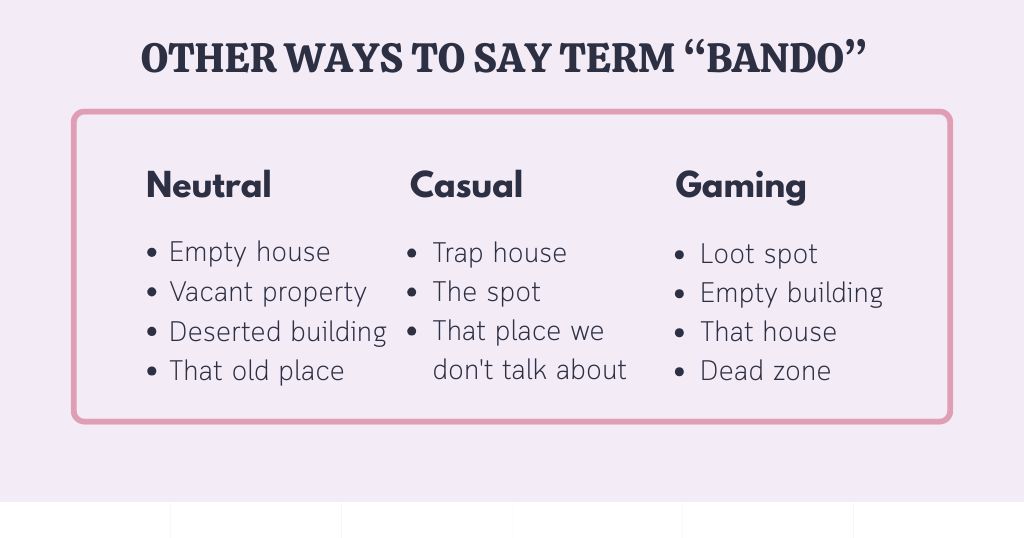
If you mean an abandoned building (neutral):
- Empty house
- Vacant property
- Deserted building
- That old place
If you mean a sketchy location (casual):
- Trap house
- The spot
- That place we don’t talk about
- Over there
If you’re gaming:
- Loot spot
- Empty building
- That house
- Dead zone
If you’re talking aesthetics:
- Abandoned vibes
- Creepy building
- Urbex spot
- Forgotten place
Actual Messages People Send Slang Bando
Text conversation: “Yo where you at?” “The bando off Martin Luther King” “Aight be there in 10”
Instagram caption under an abandoned mall photo: “These bando vibes hit different 🏚️”
Gaming voice chat: “Three guys posted up in the bando, second floor”
Group chat warning: “Don’t go to the bando on 5th, cops been circling it all week”
Song lyric context (Playboi Carti style): “She wanna come to the bando, told her it ain’t what she think”
UK Drill reference: “Back to the bando, gotta stay on my grind”
Urban explorer YouTube title: “Exploring a Crazy Bando in Detroit”
Someone being ironic: “My room’s such a bando I can’t even find my phone” (they’re exaggerating about their messy room)
How Different Groups Changed It
TikTok’s changed how younger people use this word. Kids who’ve never been near a trap house call any creepy abandoned place a bando. The meaning’s gotten softer and more visual. It’s about the aesthetic now—the peeling paint, broken windows, overgrown weeds. They’re not thinking about crime.
Older millennials and Gen X who remember when Migos first blew up use it more literally. For them, it’s still tied to the streets and what happens in those buildings.
The gaming community grabbed it because it’s quick and everyone knows what you mean in context. When you’re in a battle royale and need to call out a location fast, “enemies in the bando” is faster than “enemies in that large abandoned building with two floors.”
Japanese and Spanish speakers searching for “bando meaning” are probably confused because the word means completely different things in their languages. In Japanese, it’s usually about bands (music groups) or the verb “to bind.” In Spanish, “bando” can mean an official proclamation or a faction. Neither has anything to do with abandoned buildings.
Mistakes People Make With Bando Word
People think it means money because of the similarity to “bands” (slang for thousands of dollars). It doesn’t. Totally different words, totally different meanings.
Some people think any abandoned building is a bando. Not quite. It’s specifically ones that get used for illegal stuff or at least have that reputation. An old factory that’s been empty for years but has security and no activity? That’s just an abandoned factory.
The UK vs US usage can confuse people too. They’re similar but the UK version is more tightly connected to Drill music culture specifically, while in the US it spread across all hip-hop.
When someone says “bando aesthetic” on social media, they’re usually not talking about crime at all. They mean the visual style of decay and abandonment. That’s a huge shift from the original meaning.
The biggest misunderstanding? Thinking it’s appropriate casual slang. It’s not. It’s loaded language that comes from real struggle, real danger, real communities dealing with poverty and crime. Using it lightly shows you don’t get that.
Questions You’re Probably Wondering About Bando Slang
Is it rude to say bando?
Not rude exactly, but it’s definitely not polite. It’s street slang tied to illegal activity, so it belongs in very specific contexts. Saying it in the wrong setting makes you look clueless.
Can you use it sarcastically?
Some people do, especially online when joking about how messy their space is. But sarcasm doesn’t translate well in text, and you risk looking like you’re making fun of people’s real struggles.
Does bando mean the same thing in every country?
No. US and UK usage overlap but come from different music scenes. Other countries don’t use it at all, or the word means something completely unrelated like in Japanese or Spanish.
Is it just a rap thing?
It started in rap, but it’s spread beyond that into gaming, urban exploration, and internet culture. Each group uses it slightly differently.
What if I see it in an old text—has the meaning changed?
The core meaning (abandoned building used for drugs) has stayed the same since the early 2010s. What’s changed is younger internet users applying it more broadly to any abandoned place.
Should I use it if I’m not from that background?
Probably not. It’s like any slang that comes from a specific struggle or culture—using it when you’re not part of that feels fake and disrespectful.
Final Thoughts
Bando’s one of those words where knowing what it means isn’t the same as knowing how to use it. You can understand the definition and still mess it up completely by using it in the wrong situation or with the wrong tone.
If you’re just trying to understand rap lyrics or decode someone’s text, now you know. If you’re thinking about using it yourself, think twice about whether it fits who you are and the conversation you’re actually in. The internet’s made a lot of slang feel universal, but this one’s still got roots that matter.

I’m Hazel, and I studied BSC English at GCUF. I focus on explaining word meanings in simple, clear language that anyone can understand. My goal is helping readers grasp everyday English, confusing terms, and slang used in real conversations and social media. I believe language learning works best when definitions connect to actual life situations. Through careful research and straightforward explanations, I make vocabulary accessible for students, learners, and anyone curious about how English really works in daily use.