

What Does Bop Mean?
“Bop” has two totally different meanings: it’s either a catchy song you can’t get out of your head, or it’s a mean way to call someone (usually a girl) promiscuous. The meaning depends completely on whether you’re talking about music or people.
Nobody Warned You This Word Has Two Faces
You probably saw “bop” in a comment section or group chat and thought, “Wait, are they talking about a song or insulting someone?” You’re not alone. This word is genuinely confusing because the same three letters mean completely opposite things depending on the conversation.
Maybe someone sent you a Spotify link saying “this is such a bop!” and you felt good about it. But then you scrolled TikTok and saw someone called a “bop” in a way that definitely wasn’t a compliment. That whiplash? It’s real, and it trips people up constantly.
The music meaning is everywhere and mostly safe. The people meaning is loaded with judgment and can start actual drama.
Real Talk: What’s Actually Happening When Someone Says “Bop”
When it’s about music: You’re saying a song is ridiculously catchy. Not just good—it’s the kind of track that gets stuck in your brain and makes your head move without asking permission. It’s lighter and more melodic than words like “banger” (which sounds intense and club-ready) or “slapper” (which is all about heavy bass). A bop has that sing-along, replay-it-five-times energy.
When it’s about a person: This is where things get harsh. Calling someone a “bop” means you’re saying they hook up with lots of people or post revealing content online. It’s usually aimed at women and carries clear social stigma. Some people tried to “reclaim” the word—turning it into something like “confident” or “hot”—but that hasn’t really stuck. Most of the time, it still stings.
The person meaning came from early 2000s hip-hop and Chicago drill scenes before blowing up on TikTok around 2021. The “Lala Bop” trend turned it into a full cyberbullying tool where people got “exposed” in videos.
Read More: Dope Meaning Explained: How to Use It Without Sounding Awkward
Spotting It in the Wild: Everyday Conversations
Music context:
- Commenting under new releases: “Okay this is actually a bop”
- Adding songs to playlists with names like “Summer Bops 2026”
- Texting friends: “Just found a bop, sending link”
- Hyping up an artist: “She doesn’t miss, every song’s a bop”
Person context (warning: this is the mean one):
- Gossip in DMs: “Did you hear about her? Total bop”
- TikTok comments trying to tear someone down
- Group chats where people are being judgmental about someone’s dating life
- Instagram comment sections getting nasty
You’ll see the music version way more often in public spaces. The person version usually hides in private messages or anonymous comments because people know it’s cruel.
Reading the Room: Why Context Changes Everything
Here’s where you need to pay attention, because “bop” can go sideways fast.
Music context is usually safe: When you’re clearly talking about a song—like responding to someone’s playlist or commenting on a music video—there’s almost no way to mess this up. Everyone knows what you mean.
Person context is a minefield: Even if you think you’re joking with a close friend, calling them a “bop” can land wrong depending on how they hear it. And if you say it about someone else? You’re basically spreading gossip that attacks their personal life.
The reclamation attempt: Some creators say things like “I’m a bop and I own it!” trying to flip the script. But unless you’re the person using it about yourself, don’t assume it’s okay to call someone else that. The power dynamics matter.
Relationship check: Would you say this to your mom? Your teacher? Your boss? If the answer is “absolutely not,” that tells you something about the word’s actual weight.
Misinterpretation risk #1: Someone might text “this song is a bop” and autocorrect fails them, or the conversation shifts topics, and suddenly people think they’re calling a person a bop. Context gets lost in fast-moving group chats.
Misinterpretation risk #2: UK English throws a curveball—over there, “going for a bop” can mean taking a walk or heading to a dance. So international group chats can get genuinely confused.
Misinterpretation risk #3: Older people or non-native English speakers might not know the music slang at all and only hear the negative meaning, making your innocent music comment sound way worse than intended.
Read Also: BOL in Texting: Decode the Meaning Before You Reply Wrong
Places This Word Will Get You in Trouble
Never use it about a person in these situations:
- Professional settings (work Slack, LinkedIn, company emails)
- School environments where it could count as bullying
- Public social media where the person being discussed might see it
- When you’re mad at someone—it’ll sound like a personal attack
- Around people you don’t know well enough to gauge their reaction
Skip the music version here:
- Formal emails or professional communication
- When you’re trying to sound polite or mature
- Talking to someone much older who won’t get the slang
- Academic writing or presentations
The music meaning is mostly harmless but still too casual for anything remotely professional. The person meaning? Best avoided entirely.
Other Ways to Say What You Mean
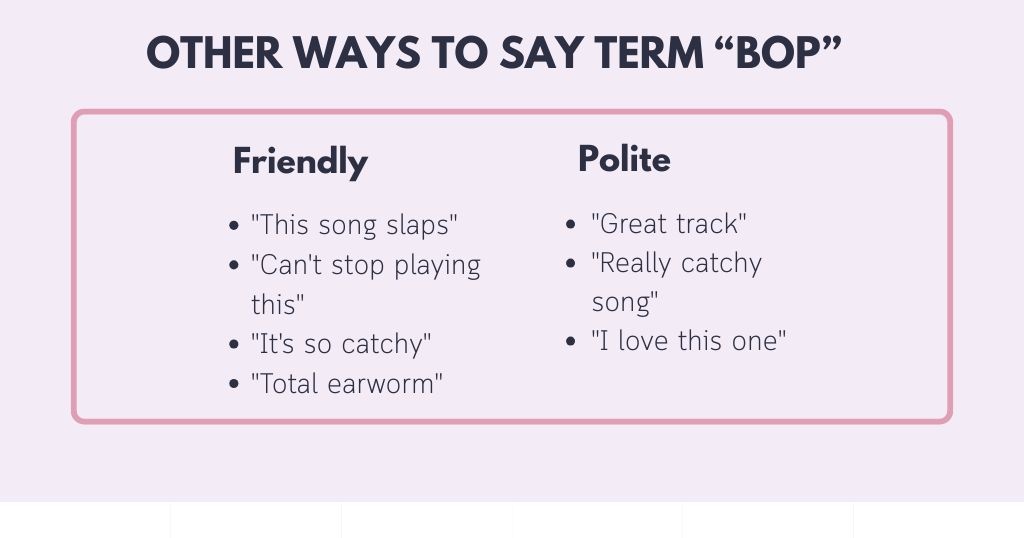
For music (casual):
- “This song slaps”
- “Can’t stop playing this”
- “It’s so catchy”
- “Total earworm”
For music (polite):
- “Great track”
- “Really catchy song”
- “I love this one”
For people (if you somehow need to describe someone dating a lot):
- Just… don’t? There’s no polite equivalent because the whole concept is rude
- If you’re genuinely trying to say someone’s confident: “They’re confident” (just say that)
- If someone asks you about dating: “They date casually” (neutral, factual, not judgmental)
Real-Life Examples
Music examples:
Text to friend: “Dude that new Sabrina song is such a bop, been stuck in my head all day”
TikTok comment: “Why is nobody talking about this bop??? 🔥”
Adding to playlist: “Morning Bops ☀️” (playlist title)
Discord chat: “Someone drop a bop in here, I need new music”
Person examples (showing how it’s actually used, not recommending it):
Private DM (gossip): “I heard she’s a bop, like talks to a different guy every week”
TikTok drama: Comment: “Lala bop exposed 💀” (This is cyberbullying, btw)
Group chat: “Why’s everyone acting like she’s not a bop? Her Instagram is all thirst traps”
Notice how the person examples all sound mean? That’s because they are.
Different Platforms, Different Vibes
TikTok made both meanings blow up, but the music one dominates hashtags and sound trends. The person meaning lives more in the comments where things get ugly.
Instagram and Twitter/X use it mostly for music, but you’ll see the person meaning pop up in gossip accounts and drama threads.
Age gap: Gen Z knows both meanings well. Millennials mostly know the music version. Gen X and older might be completely lost or only remember “bebop” from old jazz.
Music evolution: It started with 1940s-50s bebop jazz (fast, improvised music), then got picked up by early 2000s hip-hop to mean “good song,” and exploded everywhere by the 2010s through social media.
Regional twist: In the UK, “bop” can mean going dancing at a club or literally just walking somewhere (“fancy a bop to the shops?”). This creates genuine confusion in international chats.
The “Bop House” thing: This started as a TikTok content house (like Hype House) where creators lived together, but the name played on the negative slang meaning for shock value. Some people now use “bop house” to mean any party house or place where people hook up, but it’s not super common.
You may also like it: KOOK MEANING: What It Really Means (And When You’ll Sound Ridiculous Using It)
Mistakes People Keep Making
“I thought all slang was universal”: Nope. Even within the US, different cities and age groups use words differently. What’s a compliment in one friend group might be fighting words in another.
“If it’s a music compliment, the other meaning doesn’t matter”: It does when you’re unclear. If you text “she’s a bop” without context, people won’t know if you mean her music taste is great or if you’re insulting her. Make it obvious you’re talking about music.
“Reclaiming words makes them okay for everyone to use”: Not how it works. When someone reclaims an insult about themselves, that’s their choice. You don’t automatically get permission to use that word about other people.
“It’s just a joke”: Maybe to you. The person being called a bop probably doesn’t think it’s funny. Intent doesn’t erase impact.
“Older slang meanings don’t count”: They do when people still remember them. Someone’s grandma might know “bebop” as jazz music and be completely confused by your text.
Quick Questions People Actually Ask
Is calling someone a bop always rude?
When it’s about a person? Yes, pretty much always. Even if you think you’re being playful, it carries judgment about someone’s sex life or choices. When it’s about music? You’re fine.
Can “bop” be sarcastic?
Sure. Someone might say “wow, what a bop” about a terrible song as a joke. But sarcasm in text is risky because tone doesn’t always land, so people might think you’re serious.
Does everyone know both meanings?
Not at all. Lots of people only know the music version. Some only know it as an insult. And plenty of people don’t know it’s slang at all. That’s why context matters so much.
Is it a TikTok-only word?
Nope. It’s been around way longer than TikTok. But TikTok definitely made both meanings spread faster and reach more people.
What if someone calls me a bop?
If it’s about your music taste, cool. If it’s about you as a person, they’re being disrespectful and you can absolutely call that out or just block them. You don’t owe mean people your time.
Can I use it at work?
For music? Still too casual for most workplaces. Save it for lunch break conversations with work friends you’re actually close with. For people? Absolutely not, that’s HR territory.
Final Thoughts
The word “bop” is genuinely two-faced. One version is fun, harmless, and all about music you love. The other version carries baggage and can create unnecessary drama.
Stick to the music meaning in public. Be super careful with the person meaning even in private, because it’s usually just gossip dressed up as slang. And if you’re ever unsure which meaning someone’s using, just ask. Way better to clarify than to assume wrong and end up in an awkward or hurtful situation.
Language changes fast online, and “bop” is proof that one word can split into completely different directions depending on where the internet takes it.

I’m Hazel, and I studied BSC English at GCUF. I focus on explaining word meanings in simple, clear language that anyone can understand. My goal is helping readers grasp everyday English, confusing terms, and slang used in real conversations and social media. I believe language learning works best when definitions connect to actual life situations. Through careful research and straightforward explanations, I make vocabulary accessible for students, learners, and anyone curious about how English really works in daily use.