

“Dope” means something is really cool, awesome, or high-quality. It’s casual slang you’ll hear in texts, social media, and everyday conversations when someone likes something a lot.
Why This Word Confuses People
You’ve probably seen “dope” pop up in comments or texts and wondered if it’s good or bad. That’s fair—the word has a weird history. Some people remember it from old movies about drugs. Others know it as an insult for someone who’s being dumb. But today, when your friend texts “that’s dope,” they’re saying something positive.
The confusion makes sense. Same word, totally different vibes depending on who’s saying it and when.
The Real Vibe Behind “Dope”
When someone calls something “dope” in 2026, they’re saying it’s impressive without trying too hard. It’s not just “cool”—it’s got that extra something. Think of it like a stamp of approval that says “this hits different.”
People reach for “dope” when regular compliments feel too plain. Your friend could say “nice shoes,” but “those shoes are dope” sounds way more genuine. It’s got personality. The word carries this laid-back confidence, like the person saying it actually knows what they’re talking about.
Here’s the thing: “dope” works for style, skills, ideas, music, basically anything creative or well-done. It’s not about being perfect. It’s about being authentic and having quality that shows.
Where You’ll Hear It Used
You’ll see “dope” all over the place once you start noticing it.
Your friend posts their new apartment setup on Instagram? Comments flood in with “dope space” or “setup is dope.” Someone shares a playlist on Snapchat? “This is dope” means they’re actually going to listen to it, not just be polite.
In group chats, “dope” works as a quick approval. Your roommate says they got concert tickets—you just reply “dope” and everyone knows you’re excited. No need for a paragraph.
On TikTok and Instagram, people use it to hype up aesthetics. A well-edited video gets “editing is dope” in the comments. Someone’s outfit coordination? “Fit is dope.” It’s become shorthand for recognizing when someone put thought into something.
Gaming communities love it too. Pull off a clutch move in a match and your teammates hit you with “that was dope.” It’s respect without being over the top.
You may also like it: Bando Meaning: What Does This Street Slang Actually Mean?
Reading the Room: Tone Matters
Here’s where you need to pay attention. “Dope” sounds different depending on who you’re talking to.
With friends your age? It’s always safe. You can call someone’s haircut dope, their car dope, their idea dope—it all works.
With people older than you? Some of them still think “dope” means drugs or stupid. Your grandma might not appreciate you calling her casket dope, even if you mean the food is amazing. Read the room.
Strangers online? Usually fine, but keep it about things, not people. “That art is dope” lands better than “you’re dope” to someone you don’t know—that can feel too familiar.
Warning about sarcasm: If someone says “oh that’s real dope” with a flat tone or the eye-roll emoji, they’re being sarcastic. The words say compliment, but the delivery says the opposite. In text, this is easy to miss. Look for context clues.
The relationship test: Would you high-five this person? If yes, “dope” probably works. If you’d shake hands instead, pick different words.
Skip It in These Situations
Skip “dope” in these situations:
Job interviews or professional emails. “I think this opportunity is dope” will not land well with a hiring manager. Try “exciting” or “interesting” instead.
Formal writing of any kind. School essays, business reports, cover letters—keep “dope” out of these. It reads as too casual and shows you can’t code-switch.
Talking to authority figures you don’t know well. Your new boss, your professor, your doctor. Wait until they set the tone first.
Serious or sensitive conversations. If someone’s telling you about a loss or struggle, responding with “that’s dope you’re handling it” sounds thoughtless. Match the emotional weight.
Work situations where you’re representing a company or brand. Stick with standard language.
The basic rule: If you’re not sure whether it’s appropriate, it probably isn’t. Go with something safer.
Better Words for Different Vibes
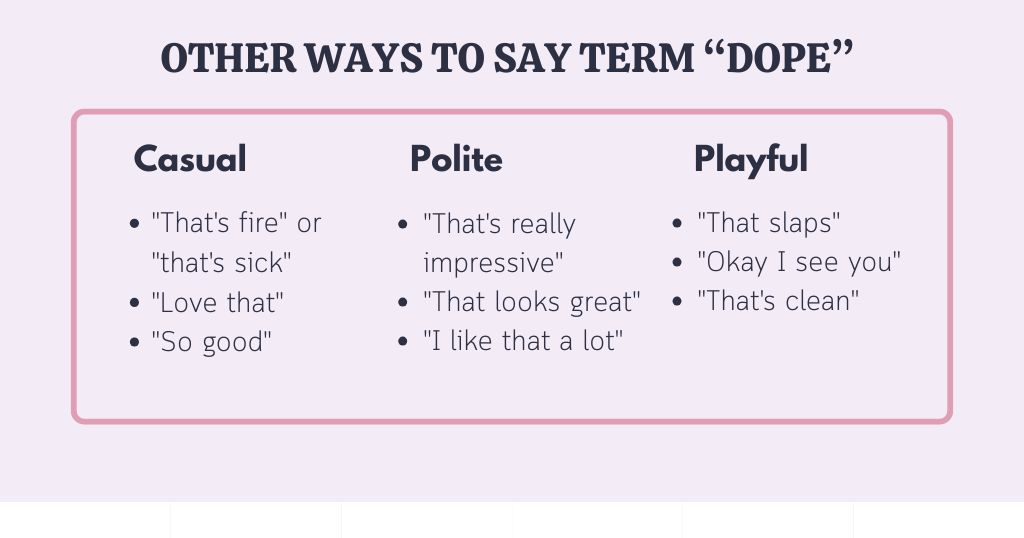
For casual situations:
- “That’s fire” or “that’s sick” (same energy)
- “Love that” (softer)
- “So good” (simple, works everywhere)
For polite or professional contexts:
- “That’s really impressive”
- “That looks great”
- “I like that a lot”
For playful situations:
- “That slaps” (very casual)
- “Okay I see you” (hyping someone up)
- “That’s clean” (style-focused)
Match your word choice to the vibe. You’ve got options. Also, choose the other slangs like KOOK and OTT for usage.
Actually Realistic Examples
Text to friend about plans: “Got us tickets to the show” “Dope, what time?”
Instagram comment on someone’s photography: “These shots are dope 🔥”
Group chat about a new song: “Just dropped, check it out” “This is dope, been on repeat”
Response to good news: “I finally finished my project” “Dope! How’d it turn out?”
Complimenting someone’s style: “You look dope in that jacket”
Gaming chat after a good play: “That clutch was dope bro”
Validating someone’s achievement: “I got promoted” “Yo that’s dope, congrats”
Quick agreement: “Wanna grab food at 7?” “Dope, see you then”
Different Crowds, Different Usage
Younger people (teens and twenties) use “dope” constantly and naturally. It’s just part of how they talk. Older millennials started it, Gen Z kept it going, and now Gen Alpha uses it sometimes, though they might throw it in ironically or pair it with newer slang.
On Reddit, “dope” shows up a lot in hobby communities. Someone posts their custom keyboard build, gaming setup, or sneaker collection—top comment is often “dope setup” or “that’s dope.” It’s how people show respect in niche communities without writing essays.
Hip-hop culture made “dope” what it is today. Started in the 80s and 90s, rappers used it to describe tight beats, smooth flows, and quality music. That spread to streetwear, skating, and eventually everywhere else. The word carries that history.
Different platforms have different vibes. TikTok users say “dope” about creative editing and unique content. Twitter (X) uses it in shorter bursts—just “dope” as a reply. Instagram sticks it in comments with emojis. The word adapts.
Mistakes People Make With This Word
Mixing up the meanings: If someone older says “don’t be a dope,” they’re calling you foolish. That’s ancient slang. But if your friend says “you’re dope,” they’re saying you’re awesome. Opposite meanings, same word. Context is everything.
Assuming it’s always about drugs: That ship has sailed for most people under 40. When someone says a song is dope, they’re not making a drug reference. They just like the song.
Using it too much: If every single thing is “dope,” the word loses punch. Save it for stuff that actually impresses you. Overuse makes you sound like you only know one adjective.
Thinking it’s too old: Some people think “dope” is outdated millennial slang. It’s not. It’s still in heavy rotation. What changed is how people mix it with other words—now you’ll see “mad dope” or “dope AF” instead of just “dope” by itself.
Missing sarcastic usage: Text has no tone. “Yeah real dope” could be genuine or dripping with sarcasm. Check what happened before that message. Are they happy or annoyed? That tells you what they really mean.
You may also like it: What Does YHU Mean in Text: The Casual Slang That’s Not a Typo
Questions You’re Probably Wondering
Is saying “dope” rude or offensive?
Not in casual settings. It’s normal slang today. The only time it feels wrong is when the setting is formal or serious.
Can “you look dope” sound weird?
It depends on your relationship with the person. Between friends, it’s a solid compliment about their style or outfit. To a stranger or coworker you barely know, it might come across as too familiar or even flirty. Stick with “you look great” for safer ground.
Does “dope” mean different things in different places?
Mostly no. It means “cool/awesome” pretty much everywhere in the U.S. that uses modern slang. Some older Southern folks used to call soda “dope,” but that’s dying out. Drug meanings vary by region too, but the positive meaning is universal now.
Is it only for complimenting things, or can you compliment people?
Both work. “That car is dope” and “you’re dope” are both fine. Just be careful with “you’re dope” around people you don’t know well—it can feel intense.
Do adults use this word?
Yeah, especially if they’re under 45 or spend time online. It’s not just teen slang. You’ll hear it from people in their 30s and 40s who grew up with hip-hop culture. Super formal corporate types? Less likely.
What if I use it wrong?
You’ll probably just sound a little awkward, not offensive. The worst that happens is someone thinks you’re trying too hard to sound young. Just own it and move on.
Wrapping This Up
“Dope” is one of those words that stuck around because it’s useful. It’s short, it sounds good, and it covers a lot of ground. You can use it to hype up a friend, appreciate someone’s work, or just show you’re paying attention.
The main thing is knowing your audience. Friends and casual situations? Go for it. Professional settings or people you don’t know? Hold back. The word itself isn’t the problem—it’s about matching your language to the moment.
If you’re still unsure, just listen to how people around you use it. You’ll pick up the rhythm pretty quick.

I’m Hazel, and I studied BSC English at GCUF. I focus on explaining word meanings in simple, clear language that anyone can understand. My goal is helping readers grasp everyday English, confusing terms, and slang used in real conversations and social media. I believe language learning works best when definitions connect to actual life situations. Through careful research and straightforward explanations, I make vocabulary accessible for students, learners, and anyone curious about how English really works in daily use.