

OIC usually means “Oh, I see” in texts and chats—a quick way to show you understand something. It can also mean “Officer in Charge” at work or refer to a large Islamic organization, depending on where you see it.
People Search This Because It’s Actually Confusing
You probably landed here because someone texted you “oic” and you weren’t sure if they were annoyed, just busy, or actually got your point. Or maybe you saw “OIC Mayor” in a news headline and thought, “Wait, is that different from a regular mayor?”
Here’s the thing: OIC means totally different stuff depending on where it pops up. In your group chat, it’s slang. In a government document, it’s a job title. On a world news site, it’s an international organization. That’s why people get mixed up—same three letters, completely different worlds.
Breaking Down What OIC Really Feels Like
When someone types “oic” in a conversation, they’re usually having a moment of clarity. Like when your friend explains why they’ve been weird lately and you finally get it—that’s an “oic” moment. You’re not just saying “okay,” you’re saying “the pieces just clicked for me.”
But here’s what most explainers miss: the feeling behind it matters more than the letters. A genuine “Ohhh I see!” means understanding. A flat “oic.” with a period? That’s often someone who’s done with the conversation. They might not actually “see” anything—they just want the topic to end. It’s similar to how “OTP” can feel dismissive depending on punctuation—what seems like a simple acknowledgment can actually signal you’re checking out of the conversation.
In work settings, Officer in Charge means you’re temporarily running things while the boss is gone. You’re holding down the fort, not moving into the corner office. It’s the difference between house-sitting and owning the house.
Where You’ll Actually See This Pop Up
In texting, you’ll see OIC pop up when:
Someone just explained something that confused you at first. Your roommate tells you why the wifi’s been down for three days, and you reply “oic, that makes sense now.”
You’re acknowledging information without needing to add much. Your mom texts “dinner’s at 6,” you might just say “oic” instead of a full response.
You’re in a fast-moving group chat and need to keep up. Typing three letters is faster than eight words when everyone’s talking at once.
At work or in official stuff, Officer in Charge shows up when:
Your manager’s on vacation and someone needs to approve things. The email might say “Contact Sarah, she’s OIC this week.”
A government position is temporarily empty. In places like the Philippines, you’ll constantly hear about OIC appointments—someone’s running a department until they find a permanent replacement.
A military unit needs temporary leadership. If the commanding officer is away, the OIC steps in to make daily decisions.
Read Also: OT Meaning in Chat: The Real Guide Behind This Confusing Slang
Reading the Room: Why Tone Changes Everything
The slang version of OIC is a mood chameleon. It changes completely based on how you use it.
Friendly and genuine: “Ohhh oic! That’s why you couldn’t come!” This feels warm. You’re actually understanding their situation.
Cold or dismissive: “oic.” One period, lowercase, nothing else. This is the text equivalent of a shrug. You’re not really listening anymore—you’re just ending it.
Sarcastic: “Oh sure, you’re too busy to text back but not too busy for Instagram. Oic.” Here, you’re saying you understand, but you’re actually pointing out something doesn’t add up.
Here’s a warning people don’t talk about enough: if you use “oic” with someone older or in a semi-professional chat, they might think you’re being sarcastic even when you’re not. My friend once texted her professor “oic, thanks!” after he explained an assignment extension, and he thought she was annoyed. She was genuinely grateful. The abbreviation just felt too casual for that relationship.
Punctuation matters too. “OIC!!!” reads excited. “oic” reads neutral. “oic.” reads like you’re over it.
Skip “OIC” in These Situations
Don’t use the slang version when:
You’re texting with a boss, teacher, or client. It looks lazy or dismissive in professional messages. Even if you’re friendly with them, save it for actual casual relationships.
Someone just shared something serious or emotional. If your friend tells you they’re going through a breakup, “oic” makes you sound like you don’t care. Write out your response. The same goes for other quick replies like “NP” or single-letter responses—they can come off as cold when someone needs actual support.
You’re in a public comment section or professional email. This belongs in private chats with people you know well.
You’re already in a tense conversation. Adding “oic” can pour gasoline on the fire because it sounds like you’re brushing them off.
The work version (Officer in Charge) isn’t something you call yourself unless it’s official. Don’t put “OIC” in your email signature if you’re just covering for someone for two days.
Better Ways to Say the Same Thing
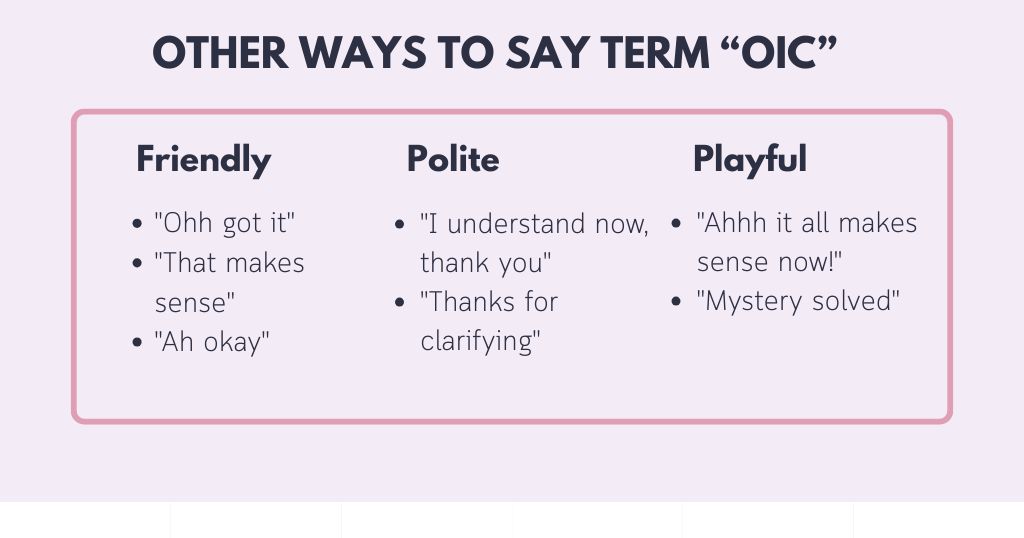
Casual with friends:
- “Ohh got it”
- “That makes sense”
- “Ah okay”
Polite or professional:
- “I understand now, thank you”
- “Thanks for clarifying”
- “That clears things up”
Playful or joking:
- “Ahhh it all makes sense now!”
- “Mystery solved”
- “Okay okay I’m following”
You don’t always need a replacement. Sometimes just reacting naturally works better than using any abbreviation.
What Real Conversations Look Like
Friend drama: “Wait, so she wasn’t ignoring you, her phone was broken?” “oic that explains everything”
Work confusion cleared up: “The report’s due Friday, not today” “Ohhh oic, I was panicking for nothing”
Group chat acknowledgment: “Pizza place changed to 7pm” “oic”
Sarcastic use: “I forgot to invite you, my bad” “oic. totally an accident.”
Gaming chat: “That boss has a second phase” “OIC now, that’s why I kept dying”
Dismissive ending: “You don’t get what I’m saying” “oic.”
Government news: “The OIC mayor will serve until elections”
Work email: “Jane Smith is OIC of operations during Tom’s leave”
Different Crowds Use It Differently
Younger people (teens and twenties) use “oic” way less than they used to. It feels kind of old-school now, like something from early texting days. You’re more likely to see “ohh” or “wait I get it” instead.
On Twitter/X and TikTok comments, people often skip it completely and just react with emojis or “WAIT” in all caps. You’re way more likely to see terms like “FR” or “AYO” in those spaces now—OIC feels like it belongs to an older internet era.
The term’s more common in gaming chats and Discord, where quick abbreviations still make sense because conversations move fast.
Older adults who text might not know “oic” at all, or they’ll read it wrong. One person’s mom thought it meant “Oh, I care” which… kind of sweet but totally off.
In the Philippines, everyone knows OIC in its Officer in Charge form because it’s constantly in the news. Political coverage uses it daily. In the US or UK, most regular people wouldn’t recognize that usage unless they work in government or military.
Mistakes People Make With “OIC”
“OIC always means the person agrees with you.” Nope. It just means they’re acknowledging what you said. They might understand your point and still disagree.
“It’s always rude or sarcastic.” Context decides this. With close friends who know your texting style, “oic” is just efficient. With someone you don’t text often, it can read cold. Just like “RT” or “YWW,” the same abbreviation can feel totally different depending on who’s saying it and when.
“Officer in Charge means you’re basically the boss now.” Not quite. An OIC usually can’t make big decisions or permanent changes. You’re a caretaker, not a decision-maker. This trips people up at work—they think being OIC comes with full power and sometimes extra pay. In most places, you get neither unless the assignment lasts a really long time.
“The Islamic OIC is the same as the texting OIC.” This one causes genuine confusion in international group chats. Someone might say “did you see what the OIC said?” and another person thinks they’re talking about workplace drama, not a statement from 57 countries.
“Using a period makes it more polite.” It’s actually the opposite in texting. “oic.” feels colder than “oic” without anything. The period makes it seem final and done.
Responding When Someone Hits You With “OIC”
If someone sends you “oic” casually: Just keep the conversation going if there’s more to say, or leave it if the topic’s done. You don’t need to respond to every acknowledgment.
If it feels sarcastic: You can call it out gently: “You sound annoyed?” or “Did that come out wrong or are you actually mad?” Don’t assume—ask.
If someone seems to misunderstand: Clarify quickly: “Just to make sure we’re on the same page…” and restate your main point.
In a work setting: If you’re the OIC, be clear about your limits: “I’m OIC this week, but I’ll need to check with [boss] before approving that.”
Questions Everyone Keeps Asking
Is “oic” rude?
It can be, depending on tone and relationship. With friends in fast chats, it’s fine. With acquaintances or in serious talks, it looks careless.
Can you use it in work emails?
Only if you mean Officer in Charge. Never use the slang version in professional writing.
Do people still say this?
Not as much as they used to. It’s becoming dated slang, though gamers and some online communities still use it.
What if someone uses it and I don’t understand which meaning they mean?
Look at context. If it’s all lowercase in a text about plans, it’s “oh I see.” If it’s capitalized in a formal message or news article, it’s probably Officer in Charge or the organization.
Is there a difference between “OIC” and “oic”?
In texting, not really—it’s just personal style. In formal contexts, capital letters usually mean the official term (Officer in Charge, Organisation of Islamic Cooperation).
Does OIC mean you’re agreeing or just listening?
Just listening. Understanding doesn’t equal agreement.
OIC is one of those terms that looks simple until you realize it does completely different jobs depending on where it lives. In your texts, it’s a quick “I get it now.” In government, it’s about who’s temporarily in charge. In world news, it’s a coalition of countries.
The trick is reading the room—or the chat. If you’re not sure whether your “oic” will land right, write out your thoughts instead. And if someone sends you a flat “oic.” that feels off, trust your gut. They might be saying more with those three letters than they’re typing.

I’m Hazel, and I studied BSC English at GCUF. I focus on explaining word meanings in simple, clear language that anyone can understand. My goal is helping readers grasp everyday English, confusing terms, and slang used in real conversations and social media. I believe language learning works best when definitions connect to actual life situations. Through careful research and straightforward explanations, I make vocabulary accessible for students, learners, and anyone curious about how English really works in daily use.