

OOP in texting is mostly a quick, playful reaction when something unexpected happens or when you slip up. It’s like saying “oops” but with more personality—a way to react to surprises, awkward moments, or tiny mistakes without being too serious about it.
Why does this three-letter word leave people puzzled?
You’re scrolling through your DMs and someone replies with just “oop.” No explanation. No context. Just… oop.
Is it a typo? Are they annoyed? Did you say something wrong?
Here’s the thing—this term pops up everywhere now. Your friend sends it after you accidentally like their ex’s photo. A classmate types it when someone shares drama in the group chat. Your crush uses it when you message the wrong person.
But nobody ever explains what it actually means or why they’re using it instead of, you know, actual words.
The real vibe behind OOP
Think of “oop” as a verbal speed bump. It’s that sharp little sound you make when reality hits differently than expected.
When you text “oop,” you’re not really apologizing. You’re acknowledging something just went sideways—maybe you said too much, maybe someone else did, or maybe the universe just threw you a curveball. It’s lighter than “sorry” and way more casual than “I apologize.” It’s similar to how people use other casual text reactions like ROFL or quick acknowledgments like OIC short, punchy, and gets the point across without a full sentence.
People choose this over full sentences because it does something clever: it names the awkwardness without making it heavier. Saying “I’m so embarrassed I sent that to the wrong chat” feels dramatic. Typing “oop” keeps things breezy.
Read Also: IHH Meaning in Text: What It Means in Chats, DMs, and TikTok
Where you’ll catch OOP in your daily chats
You’ll see “oop” show up when someone needs a quick reaction that doesn’t slow down the conversation.
In text messages, it works as damage control. You send a screenshot to your mom that was meant for your best friend? “Oop wrong person” fixes it fast. Your friend tells you they just ran into their ex at Starbucks? “Oop” is the perfect one-word response that says “I’m here for this story.”
Group chats are where it really thrives. Someone shares a hot take about another friend who’s actually in the chat? The replies flood in: “oop,” “oop—,” “OOOP.” Everyone’s reacting to the same messy moment without typing paragraphs.
On social media, it’s shorthand for “this is messy and I’m watching.” Someone posts a photo with their new partner right after a breakup? The comments fill with “oop” because it captures that collective gasp without actually starting drama. It works the same way GMS does on Snapchat platform-specific slang that feels natural in one place but weird in others.
Casual replies work too. Your roommate texts that they ate your leftover pizza? A simple “oop guess I’m ordering more” keeps it light instead of starting a fight.
Context is Everything: Here’s How OOP Changes Meaning
Here’s where things get tricky—”oop” changes completely based on who’s sending it and what just happened.
With close friends, it’s almost always playful. You can toss it back and forth like a verbal tennis ball. Your friend admits they forgot your birthday last week? You hit them with “oop” and they know you’re teasing, not actually mad.
But send that same “oop” to your boss when they point out a mistake in your report? Now it sounds dismissive. Like you don’t take the error seriously.
The relationship matters more than you’d think. Between people who text daily, “oop” builds on shared jokes and history. Between acquaintances, it can land weird—too familiar or even sarcastic when you meant it genuinely.
Warning About Misinterpretation
If someone’s genuinely upset or sharing something serious, replying with just “oop” can make you seem cold. Imagine your friend texts that they failed an important test and you respond with “oop.” They’re looking for support, not a reaction meme. You’ve just made things worse.
Timing changes everything too. Send “oop” right after someone shares good news and they might think you’re jealous or unimpressed. Drop it when a friend vents about a bad day and you look like you’re not listening.
Second Warning
Some people read “oop” as mocking, especially if they don’t use internet slang much. Your aunt might think you’re making fun of her when you’re just reacting naturally. Age gaps and different texting styles create these weird disconnects.
The safest version includes context: “oop my bad” or “oop didn’t see that coming” gives people something to work with instead of leaving them guessing.
Read Also: What Does ISG Mean in Text? (It’s Not What You Think)
Situations Where OOP Doesn’t Belong
Professional emails and work chats are automatic no-zones. Telling a client “oop sent the wrong file” makes you sound unprofessional. Stick with “I apologize for the confusion—here’s the correct attachment.”
Serious conversations need real words. If someone’s dealing with grief, health issues, or actual problems, “oop” trivializes what they’re going through. Your coworker tells you their dog died and you reply “oop that’s rough”? You’ve just failed basic human decency.
First impressions matter. Don’t use slang when you’re meeting someone’s parents, applying for jobs, or talking to teachers about grades. They’ll either not understand or think you’re not taking things seriously.
Public-facing messages are risky too. Company social media accounts, school announcements, customer service responses—these all need clear, respectful language. “Oop we made a mistake in your order” sounds careless when “We sincerely apologize for the error” shows you actually care.
When someone’s angry with you, “oop” can gasoline on a fire. It reads as flippant. They want accountability, not a casual reaction.
Better Words When OOP Feels Wrong
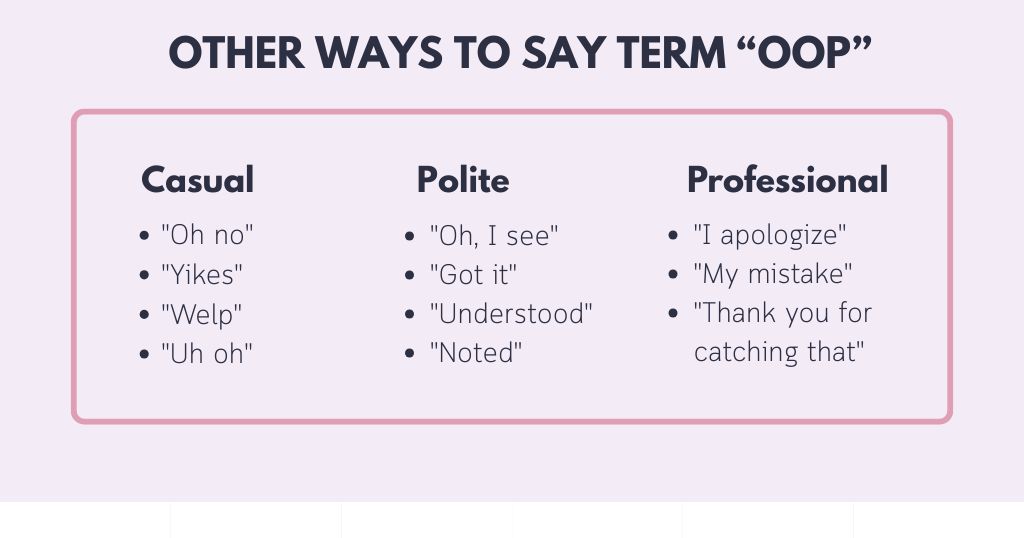
Casual with friends:
- “Oh no”
- “Yikes”
- “Welp”
- “Uh oh”
Polite or neutral:
- “Oh, I see”
- “Got it”
- “Understood”
- “Noted”
Professional settings:
- “I apologize”
- “My mistake”
- “Thank you for catching that”
- “I’ll correct that now”
Playful or joking:
- “Oopsie”
- “My bad”
- “Whoops”
- “Well that happened”
These alternatives work like other casual expressions such as TTG or playful responses like using GG they keep things light without risking confusion.
Actual Messages Examples Where OOP Makes Sense
Friend spills tea in group chat: “Did you hear Marcus and Jenna broke up again?” “oop not again”
Accidentally sending something personal: “oop that message wasn’t for you lol pretend you didn’t see it”
Reacting to someone’s bold comment: “I don’t think pineapple on pizza should be legal” “oop strong opinion there”
When you mess up something small: “oop just realized I’ve been calling you the wrong name for a week”
Responding to unexpected news: “My ex just followed me on Instagram” “oop— what are you gonna do?”
Catching yourself mid-mistake: “I was about to tell your secret but oop stopping myself”
Group chat awkwardness: Someone complains about Sarah while Sarah’s in the chat “oop 👀”
Light teasing between friends: “You really wore that shirt two days in a row huh” “oop leave me alone”
Read More: What Does WSP Mean in Text? Decoded The Real Answer
How Different Apps and Ages Treat OOP
Snapchat uses “oop” differently than regular texting. Since snaps disappear and they’re usually tied to photos or videos, people will caption an embarrassing selfie or a mess with just “oop” and the visual does the rest of the talking. The picture of your spilled coffee tells the story—the text just adds flavor.
Younger users (think middle school through college) throw it around constantly. They mix it with other slang like FR for emphasis or AYO to get attention it’s all part of the same casual texting language. It’s part of their regular vocabulary. But talk to someone over 40 and you might get “What’s oop?” back. That generational gap creates confusion when families text across age groups.
Roblox has a weird split. Kids playing games use it the slang way—“oop I fell off the map again.” But in developer spaces where people build games, OOP means Object-Oriented Programming. Same letters, completely different worlds. If you’re chatting about code, check the context first.
The term got huge around 2019 when memes spread it everywhere, but it’s cooled down a bit. It’s not trendy anymore—it’s just normal. That shift matters because now it’s less about being cool and more about genuine reactions.
Myths People Believe About OOP in Texting
Some people think “oop” only works for mistakes. Not true. It’s just as common for reacting to someone else’s mess or drama you’re witnessing. You didn’t do anything wrong—you’re just responding to chaos.
There’s also this weird idea floating around that guys and girls use it differently, or that it means something special coming from a crush — similar to myths about CS meaning something different from girls. Ignore that. It’s the same reaction regardless of who sends it. Sure, someone might use it while flirting, but the word itself isn’t flirty—the situation is.
People also confuse “oop” with “ope,” which is different. “Ope” is that Midwestern reflex when you bump into something (“ope, sorry!”). “Oop” is the internet version for digital moments. Similar sound, different origins and uses.
Another mixup: thinking you need to respond with something deep when someone sends “oop.” You don’t. Sometimes it’s just a reaction that doesn’t need a follow-up. They’re acknowledging the moment, not asking you to fix anything.
Read Also: What Does BOT Mean in Text? Nobody Explains Properly
Real Questions About Using OOP
Is it rude to use this?
Depends on the situation. With friends in casual chats? Totally fine. In serious conversations or with people you don’t know well? Skip it.
Can it sound sarcastic?
Absolutely. Tone doesn’t translate in text, so “oop” can read as mocking if the timing’s off or the relationship’s not there. When in doubt, add more words. The same goes for abbreviations like SFLR or DKM context is everything.
Does everyone know what this means?
No. Younger people and anyone active on social media will get it immediately. Parents, grandparents, or people who don’t text much might be confused. Read your audience.
Is “oop” the same as “oops”?
They’re cousins. “Oops” is the traditional version everyone knows. “Oop” is the casual internet offspring—shorter, sassier, and tied to meme culture.
What if someone just sends “oop” with no explanation?
They’re reacting to something you said or did, or they’re sharing your surprise about a situation. You can either let it sit or ask “wait what happened?” if you need clarity.
Does it work in professional messages?
Almost never. Save it for friends and casual settings. Work communication needs actual apologies and clear language.
“Oop” works because it’s quick and it captures a specific feeling that longer phrases can’t quite nail. That micro-moment of “oh wow, that just happened” gets compressed into three letters.
Use it when the vibe’s right—when you’re texting people who speak your language and the situation’s light enough to handle some casual slang. Skip it when things matter or when you’re talking to someone who might not get the reference.
If it feels natural in a casual conversation, it usually works. If you’re unsure whether it fits the situation, it’s safer to use clearer words instead.

I’m Hazel, and I studied BSC English at GCUF. I focus on explaining word meanings in simple, clear language that anyone can understand. My goal is helping readers grasp everyday English, confusing terms, and slang used in real conversations and social media. I believe language learning works best when definitions connect to actual life situations. Through careful research and straightforward explanations, I make vocabulary accessible for students, learners, and anyone curious about how English really works in daily use.