

“Wanker” is a British insult that literally means someone who masturbates, but people mostly use it to call someone a show-off, fake, or self-centered idiot who’s full of themselves.
Why You’re Probably Looking This Up
You probably saw it in a YouTube comment, heard it in a British show, or someone threw it at you online and you’re not sure if you should laugh or be mad. Maybe a friend used it and you couldn’t tell if they were joking. It’s confusing because it sounds almost funny when British people say it, but it’s actually pretty harsh. The word pops up everywhere—Twitter arguments, TikTok captions, gaming chats—and the vibe changes depending on who’s saying it and why.
The Real Deal: What It Actually Means
Here’s the thing: “wanker” isn’t just calling someone stupid. It’s got a specific sting to it. When you call someone a wanker, you’re saying they’re obsessed with themselves. They’re putting on a show, bragging, or acting like they’re better than everyone else. Think of that guy who won’t shut up about his gym routine or the person who posts 15 selfies with their new car. That’s wanker energy.
The word comes from “wank,” which is slang for masturbation. So when you call someone a wanker, you’re basically saying they’re only pleasing themselves—they don’t care about anyone else. It’s like calling them a performer with an audience of one: themselves.
In British, Australian, and Irish culture, it’s a go-to insult. But it’s not like calling someone an idiot or a loser. Those are general. “Wanker” is aimed at people who are fake, pretentious, or showy. There’s always this element of “you think you’re so great but you’re really not.”
Where You’ll Hear It (And How It Gets Used)
You’ll see “wanker” pop up in texts when someone’s annoyed. Like if your mate sends a screenshot of someone’s humble-brag post, they might just reply “what a wanker” and that says everything.
In group chats, it flies around more casually. Someone shares good news—maybe they got lucky with concert tickets—and a friend shoots back “lucky wanker” with a laugh. That’s not mean. That’s just how some friend groups talk.
On social media, it’s usually harsher. If someone’s being pretentious in the comments or acting holier-than-thou, “wanker” gets tossed out as a quick shutdown. It’s the internet’s way of saying “get over yourself.”
British sports fans use it constantly. There’s literally a chant where crowds pump their fists and yell it at opposing players or referees. It’s confrontational but also kind of traditional at this point.
In real-world arguments—road rage, pub disagreements—it can get you in serious trouble. Calling a stranger a wanker to their face in the UK can start a fight. People take it seriously.
Read More: AFAIK Meaning: What This Text Abbreviation Really Tells You
Tone Changes Everything—Here’s Why
This is where things get tricky. “Wanker” changes completely based on who’s saying it and how.
Between close friends: It can be affectionate. Seriously. If your best mate does something slightly embarrassing or gets weirdly lucky, calling them a wanker is almost a compliment. It means you’re comfortable enough to insult each other and it’s understood as banter.
From a stranger: This is hostile. No question. If someone you don’t know calls you a wanker, they’re genuinely insulting you. The word carries weight.
In a joking tone: If someone laughs while saying it or adds “you absolute wanker” with a smile, they’re probably messing around. The exaggeration makes it playful.
In a flat, serious tone: That’s when you know they mean it. No smile, no laugh, just “you’re a wanker”—that’s real anger.
Warning about misreading it: If you’re American or not used to British slang, you might think someone’s being way meaner than they are. Or the opposite—you might think it’s a joke when it’s not. Watch the person’s face and the situation. A lot of British humor involves insults that sound harsh but aren’t meant that way.
Another warning: Don’t use it on someone you just met or in a semi-professional setting thinking it’ll come across as cheeky. It won’t. It’ll just make things awkward or hostile.
Third warning: In text, you lose all the vocal tone. “You wanker” in a message to a friend might land wrong if they’re having a bad day. What you meant as light teasing can read as cruel.
Places This Word Will Get You in Trouble
Don’t use “wanker” at work. Just don’t. Even if your workplace is casual, even if everyone swears sometimes, this word crosses a line in professional settings. In the UK, using it in an email or meeting can get you written up or fired. It’s classified as seriously offensive language.
Don’t use it around people you’re trying to impress—dates, friend’s parents, teachers, anyone’s grandparents. It’s too vulgar.
Don’t use it when you’re already in a heated argument with someone you care about. It’ll make things worse fast. There are fights where throwing out “wanker” pushes things past the point of fixing.
Don’t use it in public spaces where kids are around. It’s not appropriate.
Don’t use it if you’re visiting the UK or Australia and you’re not comfortable with the culture yet. You might misjudge the situation and accidentally start a real problem.
And if someone’s genuinely upset or dealing with something serious, don’t use it at all—even jokingly. Read the room.
Say Something Else Instead “Wanker”
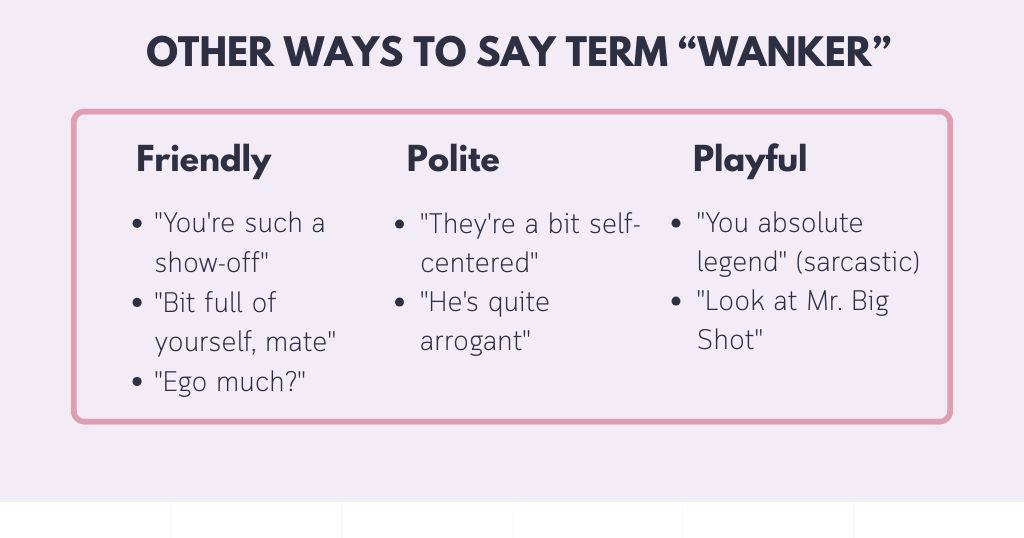
Casual / Friendly:
- “You’re such a show-off”
- “Bit full of yourself, mate”
- “Ego much?”
Polite / Professional:
- “They’re a bit self-centered”
- “He’s quite arrogant”
- “She’s really into herself”
Playful / Joking:
- “You absolute legend” (sarcastic)
- “Look at Mr. Big Shot”
- “Someone’s feeling themselves today”
Similar British slang:
- Tosser
- Prat
- Knobhead
- Bellend
You also like it: What Does Thicc Mean in Text? Real Meaning, Examples & When Not to Use It
Real-Life Examples
“Did you see Jake’s post about his promotion? Third one this week.” “Yeah, what a wanker.”
“Mate, you got front-row tickets?? You lucky wanker!”
“That driver just cut across three lanes without signaling.” “Absolute wanker.”
“This guy in the coffee shop just sent his drink back twice and talked down to the barista.” “Sounds like a proper wanker.”
“I can’t believe you beat me at FIFA again.” “That’s because you’re shit, wanker.” [said between close friends, laughing]
“Some wanker in the meeting kept interrupting everyone to talk about his weekend.”
A Quick Note on Culture and Platforms
In the US, people recognize “wanker” from British TV shows and movies, but they rarely use it. When Americans do say it, it often comes out sounding like they’re doing a bad British accent. It doesn’t have the same punch.
On TikTok and Instagram, the word sometimes gets flagged by content filters. People work around this by spelling it “w*nker” or “wanka,” or they’ll use the fist emoji ✊ repeatedly to reference the hand gesture without actually typing the word.
Younger people (teens and early 20s) might use it more lightly because they’ve picked it up from online content. Older British people understand it as genuinely offensive and wouldn’t toss it around casually.
In Australia and New Zealand, it’s used to take people down a peg—especially if someone’s acting like they’re too good. It’s tied into this cultural idea of not letting anyone get too big for their boots.
The hand gesture (making a fist and moving it up and down) exists too, and you can do it silently from across a room or through a car window. It means the same thing as saying the word.
Mistakes People Make With This Word “Wanker”
People think it’s always mean: It’s not. Context is everything. Between the right people, it’s almost a term of endearment.
People think it’s just British for “jerk”: Close, but not quite. A jerk is mean. A wanker is self-obsessed and showy. There’s a difference.
Americans think it’s cute: It’s not. If you use it in London thinking it’s quirky slang, you might get a very different reaction than you expected.
People think you can say it anywhere: You can’t. It’s still considered profanity. There are places and situations where it’s completely unacceptable.
People assume everyone will get the tone: They won’t. Especially in text. What sounds playful in your head might read as hostile to the person receiving it.
Read Also: Dope Meaning Explained: How to Use It Without Sounding Awkward
Questions People Actually Ask
Is “wanker” a really bad swear word?
In the UK, yes. It’s ranked as one of the more offensive terms. In other places, people don’t take it as seriously, but it’s still vulgar.
Can girls be called wankers?
Yeah, anyone can. It’s not gender-specific, though it gets used more often toward men.
Is it worse than calling someone an idiot?
Depends where you are. In Britain, it’s definitely stronger. It’s got that sexual reference underneath, which makes it more offensive than general insults.
Does it mean anything different in texts?
Not really. It means the same thing. But without tone, it’s easier to misread whether someone’s joking or genuinely mad.
Why do British people use it so much?
It’s just part of the culture. British humor leans on insults and sarcasm. What sounds harsh to outsiders is often just how people talk to each other.
What if someone calls me a wanker online?
Depends on the context. If it’s a stranger, they’re probably just being a dick. If it’s someone you know, think about your relationship and the situation. Don’t assume the worst, but don’t brush it off either.
Look, “wanker” is one of those words that means different things depending on where you are, who you’re with, and how you say it. It can be a serious insult or a joke between friends. It can start fights or get laughs. The key is knowing your audience and reading the situation. If you’re not sure whether to use it, you probably shouldn’t. But now at least you know what people mean when they throw it your way.

I’m Hazel, and I studied BSC English at GCUF. I focus on explaining word meanings in simple, clear language that anyone can understand. My goal is helping readers grasp everyday English, confusing terms, and slang used in real conversations and social media. I believe language learning works best when definitions connect to actual life situations. Through careful research and straightforward explanations, I make vocabulary accessible for students, learners, and anyone curious about how English really works in daily use.