

BYW is usually a typo for BTW (by the way). But it can also mean “be your way,” “bring your wallet,” or even the Welsh word “byw” meaning “alive.” Context decides everything.
Here’s Why You’re Scratching Your Head
You saw “BYW” in a text or comment and paused. Was it a typo? Slang you missed? Your friend typing too fast again?
Most online dictionaries won’t help because they mix up BYW with BTW, list weird acronyms nobody uses, or skip the real scenarios where you’d actually see this. You’re not looking for a formal definition—you want to know what your friend meant when they typed it at 2 AM.
The truth? BYW is messy. It’s one of those terms that changes based on who’s typing, how fast they’re going, and whether autocorrect decided to ruin their life.
It’s like YHU or ND—abbreviations that look wrong but might actually be intentional, depending on the situation.
The Actual Meaning (Spoiler: It’s Complicated)
Here’s the reality: nine times out of ten, BYW is just a mistake. Someone meant to type BTW but their thumb slipped. The ‘T’ and ‘Y’ keys sit close enough on most keyboards that fast texters constantly mix them up.
In the rare cases where it’s intentional, BYW can carry different meanings depending on the crowd:
Intentional uses do exist, but they’re far less common than accidental ones — most people you see typing “BYW” simply meant “BTW.”
In casual texting: It’s shorthand for “be your way”—like saying “do what you want” but shorter. Think of it as a quick, breezy sign-off when someone’s being indecisive.
In friend groups planning stuff: “Bring your wallet” is common slang, especially when someone’s organizing a night out and doesn’t want to front everyone’s money.
In Welsh contexts: If you’re seeing this from UK users or Welsh speakers, “byw” literally means “to live” or “alive.” It’s not slang—it’s an actual word. You’ll spot this on TikTok videos with Welsh captions or Instagram posts celebrating Celtic culture.
The feeling behind BYW (when intentional) is usually casual and dismissive in a friendly way. It’s not trying to be deep. It’s the kind of thing you type when you’re already halfway out the door.
Where You’ll Actually See This Pop Up
Fast replies: You’re texting back and forth quickly. Your friend says something and you want to add an afterthought. Your brain says “BTW” but your fingers type “BYW.” You hit send before noticing.
Group chats: Someone suggests plans. Another person replies “BYW I’m broke” (meant to be BTW) or “BYW bring cash” (intentionally using bring your wallet). The chat keeps moving too fast to correct it.
Social media comments: On Instagram or TikTok, you might see “BYW proud to be living my truth” from someone using the Welsh word, or “BYW that’s how I roll” as a twist on “be your way.”
Gaming circles: Old-school gaming forums sometimes used BYW for “backyard wrestling”—those homemade wrestling videos from the 2000s. It’s mostly dead slang now but pops up in nostalgic threads.
The pattern here? BYW appears in quick, informal spaces where people aren’t proofreading. Nobody’s using it in carefully crafted posts or professional emails.
Reading the Room: Why Context Changes Everything
This is where things get tricky. BYW’s meaning shifts wildly based on who’s saying it and how.
From a close friend: If your best friend texts “BYW do what you want,” they’re probably being supportive in a hands-off way. It’s not passive-aggressive—it’s giving you freedom.
From someone you barely know: That same phrase feels cold. Like they’re annoyed and don’t want to deal with your question.
In a flirty text: When someone says “BYW you looked good today” and you know they meant BTW, it’s probably just a typo. Don’t overthink it. If they follow up with “oops, meant BTW,” you have your answer.
Warning about tone loss: The biggest issue with BYW is that it’s so rare, people don’t have a shared understanding of how it should sound. If you use “be your way” sarcastically, the other person might think you’re being genuine. If you meant it genuinely, they might think you’re mad.
When autocorrect joins the chaos: Some phones autocorrect BYW to BTW automatically. Others don’t. This means your message might look different on their screen than yours, creating confusion neither of you asked for.
Real talk: if someone uses BYW and you’re not 100% sure what they mean, just ask. It’s not worth guessing wrong and creating drama.
Times to Absolutely Avoid Using BYW
Job interviews or work emails: Never. Just don’t. Even if your workplace is super casual, BYW looks like you can’t spell or don’t care enough to proofread. Use the full “by the way” or just BTW if that’s your workplace culture.
Texting your boss: Same deal. Even “bring your wallet” as a joke can sound presumptuous or rude when there’s a power dynamic.
First dates or early relationship texts: Too ambiguous. “BYW had fun tonight” could be a typo, slang, or autocorrect failure. Why risk looking careless when you’re trying to make a good impression?
Formal apologies: If you’re saying sorry for something serious, don’t add side comments with BYW/BTW. It cheapens the apology and makes you seem distracted.
Public-facing social media: Business accounts, professional profiles, or anywhere your grandma might read it. Stick to clear language.
Polite alternatives:
- “By the way” (full phrase)
- “Also” or “plus” (clean and simple)
- “One more thing” (clear intent)
- “Speaking of that” (smooth transition)
The rule: if you’re second-guessing whether BYW fits, it doesn’t. Go with something clearer.
Better Options That Won’t Confuse People
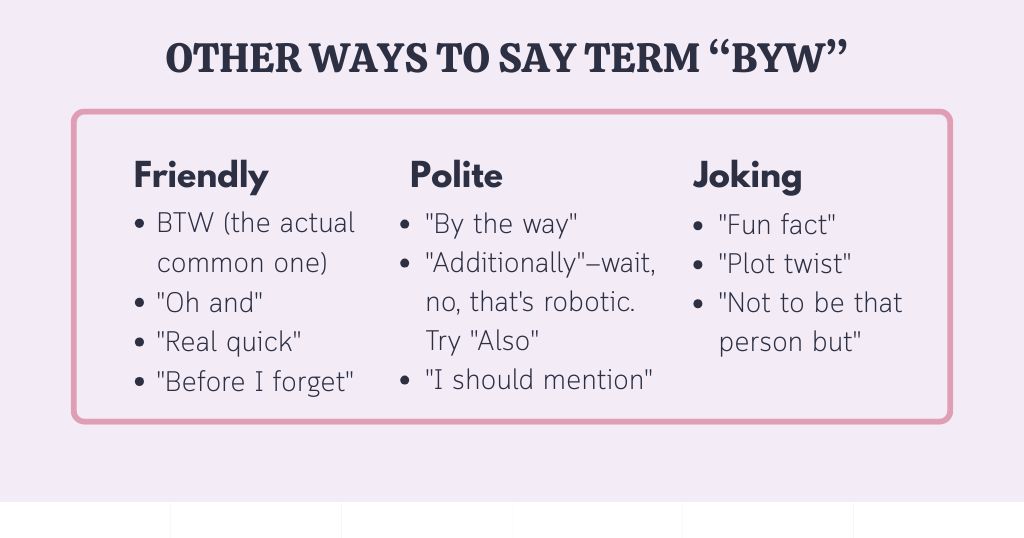
Casual/Friendly:
- BTW (the actual common one)
- “Oh and”
- “Real quick”
- “Before I forget”
Polite/Professional:
- “By the way”
- “Additionally”—wait, no, that’s robotic. Try “Also”
- “I should mention”
- “Quick note”
Playful/Joking:
- “Fun fact”
- “Plot twist”
- “Not to be that person but”
- Just saying the full thing in a goofy way
Pick based on who you’re talking to, not which sounds coolest. Your mom doesn’t need “BYW” in her life.
Example Messages You Might Actually See
Text between friends: “BYW can you grab milk?” (Probably meant BTW, they want you to remember milk)
Group chat planning: “Friday night bowling? BYW bring cash” (Intentional: bring your wallet, the arcade doesn’t take cards)
Instagram caption from Welsh user: “Byw fy mywyd gorau 🏴” (Using the Welsh word: living my best life)
Snapchat reply: “BYW I think that’s hilarious” (Typo for BTW, responding to a previous snap)
Gaming forum: “Remember BYW videos from 2005?” (Backyard wrestling nostalgia)
Text from a guy about plans: “Concert tickets are $80 BYW” (Either typo or casually saying bring your wallet)
Text from a girl ending a conversation: “Cool, talk later! BYW” (Probably meant “bye for now” but more likely autocorrect chaos)
Different Crowds Use It Differently
Instagram: You’ll see “byw” more often in Welsh-language posts or fitness communities using niche acronyms. Standard English BYW rarely trends here.
Snapchat: Mostly typos. Snapchat’s fast-reply culture means people hit send without rereading, so BYW/BTW mix-ups happen constantly.
TikTok: “Be your way” occasionally appears in self-empowerment videos or Burger King meme trends. Welsh creators use “byw” in captions regularly. TikTok slang moves fast—one day it’s BYW, the next it’s IHH or AYO taking over comment sections.
Age differences: People under 25 are more likely to recognize BYW as an intentional phrase (even if rare). Anyone older usually assumes it’s a typo and moves on.
Regional quirks: In some UK and Australian circles, “back your word” is low-key slang meaning “prove it.” But this is super niche and you won’t see it much online.
The platform doesn’t really change BYW’s meaning—it just changes how fast people type and whether they bother correcting mistakes.
Stuff People Get Wrong About BYW
Thinking it’s as common as BTW: It’s not even close. BTW has been around for decades and everyone knows it. BYW is niche at best, typo-prone at worst.
Assuming it’s always intentional: Most of the time, it’s literally just someone’s thumb hitting the wrong key. If you reply “What does BYW mean?” you’ll probably get back “Oh sorry, BTW*” within seconds.
Same thing happens with terms like SFLR or OY—people see an unfamiliar acronym and freeze, not sure if it’s a typo or actual slang they should know.
Confusing it with other acronyms: Some results online list BYW as “Baptist Young Women” or “Blakely Island Airport.” Those are real acronyms, but they’re not texting slang. If your friend texts BYW, they’re not suddenly talking about church groups or aviation codes.
Overanalyzing gender context: Searches like “BYW from a girl” or “BYW from a guy” mostly return confused forum posts. There’s no secret gendered meaning. If a girl or guy uses BYW, same rules apply—context and relationship matter more than gender.
Missing the Welsh connection: This is huge. So many people see “byw” on social media and think it’s a typo or new slang when it’s literally just Welsh. If someone’s profile has UK tags or Welsh flag emojis, that’s your clue.
Questions Everyone Actually Asks
Is BYW rude?
Not usually, but it can look careless. If someone thinks you’re too lazy to spell BTW correctly, that’s not great. In professional settings, skip it entirely.
Can BYW be sarcastic?
Sure, if you’re using “be your way” in a dismissive tone. But sarcasm rarely translates well in text, so you’re risking confusion.
Does it mean the same thing everywhere?
No. Welsh speakers use “byw” as a real word. English texters mostly use it as a typo. Gamers might remember “backyard wrestling.” There’s no universal agreement.
Should I correct someone if they type BYW?
Only if it genuinely confuses the conversation. If you understood what they meant, let it slide. Nobody likes the grammar police in casual texts.
The same rule applies to other confusing text slang like NN or WC—if the conversation still makes sense, let it go.
Is BYW getting more popular?
Not really. BTW remains king. BYW is more of a quirky footnote in texting history.
What if I genuinely want to use “be your way” as slang?
Go for it with close friends who’ll get your vibe. But be ready to explain it, because most people won’t immediately understand.
Bottom Line
BYW is one of those terms that exists in the weird space between typo, slang, and actual language. Most of the time, someone just meant BTW and their phone had other ideas. When it’s intentional, it’s usually casual shorthand among friends who already understand each other’s texting style.
The safest move? If you see BYW and you’re confused, assume it’s BTW until proven otherwise. If you’re tempted to use BYW yourself, ask whether BTW would be clearer. Your message matters more than being trendy with obscure acronyms.
And if you’re Welsh? Keep using “byw” proudly. The rest of us are just catching up.

I’m Hazel, and I studied BSC English at GCUF. I focus on explaining word meanings in simple, clear language that anyone can understand. My goal is helping readers grasp everyday English, confusing terms, and slang used in real conversations and social media. I believe language learning works best when definitions connect to actual life situations. Through careful research and straightforward explanations, I make vocabulary accessible for students, learners, and anyone curious about how English really works in daily use.