

IR usually means “In Real” — a shorter version of “In Real Life.” People use it to talk about meeting up offline or comparing online stuff to actual reality.
Why This Two-Letter Combo Confuses Everyone
You saw “IR” in a text or comment and couldn’t figure it out from context. Maybe someone said “let’s meet IR” or “you’re different IR” and you didn’t want to ask and look clueless. That’s totally normal. This abbreviation gets thrown around like everyone knows it, but it’s actually got a few different meanings depending on who’s texting.
The confusing part? IR can mean completely different things in a sports group chat versus a regular conversation with friends. And sometimes it’s not even an abbreviation — it might just be Spanish.
Breaking Down What “IR” Actually Signals
When someone types “IR,” they’re usually drawing a line between the digital world and physical reality. It’s that moment when online interactions need to become face-to-face meetups. Think of it as the opposite of “online only.”
People started using IR because typing “in real life” felt too long, and even “IRL” seemed like too much effort. It’s the texting equivalent of saying “for real” instead of “seriously, I’m not joking.”
The feeling behind it? Usually excitement about actually hanging out, or sometimes disappointment when someone’s online personality doesn’t match who they are offline. There’s also a hint of vulnerability — suggesting to meet IR means you’re ready to move past screens.
Where You’ll Actually See It Pop Up
You’ll spot IR mostly in:
Planning hangouts: “Wanna grab food IR this weekend?” It’s a way to signal you’re done with just chatting online.
Comparing appearances: “Your hair looks so much better IR” — this one can be a compliment or accidentally rude, depending on delivery.
Reality checks: When someone’s talking big online, a friend might say “but IR you wouldn’t actually do that” to call them out gently.
Status updates in group chats: “Mom IR” is code for “watch what you say, someone’s looking over my shoulder.”
Relationship talks: “Are we a thing IR or just online?” This comes up when people want to know if something’s actually real.
The pattern you’ll notice? IR almost always involves some kind of transition or comparison. It’s rarely just sitting there by itself.
Reading the Room: Why Context Changes Everything
Here’s where people mess up: IR can sound dismissive if you’re not careful.
When it’s friendly: “You’re even funnier IR!” — this works because it’s clearly a compliment about meeting someone.
When it gets weird: “You look okay IR” — wait, does this mean they looked better in photos? That’s awkward.
Warning about sarcasm: If someone says “wow, you’re really confident IR” after you’ve been quiet at a party, that’s probably not a compliment. The term can carry a “reality check” vibe that stings.
The relationship factor: Using IR with close friends feels natural. Using it with someone you barely know can seem pushy, like you’re assuming they want to meet up when they haven’t offered.
Big misinterpretation risk: In work settings, IR can confuse people who think you’re talking about a technical term (Incident Report, Industrial Relations). Save it for casual chats only.
Times to Skip “IR” Completely
Don’t use IR when:
Talking to your boss or coworkers — they’ll think you’re unprofessional or talking about something work-related. Say “in person” instead.
In formal emails or school assignments — it looks lazy. Write out “in real life” if you really need to say it.
With people over 40 — many won’t know what you mean. They might think it’s a typo for “I” or “it.”
On first dates or new relationships — using IR too soon can make it seem like you’re already bored with texting them.
Public social media posts — your aunt will comment asking what IR means, and then it gets messy.
When someone’s being vulnerable — if they’re sharing something serious, responding with “yeah IR” sounds cold and detached.
Professional networking messages — LinkedIn is not the place for this. Ever.
You also like this slang: What Does WSP Mean in Text? Decoded The Real Answer
Say It Better: Other Ways to Get Your Point Across
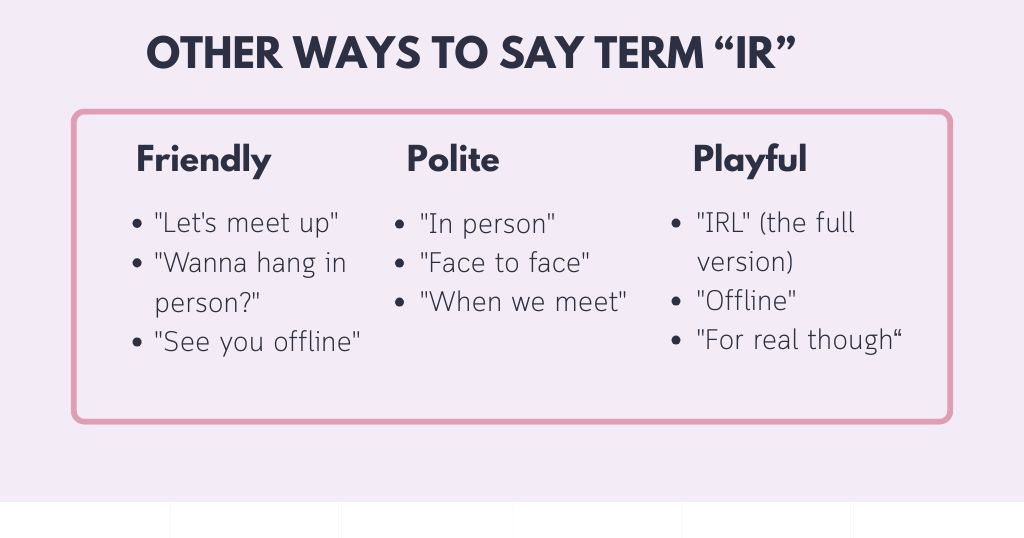
Casual hangouts:
- “Let’s meet up”
- “Wanna hang in person?”
- “See you offline”
If you want something even shorter, check out what NP means in text — it’s another quick reply that keeps things casual.
Polite or professional:
- “In person”
- “Face to face”
- “When we meet”
Playful with friends:
- “IRL” (the full version)
- “Offline”
- “For real though”
Pick based on who you’re texting, not what sounds coolest.
Examples of Actual Messages People Send
Before we jump into examples, remember that abbreviations like RT in text or BYW also shift meaning based on tone — same rules apply here.
Planning meetups:
- “That café looks good, wanna try it IR?”
- “We should definitely link IR soon”
Group chat warnings:
- “Dad IR, talk later”
- “Boss just walked in, IR”
Comparing online vs offline:
- “Your jokes hit different IR”
- “She’s actually shy IR”
Relationship clarity:
- “So are we exclusive IR or what?”
- “We vibe online but idk about IR”
Sports contexts:
- “He’s on IR again, our fantasy team is done” (Injured Reserve in football)
- “Three players on IR this week”
Mixed language situations:
- “Voy a ir al centro” (Spanish: “I’m going to go downtown” — not an abbreviation)
Different Circles Use It Differently
Instagram and Snapchat: IR shows up a lot when people want to move from DMs to actual hangouts. It’s become code for “I’m interested in knowing you beyond likes and comments.”
WhatsApp groups: Family chats use IR less, but friend groups throw it around constantly. It’s also where you’ll see the “someone’s IR” warning most often.
Gaming and Discord: Sometimes means “In Raid” or “In Room” depending on the game. Context matters a lot here. Speaking of confusing gaming slang, you might also see OT used in chat for completely different reasons depending on the server.
Age differences: Gen Z uses IR naturally. Millennials still prefer IRL. Anyone older probably won’t recognize it.
Regional stuff: In areas with lots of Spanish speakers, people sometimes type “ir” when they mean “to go,” not the abbreviation. You’ll know from context — if there’s a verb after it, it’s probably Spanish.
Post-2020 shift: After everything went online during lockdowns, IR started popping up more as people got excited about in-person stuff again. It became a way to celebrate actual meetups.
Mix-Ups That Happen All the Time
The biggest one: People assume IR always means something positive about meeting up. But it can also be used to point out that someone’s different (and not in a good way) when you meet them.
The bilingual confusion: In multicultural friend groups, “ir” gets used both ways in the same conversation. Someone might say “ir al parque” (going to the park) and another person responds “yeah IR works” (meeting in real life). It’s a mess sometimes.
The tone problem: Text doesn’t carry voice inflection. “You’re quiet IR” could mean “you’re more chill in person” or “wow, you talk big online but you’re actually timid.” The reader picks the meaning, not you. This same issue happens with tons of abbreviations — like when people misread what SUS actually means and think someone’s being serious when they’re joking.
Work context disaster: Someone texts “send me the IR” meaning “Incident Report” and their coworker thinks they want to hang out in real life. This happens more than you’d think in remote work situations.
Overuse kills meaning: If you say IR in every single message, it stops meaning anything. It becomes verbal filler.
The medical mixup: In healthcare discussions, IR means Interventional Radiology. If you’re in a medical chat and someone says “IR appointment,” they’re not meeting up — they’re getting a procedure.
Questions People Actually Ask About “IR”
Is IR rude to use?
Not usually, but it depends on your relationship with the person. With friends, it’s totally normal. With acquaintances or professional contacts, it can seem too casual or presumptuous.
Can IR be sarcastic?
Yes, definitely. “Oh you’re real brave IR” is almost always sarcastic. The term works really well for pointing out when someone’s online personality doesn’t match reality.
Does IR mean the same thing everywhere?
Not really. In Spanish-speaking areas, “ir” is a verb. In gaming communities, it might mean “In Raid.” In sports chats, it’s “Injured Reserve.” You need context to know for sure.
Is IR just a Gen Z thing?
Pretty much. Older people either won’t know it or will think you made a typo. Stick with “in person” or “IRL” if you’re not sure about your audience.
What’s the difference between IR and IRL?
IR is just shorter and feels more casual. IRL has been around longer and more people recognize it. They mean the same thing, but IR is the lazier version.
Can you use IR in work messages?
Please don’t. It looks unprofessional, and people in corporate settings use IR for technical terms. You’ll just create confusion.
Why do people type “IR” instead of just saying “in person”?
Because texting rewards short stuff. Every character you save feels like efficiency. Plus, using abbreviated slang makes you feel part of a group that gets it.
Final Thoughts on This Tiny Abbreviation
IR is one of those terms that feels simple until you actually try to use it. It’s not just about meeting offline — it’s about signaling that you’re ready to make online interactions real, or pointing out differences between someone’s digital presence and who they actually are.
The key thing? Know your audience. Your best friend will get it. Your professor won’t. And always watch your tone, because this little abbreviation carries more weight than its two letters suggest. When in doubt, just type out what you mean. Nobody ever got confused by “let’s meet in person.”

I’m Hazel, and I studied BSC English at GCUF. I focus on explaining word meanings in simple, clear language that anyone can understand. My goal is helping readers grasp everyday English, confusing terms, and slang used in real conversations and social media. I believe language learning works best when definitions connect to actual life situations. Through careful research and straightforward explanations, I make vocabulary accessible for students, learners, and anyone curious about how English really works in daily use.