

NSFW means “Not Safe For Work.” It’s a heads-up that whatever you’re about to see—a link, pic, or video—contains something you probably shouldn’t open around your boss, family, or in public.
You’ve Seen It Pop Up: Here’s Why It’s Confusing
You’re scrolling through your messages, and someone drops “NSFW” before a link. You pause. Are they talking about something sexual? Violent? Just sweary?
The confusion makes sense. Unlike terms that mean one specific thing, NSFW covers a whole range of “don’t open this in front of people” content. It’s vague on purpose—because what gets you in trouble at a corporate office isn’t the same as what’d raise eyebrows at art school.
People also wonder if it’s always dirty. Spoiler: it’s not. Sometimes it’s just loud, gross, or politically charged enough that you’d rather not explain it to whoever’s sitting next to you.
The Real Story Behind Those Four Letters
When someone tags something NSFW, they’re doing you a favor.
The term carries an unspoken agreement: I’m sending you something that could embarrass you, get you talked to by HR, or make strangers on the bus judge you. It’s less about the content being “bad” and more about it being the wrong fit for certain eyes.
Here’s the thing most definitions skip—NSFW isn’t just about nudity. A video of someone screaming political opinions at a city council meeting? That’s NSFW too, even with everyone fully clothed. Your manager walking by while that’s playing at full volume? Awkward conversation incoming.
The real meaning is about social risk, not morality.
Where You’ll Actually Spot NSFW in Your Messages
People drop NSFW in two main ways:
As a warning before sending: “Hey, NSFW but this meme is wild” or “NSFW link, don’t click at work.” It’s like putting up caution tape before you hand someone something risky.
In profiles or bios: On dating apps, you’ll see “No NSFW pics” meaning don’t send explicit photos. On Reddit, entire groups get labeled NSFW, so you know what you’re walking into before you click.
In group chats, someone might share a funny video and add “slightly NSFW” to acknowledge it’s borderline—maybe there’s cursing or a suggestive joke, but it’s not hardcore anything.
The pattern is always the same: it’s advance notice. Nobody wants to accidentally blast inappropriate content in front of their mom or during a Zoom call.
Read Also: What Does WC Meaning in Text? The Real Answer
Why Who’s Saying It Matters More Than You Think
Here’s where people mess up. NSFW itself is neutral—it’s just information. But how you use it changes the whole vibe.
Between friends: “Dude, NSFW but you gotta see this” sounds playful. You’re sharing something funny or shocking as entertainment.
From a stranger: Getting an unprompted “NSFW?” from someone you barely know on a dating app? That reads creepy. It’s essentially asking permission to cross boundaries you haven’t agreed to.
At work: If a coworker emails you a link marked NSFW, that’s a red flag. Work communication shouldn’t need that warning. Period.
The context around who’s saying it matters just as much as what they’re warning you about. Your best friend sending NSFW content you didn’t ask for might be annoying but harmless. If it keeps happening, a quick “NP but keep it SFW” sets the boundary without drama. A random internet person doing the same thing? That’s harassment territory.
Misinterpretation warning: Some people use NSFW jokingly on totally clean content—like tagging a picture of an ugly couch as “NSFW for interior designers.” If you’re expecting something shocking and it’s just a dumb joke, you’ll feel baited. Don’t be that person who cries wolf.
Places This Label Has No Business Showing Up
Skip NSFW in these situations:
Any professional email or Slack message. If you’re even thinking about typing it at work, you probably shouldn’t be sharing that content at all. There’s no world where “NSFW attached” in a work email is appropriate.
With family members. Your aunt doesn’t need to see “NSFW” pop up from you. Just don’t send questionable stuff to relatives. Save everyone the discomfort.
First conversations on dating apps. Leading with NSFW content or questions makes you look like you’re only after one thing. Even if someone’s profile says they’re open to casual chat, don’t open with that energy.
Public social media posts from your real account. Tagging your Instagram post NSFW when your employer follows you is basically asking for problems. Keep that stuff on anonymous accounts or private messages.
When you’re unsure if the other person wants it. No warning label fixes unwanted content. If you haven’t established that kind of relationship where risqué stuff is welcome, don’t send it—NSFW label or not.
The term isn’t a free pass. It’s a courtesy for content someone’s already open to receiving, just not in certain settings.
Read More: What Does BFF Mean? The Real Story Behind This Slang
Better Ways to Warn Someone
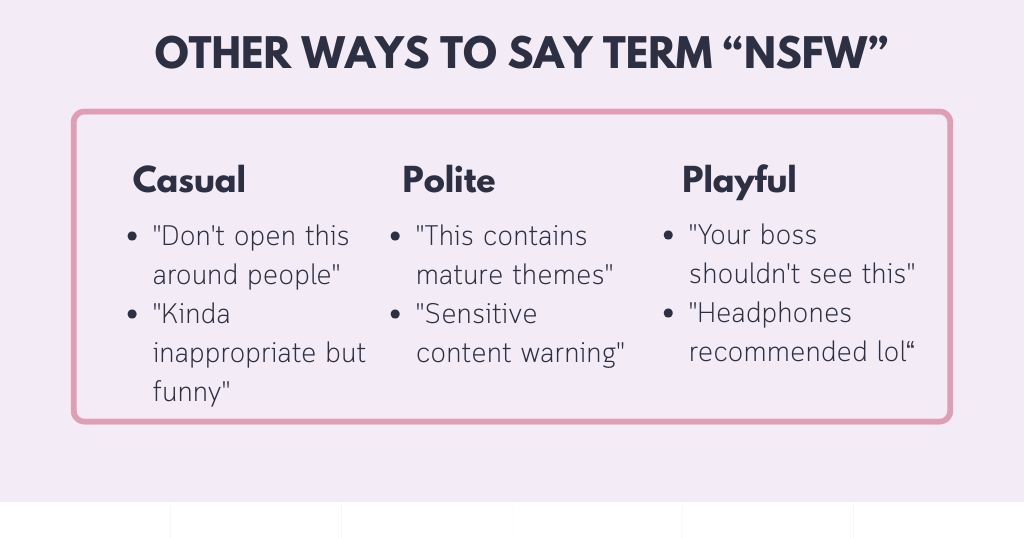
Depending on your situation, try these:
Casual/Friendly
- “Don’t open this around people”
- “Kinda inappropriate but funny”
- “Wait till you’re home to watch this”
Or keep it simple with SFLR (sorry for late reply) if you’re acknowledging you can’t respond to risky content right away.
Polite/Professional
- “This contains mature themes”
- “Sensitive content warning”
- “Viewer discretion advised” (if you absolutely must share something borderline in a semi-professional space)
Playful/Joking
- “Your boss shouldn’t see this”
- “Headphones recommended lol”
- “Not for sensitive viewers”
Direct/Blunt
- “This is explicit”
- “Nudity warning”
- “Gore ahead”
Being specific actually helps more than NSFW sometimes. “There’s blood in this video” tells someone exactly what to expect. “NSFW” leaves them guessing if it’s violence, sex, or just someone dropping F-bombs.
How NSFW Actually Looks in Real Texts
Friend sharing a funny video: “NSFW but this guy absolutely loses it at the DMV 😂”
Someone protecting you from embarrassment: “Heads up, NSFW link. Maybe don’t click in the office”
Dating app boundary: Bio: “Looking for genuine connection, no NSFW convos please”
Reddit post title: “[NSFW] My tattoo artist messed up badly”
Group chat warning: “Sending something NSFW, scroll past if you’re with family”
TikTok caption: “NSFW language warning ⚠️ rant incoming”
Declining unwanted content: “I keep my chats SFW, thanks though”
Friend joking around: “Is eating pizza in bed NSFW? Because I’m about to commit crimes”
When someone’s being dramatic or over the top (OTT) about mild stuff, the NSFW label becomes part of the joke itself. Notice how the examples that work best give you context? The ones that just say “NSFW” and nothing else leave you playing a guessing game.
Read Also: GMS Meaning: What It Really Means in Texts, Snapchat, and Real Life
Each App Treats NSFW Differently: Here’s How
NSFW lives everywhere online, but people use it differently depending on where they are.
Reddit takes it seriously. Whole communities get age-gated with NSFW tags. You’ll see blurred thumbnails until you confirm you want to see the content. It’s built into how the site works.
Twitter/X lets users mark their tweets as sensitive. The label isn’t always “NSFW” but it serves the same purpose—warning people before they see something potentially offensive.
Instagram and TikTok don’t officially use NSFW, but creators put it in captions anyway. It’s partly to warn viewers and partly to game the algorithm by making content seem edgier than it is. Some people tag totally normal videos as NSFW just to get more clicks.
Discord and gaming chats have dedicated NSFW channels. You opt into those spaces knowing what you’ll find there. It’s zoned off like the adults-only section of a video store used to be.
Dating apps are wild with it. On Grindr specifically, NSFW often means someone’s profile pic is explicit or they’re looking for immediate hookups. That’s also why you’ll see “Kik” referenced in some bios—people use it as a code for moving conversations off the main app to share NSFW content privately. Other apps like Bumble or Hinge see it more in bios as a boundary statement.
Age matters too. Younger people (teens to early twenties) sometimes throw NSFW around loosely, using it for stuff that’s just mildly edgy. Older internet users tend to reserve it for genuinely inappropriate content. This gap causes confusion when different generations are in the same chat.
Mistakes Everyone Makes About This Warning
Thinking it only means sexual content: Nope. A video of a nasty injury, a screaming match, or even someone vomiting can all be NSFW. It’s about what you can’t safely view in public, whatever the reason.
Assuming it’s always literal: Not everyone who uses NSFW works in an office. The “work” part has expanded to mean any situation where you need to be mindful of who’s around—school, home with parents, public transit, waiting rooms.
Using it as clickbait: Content creators learned that slapping NSFW on something gets more attention. It’s similar to how people misuse other slang—like calling everything “sus” until the word loses its punch. You’ll click a video tagged NSFW expecting something wild and find out it’s just someone taste-testing hot sauce. People start ignoring the warning when it’s overused this way.
Believing it makes everything okay: Just because you label something NSFW doesn’t mean you should send it. Consent matters. Some people don’t want to receive certain types of content ever, warning or not.
Missing the “soft NSFW” category: Sometimes content isn’t explicit but still isn’t work-appropriate. A heated political debate video, true crime details, or medical discussions about bodily functions all live in this gray zone. They won’t get you fired, but they’d be weird to have playing during a meeting.
Read Also: BGC Meaning: What It Really Means in Texts, Dating & Real Life (2026)
Stuff People Keep Asking About NSFW Meaning in Text
Does NSFW always mean something sexual?
No. It covers anything that’d be awkward or risky to view publicly. Violence, gross-out content, heavy profanity, and controversial topics all count.
Can I use NSFW sarcastically?
Yeah, people do. Tagging a picture of pineapple pizza as “NSFW for Italians” is a joke. But if you overuse it ironically, people stop taking your real warnings seriously.
Is sending NSFW stuff without asking rude?
Absolutely. Even with a warning label, you should know your audience. Don’t assume everyone wants to see shocking content just because you flagged it first.
Does it mean the same thing on every app?
Mostly, but the intensity varies. NSFW on LinkedIn would be career suicide. NSFW on Reddit might just mean a sweary joke. Context is everything.
What if someone keeps sending me NSFW content I don’t want?
Tell them directly: “Keep the chat SFW for me.” If they don’t respect that, you’re dealing with a boundary issue, not a communication problem.
Is there an opposite of NSFW?
SFW—Safe For Work. People use it when content looks like it might be risky but isn’t, or to clarify that a link is totally clean. Other slang gets flipped around too—“FR” (for real) works the same way as a confirmation tag in chats.
Here’s What You Need to Remember
NSFW is internet courtesy in four letters. It’s not permission to share anything you want, and it’s not a joke to throw around carelessly.
The best way to think about it: if you wouldn’t want your screen visible to someone looking over your shoulder, that’s what NSFW is for. Use it honestly, respect when others use it, and you’ll navigate the internet’s messier corners without accidentally embarrassing yourself or making someone uncomfortable.

I’m Hazel, and I studied BSC English at GCUF. I focus on explaining word meanings in simple, clear language that anyone can understand. My goal is helping readers grasp everyday English, confusing terms, and slang used in real conversations and social media. I believe language learning works best when definitions connect to actual life situations. Through careful research and straightforward explanations, I make vocabulary accessible for students, learners, and anyone curious about how English really works in daily use.