

PM usually means “Private Message” when you see it in texts or social media. It’s asking you to send a direct, one-on-one message instead of replying publicly.
Quick Meaning of “PM”
| Term | Meaning |
| PM | Private Message |
| PM (time) | Post Meridiem (the time between noon and midnight) |
| PMO | Pisses Me Off / Put Me On (slang depending on context) |
You’re Not the Only One Confused by “PM”
You’re scrolling through Instagram comments and someone writes “PM me.” Or maybe a girl replies to your story with just “pm?” and you’re not sure if she wants to chat or if you missed something.
The thing is, PM shows up everywhere—Facebook comments, WhatsApp groups, Snapchat replies—and it doesn’t always mean the exact same thing. Sometimes it’s just business (“PM for pricing”). Sometimes it feels more personal. And if you’re checking your calendar and see “meeting at 3 PM,” well, that’s a totally different PM.
People get thrown off because the same two letters can mean a private chat request, a time of day, or even slang that’s specific to certain apps. You’re not overthinking it. The context really does matter. It’s the same confusion people feel when they see OTG or other acronyms that shift meanings depending on the app.
The Real Feeling Behind Those Two Letters
When someone types “PM me,” they’re drawing a line between public and private. Think of it like pulling someone aside at a party instead of announcing something to the whole room.
People use PM when they want to share something that doesn’t belong in the comments—a phone number, an address, gossip, pricing details, or anything that feels too personal for everyone to see. It’s protective. It keeps certain info between just two people.
There’s also a filtering aspect. If someone posts “DM me if you’re serious about buying this” on Marketplace, they’re weeding out time-wasters. Only people who actually care will take the extra step to message privately.
In friend groups, PM can signal support. “Saw your post, PM me if you need to talk” means “I’m here, but I won’t put you on the spot publicly.” It’s a way of being available without forcing someone to air their business.
Read Also: What Does RT Mean in Text? The Real Answer
Where You’ll Actually See People Type This “PM”
You’ll see PM pop up in a few common patterns:
Moving a conversation off a public thread. Someone asks a question in a Facebook group. Instead of answering in the comments where 500 people can see, you reply: “I can help with that, PM me.” Keeps things tidy.
Selling stuff online. Instagram, WhatsApp groups, Facebook Marketplace—sellers constantly write “PM for price” or “interested? PM me.” They want serious buyers, not public negotiations.
Asking for sensitive info. “Can you PM me your address?” makes way more sense than posting it where strangers can screenshot it.
On Snapchat stories. You post something vague or inside-joke-ish. A friend replies “wait what happened?? pm me.” They want the full story without asking publicly.
Setting boundaries. If someone’s being weird or pushy in group chat, you might say “let’s take this to PM” as a polite way to shut down the public back-and-forth.
In short, saying “PM me” simply moves the conversation from public comments to a private chat where only the two of you can see it.
Reading the Room: Same Letters, Different Vibes
Here’s where people mess up: they assume PM is always neutral. It’s not.
From a friend: “PM me later, I have tea ☕” sounds fun and casual. They’ve got gossip.
From a stranger on your post: “You’re beautiful, PM me” can feel creepy or pushy, especially if you didn’t invite DMs.
In a work group: “Let’s PM about this” usually means “this is getting too detailed for the whole team” or “I don’t want to argue in front of the boss.”
From a girl you’re talking to: If she comments “PM me” with a specific emoji (winking face, fire emoji), it might signal interest. But “pm me” with zero context could just mean “stop blowing up the group chat.”
Tone gets lost fast. If someone seems annoyed and says “just PM me about it,” they’re probably irritated that you’re oversharing publicly. If they’re excited—”omg PM me right now!!”—they can’t wait to hear from you.
Warning: Asking someone to PM you can come off flirty even when you don’t mean it that way. If you’re not close with the person, they might read into it. Be aware of how it lands.
Times When USe “PM” Is the Wrong Move
At work, with higher-ups. Telling your boss “PM me” sounds too casual, almost like you’re ordering them around. Say “feel free to message me directly” or “let’s chat offline.”
In formal emails. If you’re writing to a professor, a client, or anyone in a professional setting, don’t use texting slang. Write out “please send me a direct message” or “we can discuss this privately.”
When someone’s upset. If a friend just vented publicly and you comment “PM me,” it can feel dismissive, like you’re shushing them. Better to text them privately first or say something supportive publicly before offering to chat one-on-one.
On platforms where everyone’s older. Some Facebook groups skew 40+, and people there might not use PM the same way. Saying “message me directly” might be clearer.
If you barely know the person. Sliding into someone’s messages with “hey you said to PM” when they didn’t actually invite you specifically? That’s awkward. Make sure the invitation was real.
Read More: What Does CS Mean in Text? From Girls, Instagram & TikTok Explained
Say It Another Way (Depends Who You’re Talking To)
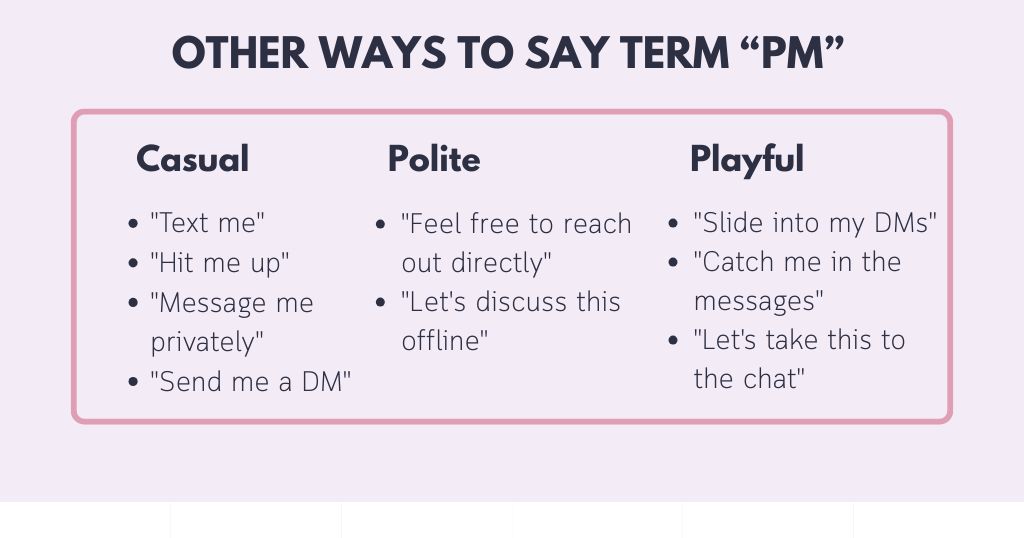
Casual / Friendly
- “Text me”
- “Hit me up”
- “Message me privately”
- “Send me a DM”
And if someone replies with something like ‘TFTI’ when you forget to invite them to the group chat, without making it awkward.
Polite / Professional
- “Feel free to reach out directly”
- “Let’s discuss this offline”
- “You can contact me separately”
- “Message me if you’d like to talk more”
Playful / Joking
- “Slide into my DMs”
- “Catch me in the messages”
- “Let’s take this to the chat”
Pick what fits your vibe. If “PM me” feels stiff, switch it up.
Actual Messages Examples People Send
Marketplace seller: “Leather jacket, size M. PM for pricing and meetup location.”
Friend helping out: “I know someone who does tattoos. PM me and I’ll send you their info.”
Shutting down drama: “This isn’t the place for this. PM me if you actually want to talk.”
Inviting deeper chat: “That’s such a good question. PM me, I don’t want to write a novel here lol.”
Being supportive: “Are you okay? You don’t have to answer here but PM me anytime.”
Snapchat curiosity: “Wait who were you talking about in your story??? pm me nowww.”
Group chat overshare: “Guys can someone PM me the notes? I’m lost.”
Flirty but casual: “You seem cool. PM me if you wanna chat sometime 😊”
Does Your App or Age Change What “PM” Means?
WhatsApp is already private by default, so saying “PM me” there usually means “text my number directly” if you’re currently in a group chat. It’s less common unless you’re asking someone to switch from the group to a personal thread.
Facebook is PM’s natural habitat. Older crowds (30+) and people who grew up on forums still say PM more than DM. It’s polite, clear, and expected.
Instagram and TikTok users lean toward “DM me” instead. If you’re under 25 and you say “PM me” on Insta, it can sound a little outdated—not wrong, just not the usual lingo.
Snapchat is tricky because people rarely say “PM” there. They just… send a chat. If someone does say it, they’re probably asking you to reply to their story privately instead of publicly.
Regional thing: In some countries (like Pakistan or India), people mix English and local languages on WhatsApp. “PM me” might get swapped with “inbox karo” (Urdu for “message me”), but PM still gets the point across.
One shift worth noting: “DM” is taking over. Five years ago, PM and DM were pretty interchangeable. Now, younger people default to DM almost exclusively. PM feels slightly more formal or “internet old-school.”
Read More: What Does IR Mean in Text? Here’s What People Actually Use It For
PM vs DM: What’s the Difference?
Both PM (Private Message) and DM (Direct Message) mean sending a private one-on-one message online instead of posting publicly.
The difference is mostly about platform culture and internet generations.
| Term | Where It’s Common |
| PM | Facebook, forums, older internet communities |
| DM | Instagram, TikTok, X (Twitter), newer social platforms |
Younger users usually say “DM me,” especially on Instagram or TikTok.
People who grew up using forums or Facebook are more likely to say “PM me.”
In most situations, though, they mean exactly the same thing.
Ways People Get “PM” Totally Wrong
Mixing up PM (message) and PM (time). If someone texts “meet at 5 PM” and you reply “ok I’ll PM you,” you’re talking about two different things. Read the context.
Thinking PM always means something romantic. It doesn’t. People ask for PMs for a million boring reasons—selling stuff, coordinating plans, asking homework questions. Don’t assume interest unless there are other signals. Same goes for terms like BSFS or BFF—they sound relationship-heavy, but they’re often just casual friendship labels.
Ignoring the public-to-private shift. When someone says “PM me” in response to your public post, they’re not trying to be secretive. They’re just keeping personal details out of the comment section. It’s normal.
Overusing it. If you comment “PM me” on every single post, people will think you’re sketchy or trying to sell something. Use it when privacy actually makes sense.
Assuming everyone knows what it means. Older folks or people new to social media might not recognize PM as slang. If your grandma sees “PM me,” she might think you’re talking about the afternoon.
The Other PM: Time on the Clock
Yeah, PM also stands for “Post Meridiem,” which is Latin for “after midday.” It covers noon to just before midnight on a 12-hour clock.
AM is the opposite—”Ante Meridiem” means “before midday.” So midnight to just before noon.
The most confusing part? 12 PM is noon, not midnight. 12 AM is midnight. People get this wrong constantly. If someone says “let’s meet at 12 PM,” they mean lunchtime.
This version of PM has nothing to do with texting. But it’s worth knowing because you’ll see it in scheduling, appointments, and calendar invites.
What About PMO? Popping Up Too
People searching for “PM meaning” sometimes also come across “PMO,” but it means something completely different.
“Pisses Me Off” — the most common texting meaning. “This traffic is really PMO right now 😤.” It’s frustration.
“Put Me On” — slang for “introduce me” or “recommend me something.” Huge on TikTok and Snapchat. “That song is fire, PMO to more like it.”
“Project Management Office” — corporate talk. If you’re in a business chat, PMO might refer to the team that oversees projects, not someone being annoyed.
Context clues help. Emojis, tone, and the platform usually make it obvious which PMO someone means.
Read Also: What Does WC Meaning in Text? The Real Answer
Questions People Actually Ask About Mean of PM
Is it rude to ask someone to PM you?
Not usually, but tone matters. If you’re being bossy about it (“just PM me, don’t reply here”), it can sound snippy. Phrasing it as an offer (“feel free to PM me”) is friendlier.
Can PM sound flirty even if I don’t mean it that way?
Yep. Asking someone to message you privately can feel like you’re singling them out, especially if you don’t know them well. If that’s not your vibe, add context: ‘PM me if you have questions about the assignment.’ Tone confusion happens with lots of texting slang—like when people aren’t sure if IMHO sounds rude or polite.
Does PM mean the same thing on every app?
The idea is the same—private messaging—but the culture around it shifts. Instagram users say DM. Facebook users say PM. WhatsApp users might just say “text me.”
What if someone says PM but I’m not comfortable messaging them?
You don’t have to. Just because someone asks doesn’t mean you owe them a private conversation. You can ignore it or reply publicly if you prefer.
Is PM outdated slang?
It’s not dead, but it’s fading with younger crowds who prefer DM. If you’re in your 30s or use Facebook a lot, PM still feels natural. Teens might side-eye it a little.
What’s the difference between PM and DM?
Basically none. PM is the older, more generic term. DM became popular because Instagram and Twitter branded their private chats as “Direct Messages.” Now people use them interchangeably, though DM is more common on newer platforms.
Bottom Line
PM isn’t complicated once you know what you’re looking at. Most of the time, it’s a simple request: talk to me privately instead of publicly. The rest is just reading the room—figuring out if someone’s being friendly, professional, flirty, or just trying to sell you something.
If you’re ever unsure, check the platform, the emojis, and who’s saying it. That’ll tell you what kind of PM you’re dealing with. And if it feels off, you’re allowed to skip it. Not every “PM me” deserves a reply.

I’m Hazel, and I studied BSC English at GCUF. I focus on explaining word meanings in simple, clear language that anyone can understand. My goal is helping readers grasp everyday English, confusing terms, and slang used in real conversations and social media. I believe language learning works best when definitions connect to actual life situations. Through careful research and straightforward explanations, I make vocabulary accessible for students, learners, and anyone curious about how English really works in daily use.