

ROFL means “Rolling On the Floor Laughing.” It’s internet slang people use when something is really funny—funnier than just typing “haha” or “LOL.”
You Saw It and Now You’re Googling It
You saw someone type ROFL in a comment or text, and you’re not sure if they’re being serious, joking around, or maybe even making fun of something. That’s normal. Texting slang can feel like a secret code, especially when people throw around letters instead of actual words. You might be wondering if it means different things from different people, or if you’re supposed to laugh back, or just… what exactly you’re supposed to do with this information.
The tricky part? ROFL doesn’t always mean someone’s actually laughing that hard. Sometimes it does. Sometimes it’s just a way to say “yeah, that’s pretty funny” without typing out a whole sentence.
Breaking Down What’s Really Happening When Someone Types ROFL
When someone sends you ROFL, they’re telling you they found something genuinely hilarious—at least, more hilarious than your average meme or joke. It’s the text version of that moment when you laugh so hard you double over or slap your knee.
But here’s the thing: nobody’s actually rolling on the floor. That’s not how this works.
ROFL is more about the energy of the reaction than the physical action. It’s like saying “I’m dying” when you’re clearly not dying, or “I’m dead” when a joke hits perfectly. You’re exaggerating to show the other person their joke landed really well.
People pick ROFL over just typing “haha” because it shows more effort. It tells the other person, “Hey, you actually made me laugh out loud, not just exhale through my nose.” It’s a compliment to whoever sent the funny thing.
Where You’ll Actually See This Pop Up
ROFL pops up most often when someone shares something unexpectedly funny. Maybe your friend sends a video of someone failing spectacularly at something simple. Maybe someone roasts another person in a group chat and it’s perfectly timed. Maybe you’re scrolling through comments and someone made a joke that caught you off guard.
You’ll see it in:
- Quick reactions to memes or videos
- Group chats when someone says something ridiculous
- Gaming chats when someone messes up in a funny way
- Comment sections under posts that are already funny
- Direct messages between friends sharing inside jokes
The key pattern? It’s almost always a reaction, not a conversation starter. You don’t open a chat with “ROFL.” You use it to respond to something that already happened.
Read More: AYO Meaning: What Does AYO Mean in Text?
Same Four Letters, Completely Different Vibes
Here’s where ROFL gets complicated. The same four letters can mean totally different things depending on who’s sending them and what just happened.
Between close friends: ROFL usually means exactly what it says. Something was funny, and they’re showing appreciation. No hidden meaning, no weird subtext.
From someone you don’t know well: It might feel more polite than genuine. Like they’re acknowledging your joke was okay, but they’re not actually cracking up.
In a group chat: ROFL can be a way to “vote” that something was the funniest thing said recently. It’s like giving someone a trophy for best joke.
Warning #1: If someone uses ROFL right after you share something personal or serious, they might be laughing at you, not with you. Pay attention to what you just said before they responded.
Warning #2: ROFL from a guy to a girl (or vice versa) doesn’t automatically mean flirting. People overthink this. Most of the time, it’s just a laugh. If someone’s interested in you romantically, they’ll show it in other ways—not by choosing ROFL over LOL.
Warning #3: In professional or semi-professional settings, ROFL can make you look immature. If your boss makes a joke in Slack, you probably shouldn’t respond with ROFL. It reads as too casual.
The biggest misunderstanding happens when someone uses ROFL sarcastically. Like if you tell a bad joke and someone replies “ROFL,” they might be saying your joke was so bad it’s funny, or they’re mocking you a little. Text doesn’t have tone of voice, so you have to guess based on your relationship with that person.
Places Where ROFL Will Make Things Awkward
Don’t use ROFL when:
Someone just shared bad news. If your friend texts “I failed my test,” responding with ROFL makes you look heartless, even if you’re trying to lighten the mood.
You’re texting a teacher, boss, or anyone in authority. ROFL is way too casual for professional conversations. Stick with “That’s funny!” or just a simple “haha.”
The conversation is serious. If you’re talking about relationships, health issues, family problems, or anything sensitive, ROFL will seem dismissive and rude.
You’re talking to someone’s parents or older relatives. They might not even know what ROFL means, and explaining it makes things awkward.
In public comments where tone matters. If you’re commenting on a news article or serious post, ROFL can make you look like you’re not taking important things seriously.
During an argument. If you’re fighting with someone and you throw in a ROFL, it comes across as condescending—like you’re laughing at them, not with them.
Better alternatives for professional situations:
- “That’s hilarious”
- “Good one!”
- “That made me laugh”
- Just use an emoji like 😂
Other Ways to Show You’re Laughing
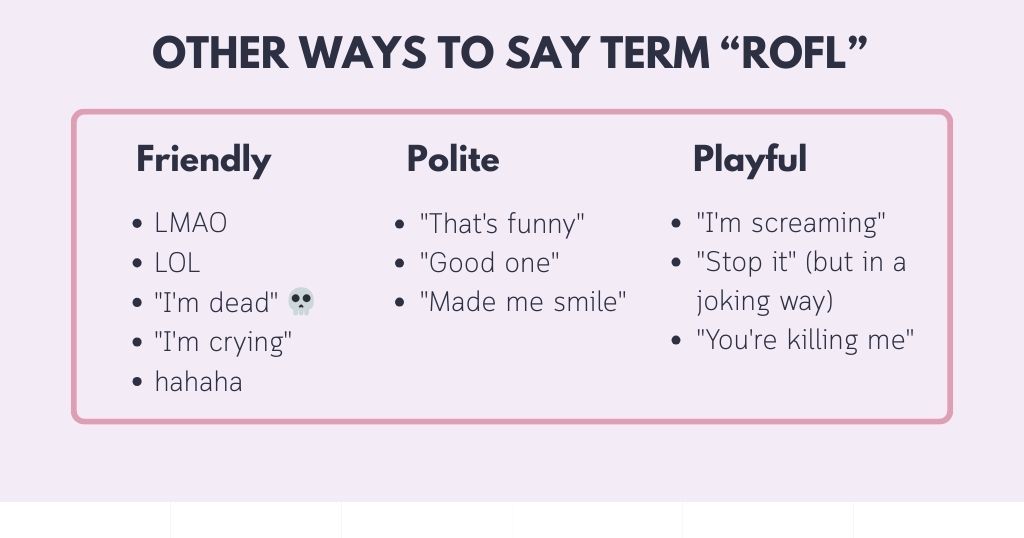
Casual / friendly:
- LMAO (Laughing My Ass Off)
- LOL (Laughing Out Loud)
- “I’m dead” 💀
- “I’m crying”
- hahaha (the more ha’s, the funnier)
Polite / professional:
- “That’s funny”
- “Good one”
- “Made me smile”
- 😊 or 😂 (emojis are safer)
Playful / joking:
- ROFLMAO (ROFL + LMAO combined)
- “I’m screaming”
- “Stop it” (but in a joking way)
- “You’re killing me”
Pick based on how funny something actually was and who you’re talking to. You don’t need to use the strongest laugh-term every time someone makes a mild joke.
Real Texts People Actually Send
Example 1: Friend: “I just walked into a glass door in front of my crush” You: “ROFL no you didn’t”
Example 2: Group chat: Person A: “Why did the scarecrow win an award?” Person B: “why” Person A: “Because he was outstanding in his field” You: “ROFL that’s so dumb”
Example 3: Gaming chat: Player 1: misses an easy shot Player 2: “ROFL how’d you miss that”
Example 4: Comment on a funny video: “The way he just accepted defeat at the end ROFL”
Example 5: Text conversation: Them: “I tried to cook dinner and set off the smoke alarm twice” You: “ROFL what were you even making”
Example 6: Someone shares a meme: You: “ROFL where do you find these”
Example 7: Friend tells an embarrassing story: You: “ROFL I would’ve died right there”
Example 8: Gaming fail: “Just got eliminated by fall damage ROFL”
Notice how ROFL works best when something is genuinely surprising or funny, not just mildly amusing.
Why Your Age and App Choice Matter Here
ROFL used to be everywhere in the 2000s and early 2010s. Back then, it was peak internet slang on forums, instant messengers like AIM and MSN, and early social media.
These days? It’s become kind of retro.
On TikTok and Instagram: Younger users (Gen Z and Gen Alpha) almost never use ROFL. They prefer emojis like 💀 (skull emoji) or phrases like “I’m crying” or “not me screaming.” If someone under 20 uses ROFL, they’re probably being ironic or making fun of how old it sounds.
On Facebook and older platforms: Millennials and Gen X users still use ROFL regularly. It hasn’t died out for them.
In gaming: ROFL is still common, especially in multiplayer games like League of Legends, Roblox, Minecraft, and Fortnite. Gamers use it when someone makes a hilarious mistake or when something unexpected happens in the game. In Roblox specifically, kids use ROFL all the time in chat—it’s one of the terms that hasn’t aged out there yet.
The “ROFLCOPTER” phenomenon: This is an ancient meme from the mid-2000s that combined ROFL with helicopter. It came with ASCII art (text pictures) and was huge on gaming forums and World of Warcraft. If someone says “ROFLCOPTER” today, they’re either being intentionally cringe for laughs, or they’re old enough to remember when it was actually popular.
You may also like: What Does TBC Mean? A Simple Guide to Using It Right
Things Everyone Gets Wrong About ROFL
Misunderstanding #1: “They must be laughing really hard” Not really. It’s usually just a way to signal that something deserves a bigger laugh reaction. Think of it as social currency—you’re “paying” someone for making you smile by giving them a stronger reaction word.
Misunderstanding #2: “ROFL from a guy means he likes me” Nope. Guys use ROFL the same way girls do—to react to funny stuff. If a guy is into you, he’ll show it by asking questions, starting conversations, or actually saying something flirty. ROFL by itself is just a laugh. Don’t read into it.
Same goes the other way. A girl sending you ROFL doesn’t mean she’s flirting. She just thought something was funny.
Misunderstanding #3: “ROFL and LOL mean the same thing” They’re similar, but there’s a hierarchy. LOL is the basic level—like a chuckle. ROFL is a step up—like a real belly laugh. LMAO is even stronger. ROFLMAO is the nuclear option. Using ROFL for something that only deserves a “haha” makes you look like you’re overdoing it.
Misunderstanding #4: “It’s always positive” Context matters. If you mess up and someone says “ROFL nice one,” they might be making fun of you. If you tell a story about something embarrassing and they respond with just “ROFL,” they might be laughing at your expense. The key is whether they add anything supportive after it.
Misunderstanding #5: “Older people don’t know what it means” Actually, ROFL is old enough that many parents and even grandparents who used early internet probably know it. It’s not as mysterious as newer slang like “bussin” or “rizz.” But they might not use it themselves.
Misunderstanding #6: “ROTFL is different from ROFL” ROTFL just adds the word “the” in the middle—”Rolling On The Floor Laughing.” It means the exact same thing. ROTFL was more common in the 1990s and early 2000s, but both versions exist. Most people use ROFL now because it’s shorter.
Knowing How to Reply When Someone Hits You With ROFL
If someone sends you ROFL in a casual chat:
- Send another joke or meme to keep the energy going
- Say “glad you liked it”
- React with an emoji like 😂 or 😁
- Send “right??” if you’re agreeing something was funny
If you’re not sure if they’re being sarcastic:
- Look at what you said right before they responded
- Check if they added anything else after ROFL
- Consider your relationship—are they usually supportive or do they tease you?
- When in doubt, just move on to a new topic
If someone uses ROFL and you don’t think what you said was funny:
- They might’ve misunderstood you
- You can clarify: “Wait I was being serious”
- Or just let it go if it’s not worth explaining
If you want to match their energy:
- Send back something equally enthusiastic
- Share another funny thing
- Use ROFL yourself in response to the next funny thing
In a professional context (if someone surprisingly uses it):
- Respond more formally than they did
- Something like “Glad you enjoyed it!” works
- Don’t mirror their casual tone in professional settings
Questions People Keep Asking
Is ROFL rude or disrespectful?
Not by itself, but it depends on timing. If someone’s being serious and you respond with ROFL, yes, that’s rude. In casual, funny conversations? It’s perfectly fine.
Can ROFL be sarcastic?
Absolutely. If someone tells a bad joke and you reply “ROFL,” you might be saying it’s so unfunny it’s funny. Sarcasm is hard to catch in text, so pay attention to patterns in how that person usually talks to you.
Do people actually roll on the floor?
No. Nobody does. It’s an exaggeration. Same way nobody’s actually dying when they say “I’m dead.”
Is it outdated?
Depends who you ask. Younger people see it as old-school. Gamers and people over 25 still use it regularly. It’s not dead, but it’s not trendy either.
What’s the difference between ROFL and LMAO?
ROFL feels slightly less intense than LMAO to most people, but honestly, they’re pretty interchangeable. LMAO has stayed more popular with younger crowds. ROFL feels a bit more retro.
Should I use ROFL in work emails?
Absolutely not. Save it for personal texts and casual platforms. Work communication should be professional, and ROFL crosses that line.
What does ROFLMAO mean?
It’s ROFL and LMAO combined: “Rolling On the Floor Laughing My Ass Off.” It’s the most extreme version, like when something is so funny you can’t handle it. It’s over-the-top on purpose.
Why do gamers use ROFL so much?
Gaming culture holds onto internet slang longer than other spaces. Gamers also experience lots of funny fails, glitches, and unexpected moments that deserve a big laugh reaction. In games like Roblox or League of Legends, ROFL is just part of the standard chat vocabulary.
ROFL isn’t complicated once you understand it’s just a laugh reaction—a bigger one than LOL, but still pretty standard internet talk. Use it when something genuinely makes you laugh, skip it in serious or professional moments, and don’t overthink whether someone’s flirting or mocking you. Most of the time, it’s just people trying to show they found something funny. That’s it.

I’m Hazel, and I studied BSC English at GCUF. I focus on explaining word meanings in simple, clear language that anyone can understand. My goal is helping readers grasp everyday English, confusing terms, and slang used in real conversations and social media. I believe language learning works best when definitions connect to actual life situations. Through careful research and straightforward explanations, I make vocabulary accessible for students, learners, and anyone curious about how English really works in daily use.