

In texting, SOS usually means “help me out of this situation” or “I need backup right now.” It’s rarely about life-or-death emergencies—most people use it when they’re stuck in an awkward conversation, bored out of their mind, or dealing with some minor crisis that feels huge in the moment.
You’re Not the Only One Confused
You’ve seen “SOS” pop up in a text or comment, and you’re not sure if your friend is joking around or actually needs help. Maybe someone sent you “SOS” with a bunch of laughing emojis, which seems… contradictory? Or you’re wondering if it’s the same SOS from those old ship distress calls you learned about in history class.
Here’s the thing: SOS has become one of those terms that means completely different things depending on who’s sending it and what’s happening. Your teenage cousin might text “SOS” because their crush just walked by. Your coworker might use it because they’re trapped in a meeting that should’ve been an email. And your phone might display “SOS” in the corner when you’re in the middle of nowhere with no signal.
It’s confusing because the same three letters carry wildly different weight based on context.
Beyond the Dictionary Definition
When someone types SOS in a message, they’re usually saying “I’m in over my head and could use a lifeline.” But that “lifeline” isn’t always serious. Most of the time, people use it as a half-joking, half-serious way to say they’re overwhelmed, uncomfortable, or just want an excuse to escape something.
Think of it like a social panic button. You’re not calling 911, but you are signaling that you’d really appreciate if someone gave you an out. It’s the digital version of making eye contact with your friend across the room when you need them to fake an emergency so you can leave.
The feeling behind it is usually a mix of stress and humor. People pick SOS instead of typing “help” because it sounds more dramatic and a little less desperate. It adds this layer of “I know I’m being dramatic but also please actually help me” that a plain “help” doesn’t capture.
Read More: OTT Meaning: What It Really Means in Texts, Streaming, and Everyday Life
Where You’ll Actually See It Pop Up
In group chats, someone might drop an “SOS” when they need advice fast—like they’re about to meet their partner’s parents and don’t know what to wear. It’s a way to flag that they need responses NOW, not in three hours when everyone finally checks their phones.
On social media, you’ll see it in captions or comments when someone’s reacting to something wild. A photo of a massive pile of laundry might get captioned “SOS send help” or a video of someone’s cat destroying their apartment gets flooded with “SOS” comments from people who relate.
In one-on-one texts, it’s often a rescue signal. Someone at a party they don’t want to be at. Someone whose date is going terribly. Someone who agreed to plans and now regrets it. The “SOS” is their way of asking you to call them with a fake emergency.
People also use it when they’re genuinely stuck but not in danger—like when they’ve locked themselves out, can’t figure out how to work something, or need someone to bring them something they forgot.
Reading the Room: Why Context Is Everything
Between close friends, SOS is almost always playful or exaggerated. If your best friend texts “SOS I’m dying” about running out of coffee, you know they’re not actually dying. You have enough history to read the joke.
But if someone you barely know sends you a standalone “SOS” with no context? That hits different. You might actually worry. The lack of relationship means you can’t tell if they’re being dramatic or serious.
In work contexts, SOS can come across as unprofessional or overly casual. Texting your boss “SOS need that file” might seem disrespectful, like you’re not taking your job seriously enough to use actual words.
The biggest misinterpretation happens when someone sends “SOS” trying to be funny, but the other person doesn’t get the joke. Let’s say you text “SOS this meeting is killing me” to a coworker, but they take it literally and think you’re having a medical emergency. That’s awkward for everyone.
Another warning: on platforms like Snapchat, “SOS” sometimes means “someone’s over my shoulder” (like a parent watching). If you miss that signal and send something you wouldn’t want others to see, that’s a problem. Always clarify if you’re unsure what someone means.
Times to Skip “SOS”
Don’t use SOS in formal emails or professional messages. It makes you sound immature or like you can’t handle basic work stress. If you need urgent help at work, say “urgent” or “time-sensitive” instead.
Skip it when talking to people who might not understand internet slang—like your grandparents or older relatives. They might genuinely panic thinking you’re in danger.
Avoid it in serious or sensitive situations. If something legitimately bad is happening, use clear language. “SOS” has been overused for minor stuff to the point where people might not take you seriously when you actually need help.
Don’t send it to strangers or people you just started talking to. It assumes a level of familiarity that isn’t there yet. They won’t know if you’re joking or genuinely need something.
And be careful using it about topics that are actually dangerous or triggering. Joking “SOS I want to die” about homework might seem funny to you, but it can genuinely upset people who’ve dealt with mental health crises.
Say It a Different Way
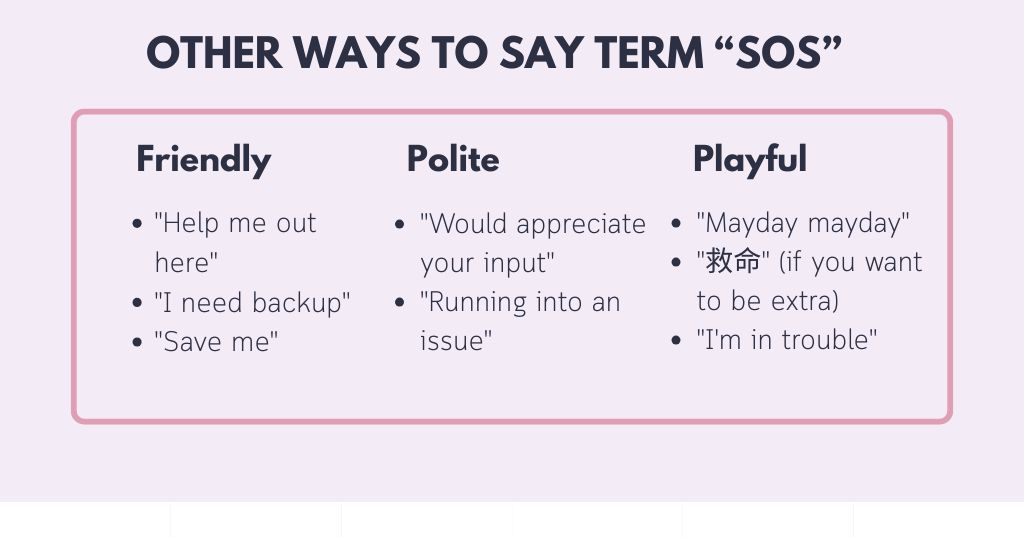
For casual situations:
- “Help me out here”
- “I need backup”
- “Save me”
- “Get me out of this”
For work or polite contexts:
- “Could really use your help”
- “Need assistance when you have a moment”
- “Would appreciate your input”
- “Running into an issue”
For playful moments:
- “Mayday mayday”
- “救命” (if you want to be extra)
- “I’m in trouble”
- “Come rescue me”
Read Also: What Does OTP Mean in Text? The 3 Meanings You Need to Know
Messages Examples That Sound Real
Social rescue: “SOS this guy won’t stop talking about crypto”
Gaming context: “SOS they’re camping our spawn point”
Fashion emergency: “SOS does this outfit work for a wedding?”
Homework panic: “SOS forgot we had a test tomorrow”
Family dinner escape: “SOS how do I get out of Sunday dinner without being rude”
Friend needs distraction: “SOS bored out of my mind, entertain me”
Date gone wrong: “SOS call me in 10 minutes with a fake emergency”
Running late: “SOS stuck in traffic, stall them for me”
Different Crowds, Different Vibes
On TikTok, SOS has become part of reaction culture. People comment it on videos that make them feel some type of way—overwhelmed, shocked, or just really relate to what they’re watching. It’s less about needing help and more about expressing that something hit them hard.
Snapchat users tend to use it more literally, either as a warning that someone’s watching their screen or as a quick way to signal they need their friends to check in.
Younger people (teens and early twenties) use SOS way more casually than older folks. If you’re over 30, you probably still associate it with actual emergencies. If you’re under 25, it’s just another way to be dramatic about everyday stuff.
The term has gotten so overused in some circles that it’s lost its punch. Some people won’t even look up when someone types SOS anymore because they assume it’s about something minor.
What People Get Wrong About “SOS”
The “Save Our Souls” thing: People think SOS stands for “Save Our Souls” or “Save Our Ship,” but it doesn’t actually stand for anything. It was picked for Morse code because the pattern (dot-dot-dot dash-dash-dash dot-dot-dot) was easy to recognize. The backronym came later.
The sorry confusion: Some people think SOS can mean “sorry” in certain contexts, but that’s not really a thing. If someone types SOS when they seem to be apologizing, they probably made a typo or you’re misreading the situation.
The medical prescription: In medicine, S.O.S. means “si opus sit” (Latin for “if needed”), which is completely unrelated to texting slang. If your doctor writes SOS on a prescription, they’re not being dramatic about your medication.
The iPhone thing: If your phone shows “SOS” or “SOS only” at the top, that’s not someone texting you. It means your phone can’t connect to your carrier but can still make emergency calls through other networks. You’re basically in a signal dead zone.
When people take it too seriously: Someone might send “SOS” as a joke, and the other person calls the cops. Or the opposite—someone genuinely needs help but everyone thinks they’re exaggerating because they use SOS for everything.
You might also like it: What Does WC Meaning in Text? The Real Answer
Questions You’re Probably Wondering About
Is it rude to use SOS?
Between friends, not at all. In formal settings or with people you don’t know well, yeah, it can come off as immature or overly dramatic.
Can I use it sarcastically?
Sure, but make absolutely certain the other person will catch the sarcasm. Text doesn’t carry tone well, and SOS is one of those terms where sarcasm can backfire badly.
Does a girl mean something different than a guy when texting SOS?
Not really. Girls might use it more often for social situations (bad date, awkward hangout), while guys might use it more for gaming or sports contexts, but there’s no hard rule. Anyone can use it for anything.
What do I do if someone sends me SOS?
Ask for context. A quick “You okay? What’s up?” usually clears things up fast. If they’re joking, they’ll laugh it off. If they actually need something, they’ll tell you.
Does it mean the same thing everywhere?
Pretty much. English-speaking internet culture has spread SOS as slang globally. You’ll see it used the same way in the US, UK, Australia, and even in countries where English isn’t the first language.
SOS went from a maritime distress signal to internet slang for “I need an exit strategy from this situation.” It’s one of those terms that works because everyone kind of knows what you mean, even if the specifics change based on who’s talking and what’s going on.
Just remember that tone and relationship matter way more than the actual letters. The same “SOS” can be hilarious between best friends and genuinely concerning from an acquaintance. When in doubt, ask for clarification—it beats assuming wrong and either panicking unnecessarily or ignoring someone who actually needs help.

I’m Hazel, and I studied BSC English at GCUF. I focus on explaining word meanings in simple, clear language that anyone can understand. My goal is helping readers grasp everyday English, confusing terms, and slang used in real conversations and social media. I believe language learning works best when definitions connect to actual life situations. Through careful research and straightforward explanations, I make vocabulary accessible for students, learners, and anyone curious about how English really works in daily use.