

STTM usually means “Send This To Me” when someone wants you to share a photo, video, or link. It can also mean “Stop Talking To Me” when ending a conversation or setting a boundary.
Why This Term Confuses People
You’re scrolling through Instagram comments and see “STTM” under a recipe video. Or maybe someone replies with just “STTM” after you sent three long texts. Wait—are they asking for something or telling you to back off?
That’s the problem with STTM. It’s one of those acronyms that flips meaning depending on who says it and what’s happening in the conversation. You can’t just memorize one definition and call it a day.
The Real Meaning Behind Those Four Letters
The feeling behind STTM changes completely based on context. When someone types “STTM” under a TikTok they love, they’re basically saying “I need this saved on my phone right now.” It’s urgent but friendly—like grabbing someone’s arm and pointing at something cool.
But when STTM shows up as a standalone reply after you’ve been texting too much? That’s a boundary. It’s the digital version of putting up a hand. Not always mean, but definitely firm. People use it because typing “Stop Talking To Me” feels too formal and aggressive, while “STTM” sounds casual enough to soften the blow.
There’s also the less common “Something Tells Me,” which is more of a hunch starter. Like when you suspect your friend is lying about where they were last night: “STTM you weren’t actually studying.”
Where You’ll Actually See STTM Pop Up
STTM pops up when someone sees content they want to keep. You’re in a group chat and someone shares a workout routine screenshot. Your friend replies “STTM” because they want the original file, not a compressed version.
On Instagram Stories, it’s become a request phrase. Someone posts a product or a funny meme, and their DMs fill up with “STTM” messages. It’s faster than typing “Can you send me that?” and everyone understands.
In arguments or when someone’s annoyed, STTM works as an exit strategy. Your friend keeps ranting about their ex for the third time today. You’re tired. You type “STTM” and it gets the point across without starting a bigger fight.
Reading the Room: Why Context Changes Everything
Here’s where people mess up: STTM from your best friend during a funny conversation hits different than STTM from someone you barely know.
If you’re joking around and send a ridiculous selfie, your friend might reply “STTM 😂” meaning they want to save it for blackmail purposes. That’s playful.
But if you’re texting someone who’s giving short replies, then suddenly drops “STTM” with no emoji or context? That’s a shutdown. They’re done with the conversation and you’re not reading the room.
Warning about misinterpretation: When you see STTM, look at what came before it. If it follows a link, video mention, or “look at this,” it’s probably “Send This To Me.” If it comes after you’ve been talking at someone for a while, it’s “Stop Talking To Me.” Missing this difference can make you look clueless. It’s the same issue people face with terms like NP in text — what sounds polite to you might feel dismissive to someone else.
The relationship matters too. From a girl you’re dating, “STTM” might mean she wants straight talk about where things are going. From a stranger online? It’s almost always a request to share content or a brush-off.
Another warning: Using STTM with someone older or unfamiliar with texting slang can backfire. They might think you’re being rude when you’re just asking them to forward something.
More Posts: What Does BOT Mean in Text? Nobody Explains Properly
Places Where “STTM” Will Backfire on You
Don’t use STTM in work emails or professional chats, even if your workplace is casual. Typing “Could you please send me that file?” takes three extra seconds and won’t make you look immature.
Skip it with parents, teachers, or anyone in authority. They probably don’t know what it means, and explaining slang makes everything awkward.
Avoid using “Stop Talking To Me” version of STTM in sensitive situations. If someone’s sharing something serious or emotional, hitting them with STTM comes across cold. Just say you need space or that you’ll talk later.
Don’t throw STTM at customer service reps, even if they’re annoying you. It reads as disrespectful and won’t get your problem solved faster.
And here’s a big one: Don’t use STTM to request content from creators or businesses unless they’ve specifically told people to comment that. It can look demanding.
Better Ways to Say What You Mean
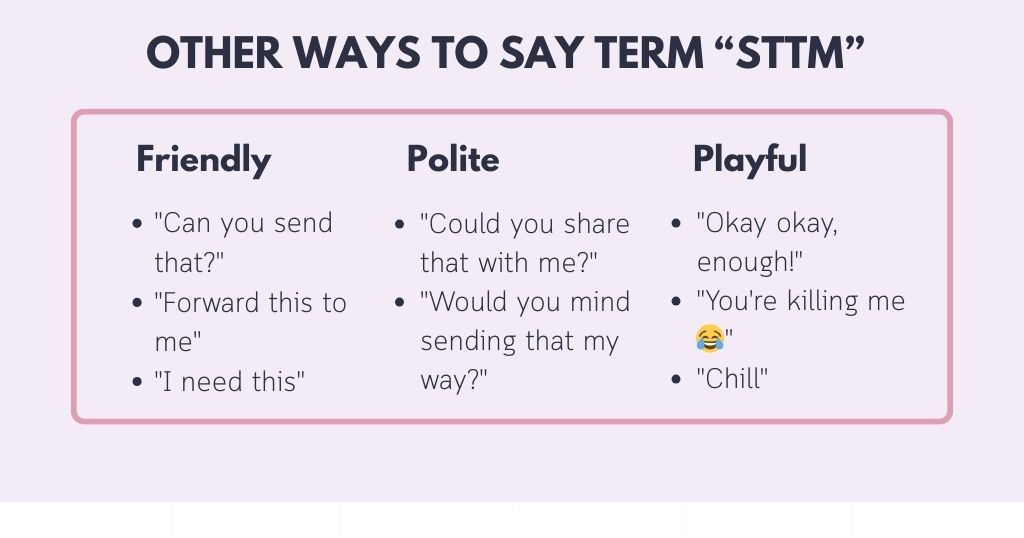
When you want something sent:
- “Can you send that?”
- “Forward this to me”
- “I need this”
- “Link?”
When you need someone to stop:
- “I need a break from this”
- “Let’s talk later”
- “I’m done with this topic”
- “Can we move on?”
When you’re being playful:
- “Okay okay, enough!”
- “You’re killing me 😂”
- “Chill”
For professional settings:
- “Could you share that with me?”
- “Would you mind sending that my way?”
- “I’d appreciate a copy when you have a moment”
Real-Life Examples That Actually Happen
Someone posts a hair tutorial on TikTok Comment: “STTM I need to try this” (Wants the video saved)
Friend won’t stop complaining in texts You: “STTM I can’t handle more drama today” (Setting a boundary)
Group chat discussing weekend plans Friend 1: “Found the perfect Airbnb” You: “STTM” Friend 1: [sends link] (Quick content request)
Instagram DM after posting a meme “Yooo STTM that’s hilarious” (Wants to repost it)
Argument in messages Them: [long paragraph] Them: [another paragraph] You: “STTM” (Ending the conversation)
Snapchat conversation about outfit “That jacket is fire, STTM where you got it” (Asking for info/link)
Platform Notes: Where You’ll See It Most
Instagram and TikTok dominate STTM usage, especially for the “Send This To Me” meaning. These platforms are visual, so people constantly want to save and share content. The term became a shortcut for “I want this on my camera roll.”
Snapchat uses it more personally since everything’s one-on-one or small groups. When someone says STTM there, it’s usually about a specific snap they want saved before it disappears.
Twitter (X) rarely uses STTM because quote tweets and retweets already exist. People just share directly instead of asking.
Younger users (Gen Z and younger Millennials) get STTM instantly. If you’re texting someone over 35, expect confusion. They might ask what you mean, which defeats the whole point of using shorthand. It’s part of a bigger trend with terms like Thicc and Wig that older generations don’t always understand.
The “Stop Talking To Me” version is spreading on TikTok comment sections where people argue. It’s becoming the go-to dismissal for shutting down someone without engaging further.
Misunderstandings That Trip People Up
People think STTM is always rude. It’s not. Tone lives in the context, not the letters. STTM under a cooking video isn’t hostile—it’s enthusiastic.
Another mix-up: thinking STTM works everywhere. Some friend groups have never heard of it. You drop “STTM” and get back “What?” Now you’re explaining instead of communicating.
Some people use “STT” (without the extra M) thinking it’s the same thing. It’s not. STT in tech circles means “Speech To Text.” Adding that M changes everything. Same thing happens with BYW — people assume it’s a typo when it’s actually intentional slang.
The biggest confusion: Not realizing STTM has a professional meaning in data and energy sectors. If you’re in a work setting and someone mentions STTM, they might be talking about “Source To Target Mapping” (data engineering) or Australia’s “Short Term Trading Market” (gas wholesale). Reading the room wrong here can make you look silly.
People also miss that overusing STTM makes you sound dismissive even when you don’t mean it that way. If you reply with only “STTM” to multiple conversations, people start thinking you’re always trying to cut them off.
You also like this slang: What Does SOS Really Mean When Someone Texts It?
Responding When Someone Hits You With “STTM”
If they want something sent: Just send it. Don’t make them ask twice. Share the link, forward the video, or screenshot what they need.
If they’re setting a boundary: Respect it. Don’t keep texting or get defensive. A simple “Got it” or “My bad” works. Then actually stop.
If you’re not sure which meaning: Ask. “You want me to send something or need space?” beats guessing wrong.
If it feels rude: Take a breath before responding. Maybe they’re overwhelmed, not attacking you. Give them time before bringing it up.
Questions People Actually Ask for Usage “STTM”
Is STTM rude to use?
Depends. Asking someone to send content? Not rude. Telling someone to stop talking? Can be, depending on how and when you use it. With friends who get your humor, it’s fine. With people you don’t know well, it’s risky.
Can STTM be sarcastic?
Absolutely. Friends use it jokingly all the time. Someone shares a bad pun, you reply “STTM 😭” meaning “stop with these terrible jokes.” The emoji usually signals you’re playing. Other terms like SUS work the same way — tone completely depends on how you deliver it.
What if someone sends just “STTM” with nothing else?
Look at your recent messages. Were you sending multiple texts? Talking about the same thing over and over? That’s probably “Stop Talking To Me.” If you just showed them something cool, they want you to send it.
Do guys and girls use it differently?
Not really. Both use it to request content or set boundaries. Some people think girls use it more for requesting things (like outfit links) while guys use it to shut down conversations, but that’s not backed by anything real. It’s personal preference.
Does STTM mean something in gaming?
Sometimes. Roblox players occasionally use “Screaming To The Moon” in specific games, but it’s super niche. If you’re not in that community, don’t worry about it.
STTM is one of those terms where paying attention matters more than memorizing definitions. You can’t just learn it once and move on—you have to read the situation every time you see it.
If someone’s sharing something cool and you want it, STTM works great. If you need space from a conversation, it’s a quick exit. Just remember that clarity beats cleverness. When in doubt, use actual words instead of hoping four letters do the job.

I’m Hazel, and I studied BSC English at GCUF. I focus on explaining word meanings in simple, clear language that anyone can understand. My goal is helping readers grasp everyday English, confusing terms, and slang used in real conversations and social media. I believe language learning works best when definitions connect to actual life situations. Through careful research and straightforward explanations, I make vocabulary accessible for students, learners, and anyone curious about how English really works in daily use.