

TFTI stands for “Thanks For The Invite.” It’s usually sarcastic—used when you see your friends hanging out without you and want them to know you noticed being left out.
You’re Here Because Someone Just Said It
You just saw someone comment “TFTI” on an Instagram story or send it in a group chat, and you’re not totally sure if they’re actually saying thanks or being petty. Maybe you got one yourself and you’re panicking about whether you messed up. The confusion makes sense because this term lives in a weird space where the words say one thing but the vibe says something else.
People also mix it up with TFT (which usually means “thanks for that”) or think it’s always rude when sometimes it’s actually genuine. The tricky part? You need context to figure out which version you’re dealing with.
Behind the Words: What’s Really Being Said
When someone types TFTI, they’re basically holding up a mirror to your social life. It’s their way of saying “I see you had fun, and I see I wasn’t part of it.” The sarcasm works because it flips a polite phrase into a gentle roast.
It’s the digital version of FOMO—that feeling when you realize everyone else is having fun without you. Speaking of texting shorthand for complex feelings, people also use HML when they’re frustrated or annoyed, though that one carries a different edge. The term exists because typing out “Hey, kind of hurts that I wasn’t included” feels too heavy, but staying silent feels worse.
The sincere version (actual gratitude for an invitation) barely exists anymore. If someone really means “thank you,” they’ll usually add emojis or extra words to make it obvious they’re not being shady.
Where You’ll Actually See This Pop Up
TFTI pops up most often right after someone posts about an event. You’re watching Instagram stories at 11 PM, see your whole friend group at someone’s house, and drop a “tfti” in the comments or DMs. It’s a digital tap on the shoulder.
In group chats, it shows up when plans get made and one person realizes they were never asked. Like when four people are talking about meeting up and the fifth person just writes “tfti” to point out they were watching the whole conversation unfold without being invited.
Some people also use it on TikTok comments, but that’s more performative—it’s for everyone else to see, not just the person who posted. The audience gets to witness the callout, which changes the energy completely.
Read More: TTG Meaning in Text, Rap, and More: The Complete Guide
Reading the Room (And the Text)
The relationship between you and the sender completely changes what TFTI means. From a close friend, it’s usually playful teasing with no real hurt behind it. From someone you’re not that tight with, it might carry actual resentment or be a passive-aggressive hint that they want to be closer.
Warning about misreading: If you can’t tell if someone’s joking, look at what they do next. Do they laugh it off and keep chatting normally? Probably playful. Do they go quiet or leave the chat? They might actually be bothered.
Girls often use TFTI as a softer callout—it keeps things light while still letting you know they noticed. Guys tend to use it more directly, sometimes as banter between friends who constantly roast each other. But these aren’t rules, just patterns.
The biggest tone shift happens based on timing. TFTI sent during the event hits different than one sent days later. During = “I’m seeing this in real time and feeling left out.” Days later = “I’m still thinking about this and it bothered me more than I showed.”
Times to Keep TFTI Out of Your Mouth
Don’t use TFTI at work. Ever. Commenting it on a coworker’s LinkedIn post about a team lunch you weren’t invited to makes you look unprofessional and petty. If you’re actually upset about being excluded from a work thing, talk to someone directly instead of leaving a passive-aggressive comment.
Skip it with people you barely know. Sending TFTI to an acquaintance who posted about hanging out with their other friends comes across as entitled. They don’t owe you an invitation just because you’re Instagram mutuals.
It’s also risky with family members, especially older relatives who won’t get that it’s slang. Your aunt will think you’re genuinely thanking her and get confused, or she’ll sense the sarcasm and feel attacked.
Public comments on posts with lots of people watching can backfire. What feels like a joke between friends might look like drama to everyone else scrolling by. Save it for DMs if you’re unsure about the audience.
Other Ways to Say the Same Thing
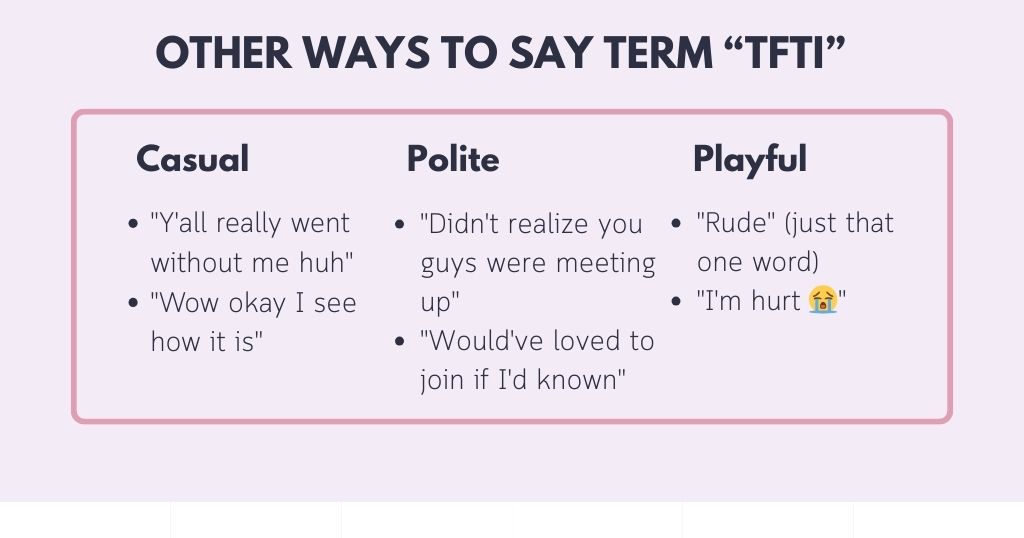
Casual with close friends:
- “Y’all really went without me huh”
- “Wow okay I see how it is”
- “Next time I’m coming whether you want me there or not”
You could also throw in something like FR (for real) to emphasize you’re serious: ‘FR though, wish I’d known you guys were going out.’
Polite or neutral:
- “Looks like fun! Let me know next time you’re doing something”
- “Didn’t realize you guys were meeting up”
- “Would’ve loved to join if I’d known”
Playful without the edge:
- “Rude” (just that one word)
- “I’m hurt 😭” (with the crying emoji to show you’re joking)
- “And I wasn’t invited because…?”
When you’re genuinely thanking someone:
- “Thanks so much for inviting me!”
- “Appreciate you thinking of me”
- “Can’t wait, thanks for including me”
You Also like it: What Does STTM Mean in Text? Acronym That Changes With Context
Messages That Could Show Up in Your Phone
Sees friends at a restaurant on Snapchat “tfti guys 🙃”
Group chat making weekend plans without asking you “tfti I guess I’ll just stay home”
Friend posts concert pics “TFTI!!! jk hope it was fun”
Someone shares they’re engaged “Congrats!! (also tfti to the wedding lol)”
Coworker starts a project without looping you in Don’t: “tfti for the meeting” Do: “Hey, can you catch me up on the project? Want to make sure I’m in the loop”
Your sibling has dinner with your parents Them: posts photo You: “having family dinner without me is crazy” (Not “tfti” because it sounds weird with family)
Different Apps, Different Vibes
On Instagram and TikTok, TFTI often becomes a performance. You’re not just telling your friend you noticed—you’re telling everyone who sees the comment that you noticed. It’s a public receipt.
In text messages or private DMs, it’s more personal and the stakes feel higher. There’s no audience buffering the awkwardness, so the person receiving it knows you’re talking directly to them about feeling excluded.
Snapchat sits in the middle. Stories disappear, so a TFTI there feels less permanent than an Instagram comment that stays up forever. Some people use that temporary nature to be more honest about feeling left out.
Younger people (teens and early twenties) throw TFTI around more loosely, often as a joke even when they wouldn’t have wanted to come anyway. People in their late twenties and up use it less frequently and usually mean it more seriously when they do.
Mix-Ups People Keep Making
The biggest confusion: people think TFTI is always mean. It’s not. Between close friends who constantly joke around, it can be completely lighthearted. The problem is that text doesn’t carry tone, so you’re left guessing.
Some people overuse it and it loses meaning. If someone comments TFTI on every single post where they weren’t included, friends stop taking it seriously. It becomes background noise instead of a genuine “hey, I wanted to be there.”
Another mix-up happens when people think adding “lol” or “jk” automatically makes it okay. Sometimes those additions help soften it, but if you’re actually hurt, hiding behind “just kidding” doesn’t really fix anything. The person receiving it can still tell you’re bothered.
The term also gets misread generationally. Someone in their thirties might not realize it’s usually sarcastic and respond with “You’re welcome!” thinking the person genuinely thanked them. That creates a whole new layer of awkward.
Someone Hit You With TFTI—Now What?
If it’s from a close friend and clearly joking: “Omg I know I’m sorry it was so last minute” “You were literally asleep when we decided to go” “My bad! We’re hitting up [place] Friday, you coming?”
If you can’t tell if they’re serious: “Wait are you actually mad or joking? Hard to tell through text” “Didn’t mean to leave you out, totally thought someone else invited you”
If they seem genuinely hurt: Don’t get defensive. Try: “I should’ve reached out, that’s on me. Let’s do something soon, just us?” Or: “You’re right, I messed up. Want to grab food this week?”
If it’s someone being dramatic over nothing: “It was just a quick coffee run, wasn’t a whole thing” Sometimes you can just like the message and move on without making it bigger.
If you’re the one sending TFTI and someone asks if you’re mad: Be honest: “Nah not mad, just bummed I missed out” Or commit to the joke: “Devastated, crushed, will never recover” (obvious sarcasm)
Read Also: AFAIK Meaning: What This Text Abbreviation Really Tells You
Similar Slang You Might Run Into
TFT usually means “thanks for that” and is less loaded than TFTI. It’s more neutral and less likely to be sarcastic.
TFTI Crew is slang some people use to describe their “B-team” friends—the ones who get invited to stuff less often. It’s kind of dark humor about feeling like a backup option.
Some people type it lowercase (tfti) to make it seem more casual, or all caps (TFTI) to add intensity. The punctuation matters too—”tfti…” with trailing dots suggests you’re thinking about it, while “tfti!!!” with exclamation points might be covering hurt with forced energy.
On dating apps, TFTI sometimes means “thanks for the info” when someone shares their Instagram or gives details about themselves. This usage is way less common and usually clear from context.
If you’re diving into texting slang, you’ll probably also see SFLR (sorry for late reply) and DKM (don’t kill me) pop up in similar casual conversations where people are being half-joking, half-apologetic.
Questions People Actually Ask
Is TFTI always rude?
No. Between friends who joke around constantly, it’s often just banter. But with acquaintances or in professional settings, it usually comes across as passive-aggressive.
Can I use it seriously to say thanks?
Technically yes, but people will probably think you’re being sarcastic. If you want to genuinely thank someone, spell it out or add clear positive emojis.
What if someone sends it to me and I didn’t even know they wanted to come?
Just be honest: “Had no idea you’d want to join, my bad for not thinking of it.” Most people just want acknowledgment.
Does it mean something different from a girl versus a guy?
The words mean the same thing, but how it’s received can differ. Girls often use it as a gentler nudge that maintains the friendship, while guys might use it as more direct teasing. But plenty of people use it however they want regardless of gender.
Is it weird to use TFTI if the event was small and obviously couldn’t include everyone?
Kind of, yeah. Using it when someone hung out with one other person or went to a family thing makes you seem clingy. Save it for group activities you’d normally be part of.
How do I know if someone’s actually mad when they send it?
Check their follow-up. If they keep the conversation going normally, they’re probably fine. If they give short responses or stop replying, they might be more bothered than they let on.
TFTI walks a thin line between humor and honesty. It lets people call out feeling excluded without making things too serious, which is probably why it caught on so hard. Just remember that tone is everything—what sounds like a joke to you might land differently with someone else.
If you’re on the receiving end, don’t ignore it. Even if it seems like nothing, the person cared enough to say something instead of just scrolling past. And if you’re the one typing it, make sure you actually want to have that conversation, because even jokes can open doors you weren’t planning to walk through.

I’m Hazel, and I studied BSC English at GCUF. I focus on explaining word meanings in simple, clear language that anyone can understand. My goal is helping readers grasp everyday English, confusing terms, and slang used in real conversations and social media. I believe language learning works best when definitions connect to actual life situations. Through careful research and straightforward explanations, I make vocabulary accessible for students, learners, and anyone curious about how English really works in daily use.