

WSP means “What’s up?” in texting. It’s a casual way to start a conversation or check in with someone, mostly used in DMs, group chats, and social media messages.
You’re Not Alone in Being Confused
You probably saw “WSP” pop up in a text or Snapchat message and thought, “Wait, what?” It looks like it could be an app name, a typo, or some new internet code you missed. The confusion makes sense—it’s not obvious that three letters replace a whole greeting. Plus, depending on where you see it, WSP can mean totally different things. In gaming, it’s not a greeting at all. In business contexts, it refers to companies or safety plans. So yeah, it’s reasonable to wonder which meaning someone’s using.
The Real Vibe Behind WSP
When someone sends you “WSP,” they’re basically saying “What’s up?” but with less effort. And that’s the key part—it’s low-energy on purpose. Think of it as the text equivalent of a head nod. They’re not ignoring you, but they’re also not writing you an essay.
The feeling behind WSP is usually one of three things: they want to talk but don’t have a specific topic in mind, they’re bored and fishing for conversation, or they’re testing the waters to see if you’ll reply. It’s different from a full “Hey, how are you?” because that sounds more intentional. WSP is more like “I’m here if you want to chat.”
People use it instead of typing out the full phrase because it feels more relaxed. Saying “What’s up?” can sometimes sound too formal for a quick DM, while “sup” might feel too bro-ish for some people. WSP sits in that middle zone where it’s chill but not trying too hard.
Where You’ll Actually See It
WSP usually appears at the start of a conversation, especially when someone hasn’t talked to you in a while. You’ll see it in:
Late-night texts – Someone sends “wsp” at 11 PM because they’re bored or want to hang out. It’s their way of saying “you awake?” without being that obvious.
Snapchat replies – You post a story about your day, and someone swipes up with just “wsp.” They saw what you’re doing and want in on the conversation.
Instagram DMs – A friend you haven’t talked to in weeks sends “WSP” as an icebreaker. They’re checking if you’re still cool with chatting.
Group chats – Someone drops “wsp guys” to see who’s around or to restart a dead conversation.
The pattern is usually the same: WSP comes first, then the real conversation starts. It’s rarely the whole message. If someone only sends “WSP” and nothing else, they’re waiting for you to carry the energy.
Read More: What Does “Wig” Mean in Slang? The Real Story Behind It
Reading Between the Lines
Here’s where WSP gets tricky. The same three letters can feel completely different based on who sends it and when.
From a close friend: It’s just a normal check-in. Totally fine, no hidden meaning.
From someone you barely know: It can feel a bit forward, like they’re assuming you’re already friendly enough for super casual talk.
Late at night from a romantic interest: It probably means they want to talk or hang out. The timing matters more than the word itself.
In a work group chat: It’s too casual. Your coworkers might think you’re being unprofessional or treating work like a social hangout.
With a question mark (WSP?): This feels more genuine, like they actually want to know what you’re up to.
Without punctuation (WSP): This can read as more confident or even demanding, like “What’s the move?” It’s less of a question and more of a statement.
One big warning: If someone you’re not close with sends WSP as their opening line, they might be copy-pasting the same message to multiple people. It’s the mass-text version of “hey.” They might just be sending it to a few people to see who responds.
The other risk is sounding lazy. If you only ever send “WSP” and never follow up with real conversation, people will stop replying. It makes you seem like you want them to do all the work.
Times to Avoid “WSP” Completely
Don’t use WSP in these situations:
Work emails or Slack messages with your boss – It’s way too casual. Use “Hi,” “Hey,” or “Good morning” instead.
First messages to people you don’t know well – It assumes a level of comfort you haven’t earned yet. Start with something more complete like “Hey, how’s it going?”
Serious conversations – If you’re apologizing, sharing bad news, or talking about something important, WSP makes it seem like you’re not taking it seriously.
When someone just shared something emotional – Replying with “wsp” to someone’s vulnerable post or message feels cold and dismissive.
Professional networking – LinkedIn, job applications, formal introductions—WSP has no place here. Full sentences only.
Older relatives or authority figures – They probably won’t understand it, and it might come across as disrespectful.
If you’re unsure whether WSP fits, ask yourself: “Would I say ‘What’s up?’ in this situation?” If the answer is no, skip the shorthand too.
Say It Different Ways
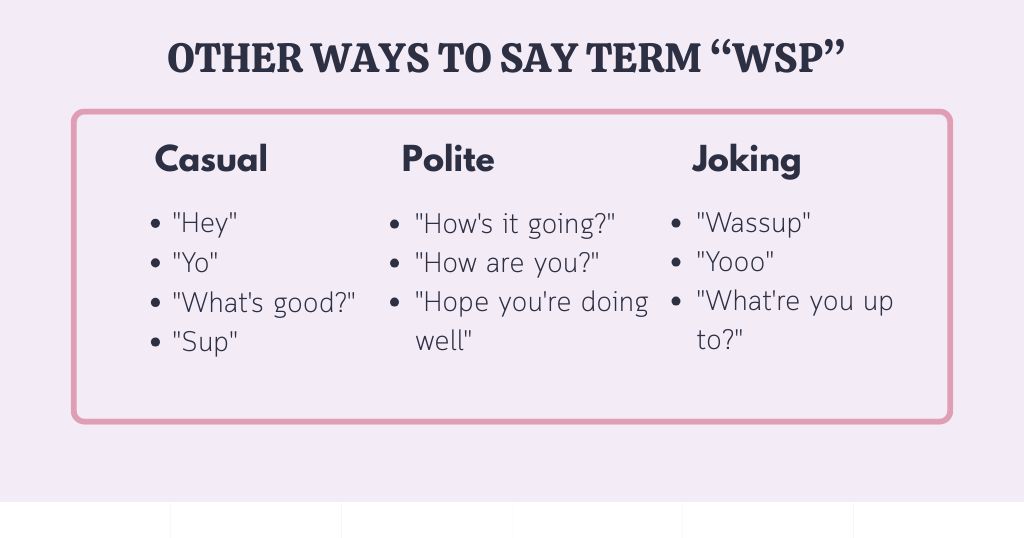
Depending on the vibe you want, here are natural swaps:
Casual/Friendly:
- “Hey”
- “Yo”
- “What’s good?”
- “Sup”
Polite/Safe:
- “How’s it going?”
- “How are you?”
- “Hope you’re doing well”
Playful/Fun:
- “Wassup”
- “Yooo”
- “What’re you up to?”
You don’t need a formal list in your head. Just match the energy of how you’d normally talk to that person. Check out more slang like YWW for usage in chats.
Actual Conversations Using “WSP”
Example 1:
Friend 1: “wsp”
Friend 2: “nm just got home from work, you?”
Friend 1: “same, tryna do something tonight?”
Example 2:
Person A: “WSP”
Person B: “hey! nothing much, just studying”
Person A: “boring lol wanna grab food later”
Example 3:
Guy: “wsp”
Girl: “hey, what’s up with you?”
Guy: “not much, saw your story. that place looked cool”
Example 4:
Group chat:
Person 1: “WSP everyone”
Person 2: “yooo”
Person 3: “hey what’s the plan for tonight”
Example 5:
On Snapchat:
Someone replies to your story with “wsp”
You: “just chilling, hbu?”
Example 6:
Late night text:
“wsp you still up?”
Example 7:
From someone you haven’t talked to in months:
“Yooo wsp! Been a minute”
Notice how the conversation doesn’t end with WSP—it’s just the door that opens things up.
App-Specific Quirks Worth Knowing
On Instagram, it shows up in DMs the same way. Someone might reply to your story with “wsp” or send it cold if they want to reconnect.
The platform doesn’t change the meaning, but it does change the intent. A random “wsp” text feels more intentional. A “wsp” story reply feels more spontaneous, like they’re jumping into your world right then.
Age matters a bit too. Younger people (teens to early 20s) use WSP more naturally. If you’re texting someone in their 30s or older, they might not recognize it or might think it’s a typo. It’s not a rule, but it’s worth keeping in mind.
Mistakes People Make With WSP
Mistake 1: Thinking it’s always friendly
Sometimes WSP is just someone being nosy. If you barely know them and they send “wsp,” they might be fishing for gossip or trying to insert themselves into your business.
Mistake 2: Assuming it needs a long reply
You don’t owe anyone a paragraph response to “wsp.” A short answer is totally fine. If they wanted depth, they’d ask a real question.
Mistake 3: Using it too often
If you start every single conversation with “wsp,” people will get bored. Mix it up. Ask actual questions sometimes.
Mistake 4: Not reading the room
Sending “wsp” to someone who’s clearly upset or stressed makes you look clueless. Pay attention to what they’ve shared before you message them.
Mistake 5: Confusing it with other meanings
In gaming, WSP can mean “whisper” (private message). In business, it’s an acronym for companies or plans. If you’re not in a texting context, double-check what someone means before assuming.
Beyond Texting: Other WSP Meanings
Outside of casual texting, WSP pops up in these areas:
Gaming: In some online games, WSP is short for “whisper,” which is a private message to another player. If someone says “WSP me,” they want you to message them privately instead of talking in public chat.
Business: WSP Global is a huge engineering and consulting company. If someone mentions WSP in a work context, they’re probably talking about the firm, not saying “What’s up?”
Workplace Safety: WSP can stand for Workplace Safety Plan in industrial or construction settings. It’s a required document that outlines how to keep workers safe.
Tech: Web Service Provider. Less common now, but still used in some IT contexts.
Social issues: White Skin Privilege. You’ll see this in academic or activist discussions about race.
The key is context. If you’re texting a friend, it’s almost always “What’s up?” If you’re in a professional setting or playing a game, it’s probably one of the other meanings.
Responding the Right Way
Your response depends on how you feel about the person and what you’re doing.
If you want to talk:
“Not much, just [activity]. What’s up with you?”
“Hey! Just got done with [thing]. You?”
“Chilling, wbu?”
If you’re busy but want to be nice:
“Hey! Swamped right now but I’ll text you later”
“At work rn, catch you in a bit?”
If you’re not interested:
“Hey” (and leave it there—they’ll get the hint)
Don’t reply at all if they’re being weird or pushy
If it’s from someone you like:
Don’t just say “nothing much.” Give them something to work with. Mention what you’re doing or ask them a question back.
If you’re in a group chat:
“Yooo” or “hey everyone” works fine.
The trick is matching their energy. If they sent a quick “wsp,” keep your reply short. If they follow up with more, then you can expand.
Questions People Actually Ask About “WSP”
Is WSP rude?
Not by itself, but it can feel lazy if that’s all someone ever sends you. In professional settings, yeah, it’s too casual.
Can girls and guys use it the same way?
Yes. WSP doesn’t have a gender lean. Anyone can use it to start a conversation.
Does WSP always mean someone wants to hang out?
Not always. Sometimes people just want to chat online. The time of day and your relationship with them gives you clues.
What if someone sends WSP and I don’t know what to say?
Just reply with “hey, not much, you?” and see where it goes. You’re not locked into a deep conversation.
Is WSP used more on certain apps?
It’s common on Snapchat and Instagram because people use those for quick, casual messages. You’ll see it in texts too, but less on platforms like LinkedIn or email.
Can WSP be sarcastic?
Kind of. If someone hasn’t talked to you in forever and suddenly sends “wsp” out of nowhere, it might feel passive-aggressive, like they only remember you when they need something.
WSP is just a shortcut for “What’s up?”—simple as that. But like most internet slang, how you use it and when you use it changes everything. It’s perfect for casual chats with friends but totally wrong for work messages or serious moments. The trick is reading the situation and matching the vibe.
If you’re still unsure, start with something more complete like “Hey, how’s it going?” until you get a feel for how someone texts. Once you know them better, WSP becomes just another tool in your messaging toolkit. It’s not magic, just a quick way to say “I’m here, let’s talk.”

I’m Hazel, and I studied BSC English at GCUF. I focus on explaining word meanings in simple, clear language that anyone can understand. My goal is helping readers grasp everyday English, confusing terms, and slang used in real conversations and social media. I believe language learning works best when definitions connect to actual life situations. Through careful research and straightforward explanations, I make vocabulary accessible for students, learners, and anyone curious about how English really works in daily use.