

LS in text usually means “losses” (failures or taking Ls). In gaming, it means “lifesteal,” and in relationships, it can mean “low stakes.” The meaning depends on context.
Why Your Brain Freezes When You See LS
You’re scrolling through comments and someone says “bro’s collecting LS again” or you get a text that says “this relationship is LS.” Your brain stalls. Is it initials? A typo? Some new slang you missed? It’s like seeing WSP or RT for the first time—your brain tries to decode it on the fly.
The confusion makes sense. LS doesn’t have one clean definition. What it means in a gaming Discord is totally different from what it means in a dating app conversation. And unlike terms that stay in one corner of the internet, LS pops up everywhere with zero warning labels.
The Real Story Behind Those Two Letters
When most people type LS in casual conversation, they’re talking about losses—plural. Not just one embarrassing moment, but a streak of them. It’s the text version of watching someone faceplant repeatedly while everyone else winces.
The feeling behind LS is usually frustration mixed with dark humor. Like when your friend bombs three job interviews in one week and texts “I’m just taking LS left and right.” They’re not asking for advice. They’re acknowledging the chaos. It’s the same energy as TFTI or WTV shortcuts for complex feelings.
In gaming spaces, LS means lifesteal—a game mechanic where you drain an opponent’s health to heal yourself. Gamers say “I need more LS” the way other people say “I need coffee.” It’s practical, not emotional.
The relationship version is newer and less common. “LS relationship” means low stakes—no pressure, no drama, no meeting parents next month. It’s the opposite of intense. People use it when they want connection without the weight.
More Post: TYL Meaning in Chat: What It Really Means When Someone Says It
Where “LS” Actually Shows Up in Your Messages
You’ll see LS in group chats when someone’s roasting a friend who keeps making bad calls. “He took another LS trying to text his ex” or “that’s three LS this week, maybe sit down.”
In gaming, it shows up mid-battle. “Stack LS items” or “my LS build is carrying me through this boss.” It’s quick shorthand when your hands are on the controller.
On dating apps, people put “looking for something LS” in their bio. It signals they’re not trying to lock anyone down or have serious talks about the future. It’s upfront about expectations.
Social media comments use it for self-roasting. Someone posts a photo with a caption like “another day, another LS” after showing their burnt dinner or parking ticket. It’s vulnerability disguised as a joke. Similar to how people use GG or OOP to lighten awkward moments.
Why “LS” Hits Different Every Time
The same two letters can either make someone laugh or genuinely annoy them. Context is everything.
If your friend texts “took a massive LS today” after failing their driving test, responding “lol yeah you did” hits different than “aw that sucks, you’ll get it next time.” One feels supportive, the other feels like piling on. The acronym itself is neutral—your response sets the tone. Just like YW can sound genuine or passive-aggressive depending on timing.
Misinterpretation warning #1: When someone says “I’m done taking LS,” they might sound lighthearted but actually feel defeated. Text hides exhaustion well. If you’re not sure, ask before jumping into jokes.
Misinterpretation warning #2: In work chats, “this project is LS” could mean low stakes (casual) or might be someone’s shorthand for “losing situation.” The difference matters before you respond “cool, no pressure then.”
Misinterpretation warning #3: Gaming LS (lifesteal) gets confused with losing streak constantly. If someone says “my LS is terrible” in a game chat, check if they’re talking about their character build or their win rate. Giving build advice when they’re venting about losses is awkward.
The playful-to-serious scale shifts fast. Between close friends, “you’re collecting LS like Pokémon” is funny. To an acquaintance going through real problems, it lands mean.
Places Where “LS” Will Make Things Awkward
Don’t use LS in professional emails or formal messages. Telling your boss “took an LS on that presentation” sounds like you’re not taking work seriously, even if you’re trying to be honest about a mistake.
Skip it in conversations with people over 40 unless they’ve used internet slang with you first. They’ll probably think it’s a typo or ask what you’re abbreviating. You’ll end up explaining instead of communicating. Stick to IMHO or AFAIK if you need professional-friendly shortcuts.
Avoid LS when someone’s dealing with actual loss—death, breakup, health scare. “Sorry you took that L” about grief is tone-deaf. Save the slang for lighter failures like burnt toast or a bad haircut.
Don’t use the relationship version (low stakes) if the other person seems emotionally invested. Telling someone “I see this as LS” after they’ve introduced you to friends is a recipe for hurt feelings and confusion.
In public comments on someone’s professional page—LinkedIn, portfolio site, business account—keep LS out of it. It reads as immature or dismissive of their work.
Better Ways to Say What LS Means
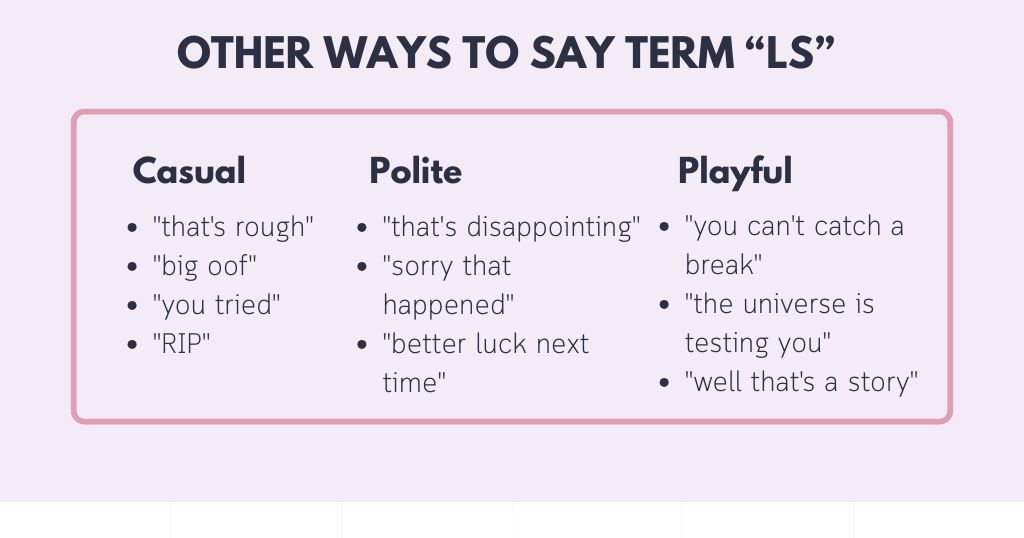
Casual with friends:
- “that’s rough”
- “big oof”
- “you tried”
- “RIP”
Polite or neutral:
- “that’s disappointing”
- “sorry that happened”
- “better luck next time”
- “that’s frustrating”
Playful without slang:
- “you can’t catch a break”
- “the universe is testing you”
- “character development moment”
- “well that’s a story”
For gaming instead of LS:
- “health drain”
- “vamp”
- “sustain”
- “regen stat”
Read More: SKID Meaning in Text: Why This Gaming Insult Stings So Hard
“LS” in Action: Messages That Actually Happen
Friend fails exam: “Three LS this semester, I’m switching majors”
Gaming build question: “Does this character scale better with LS or crit?”
Dating app bio: “Not looking for anything serious, just LS vibes”
Self-deprecating post: “Locked my keys in the car. Again. The LS never stop.”
Group chat roast: “Name one decision you made this month that wasn’t an LS”
Work frustration (casual team): “This client keeps changing requirements, we’re just taking LS at this point”
Relationship boundary: “I like you but I need this to stay LS for now”
Gamer asking for help: “My LS isn’t proccing, is the item bugged?”
Different Corners of the Internet Use “LS” Differently
LS as “losses” lives mostly on Twitter, TikTok, and Discord. It spread through sports commentary (teams “taking an L”) and morphed into personal failure humor. Younger users (under 25) recognize it instantly. People over 30 might need context. Same goes for terms like IIRC or NM generational gaps matter.
Gaming LS predates the slang version by years. If you’re in a gaming space, assume LS means lifesteal unless someone’s clearly talking about performance or win rates.
The relationship meaning is newest—maybe 2-3 years old. It’s most common on Hinge and Bumble where people try to signal intentions upfront. But it hasn’t fully crossed over to everyday texting yet.
Chinese internet users see LS as “楼上” (person who commented above you), but that meaning doesn’t overlap into English-speaking spaces at all. Completely separate usage.
Read Also: What Does CS Mean in Text? From Girls, Instagram & TikTok Explained
Why People Get LS Meaning Wrong
People mix up LS with SLS (so long sucker) because autocorrect and fast typing blur the lines. If someone types “LS!” as a goodbye, they probably meant SLS or just mashed letters.
The plural confusion trips people up constantly. LS isn’t a new acronym—it’s just L + s. But because we read it as two letters, our brain wants it to stand for two words. It doesn’t. This happens with NOOB, BOT, and GGS too—we overthink abbreviations.
Some people think LS always sounds negative. In gaming, it’s completely neutral—just a stat. And in self-deprecating humor, calling out your own LS can actually make people like you more. It’s the opposite of bragging.
The low stakes relationship meaning gets confused with “lazy” or “low effort.” They’re not the same. LS means low pressure, not low care. You can still put effort into something that’s casual.
When someone uses LS about themselves, it’s usually a coping mechanism. When they use it about someone else, check the tone. One is self-awareness, the other might be bullying.
Questions You’re Probably Wondering About LS Meaning
Is LS always about failing?
Not in gaming. There it’s just a mechanic. But in texting and social media, yeah, it usually means something went wrong.
Can I use it to cheer someone up?
Depends. “Everyone takes LS sometimes” can normalize a bad day. But “wow, another LS” when someone’s already down just rubs it in.
Does age matter for this term?
Kind of. Under 25, it’s universal slang. Over 30, you might get blank stares unless they’re online a lot.
Is it rude in a relationship context?
If someone wants serious and you say “I’m looking for LS,” yeah, that stings. But between two people on the same page, it’s just honest.
What if I use it wrong?
You’ll probably just confuse people. Worst case in gaming, you’ll ask for the wrong item. In texting, someone might think you typo’d. You won’t accidentally offend anyone like you might with GFYS or NSFW.
Does it show up in professional settings ever?
Only in very casual startups or creative teams where everyone’s under 30 and already talks like this. Otherwise, no.
Final Thoughts on Decoding LS Means
LS doesn’t have one tidy definition you can memorize. It shifts with context—gaming, dating, self-deprecating humor, or just venting about a rough week. The trick isn’t knowing every meaning. It’s reading the room (or the chat) and noticing what kind of conversation you’re in. When someone uses it, let the situation tell you what it means. And if you’re still not sure, it’s fine to just ask.

I’m Hazel, and I studied BSC English at GCUF. I focus on explaining word meanings in simple, clear language that anyone can understand. My goal is helping readers grasp everyday English, confusing terms, and slang used in real conversations and social media. I believe language learning works best when definitions connect to actual life situations. Through careful research and straightforward explanations, I make vocabulary accessible for students, learners, and anyone curious about how English really works in daily use.