

WTV stands for “whatever.” People type it when they’re flexible about plans, feeling indifferent, or sometimes when they’re done with a conversation and don’t want to argue anymore.
You Got “WTV” and Now You’re Wondering If You Messed Up
You got a message. Just three letters: “wtv.” And now you’re sitting there wondering if you messed up.
Maybe you asked someone where they want to eat, and they hit you with “wtv.” Or you apologized for something, and instead of “it’s okay,” you got “wtv” with zero emojis. That silence feels heavy, right?
Here’s the thing—you’re not overthinking it. Those three letters change meaning based on the situation and the person texting. That’s why you’re here, and that’s what we’re gonna clear up.
Breaking Down What WTV Really Sounds Like
Sure, WTV technically spells out “whatever.” But that’s like saying “K” just means “okay.” There’s a whole vibe attached to it that the dictionary definition misses.
When someone types “wtv,” they’re usually doing one of three things:
They genuinely don’t care and want you to decide. No hidden feelings, no attitude—just “you pick, I’m good.”
They’re backing out of a conversation because they’re tired of going in circles. This version feels colder.
They’re being playful with friends in a “oh please, you know I’m right” kind of way.
The meaning comes from context — what happened before and who sent it. That’s what makes it tricky.
Where You’ll Actually See WTV Pop Up
You’ll see WTV pop up most often when decisions are happening. Someone asks “pizza or burgers?” and the reply is just “wtv works.” Quick, simple, no drama.
It shows up a lot in group chats when nobody wants to be the one picking the movie or the meetup time. One person throws out “wtv y’all want” and suddenly everyone else has to actually decide. It’s in the same family as texting NP when someone thanks you — short, casual, and only rude if the situation makes it rude.
WTV in arguments. When two people are texting back and forth, getting nowhere, and one person types “wtv” with a period—that’s a door closing. The conversation just ended, even if nobody said goodbye.
WTV as a “chill” signal, especially on their stories or in comments. It’s like saying “I’m too chill to stress about this” out loud.
More Post: What Does DTM Mean in Text? Slang That Changes Based on Vibes
The Same Three Letters Can Mean Totally Different Things
If your best friend texts “wtv let’s just go” after you suggested a plan, that’s easygoing. No tension. But if someone you’re dating sends “wtv” after you canceled plans, that’s not easygoing. That’s hurt trying to sound casual.
Watch out for these signs:
- Plain “wtv” → can feel cold or annoyed
- “wtv…” → sounds like a sigh / giving up
- “wtv 😂” → playful, not serious
The relationship matters too. Your coworker saying “wtv” in Slack feels way different than your younger sibling saying it at the dinner table. One might be unprofessional. The other might just be them being a teenager.
Misreading this gets people in trouble. Same thing happens with slang like sus or dope — the word stays the same, but the feeling behind it shifts. You think someone’s fine, but they’re actually mad and waiting for you to notice. Or you think they’re mad, and they’re just genuinely telling you to choose the restaurant.
Times When Typing WTV Will Backfire on You
Don’t text “wtv” to your boss. Just don’t. It reads as disrespectful even if you mean it as “I’m flexible with the meeting time.”
Skip it in situations where someone’s opening up to you. If a friend says “I’m really stressed about my exam,” and you reply “wtv you’ll be fine,” that sounds dismissive. They wanted support, not a brush-off.
Don’t use it with people you don’t know well. Your mom’s friend, your new roommate, someone you just started talking to—they don’t have the context to know you’re being chill and not rude.
If you’re apologizing, never follow it with “wtv.” “Sorry, wtv” makes it sound like you don’t actually care that you messed up.
And if you’re already in a tense conversation, throwing in a “wtv” is like gasoline. It tells the other person you’ve checked out, which usually makes things worse.
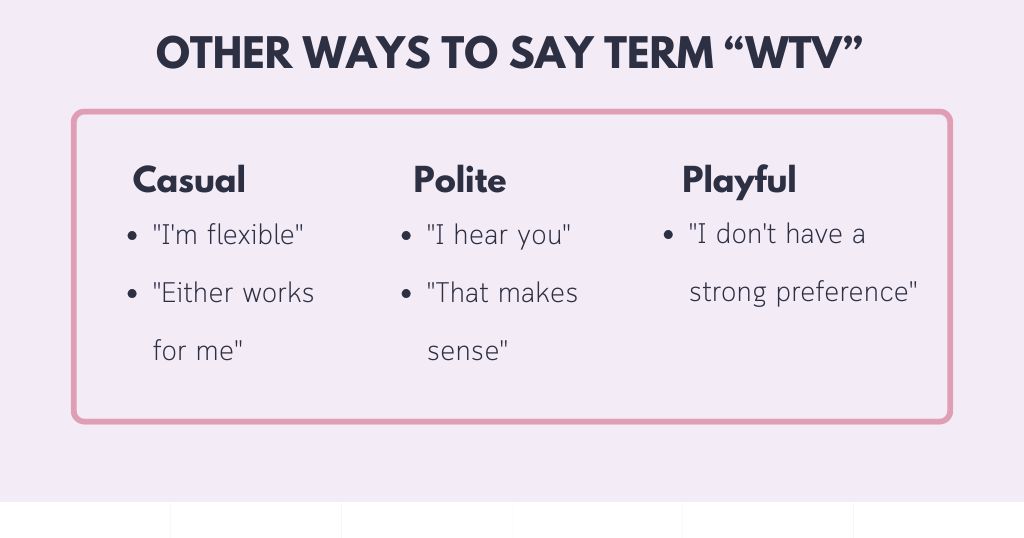
Better options for these situations:
- Work: “I’m flexible” or “Either works for me”
- Serious talks: “I hear you” or “That makes sense”
- New people: “I don’t have a strong preference”
You can also use phrases like ‘IMHO either works’ to sound polite without being stiff.
Here’s What WTV Looks Like in Actual Conversations
When it’s genuinely neutral:
“Wanna watch a movie or play games?”
“Wtv you want, I’m down for both”
“Should I get chocolate or vanilla ice cream?”
“Wtv, they’re both good”
When it sounds annoyed:
“I’m sorry I forgot to text you back”
“Wtv”
“Can we talk about what happened?”
“Wtv there’s nothing to talk about”
When it’s playful:
“You’re literally always late”
“Wtv you still wait for me 😏”
“I’m the better driver between us”
“Wtv helps you sleep at night lol”
When someone’s just done arguing:
“But I said I would do it tomorrow”
“Wtv.”
“You’re not even listening to me”
“Wtv think what you want”
Read Also: What Does MFS Mean? Guide to This Confusing Acronym
That “From a Girl vs From a Guy” Thing Everyone Find Out
People search “what does wtv mean from a girl” or “from a guy” all the time. Not because the word changes, but because the worry changes.
Here’s the truth: girls and guys can both use “wtv” in all the same ways. But people read it differently based on who they’re talking to and what they’re scared of.
If you’re into someone and they text “wtv,” you panic a little. You start rewinding the conversation looking for what you said wrong. Sometimes you did mess up. Sometimes they’re just actually fine with whatever restaurant you pick.
The stereotype is that when girls say “wtv,” there’s subtext. That it means “I’m upset but I’m not gonna say it.” Sometimes that’s true. Sometimes it’s not. Same with guys—sometimes “wtv” means “I don’t care,” and sometimes it means “I’m irritated but don’t wanna get into it.”
Stop trying to decode it based on gender. Look at how they usually text you. Did they use emojis before and suddenly stop? Did the vibe shift after something specific happened? That context tells you more than whether they’re a girl or a guy.
Different Apps, Slightly Different Vibes for WTV
On Snapchat, “wtv” shows up in quick replies to stories. Someone posts a pic of their messy desk with “wtv,” and it’s them being relatable, not actually upset.
Instagram captions and comments use it to seem carefree. “Didn’t get the job wtv 🤷♀️” is someone trying to look like they’re handling rejection smoothly, even if they’re not.
In Discord servers or gaming chats, it’s super practical. Gaming culture has its own language — terms like GG or noob mean specific things there too. “Wtv class you wanna play” just means pick your character, no hidden feelings.
Younger people (like middle school through college) use it constantly without thinking twice. Older adults might see it and think it’s rude by default because they didn’t grow up typing that way.
Myths People Believe About WTV
Biggest mistake: Thinking it’s always rude. It’s not. A lot of the time, it genuinely just means “I don’t mind.”
Second biggest mistake: Using it too much. If you reply “wtv” to everything, people stop asking your opinion. They assume you’ll never care, even about stuff that actually matters to you.
Some people think adding extra letters makes it softer. Like “wtvvv” or “wtvr.” It doesn’t really work that way. If you want it to sound nicer, add an emoji or say more words.
And here’s a weird one—people sometimes confuse WTV with WTH (what the heck) or WTF. Those are completely different. One is indifference, the others are confusion or anger. Don’t mix them up.
Smart Ways to Reply When You Get Hit With WTV
If it seems casual:
Just make the decision. “Cool, let’s do tacos then” or “Alright, 7pm works.”
If it feels off:
Check in without making it a big deal. “You sure? You seem quiet” or “Everything good?”
If you’re in an argument:
Give them space. A “wtv” during a fight usually means they need a break. Pushing right then makes it worse. Circle back later with “Hey, can we actually talk about this?”
If you genuinely can’t tell:
Mirror their energy. If they gave you one word, give one back. If they’re being short, don’t send paragraphs trying to fix it. Matching someone’s texting energy works for most slang — whether it’s YW, OOP, or anything else that feels ambiguous.
You don’t need to decode it perfectly — just read the situation. It’s to pay attention to patterns and actually know the person you’re talking to.
Read More: What Does IIRC Mean in Text? Decode Before You Use It Wrong
Questions You’re Probably Still Asking About WTV
Is WTV always rude or disrespectful?
No. It’s neutral most of the time. It only sounds rude when there’s tension already or when someone uses it to shut you down.
Can it be sarcastic?
Absolutely. With the right emoji or context, “wtv” can be playful teasing. Tone doesn’t translate automatically in text, so people add clues.
Does it mean the same thing on every app?
Mostly, yeah. But how people use it shifts a bit. Snapchat feels more casual. A work Slack feels more risky.
What if I can’t tell if someone’s mad?
Look at the whole conversation. Did they go from full sentences to one word? Did emojis disappear? Those are bigger clues than the word itself.
Should I use it with my parents or teachers?
Nope. Stick to full words. Even if you mean well, it can sound like you don’t care.
Is there a difference between “wtv” and “w/e”?
Not really. They both mean “whatever.” “w/e” is a little older, more from the early texting days. Same vibe though. Other old-school abbreviations like ROFL or BFF stuck around too.
The Real Takeaway on Reading WTV in Texts
WTV isn’t complicated because the word is hard. It’s complicated because texting is. You can’t hear someone’s voice or see their face, so three letters end up carrying a lot of weight.
Most of the time, people really do just mean “I’m cool with whatever.” But sometimes they’re tired, hurt, or done talking, and “wtv” is the quickest way to show it without starting another argument.
Your best move? Pay attention to the person, not just the word. Notice if their texting style changed. Notice what happened right before. And if you’re still confused, just ask. “That wtv felt weird—you good?” beats sitting there spiraling.
You’ll get better at reading it the more you text people. And you’ll get better at using it in a way that actually sounds like what you mean.

I’m Hazel, and I studied BSC English at GCUF. I focus on explaining word meanings in simple, clear language that anyone can understand. My goal is helping readers grasp everyday English, confusing terms, and slang used in real conversations and social media. I believe language learning works best when definitions connect to actual life situations. Through careful research and straightforward explanations, I make vocabulary accessible for students, learners, and anyone curious about how English really works in daily use.