

MFS usually means “motherf*ckers” in texting and online chats. It’s slang people use to talk about a group of folks, usually when they’re annoyed, surprised, or just messing around with friends. Because the term contains profanity, it’s mostly used casually with friends or in informal online spaces.
You Just Saw “MFS” and Now You’re Lost
You saw “mfs” pop up somewhere—maybe in a TikTok comment, a Snapchat message, or your friend’s Instagram story—and you’re sitting there thinking, “Wait, what?” That’s normal. This term gets thrown around constantly online, but nobody really explains it unless you’re already in on the joke. And here’s the thing: it doesn’t always mean what you think it means, depending on who’s saying it and where you’re reading it.
The Real Deal Behind “MFS” in Everyday Convos
When someone types “mfs,” they’re usually talking about a group of people in a blunt, slang-heavy way. Think of it like saying “these people” or “those guys,” but with way more attitude.
People use “mfs” instead of typing out full sentences because it’s faster and it carries a vibe. It’s got edge to it. You’re not just saying “people are annoying”—you’re saying it with your whole chest, even if you’re half-joking. It’s the texting version of rolling your eyes while you laugh.
Here’s where it gets tricky: among close friends, “mfs” can actually be affectionate. Like when you say “I hate you” to your best friend but you’re smiling. The words sound harsh, but the meaning isn’t.
Where This Slang Actually Shows Up
You’ll see this term most often in:
- Group chats where friends are joking around or complaining about something together
- Social media comments under funny videos or relatable posts
- Text messages when someone’s venting about their day
- Quick reactions to something wild or unexpected
It shows up when people are being casual and unfiltered. You won’t see it in formal writing or professional messages (at least, you really shouldn’t). It’s strictly for spaces where you can be loose with your language.
Read Also: What Does PM Mean in Text? Here’s What They Really Want
Tone & Context Matter More Than You Think
This is where people mess up. “MFS” can sound friendly or seriously insulting based on who’s saying it.
With your close friends? It’s probably fine. “These mfs forgot my birthday again 💀” sounds like teasing, not actual anger.
With someone you barely know? Red flag. They might think you’re being genuinely disrespectful or way too familiar.
In a public comment section? Risky. You don’t know how strangers will read your tone, and text doesn’t carry your facial expression or voice.
One major warning: if you use this with the wrong person, they might think you’re calling them out specifically, even if you meant “people in general.” Context gets lost fast in text. What feels like a joke to you might land as an insult to someone else.
Age matters here too. Younger people (teens, early 20s) are more likely to recognize this as normal slang. Older folks might just see profanity and nothing else.
Places You’ll Regret Using “MFS”
Don’t type “mfs” in:
- Work emails or Slack messages with colleagues (even if your workplace is “casual”)
- Texts to your parents, teachers, or bosses (unless you want an awkward conversation)
- Customer service chats or support tickets
- Professional social media accounts (like your LinkedIn—please)
- First conversations with new people (you’ll scare them off)
- Any situation where you’re already on thin ice
If you’re in a space where you’d normally watch your language, skip this one entirely. There are way safer ways to express frustration.
Better alternatives for professional settings:
- “Some people” or “certain folks”
- “They” or “those individuals”
- Just… describe the actual behavior without the slang
Read More: What Does PFP Mean in Text? The Two Definitions You Need to Know
Swap It Out: Other Ways to Say the Same Thing
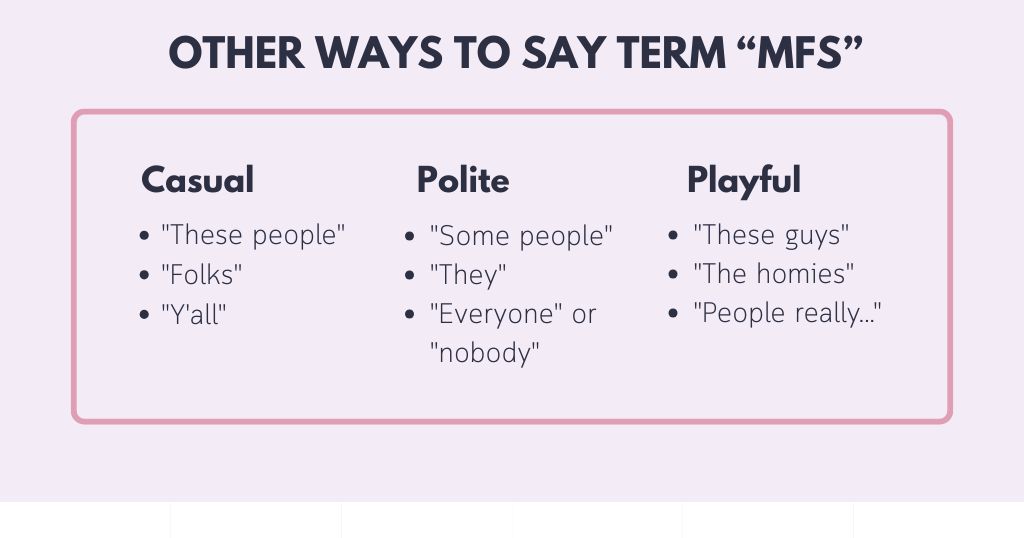
Casual with friends:
- “These people”
- “Folks”
- “Y’all” (if that fits your style)
Polite or neutral:
- “Some people”
- “They”
- “Everyone” or “nobody” (depending on context)
Playful:
- “These guys”
- “The homies” (if you’re talking about friends)
- “People really…” (keeps it light)
You don’t always need slang to get your point across. Sometimes simpler actually works better.
MFS in Action: Messages People Actually Send
Here’s how it shows up naturally:
“mfs be ordering the whole menu then say they’re broke”
“these mfs really thought I wouldn’t notice 😭”
“why do mfs always leave me on read”
“mfs will do anything except admit they’re wrong”
“woke up late because mfs were loud all night”
“mfs said they’re 5 minutes away an hour ago”
Notice the lowercase spelling? That’s super common in casual texting. Capital letters make it feel more aggressive. Lowercase with a crying emoji makes it feel more like you’re laughing about it.
How Different Apps Change the “MFS” Vibe
This term lives mostly on TikTok, Twitter (X), Snapchat, and Instagram. Each platform has a slightly different energy with it.
On TikTok, you’ll see it in captions paired with funny videos—usually observational humor about how people act.
On Snapchat, it shows up in private stories and quick rants to close friends. The vibe is more personal and raw.
On Twitter/X, it’s more commentary-driven. People often use it to react to news, trends, drama, or viral posts, and the tone can get sharper than on other platforms.
The term’s been around for years, but its usage has softened slightly. Five years ago, it was almost always negative. Now, Gen Z especially uses it more loosely—almost like saying “people” or “everyone.” The profanity is still there, but the sting has faded in some circles.
Read Also: What Does SOS Really Mean When Someone Texts It?
Getting “MFS” Wrong (And Why That Happens)
“Is this always an insult?” Nope. That’s the biggest mix-up. In tight friend groups, it’s closer to a nickname for your crew. The insult version still exists, but context tells you which one it is.
“Does it mean the same thing everywhere?” Not quite. In some regions or age groups, people won’t use this at all. In others, it’s every third word online. Your mileage will vary.
“Can I use it sarcastically?” You can, but be careful. Sarcasm already gets lost in text. Add slang that’s easy to misread, and you’ve got a recipe for confusion. If you’re unsure, just spell out what you actually mean.
Beyond Texting: What “MFS” Means in Money, Medicine, and More
Outside of texting slang, MFS means completely different things in other areas:
In finance and taxes: Married Filing Separately (a tax status when couples file individual returns instead of together)
In medicine: Marfan Syndrome or Miller-Fisher Syndrome (serious health conditions—nothing to do with slang)
In business: Mobile Financial Services (banking on your phone, like Cash App or Venmo)
In cars: Multi-Function Switch (the stick near your steering wheel that controls turn signals and wipers)
In stocks: Massachusetts Financial Services (an investment company)
If you see “MFS” on a hospital form, tax document, or financial statement, it’s definitely not the slang version. Context will make it obvious.
Read More: What Does IR Mean in Text? Here’s What People Actually Use It For
Stuff Everyone Wonders About “MFS”
Is saying “mfs” rude?
Depends who you’re talking to and how you say it. With friends who talk like this? Usually fine. With anyone else? Probably too much.
Can older people use this term?
Technically yes, but it might sound forced or weird if it’s not natural to how you normally talk. Slang works best when it fits your actual voice.
Does it mean something different on Snapchat?
Not really. The meaning stays the same, but Snapchat’s more private vibe makes people comfortable using it more freely there.
What if someone uses it and I don’t like it?
You can ignore it, respond without matching their energy, or just tell them it’s not your style. You’re not required to mirror someone else’s language.
Is “mfs” the same as “NFS”?
Nope. NFS usually means “no funny sh*t” (like “I’m being serious”) or “not for sale” in buying/selling contexts. Different abbreviations entirely.
Final Thoughts on This Whole “MFS” Thing
Look, slang changes fast, and what’s cool today might feel outdated next month. “MFS” is one of those terms that’s everywhere right now in certain circles and invisible in others. If you see it and you’re confused, you’re not alone. Just remember: it’s usually about a group of people, the tone matters way more than the actual letters, and you don’t have to use it just because everyone else does. Knowing what it means is enough. Using it? That’s your call.

I’m Hazel, and I studied BSC English at GCUF. I focus on explaining word meanings in simple, clear language that anyone can understand. My goal is helping readers grasp everyday English, confusing terms, and slang used in real conversations and social media. I believe language learning works best when definitions connect to actual life situations. Through careful research and straightforward explanations, I make vocabulary accessible for students, learners, and anyone curious about how English really works in daily use.