
MW in text usually means Most Welcome, My Way, Mwah (kiss), or My World, depending on context. It shifts meaning based on your relationship with the person and what you’re talking about.
Nobody Tells You “MW” Has Multiple Personalities
You get a text that ends with “MW” and you’re sitting there wondering if it’s affection, attitude, or something else entirely. Someone might use it to blow you a kiss while another person uses it to assert their independence. It’s the same confusion people get with abbreviations like ND or YHU—two letters that mean totally different things depending on the conversation.
The Real Feeling Behind “MW” (Not Just Letters)
“MW” changes meaning based on context:
- After thanks → “Most Welcome”
- In romantic texts → “Mwah” (kiss)
- In decisions → “My Way”
“MW” as a reply to thanks feels generous. “MW” in someone’s bio or caption feels confident, maybe even a little defiant. “MW” with heart emojis feels intimate.
Where You’ll Actually See “MW” Pop Up
You’ll spot MW in texts when:
After gratitude exchanges — Friend A says “Thanks for covering my shift!” and Friend B replies “MW! 😊” instead of typing out the full response.
In romantic messages — Someone ends their goodnight text with “Sleep well, mw 💕” as a quick way to send a kiss without using the emoji.
When making personal declarations — Captions like “Quit my job, moved to the coast, living life MW” show up on social feeds when people want to announce they’re doing things their own way.
As relationship nicknames — Some people save their partner’s contact as “My MW” or sign private notes with it to mean “my world” or “my whole life.”
In gaming circles — Though less common in regular texting, gamers shorten “Modern Warfare” to MW when organizing matches or discussing gameplay.
The pattern? MW works best in quick, casual exchanges where you already know the person well enough to read their intention.
Why “MW” Can Sound Sweet or Sketchy Depending on Who’s Texting
MW can sound sweet or awkward depending on relationship and tone.
Between close friends or partners, “MW” after a favor feels warm and genuine. It says “I was happy to help” without sounding formal.
From an acquaintance or coworker, the same MW might read as trying too hard or overly familiar—especially if you don’t text this person often.
In a heated conversation, typing “I’m doing it MW” can sound dismissive, like you’re shutting down feedback. Even if you just meant “my way,” it might come across as “my way, end of discussion.”
⚠️ Overuse warning: Saying “MW” too often makes it feel robotic instead of genuine. The same warmth that made it nice in the first message evaporates by the fifth time.
Tone also gets messy when someone uses “MW” to mean “my world” in a friendship that hasn’t reached that level yet. What feels sweet to the sender might feel uncomfortably intense to the receiver.
Read Also: What Does PM Mean in Text? Here’s What They Really Want
Times MW Meaning Will Make Things Awkward (Trust Me)
Skip MW in these situations:
Professional emails or formal work chats: Replying to your boss’s thank-you with “MW” reads as too casual, even unprofessional. Stick with “You’re welcome” or “Happy to help.”
With people you barely know: Sending MW to someone you matched with yesterday on a dating app can feel presumptuous. They don’t know your texting style yet.
When someone’s upset or stressed: If a friend thanks you for listening to their problems, “MW” might sound flippant. A fuller response shows you actually care.
In group settings with mixed company: What your best friend understands as affectionate might confuse your aunt or your study group. Clarity matters more than brevity.
When the other person is being formal with you: If they’re typing complete sentences and proper punctuation, matching their energy is smarter than suddenly throwing in casual shortcuts.
A good rule: if you wouldn’t say “mwah” out loud or announce “it’s my way” in this exact situation, don’t text it either.
Better Ways to Say What “MW” Usually Means
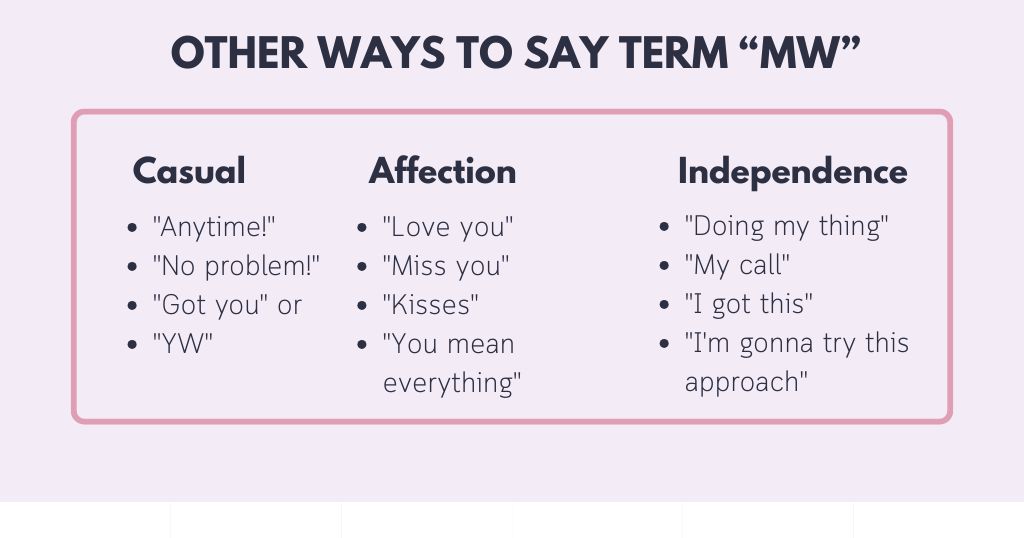
If you’re responding to thanks:
- Casual: “Anytime!” “No problem!” “Got you” or “YW” if you want another shortcut
- Polite: “You’re welcome” “My pleasure” “Glad I could help”
If you’re showing affection:
- With friends: “Love you” “Miss you” with a heart emoji
- With partners: “Kisses” “You mean everything” “XOXO”
If you’re expressing independence:
- Casual: “Doing my thing” “My call” “I got this”
- Less confrontational: “I’m gonna try this approach” “Let me handle it my style”
If you’re reacting to news:
- Surprised: “Wow!” “No way!” “NFW!” “Seriously?!”
- Impressed: “That’s amazing” “Incredible” “So cool”
Pick based on your actual relationship and what response fits the moment, not just what’s shortest.
Read Also: CD Meaning Decoded: Why This Abbreviation Confuses Everyone
Actual “MW” Messages Example People Send (The Unfiltered Version)
After a favor: “Thanks for sending me those notes!” “MW! Hope they help 😊”
Sweet goodnight: “Had the best time today” “Me too. Goodnight, mw ❤️”
Personal choice: “Everyone’s applying to business school but I’m taking a gap year. Doing this MW.”
Expressing surprise (older style): “MW! I can’t believe you ran a marathon!”
Gaming coordination: “Anyone want to play MW tonight? Need two more for the squad.”
Romantic nickname: “You’re seriously my MW. Don’t know what I’d do without you.”
Independence in a caption: “New city, new job, new rules. Living MW ✨”
Casual thanks response: “Appreciate you picking up my package!” “MW! It’s on your porch”
How “MW” Changes Across Apps and Age Groups
Instagram and TikTok users under 25 lean into “MW” for bios and captions more than older generations, often pairing it with aesthetic posts about personal growth or independence. On these platforms, “MW” as “my way” connects to self-empowerment content.
In private texts between romantic partners, the kiss interpretation (mwah) and “my world” meaning dominate. You won’t see these in public comments—they’re too intimate.
Gaming communities on Discord keep “MW” firmly in the Modern Warfare camp. If you’re in a server focused on Call of Duty, assume that’s what people mean unless context screams otherwise.
“Most Welcome” is less common among Gen Z, who prefer “ofc” or “NM” (no problem).
The slash version—M/W—usually shows up on Instagram bios to indicate “matching with” someone (coordinated profile pictures or themes with a friend or partner). That’s a different beast entirely and worth knowing if you’re decoding bio text.
More Post: IHH Meaning in Text: What It Means in Chats, DMs, and TikTok
Mistakes People Make Reading “MW” Wrong
People think MW always sounds sweet. It doesn’t. Context flips the meaning completely. What reads as affectionate in a goodnight text can read as pushy or dismissive in a work discussion.
The kiss interpretation gets missed by people who don’t text emotionally. Someone types “mw” with hearts, and the receiver just sees letters. If you’re not used to phonetic texting (writing sounds like “ugh” or “psst”), you might not catch that MW mimics a kissing noise.
Overuse kills the warmth. When someone answers every thank-you with “MW,” it stops feeling personal. The receiver starts wondering if it’s just autopilot typing instead of genuine feeling.
Without context, “MW” can be confusing. Is it affectionate? Assertive? Grateful? The reader has to guess, and they’ll often guess wrong if you haven’t set the tone through the rest of your message. The same thing happens with slang like WTV or IGHT—they sound casual until tone makes them feel dismissive.
Some people confuse it with other acronyms entirely. MW gets mixed up with MW for megawatt (in science contexts) or with M/W in relationship bios. If the conversation has nothing to do with romance, gaming, or gratitude, the person might be using a technical definition you’re not thinking of.
Questions You’re Probably About MW Meaning Right Now
Can MW sound rude?
Yes, if you use it to brush someone off. “I’m doing it MW” in response to constructive feedback sounds like you’re rejecting their input. Timing and relationship matter.
Is it weird to use MW with someone older?
Depends on the person. Some older texters like casual shortcuts; others find them confusing or too informal. If they text in full sentences, match that style.
Does MW mean the same thing everywhere?
Not even close. Gaming communities, romantic partners, and casual friends all interpret it differently. Always check what you were discussing before you decide what it means.
Can I use it sarcastically?
“Much wow” (a meme reference) is sarcastic by default, but most MW meanings aren’t. If you want sarcasm to land, you need to make it super obvious through your wording or add something like “…sure, MW 🙄.” If you want obvious sarcasm, try something like OTT (over the top) instead it’s clearer.
What if I’m not sure which meaning someone meant?
Ask. Seriously. “Wait, MW as in you’re welcome or my way?” People would rather clarify than have you guess wrong and respond weirdly.
Is this more of a girl thing or guy thing?
The romantic meanings (“my world,” kiss sounds) do skew toward how people in relationships text regardless of gender. The independence meaning (“my way”) doesn’t skew anywhere specific—anyone asserting their choices uses it. Gaming references are more common among guys statistically but not exclusively.
Should You Actually Use MW? Here’s the Deal
MW works best when context is clear and the relationship is established. But that same flexibility makes it risky with people you don’t know well or in situations where tone really matters. If you’re unsure whether your MW will land right, just type out the actual words. When shortcuts backfire, clarity beats speed. That’s why terms like SFLR and TFTI exist to acknowledge the awkwardness directly. You’ll save yourself the awkward follow-up where you have to explain what you meant.

I’m Hazel, and I studied BSC English at GCUF. I focus on explaining word meanings in simple, clear language that anyone can understand. My goal is helping readers grasp everyday English, confusing terms, and slang used in real conversations and social media. I believe language learning works best when definitions connect to actual life situations. Through careful research and straightforward explanations, I make vocabulary accessible for students, learners, and anyone curious about how English really works in daily use.