

Math vocabulary builds the foundation for understanding every subject area from basic arithmetic to advanced calculus. If you’re searching for math words that start with M, this guide covers common, advanced, and specialized terms with accurate definitions, clear examples, and practical context. Whether you’re a student, teacher, or parent, you’ll find exactly what you need here.
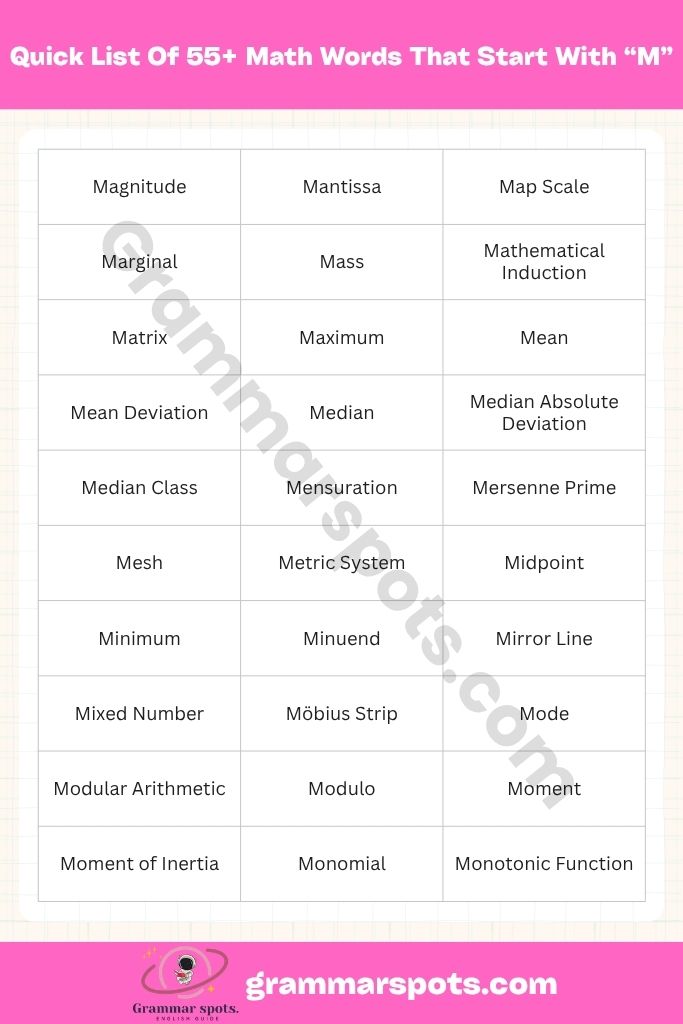
Quick List: 55+ Math Words That Start With M
- Magnitude
- Mantissa
- Map Scale
- Marginal
- Mass
- Mathematical Induction
- Matrix
- Maximum
- Mean
- Mean Deviation
- Median
- Median Absolute Deviation
- Median Class
- Mensuration
- Mersenne Prime
- Mesh
- Metric System
- Midpoint
- Minimum
- Minuend
- Mirror Line
- Mixed Number
- Möbius Strip
- Mode
- Modular Arithmetic
- Modulo
- Moment
- Moment of Inertia
- Monomial
- Monotonic Function
- Multinomial
- Multinomial Theorem
- Multiple
- Multiple Regression
- Multiplicand
- Multiplication
- Multiplicative Inverse
- Multiplier
- Multivariable Calculus
- Mutual Exclusivity
- Mandelbrot Set
- Maxima
- Minima
- Measure of Central Tendency
- Measurement
- Mirror Symmetry
- Monomial Expression
- Marginal Cost
- Marginal Rate
- Mean Absolute Deviation
- Metric Tensor
- Moore Determinant
- Morphism
- Modulus
- Multiset
- Modus Ponens
- Majorization
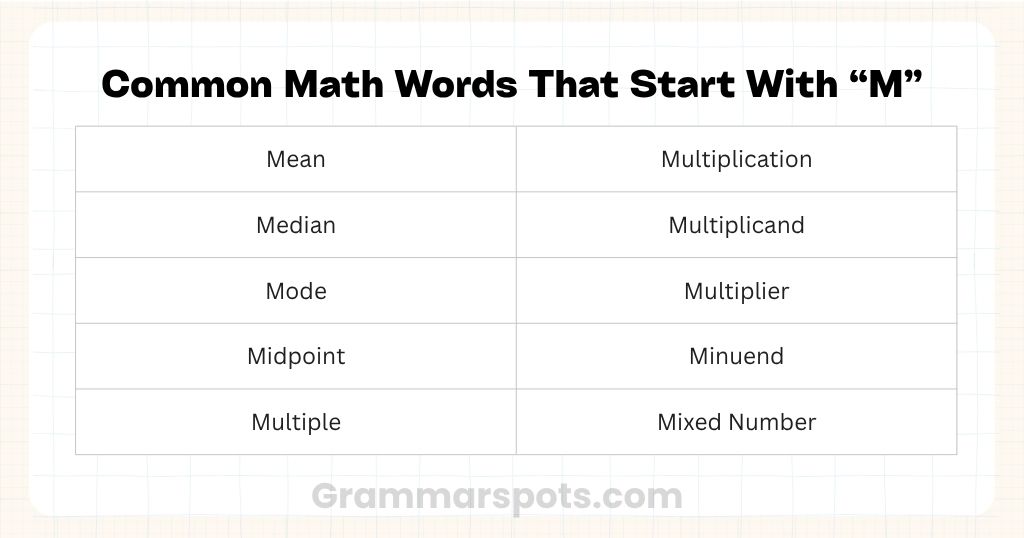
Common Math Words That Start With M
Mean
- Meaning: The arithmetic average of a data set
- Example: Mean of 4, 8, 12 → (4+8+12) ÷ 3 = 8
- Why it matters: Used in every level of data analysis, from class grades to national statistics
Median
- Meaning: The middle value in an ordered data set
- Example: In {3, 7, 9, 12, 15} → median = 9
- Why it matters: More reliable than mean when data has extreme outliers
Mode
- Meaning: The value that appears most frequently in a data set
- Example: In {2, 4, 4, 7, 7, 7} → mode = 7
- Why it matters: Identifies the most common result in surveys and frequency tables
Midpoint
- Meaning: The exact center between two points on a line segment
- Formula: ((x₁+x₂)/2, (y₁+y₂)/2)
- Example: Midpoint of (2,4) and (8,10) = (5, 7)
- Why it matters: Used in coordinate geometry and map reading
Multiple
- Meaning: The product of a number and any integer
- Example: Multiples of 6 → 6, 12, 18, 24…
- Why it matters: Essential for LCM problems, fractions, and number patterns
Multiplication
- Meaning: The operation of repeated addition of a number
- Example: 6 × 4 = 24
- Why it matters: One of the four core arithmetic operations; foundational at every level
Multiplicand
- Meaning: The number being multiplied in a multiplication expression
- Example: In 6 × 4, 6 is the multiplicand
- Why it matters: Helps students understand the structure of multiplication expressions
Multiplier
- Meaning: The number by which the multiplicand is multiplied
- Example: In 6 × 4, 4 is the multiplier
- Why it matters: Key in scaling, percentage problems, and ratio contexts
Minuend
- Meaning: The number from which another is subtracted
- Example: In 15 − 6 = 9, 15 is the minuend
- Why it matters: Builds proper understanding of subtraction structure
Mixed Number
- Meaning: A whole number combined with a proper fraction
- Example: 3½ (3 whole and one-half)
- Why it matters: Appears in measurement, cooking, and fraction operations
Mass
- Meaning: The amount of matter in an object, measured in grams or kilograms
- Example: A textbook has a mass of 800 grams
- Why it matters: Used in measurement and science-math crossover problems
Metric System
- Meaning: A base-10 measurement system using meters, grams, and liters
- Example: 1 kilometer = 1,000 meters
- Why it matters: The global standard for mathematical and scientific measurement
Measurement
- Meaning: Determining the size, length, area, or volume of something using standard units
- Example: A desk measures 120 cm in length
- Why it matters: One of the most practical, real-world applications of math
Mirror Line
- Meaning: The line of symmetry across which a figure is reflected
- Example: The letter “A” has a vertical mirror line down its center
- Why it matters: Core to understanding geometric transformations and symmetry
Map Scale
- Meaning: The ratio comparing a distance on a map to the actual real-world distance
- Example: A scale of 1:50,000 means 1 cm on the map = 50,000 cm (500 m) in reality
- Why it matters: Applies ratio and proportion to real navigation problems
Maximum
- Meaning: The greatest value in a set or the highest point of a function
- Example: In {3, 8, 14, 6} → maximum = 14
- Why it matters: Used in optimization problems, graph analysis, and calculus
Minimum
- Meaning: The smallest value in a set or lowest point of a function
- Example: f(x) = x² + 4 has a minimum of 4 at x = 0
- Why it matters: Appears in cost minimization, parabola graphing, and calculus
Monomial
- Meaning: An algebraic expression with exactly one term
- Example: 5x², −3y, 7
- Why it matters: The building block of polynomials and algebraic expressions
Magnitude
- Meaning: The size or length of a mathematical object such as a vector or complex number
- Formula: |v| = √(x² + y²)
- Example: Vector (3, 4) has magnitude 5
- Why it matters: Essential in vector math, physics, and complex number theory
Modulo
- Meaning: The remainder after dividing one integer by another
- Example: 17 mod 5 = 2 (17 ÷ 5 = 3 remainder 2)
- Why it matters: Foundation of cryptography, computer science, and number theory
Mensuration
- Meaning: The branch of geometry focused on calculating lengths, areas, and volumes
- Example: Surface area of a cylinder = 2πr² + 2πrh
- Why it matters: Applied in construction, engineering, and every geometry curriculum
Multiplicative Inverse
- Meaning: The number that, when multiplied by the original, gives 1 (the reciprocal)
- Example: Multiplicative inverse of 5 = 1/5, because 5 × 1/5 = 1
- Why it matters: Used in dividing fractions, solving equations, and abstract algebra
Mantissa
- Meaning: The decimal (fractional) part of a logarithm
- Example: In log(350) ≈ 2.544, the mantissa is .544
- Why it matters: Important in logarithmic calculations and floating-point arithmetic
Mean Deviation
- Meaning: The average of the absolute differences between each value and the mean
- Example: For {2, 4, 6, 8}, mean = 5; deviations = 3,1,1,3; mean deviation = 2
- Why it matters: An intuitive measure of how spread out data values are
Median Class
- Meaning: The class interval containing the median in a grouped frequency distribution
- Example: If most data falls in the 40–50 range, that is the median class
- Why it matters: Used when data is grouped in ranges rather than listed individually
Mirror Symmetry
- Meaning: A property where one half of a figure is the exact reflection of the other
- Example: A square has 4 lines of mirror symmetry
- Why it matters: Fundamental in geometry, art, nature, and engineering design
Mutual Exclusivity
- Meaning: Two events are mutually exclusive if they cannot both occur at the same time
- Example: Rolling a 3 and rolling a 5 on one die are mutually exclusive
- Why it matters: Core concept in probability rules and event calculation
Modulus
- Meaning: The absolute value of a real number, or the magnitude of a complex number
- Example: |−7| = 7; modulus of (3+4i) = 5
- Why it matters: Used in both real number arithmetic and complex number theory
Related Post: 45+ Math Words That Start With N (With Meanings and Examples)
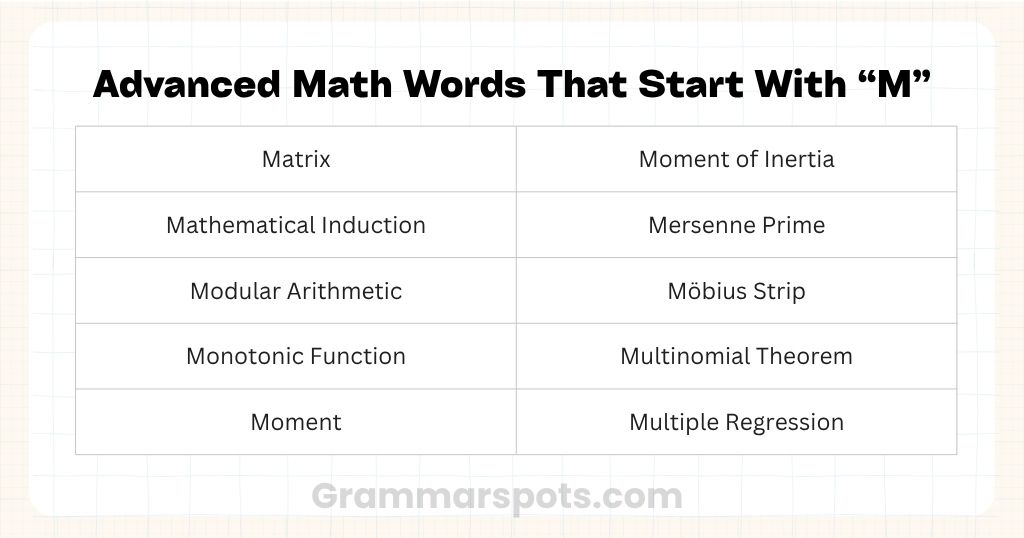
Advanced Math Words That Start With M
Matrix
- Meaning: A rectangular array of numbers arranged in rows and columns
- Example: A 2×2 matrix: | 2 5 | / | 3 8 |
- Math Branch: Linear Algebra
- Application: Solving systems of equations, computer graphics, data transformation
Mathematical Induction
- Meaning: A proof method that proves a statement true for all natural numbers via a base case and inductive step
- Example: Proving 1+2+3+…+n = n(n+1)/2
- Math Branch: Proof Theory
- Application: Verifying formulas and algorithms across all integer values
Modular Arithmetic
- Meaning: Arithmetic where numbers reset after reaching a set modulus
- Example: 10 + 4 = 2 (mod 12) — like a 12-hour clock
- Math Branch: Number Theory
- Application: Cryptography, computer hashing, circular scheduling
Monotonic Function
- Meaning: A function that only increases or only decreases never reverses direction
- Example: f(x) = 2x is monotonically increasing
- Math Branch: Calculus / Analysis
- Application: Determining if a function has an inverse; analyzing trends
Moment
- Meaning: A quantitative measure describing the shape of a probability distribution
- Example: The 2nd moment about the mean gives variance: σ² = Σ(x−μ)²/n
- Math Branch: Statistics
- Application: Describing distribution shape (skewness, kurtosis)
Moment of Inertia
- Meaning: A measure of resistance to rotational acceleration, calculated as I = Σmr²
- Example: A solid disk has I = ½mr²
- Math Branch: Applied Math / Physics Math
- Application: Structural engineering, mechanical design, rotational dynamics
Mersenne Prime
- Meaning: A prime number of the form 2ⁿ − 1
- Example: 2³ − 1 = 7; 2⁵ − 1 = 31 (both Mersenne primes)
- Math Branch: Number Theory
- Application: Prime research; connected to perfect numbers
Möbius Strip
- Meaning: A one-sided, non-orientable surface created by giving a strip a half-twist and joining the ends
- Example: Drawing a line along its center brings you back to the start without lifting your pen
- Math Branch: Topology
- Application: Abstract math, conveyor belt engineering, circuit design
Multinomial Theorem
- Meaning: Extends the binomial theorem to expressions with three or more terms raised to a power
- Example: (a+b+c)² = a²+b²+c²+2ab+2bc+2ac
- Math Branch: Combinatorics / Algebra
- Application: Probability distributions, algebraic expansion
Multiple Regression
- Meaning: A statistical model predicting one outcome using two or more independent variables
- Example: Predicting exam score from hours studied + hours slept
- Math Branch: Statistics
- Application: Data science, research analysis, forecasting
Multivariable Calculus
- Meaning: Calculus extended to functions of more than one variable
- Example: Gradient of f(x,y) = x²+y² → (2x, 2y)
- Math Branch: Calculus
- Application: Physics, engineering, machine learning, economics modeling
Mandelbrot Set
- Meaning: The set of complex numbers c for which the sequence z → z²+c remains bounded
- Example: Produces infinitely detailed fractal boundary patterns
- Math Branch: Fractal Geometry / Complex Analysis
- Application: Chaos theory, computer graphics, mathematical art
Marginal
- Meaning: The rate of change of a quantity with respect to a one-unit change in another
- Example: If C(x) = 3x²+2x, marginal cost = C'(x) = 6x+2
- Math Branch: Calculus / Applied Math
- Application: Economics optimization, cost and revenue analysis
Metric Tensor
- Meaning: A mathematical object that defines distances and angles in curved space
- Example: Used to compute arc length on a curved surface
- Math Branch: Differential Geometry
- Application: General relativity, advanced geometry
Morphism
- Meaning: A structure-preserving map between two mathematical objects
- Example: A group homomorphism maps one group to another while preserving operations
- Math Branch: Abstract Algebra / Category Theory
- Application: Unifying structures across different areas of math
Majorization
- Meaning: A concept describing when one vector’s values are more “spread out” than another’s
- Example: (3,1) majorizes (2,2) because its values are more unequal
- Math Branch: Linear Algebra / Optimization
- Application: Inequality proofs, quantum information, optimization theory
Multiset
- Meaning: A generalization of a set that allows repeated elements
- Example: {2, 2, 3, 5, 5, 5} is a multiset
- Math Branch: Set Theory / Combinatorics
- Application: Counting problems, database theory, combinatorial analysis
Modus Ponens
- Meaning: A fundamental logical inference rule: if P implies Q, and P is true, then Q must be true
- Example: If “x > 5 → x > 3” and x = 7, then x > 3
- Math Branch: Logic / Mathematical Proof
- Application: Constructing valid mathematical arguments and proofs
Mesh
- Meaning: A grid of discrete points used to numerically approximate continuous solutions
- Example: A mesh divides a bridge structure into triangles to simulate stress loads
- Math Branch: Numerical Analysis
- Application: Engineering simulations, computational fluid dynamics, 3D modeling
Geometry Terms That Start With M
- Midpoint
- Mensuration
- Mirror Line
- Mirror Symmetry
- Möbius Strip
- Map Scale
Related Post: 35+ Math Words That Start With O | Meanings, Examples & Uses
Statistics Terms That Start With M
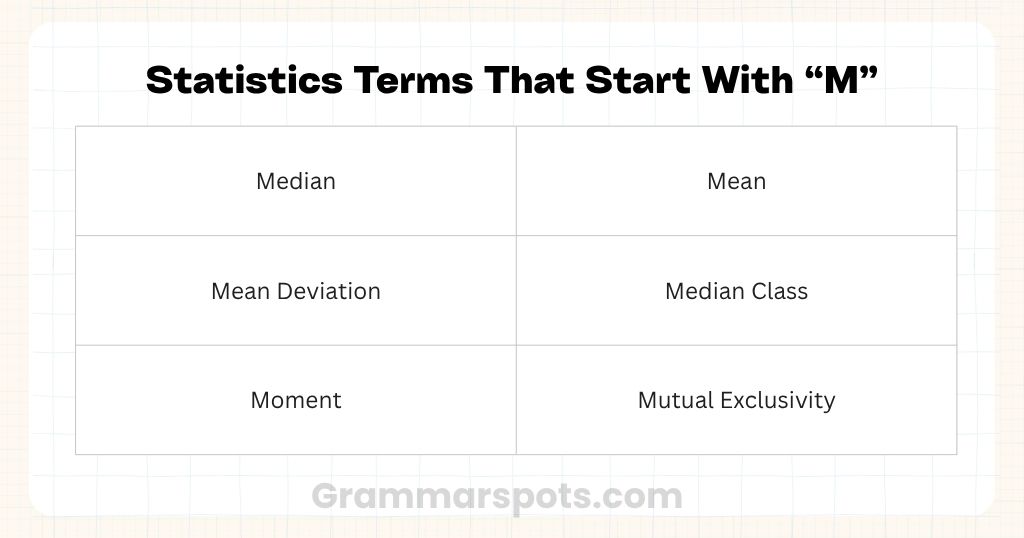
- Mean
- Median
- Mode
- Moment
- Mean Deviation
- Median Class
- Median Absolute Deviation
- Multiple Regression
- Mutual Exclusivity
Algebra Terms That Start With M
- Monomial
- Matrix
- Multiplicative Inverse
- Maximum
- Minimum
- Multinomial
- Multinomial Theorem
Number Theory Terms Starting With M
- Modulo
- Modulus
- Modular Arithmetic
- Mersenne Prime
- Multiple
Arithmetic Terms Starting With M
- Multiplication
- Multiplicand
- Multiplier
- Minuend
- Mixed Number
Advanced / Pure Math Terms That Start With M
- Mathematical Induction
- Möbius Strip
- Monotonic Function
- Multivariable Calculus
- Mandelbrot Set
- Metric Tensor
- Morphism
- Majorization
- Modus Ponens
- Multiset
- Mesh
Real-World Applications
Construction and Engineering
- Mensuration calculates material quantities (concrete, flooring, paint)
- Moment of inertia determines beam and axle behavior under rotation
- Mesh grids simulate structural stress and fluid flow
Data Science and Research
- Mean, median, and mode form the core of descriptive statistics
- Multiple regression models relationships between multiple variables
Cryptography and Computing
- Modular arithmetic powers RSA encryption and internet security
- Modulo operations appear in hashing functions and loop cycling
Navigation and Mapping
- Map scale applies ratio and proportion to real distances
- Midpoint and magnitude calculations support GPS and surveying
Physics and Applied Math
- Magnitude describes vector size in force and velocity problems
- Multivariable calculus models fields, motion, and energy in three dimensions
Finance and Economics
- Marginal cost and marginal revenue guide production decisions
- Multiple regression forecasts prices, risk, and demand
Tips for Remembering Math Words Starting With M
- Group by branch learn mean, median, and mode as a trio; matrix with linear equations; modulo with modular arithmetic
- Ask “what does it measure?” many M-words quantify something (mean = center, magnitude = size, minimum = lowest)
- Make vocabulary cards for advanced terms, write the definition in your own words, add a quick example, note one real use
- Anchor to real data calculate the mean and median of your last five quiz scores; find the midpoint between two cities on a map
- Use spaced repetition apps like Anki help lock in advanced terms like monotonic, mantissa, and Mersenne prime through timed review
Related Post: 40+ Math Words That Start With L (With Meanings and Examples)
Commonly Confused Math Terms That Start With M
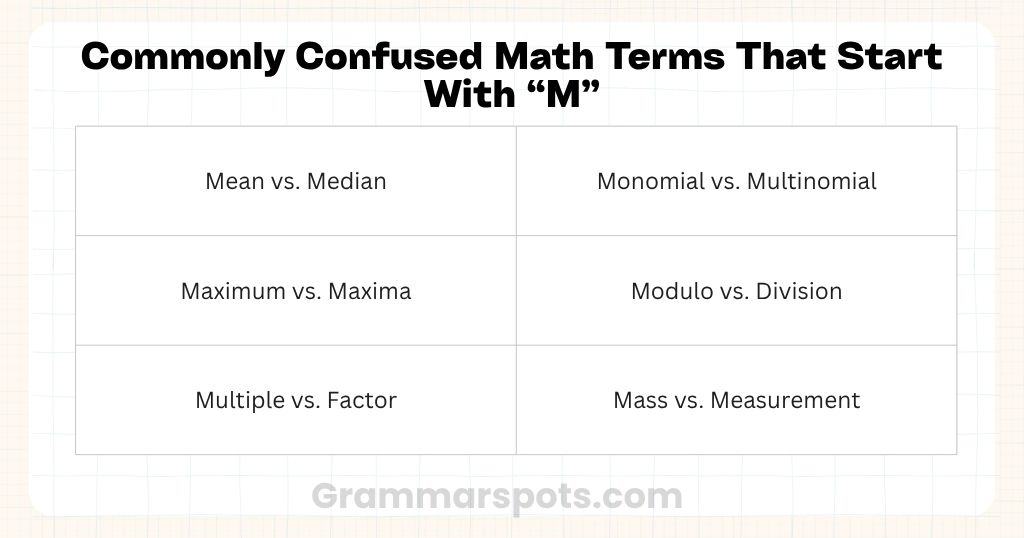
Mean vs. Median
- Mean adds all values and divides sensitive to outliers
- Median finds the literal middle value resistant to outliers
- Five employees earn $30K; one earns $500K → mean salary is misleading; median is more honest
Maximum vs. Maxima
- Maximum = the single greatest value in a specific context
- Maxima = all local and global high points of a function
- A function can have many local maxima but only one global maximum
Multiple vs. Factor
- Multiple of 6 → numbers you get by multiplying 6 (6, 12, 18…)
- Factor of 6 → numbers that divide into 6 evenly (1, 2, 3, 6)
- Multiples go up; factors go down
Monomial vs. Multinomial
- Monomial = one term (7x³)
- Multinomial = three or more terms (x²+3x+5)
- A binomial (two terms) sits between them
Modulo vs. Division
- Division asks: how many times does one number fit into another?
- Modulo asks: what is left over?
- 20 ÷ 6 = 3 remainder 2 → modulo gives 2, division gives 3
Mass vs. Measurement
- Mass is one specific quantity (amount of matter in grams/kg)
- Measurement is the broader process of quantifying anything (length, area, volume, time)
- Mass is always a measurement, but measurement is not always about mass
Modulus vs. Modulo
- Modulus = the absolute value of a number (real or complex); |−7| = 7
- Modulo = the remainder operation; 17 mod 5 = 2
- Related but different operations used in different contexts
Frequently Asked Questions
What are the most important math words starting with M for elementary students?
- Mean, median, mode, multiple, midpoint, measurement, mixed number, and mass are the core terms at elementary level
Which M words appear most on standardized tests?
- Mean, median, mode, maximum, minimum, and modulo are most commonly tested
- At SAT/ACT level, interpreting mean vs. median in data problems is especially important
What is the easiest way to remember modulo?
- Think of a 12-hour clock — after 12 it resets to 1
- 14 o’clock on a 12-hour clock = 2 → that’s 14 mod 12 = 2
Is matrix only for advanced students?
- Matrices appear in pre-algebra for some curricula and become central in linear algebra
- High school students use them to solve systems of equations; college students use them across every quantitative field
What M words relate to shapes and geometry?
- Midpoint, mensuration, Möbius strip, mirror line, mirror symmetry, and map scale all belong to geometry
What is a Mersenne prime and why does it matter?
- A prime of the form 2ⁿ − 1 (e.g., 7, 31, 127)
- The largest known prime numbers are Mersenne primes, discovered through distributed computing projects
- They are also connected to perfect numbers in number theory
What does monotonic mean in plain terms?
- A function that only ever goes up, or only ever goes down never both
- f(x) = x³ always increases; f(x) = −x always decreases both are monotonic
Conclusion
Math words that start with M span every level of the subject from the everyday (mean, multiple, measurement) to the theoretical (Mersenne primes, Möbius strip, modular arithmetic). The 57 terms in this guide cover:
- Easy terms for elementary and middle school
- Medium terms for high school algebra, geometry, and statistics
- Advanced terms for calculus, number theory, and pure mathematics
Start with the common terms, connect each one to a real example, and work upward. That’s how math vocabulary becomes second nature.

I’m Hazel, and I studied BSC English at GCUF. I focus on explaining word meanings in simple, clear language that anyone can understand. My goal is helping readers grasp everyday English, confusing terms, and slang used in real conversations and social media. I believe language learning works best when definitions connect to actual life situations. Through careful research and straightforward explanations, I make vocabulary accessible for students, learners, and anyone curious about how English really works in daily use.