

Math vocabulary builds the foundation for understanding every concept from basic arithmetic to advanced calculus. The letter O contains a rich set of mathematical terms used across geometry, algebra, number theory, probability, and higher mathematics.
This guide covers 35+ verified math words that start with O. Each term includes a clear meaning, a practical example, and why it matters in math. Useful for students, teachers, and parents at every level.
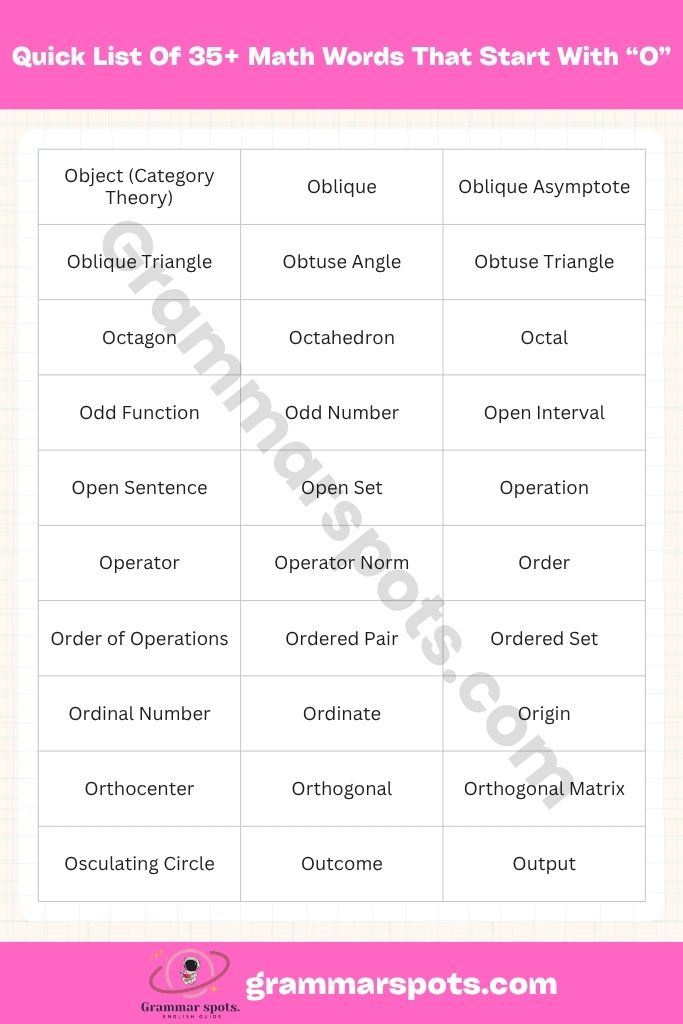
Quick List: 35+ Math Words That Start With O
- Object (Category Theory)
- Oblique
- Oblique Asymptote
- Oblique Triangle
- Obtuse Angle
- Obtuse Triangle
- Octagon
- Octahedron
- Octal
- Odd Function
- Odd Number
- Open Interval
- Open Sentence
- Open Set
- Operation
- Operator
- Operator Norm
- Order
- Order of Operations
- Ordered Pair
- Ordered Set
- Ordinal Number
- Ordinate
- Origin
- Orthocenter
- Orthogonal
- Orthogonal Matrix
- Osculating Circle
- Outcome
- Output
- Oval
- Overflow
- Overestimate
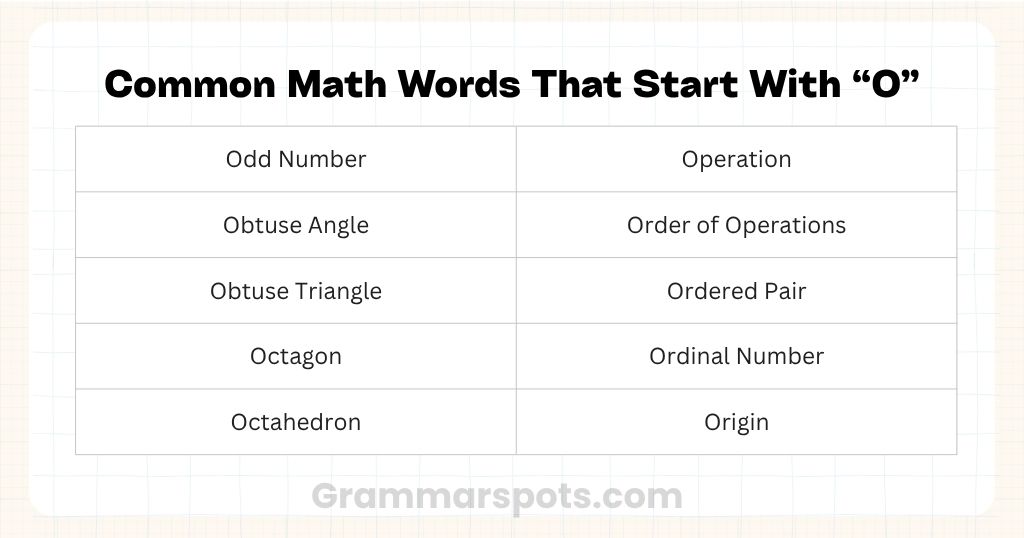
Common Math Words That Start With O
Odd Number
Meaning: Any integer that cannot be divided evenly by 2. It always leaves a remainder of 1.
Example: 1, 3, 5, 7, 9 are odd numbers. 7 ÷ 2 = 3 remainder 1.
Why It Matters: Odd/even classification is foundational in divisibility, factoring, and number theory.
Obtuse Angle
Meaning: An angle that measures more than 90° but less than 180°.
Example: An angle of 115° is obtuse.
Why It Matters: Used in triangle classification, polygon angle sums, and trigonometry.
Obtuse Triangle
Meaning: A triangle containing exactly one obtuse angle.
Example: A triangle with angles 110°, 40°, and 30° is an obtuse triangle.
Why It Matters: Obtuse triangles require special approaches in trigonometric calculations since the standard right-triangle rules don’t apply directly.
Octagon
Meaning: A polygon with exactly eight sides and eight angles.
Example: A standard stop sign is shaped like a regular octagon.
Why It Matters: The interior angle sum of any octagon is always 1,080°. Octagons appear in geometry, architecture, and tile design.
Octahedron
Meaning: A three-dimensional solid with eight triangular faces.
Example: A regular octahedron looks like two square pyramids joined at their bases.
Why It Matters: One of the five Platonic solids. Students encounter it in 3D geometry and solid figure classification.
Operation
Meaning: A mathematical process applied to numbers to produce a result. The four basic operations are addition, subtraction, multiplication, and division.
Example: In 8 − 3 = 5, subtraction is the operation.
Why It Matters: Operations are the core actions of all mathematics. Every equation and expression depends on them.
Order of Operations
Meaning: A standard rule set that determines which calculation to perform first in an expression. Remembered as PEMDAS or BODMAS.
Example: In 5 + 2 × 3, multiplication comes first: 2 × 3 = 6, then 5 + 6 = 11. Not 21.
Why It Matters: Without this rule, the same expression produces different answers. It is one of the most practically important rules in arithmetic and algebra.
Ordered Pair
Meaning: Two numbers written in a fixed order as (x, y) that locate a point on a coordinate plane.
Example: The point (4, 7) is 4 units along the x-axis and 7 units along the y-axis.
Why It Matters: Essential for graphing functions, mapping coordinates, and understanding spatial relationships.
Ordinal Number
Meaning: A number that shows position or rank in a sequence rather than quantity.
Example: First, second, fifth these are ordinal numbers. The 4th term of a sequence uses an ordinal.
Why It Matters: Used in sequences, data ranking, and statistics. Different from cardinal numbers, which count quantity.
Origin
Meaning: The point (0, 0) on a coordinate plane where the x-axis and y-axis intersect.
Example: The line y = 3x passes through the origin.
Why It Matters: The origin is the reference point for all coordinate measurements on any graph.
Output
Meaning: The result a function produces when an input value is applied.
Example: If f(x) = 5x and x = 3, the output is 15.
Why It Matters: Input-output relationships are central to understanding functions throughout algebra and calculus.
Oval
Meaning: A closed, elongated curved shape that resembles a flattened circle. An ellipse is a mathematically precise type of oval.
Example: An egg shape is an oval. An ellipse with semi-axes 4 and 2 is a defined oval.
Why It Matters: Ovals and ellipses appear in conic sections, astronomy (orbital paths), and engineering design.
Overestimate
Meaning: An approximation that is higher than the actual value.
Example: If a sum is actually 48 but you round and estimate 60, that is an overestimate.
Why It Matters: Students use overestimates in rounding, mental math, and error analysis to check reasonableness of answers.
Outcome
Meaning: A single possible result of a probability experiment.
Example: When flipping a coin, the possible outcomes are heads and tails.
Why It Matters: Outcomes are the building blocks of probability theory. Listing all outcomes creates the sample space.
Related Post: 45+ Math Words That Start With N (With Meanings and Examples)
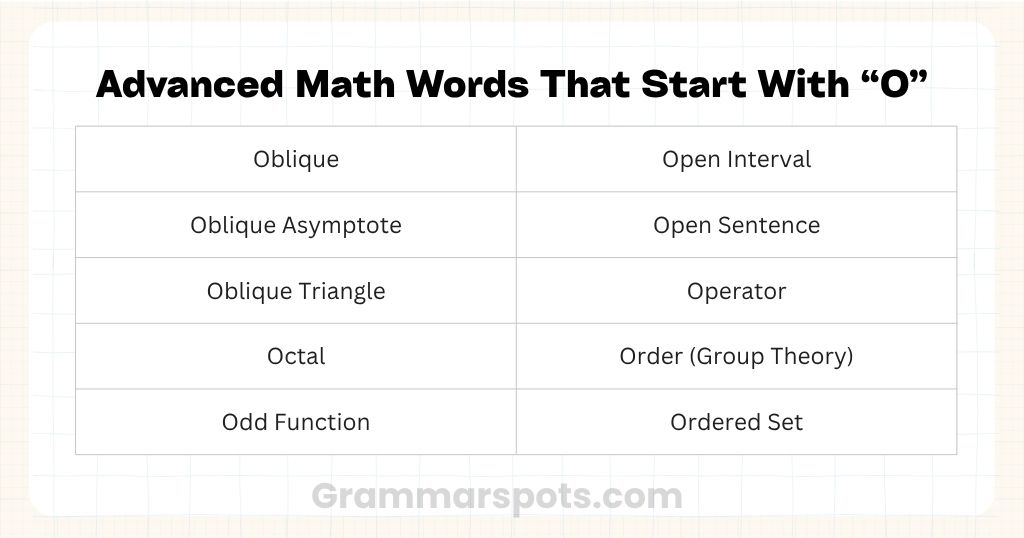
Advanced Math Words That Start With O
Oblique
Meaning: A line, plane, or figure that is neither horizontal nor vertical it is slanted or at an angle.
Example: A ramp is an oblique surface. A line with slope 2 is an oblique line.
Why It Matters: Oblique lines and planes appear in coordinate geometry, 3D solid geometry, and trigonometry.
Oblique Asymptote
Meaning: A slanted (non-horizontal, non-vertical) line that a graph approaches as x moves toward positive or negative infinity. Also called a slant asymptote.
Example: The function f(x) = (x² + 1) / x has the oblique asymptote y = x.
Why It Matters: Oblique asymptotes appear in rational function analysis, a key topic in precalculus and calculus curve sketching.
Math Branch: Algebra, Precalculus, Calculus
Oblique Triangle
Meaning: Any triangle that contains no right angle either all acute angles or one obtuse angle.
Example: A triangle with angles 80°, 60°, and 40° is an oblique triangle.
Why It Matters: Oblique triangles require the Law of Sines or Law of Cosines to solve for unknown sides and angles.
Math Branch: Trigonometry
Octal
Meaning: A base-8 number system using only the digits 0 through 7.
Example: The decimal number 8 equals 10 in octal. Decimal 64 equals 100 in octal.
Why It Matters: Octal connects to computer science and digital systems. Understanding different number bases strengthens overall number sense.
Math Branch: Number Systems, Discrete Mathematics
Odd Function
Meaning: A function f(x) where f(−x) = −f(x) for all values of x. Its graph is symmetric about the origin.
Example:
f(x) = x³ is odd because f(−2) = −8 = −f(2).
Why It Matters: Odd function symmetry simplifies integration in calculus. The definite integral of an odd function over a symmetric interval equals zero.
Math Branch: Algebra, Calculus
Open Interval
Meaning: All real numbers strictly between two endpoints, written as (a, b), where the endpoints are not included.
Example: The open interval (3, 8) includes every number greater than 3 and less than 8 — but not 3 or 8.
Why It Matters: Open intervals define domains, ranges, and conditions for limits and continuity in calculus.
Math Branch: Algebra, Calculus, Real Analysis
Open Sentence
Meaning: A mathematical statement containing a variable that is neither true nor false until the variable is replaced with a value.
Example: x + 5 = 12 is an open sentence. It becomes true when x = 7 and false for any other value.
Why It Matters: Open sentences introduce students to algebraic thinking and equation solving at the pre-algebra level.
Math Branch: Pre-Algebra, Algebra
Operator
Meaning: A symbol or function that performs a specific mathematical action on a value or expression.
Example:
- +, −, ×, ÷ are arithmetic operators.
- d/dx is the derivative operator in calculus.
- ∫ is the integral operator.
Why It Matters: Operators are the language of higher mathematics. Understanding what each operator does is essential from arithmetic through advanced calculus.
Math Branch: Algebra, Calculus, Functional Analysis
Order (Group Theory)
Meaning: In group theory, the order of a group is the total number of elements it contains. The order of an element is the smallest positive integer n such that applying the element n times returns to the identity.
Example: The group of symmetries of a square has order 8.
Why It Matters: Order is a central concept in abstract algebra and number theory, with applications in cryptography.
Math Branch: Abstract Algebra, Group Theory
Ordered Set
Meaning: A set in which elements are arranged according to a defined relationship typically from least to greatest or by rank.
Example: {1, 3, 5, 7, 9} is an ordered set of odd numbers arranged in ascending order.
Why It Matters: Ordered sets are foundational in set theory, discrete mathematics, and data organization.
Math Branch: Set Theory, Discrete Mathematics
Ordinate
Meaning: The y-coordinate of a point on a coordinate plane the vertical distance from the x-axis.
Example: In the point (6, 11), the ordinate is 11.
Why It Matters: Students frequently confuse ordinate (y-value) with abscissa (x-value). Knowing the precise term matters in geometry and algebra communication.
Math Branch: Coordinate Geometry
Orthocenter
Meaning: The point where all three altitudes of a triangle meet. An altitude is a perpendicular line from a vertex to the opposite side.
Example: In an acute triangle, the orthocenter sits inside the triangle. In an obtuse triangle, it falls outside.
Why It Matters: One of a triangle’s four classical centers. It appears in advanced geometry and is connected to the Euler Line.
Math Branch: Euclidean Geometry
Orthogonal
Meaning: Two lines, vectors, or functions are orthogonal when they are perpendicular meeting at exactly 90°. In broader math, two objects are orthogonal when their inner product equals zero.
Example: Vectors (1, 0) and (0, 1) are orthogonal. Their dot product = 0.
Why It Matters: Orthogonality is central to linear algebra, Fourier analysis, 3D modeling, and machine learning mathematics.
Math Branch: Linear Algebra, Geometry
Orthogonal Matrix
Meaning: A square matrix whose rows and columns are orthogonal unit vectors. Its transpose equals its inverse: Qᵀ = Q⁻¹.
Example: Rotation matrices in 2D and 3D are orthogonal matrices.
Why It Matters: Orthogonal matrices preserve lengths and angles. They are fundamental in computer graphics, physics simulations, and data science.
Math Branch: Linear Algebra
Related Post: 55+ Math Words That Start With M (With Meanings and Examples)
Rare and Specialized Math Words That Start With O
Osculating Circle
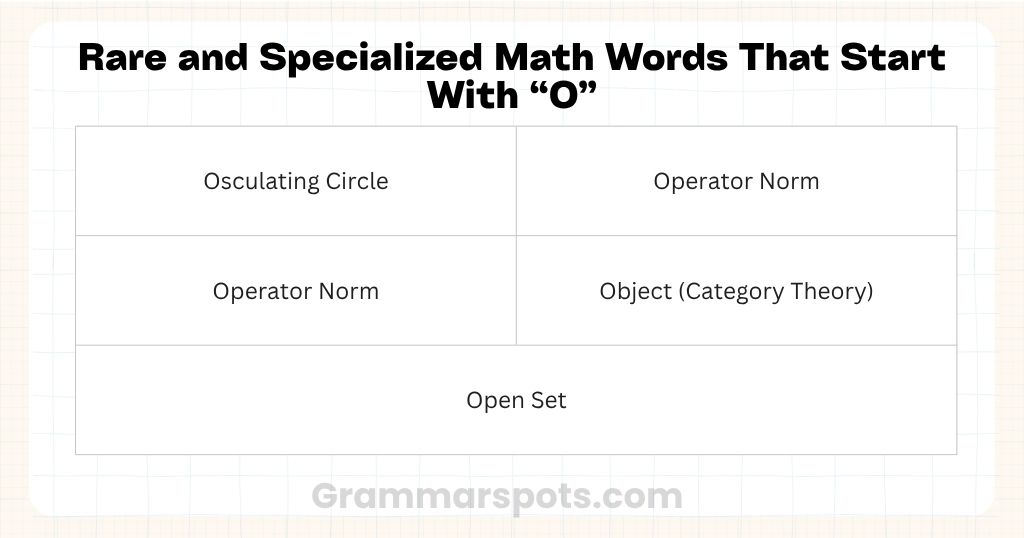
Meaning: The circle that best fits the curvature of a curve at a specific point. It shares the same tangent and curvature as the curve at that point.
Example: At any point on a parabola, the osculating circle “kisses” the curve, touching and curving with it exactly at that location.
Math Branch: Differential Geometry, Calculus
Real-World Use: Road design, roller coaster engineering, satellite orbital paths.
Operator Norm
Meaning: A measure of the maximum factor by which a linear operator can stretch a vector.
Math Branch: Functional Analysis, Linear Algebra
Real-World Use: Numerical methods, quantum mechanics, optimization algorithms.
Open Set
Meaning: A set in which every point has a surrounding neighborhood entirely contained within the set no boundary points are included.
Example: All real numbers between 0 and 1, excluding 0 and 1, form an open set.
Math Branch: Topology, Real Analysis
Real-World Use: Foundation of topological spaces used in physics, data science, and pure mathematics.
Object (Category Theory)
Meaning: The most basic element in category theory a node in a mathematical structure connected by morphisms (arrows). Objects can represent sets, spaces, numbers, or any mathematical entity.
Math Branch: Category Theory, Abstract Algebra
Real-World Use: Theoretical computer science, type theory, formal verification systems.
Overflow
Meaning: In computer mathematics, overflow occurs when a calculation produces a result too large for the allocated memory space to store.
Example: An 8-bit integer can hold values up to 255. Adding 200 + 100 = 300 causes an overflow error.
Math Branch: Discrete Mathematics, Computer Science
Why It Matters: Students in computer math and programming encounter overflow when working with data types and binary arithmetic.
Real-World Applications
Geometry (Obtuse, Octagon, Orthogonal):
- Architects use orthogonal lines to ensure walls and floors meet at perfect right angles.
- Octagons appear in road signs, tile patterns, and building layouts.
- Obtuse angle calculations help engineers measure slopes and inclines.
Navigation and Surveying (Oblique Triangle):
- Surveyors use the Law of Sines and Cosines on oblique triangles to measure distances across irregular terrain where no right angle exists.
Computer Science (Octal, Operator, Overflow):
- Octal numbers were standard in early computing systems.
- Logical and bitwise operators are used constantly in programming.
- Overflow errors affect every system that processes large numerical data.
Probability (Outcome):
- Every risk model, weather forecast, and clinical trial begins with listing and analyzing all possible outcomes.
Physics and Engineering (Orthogonal Matrix, Osculating Circle):
- Orthogonal matrices describe rotations in 3D graphics and robotics.
- Osculating circles define the curvature of roads and satellite paths.
Everyday Arithmetic (Order of Operations, Overestimate):
- Every spreadsheet formula and calculator applies order of operations automatically.
- Builders and shoppers use overestimates to budget with a safety margin.
Tips for Remembering Math Words Starting With O
- Group by field. Separate geometry terms (obtuse, octagon, orthogonal) from algebra terms (output, open interval, operator) from probability terms (outcome). Studying by category reduces confusion.
- Plot to learn coordinates. Practice labeling the origin, ordinate, and ordered pairs on blank grids until the terms feel automatic.
- Fix order of operations with wrong-answer drills. Find intentionally incorrect solutions and identify where the rule was broken. Spotting errors builds the rule faster than solving fresh problems.
- Draw oblique vs. obtuse side by side. One refers to direction (slant), the other to angle size. A single comparison sketch eliminates this confusion permanently.
- Use vocabulary journals. Write each new O-term with one example sentence and a small sketch. Review weekly for three weeks.
- Connect octal to counting on two hands. Base-8 uses only 8 digits. Connecting unfamiliar number systems to familiar ones speeds up understanding.
Related Post: 40+ Math Words That Start With L (With Meanings and Examples)
Commonly Confused Terms
Odd Number vs. Ordinal Number
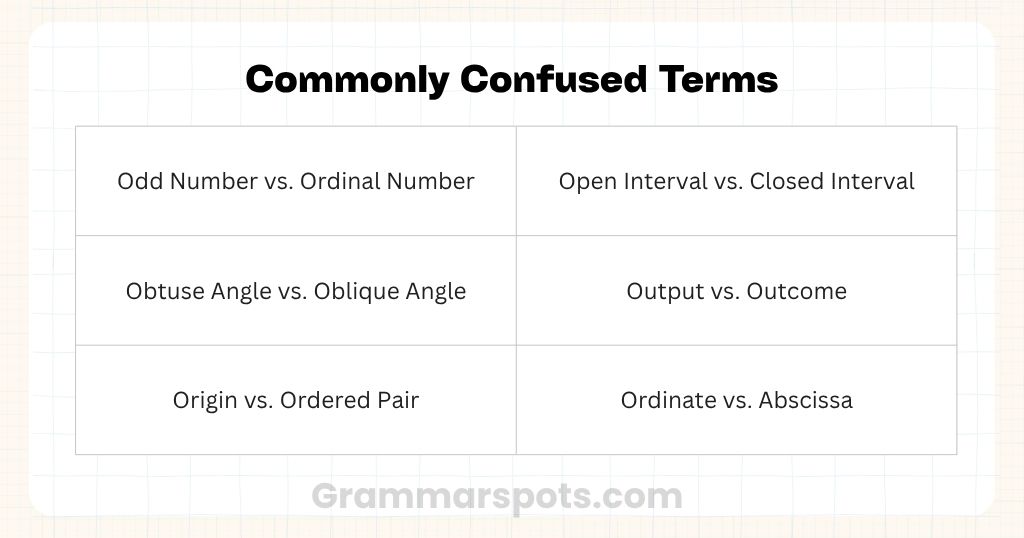
- Odd Number describes a type of integer (not divisible by 2).
- Ordinal Number describes position in a sequence (1st, 3rd, 7th).
A number can be both: the 3rd position uses an ordinal that is also odd. But the terms describe different properties entirely.
Obtuse Angle vs. Oblique Angle
- Obtuse Angle a precise category: between 90° and 180°.
- Oblique Angle any angle that is not exactly 0°, 90°, or 180°.
An obtuse angle is always oblique. But an oblique angle is not always obtuse it could also be acute.
Origin vs. Ordered Pair
- Origin always the single fixed point (0, 0).
- Ordered Pair any two numbers written as (x, y).
The origin is one specific ordered pair. Not every ordered pair is the origin.
Output vs. Outcome
- Output the result of applying a function rule to an input. Belongs to algebra and functions.
- Outcome one possible result of a random experiment. Belongs to probability.
Both involve results, but they come from entirely different branches of math.
Open Interval vs. Closed Interval
- Open Interval (a, b) parentheses signal that endpoints are excluded.
- Closed Interval [a, b] brackets signal that endpoints are included.
Memory trick: brackets hug the endpoints in; parentheses push them away.
Ordinate vs. Abscissa
- Ordinate the y-coordinate (vertical value) of a point.
- Abscissa the x-coordinate (horizontal value) of a point.
In the point (5, 9): abscissa = 5, ordinate = 9.
FAQs About Math Words That Start With O
Q1. What are the most common math words starting with O for elementary students?
- Odd number
- Operation
- Order of operations
- Ordered pair
- Origin
These five appear in math curricula from grades 2 through 6.
Q2. What is the difference between an obtuse angle and an obtuse triangle?
An obtuse angle is a single angle between 90° and 180°. An obtuse triangle is a triangle that contains one obtuse angle. A triangle can have only one obtuse angle because all three angles must sum to 180°.
Q3. Why does order of operations matter?
Without a universal rule, the expression 5 + 3 × 2 could equal 11 or 16 depending on who solves it. Order of operations guarantees one correct answer for every expression for every person, calculator, and computer.
Q4. What does orthogonal mean in simple terms?
Orthogonal means “at right angles.” Two lines meeting at 90° are orthogonal. Two vectors with a dot product of zero are orthogonal. Outside math, the word is sometimes used to mean “completely independent.”
Q5. Is zero an odd or even number?
Zero is even. It is divisible by 2 with no remainder (0 ÷ 2 = 0) and satisfies the definition of an even integer.
Q6. What is the ordinate in coordinate geometry?
The ordinate is the y-value of a point. In (x, y), the second number is the ordinate. It measures vertical distance from the x-axis.
Q7. What is an open sentence in math?
An open sentence is a mathematical statement containing a variable that cannot be evaluated as true or false until the variable is given a value. Example: y − 4 = 10 is open. When y = 14 it becomes true; all other values make it false.
Conclusion
Math words starting with O span every level from foundational terms like odd number, operation, and origin that students meet in early elementary school, to advanced concepts like orthogonal matrix, osculating circle, and open set explored at the university level.
Knowing these terms accurately not just recognizing them is what makes the real difference in mathematical understanding. Use the vocabulary table for quick reference, the definitions section for depth, and the commonly confused pairs before any test or assignment.

I’m Hazel, and I studied BSC English at GCUF. I focus on explaining word meanings in simple, clear language that anyone can understand. My goal is helping readers grasp everyday English, confusing terms, and slang used in real conversations and social media. I believe language learning works best when definitions connect to actual life situations. Through careful research and straightforward explanations, I make vocabulary accessible for students, learners, and anyone curious about how English really works in daily use.