


You need science words that start with D. Maybe it’s for a test. Maybe you’re studying for a quiz, helping a student, or building a word list. Whatever the reason, this page gives you exactly that.
Over 160 science words. Real definitions. Organized by subject. No padding, no filler.
Quick Answer: 160+ Most-Used Science Words Starting With D
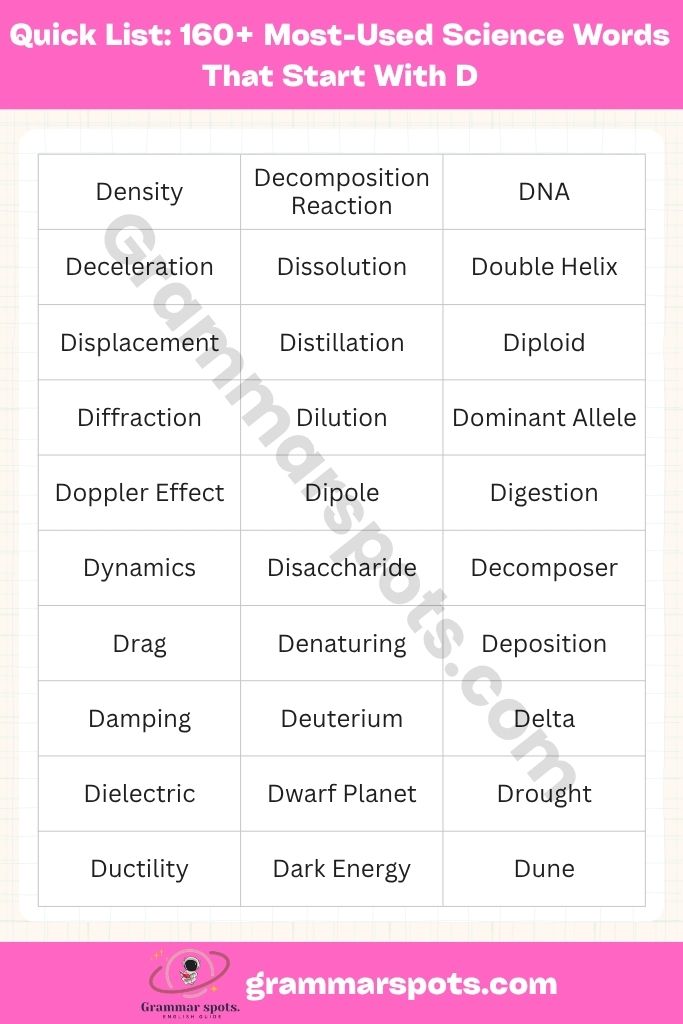
| Word | Meaning |
| DNA | Molecule carrying genetic instructions in every living cell |
| Density | Amount of mass packed into a given volume |
| Diffusion | Particles spreading from high to low concentration |
| Decomposition | Dead matter broken down by bacteria and fungi |
| Digestion | Food broken into nutrients the body can absorb |
| Dominant Gene | Gene whose trait appears even with one copy present |
| Diploid | Cell containing two full sets of chromosomes |
| Displacement | Volume of fluid pushed aside by a submerged object |
| Doppler Effect | Wave frequency change caused by motion of source or observer |
| Dwarf Planet | Round space body that hasn’t cleared its orbital path |
| Drought | Extended period of abnormally low rainfall |
| Delta | Fan-shaped land where a river deposits sediment at its mouth |
| Dormancy | State where a living thing is alive but not actively growing |
| Deposition | Sediment settling and building layers in a new location |
| Diastole | Heart relaxation phase when chambers fill with blood |
| Decibel | Unit measuring the intensity of sound |
| Dynamo | Device converting mechanical motion into electrical energy |
| Ductility | Ability of a metal to be drawn into thin wire without breaking |
| Dilation | Widening of a vessel, opening, or material |
| Deceleration | Rate of slowing down; negative acceleration |
Physics Science Words That Start With D
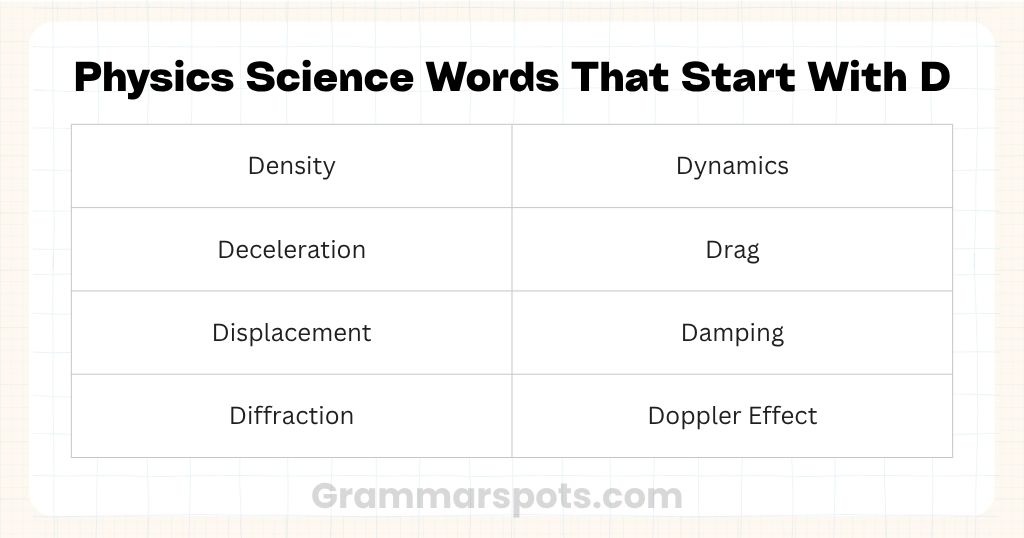
Density — Mass per unit volume. Iron is denser than wood because more matter packs into the same space.
Deceleration — Slowing down. Pressing your bicycle brakes applies deceleration.
Displacement — Distance moved in a specific direction. Not the same as total distance traveled.
Diffraction — Bending of waves around obstacles or through openings. Sound bends through doorways because of diffraction.
Doppler Effect — Frequency change when a wave source moves. An approaching siren sounds higher; a retreating one sounds lower.
Dynamics — The branch of physics studying how forces produce or change motion.
Drag — Resistance force that air or water exerts on a moving object.
Damping — Gradual reduction of wave amplitude or vibration over time.
Dielectric — Insulating material that stores electrical energy in an electric field. Found inside capacitors.
Ductility — Property of metals that allows stretching into thin wire. Copper wires exist because copper is ductile.
Decibel (dB) — Logarithmic unit for sound intensity. A whisper sits near 30 dB; a jet engine near 140 dB.
Dark Matter — Invisible matter detected only through gravitational effects on visible objects.
Diffusion — Natural spreading of particles without any external force applied.
Dynamic Equilibrium — State where a system continuously changes but overall properties stay constant.
Dynamic Pressure — Pressure due to fluid motion, as opposed to static pressure.
Derived Unit — Unit formed by combining base SI units. Newtons and joules are derived units.
Dimensional Analysis — Method of checking equations by tracking their physical units.
Drag Coefficient — Number expressing how aerodynamic a shape is. Lower = less air resistance.
Diamagnetism — Weak repulsion from a magnetic field shown by certain materials like copper and water.
Diffuse Reflection — Light scattering in many directions off a rough surface, unlike mirror reflection.
Chemistry Science Words That Start With D
- Decomposition Reaction — One compound breaks into two or more simpler substances when heated or exposed to light.
- Dissolution — Process of a solute breaking apart and mixing evenly into a solvent.
- Distillation — Separation of liquids by heating to vapor, then cooling back to liquid. Used to purify water and make perfume.
- Dilution — Reducing a solution’s concentration by adding more solvent.
- Dipole — Molecule with slight positive charge on one end and negative on the other. Water is a dipole.
- Disaccharide — Sugar made of two bonded simple sugars. Table sugar (sucrose) is a disaccharide.
- Denaturing — Protein losing its shape due to heat or chemicals. Cooking an egg denatures its proteins.
- Deuterium — Isotope of hydrogen with one proton and one neutron. Used in nuclear reactors.
- Deliquescence — When a solid absorbs enough air moisture to fully dissolve itself.
- Desiccant — Moisture-absorbing material used to keep products dry. The silica packets in packaging are desiccants.
- Dispersion (Chemistry) — Mixture where fine particles are spread through another substance without fully dissolving. Milk and fog are dispersions.
- Double Bond — Chemical bond where two atoms share two pairs of electrons.
- Diastereomer — A type of stereoisomer that is not a mirror image of its partner molecule.
- Dipole Moment — Measure of charge separation across a molecule. Tells chemists how polar it is.
- Decay Chain — Sequence of radioactive decays from one element to a more stable one.
- Decay Constant — Number expressing how fast a radioactive substance loses half its atoms.
- Dispersion Force — Weak attraction between molecules caused by temporary charge imbalances. Also called London forces.
- Deoxyribose — Five-carbon sugar that forms part of the backbone of DNA.
Biology Science Words That Start With D
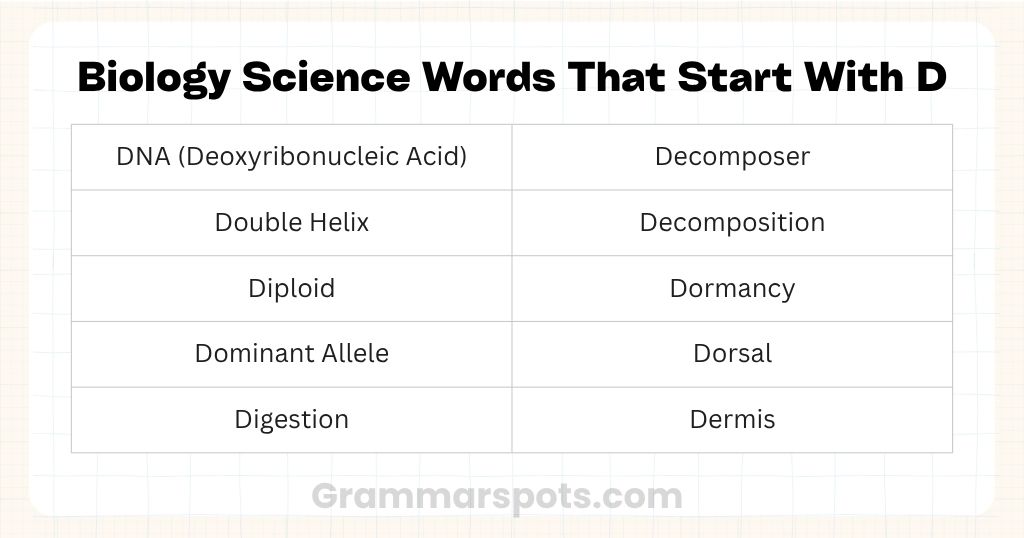
DNA (Deoxyribonucleic Acid) — Double-helix molecule carrying the genetic code of every living organism.
Double Helix — The twisted-ladder shape of a DNA molecule.
Diploid — Cell with two complete chromosome sets (one from each parent). Human body cells are diploid (46 chromosomes).
Dominant Allele — Version of a gene that expresses its trait when at least one copy is present.
Digestion — Mechanical and chemical breakdown of food into absorbable nutrients.
Decomposer — Organism (bacteria, fungi) that breaks down dead matter and returns nutrients to soil.
Decomposition — The full process of organic matter being broken down by decomposers.
Dormancy — Suspended biological activity during unfavorable conditions. Seeds stay dormant; bears hibernate.
Dorsal — Relating to the back or upper side of an organism. A shark’s dorsal fin is on top.
Dermis — Inner layer of skin containing nerves, hair follicles, and sweat glands.
Diaphragm — Dome-shaped muscle below the lungs that drives breathing by contracting and relaxing.
Diastole — Heart’s resting phase. Chambers fill with blood before the next contraction.
Duodenum — First section of the small intestine where digestive juices from the liver and pancreas enter.
Dichotomous Key — Identification tool using a series of yes/no questions to classify organisms.
Differentiation (Cell Biology) — Process where unspecialized cells become specific cell types (muscle, nerve, skin).
Disruptive Selection — Natural selection favoring extreme traits over intermediate ones, splitting a population.
Directional Selection — Natural selection consistently favoring one extreme trait in a population.
Disjunction (Genetics) — Separation of chromosome pairs during cell division.
Dorsal Fin — Fin on the top (back) of a fish or marine mammal; provides stability.
Deciduous — Trees or plants that shed leaves seasonally, usually in autumn.
Earth Science Words That Start With D
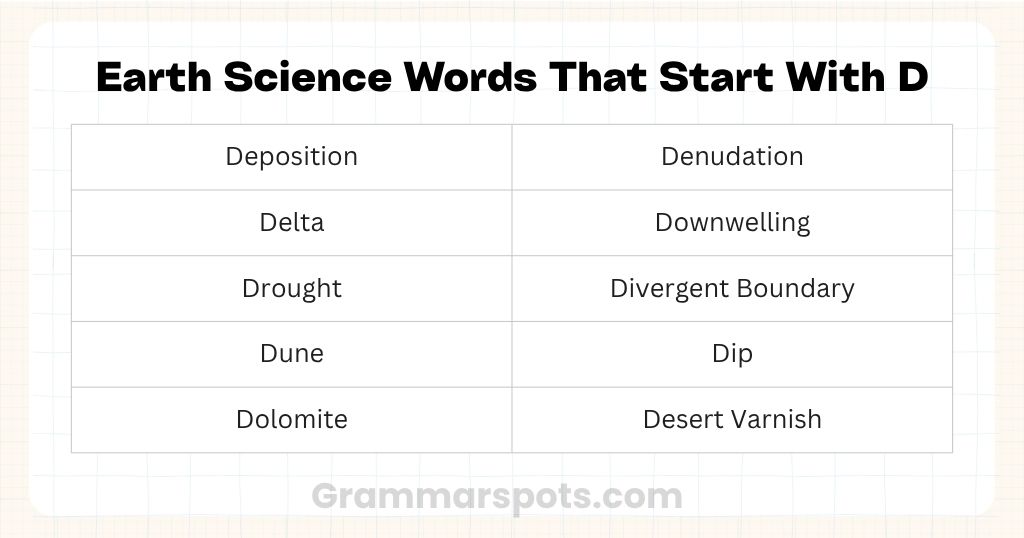
Deposition — When wind, water, or ice drops the sediment it has been carrying.
Delta — Triangular landmass formed where a river slows and deposits sediment at its mouth.
Drought — Prolonged period of below-normal rainfall affecting water supply and ecosystems.
Dune — Hill of loose sand shaped by wind. Dunes can migrate slowly over time.
Dolomite — Sedimentary rock made of calcium magnesium carbonate. Similar to limestone but chemically distinct.
Denudation — Long-term wearing away of Earth’s surface through erosion and weathering.
Downwelling — Sinking of dense ocean surface water. Drives deep ocean circulation.
Divergent Boundary — Tectonic plate boundary where plates move apart, creating new crust. The Mid-Atlantic Ridge is one.
Dip — Angle at which a rock layer tilts below horizontal. Measured by geologists to map formations.
Desert Varnish — Dark mineral coating (manganese and iron oxides) that slowly builds on exposed rock surfaces.
Desertification — Process where fertile land turns to desert due to climate change or overuse.
Deep Time — Geological concept of Earth’s immense age (4.5 billion years).
Drainage Basin — Area of land that collects rainfall and drains into a single river or lake.
Dust Bowl — Region stripped of topsoil by wind erosion, made worse by drought. The 1930s U.S. event is the classic example.
Dust Storm — Strong wind carrying large amounts of fine soil particles across a landscape.
Diastrophism — Large-scale crustal movement that creates mountains, folds, and rift valleys.
Deep Current — Slow-moving ocean current driven by differences in water temperature and salt content.
Deposit — Accumulation of mineral or sediment material in a specific location over time.
Depression (Weather) — Low-pressure weather system associated with cloud, wind, and rain.
Dead Zone (Ocean) — Oxygen-depleted ocean area where most marine life cannot survive.
Space & Astronomy Science Words That Start With D
- Dwarf Planet — Spherical body orbiting the Sun that hasn’t gravitationally cleared its orbital neighborhood. Pluto is one.
- Dark Matter — Non-luminous mass making up roughly 27% of the universe, detectable only by its gravity.
- Dark Energy — Unknown force driving the accelerating expansion of the universe.
- Doppler Shift — Change in observed light frequency from moving stars or galaxies. Redshift = moving away; blueshift = approaching.
- Declination — Angular distance of a celestial object north or south of the celestial equator.
- Dust Disk — Flat ring of gas and dust orbiting a young star, from which planets eventually form.
- Double Star — Two stars appearing close together in the sky. True binaries orbit each other; optical doubles just look close.
- Degenerate Matter — Extremely dense matter in white dwarfs and neutron stars where quantum pressure prevents collapse.
- Dark Nebula — Cloud of interstellar dust thick enough to block background starlight.
- Degenerate Pressure — Quantum mechanical force resisting further compression in stellar remnants.
Medical & Health Science Words That Start With D
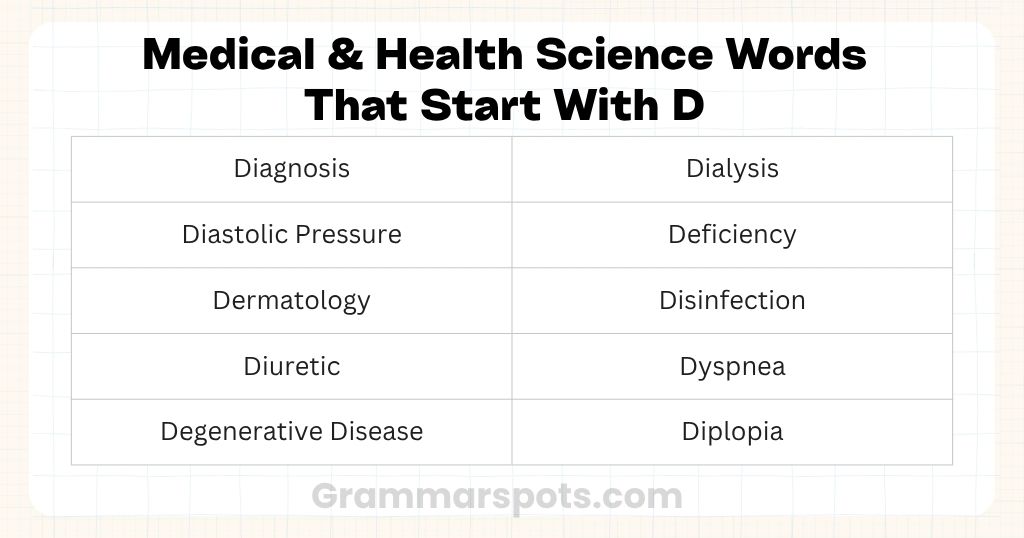
Diagnosis — Identifying a disease or condition from symptoms and test results.
Dialysis — Machine filtering of blood waste when kidneys cannot function. Patients may need it several times weekly.
Diastolic Pressure — Lower number in a blood pressure reading. Measures artery pressure between heartbeats.
Deficiency — Shortage of a required nutrient. Iron deficiency causes anemia; Vitamin D deficiency weakens bones.
Dermatology — Medical specialty focused on skin, hair, and nails.
Disinfection — Killing harmful microorganisms on surfaces using heat or chemical agents.
Diuretic — Substance that increases urine output to reduce fluid buildup in the body.
Dyspnea — Medical term for shortness of breath or labored breathing.
Degenerative Disease — Condition where tissues or organs progressively break down. Arthritis and Parkinson’s are examples.
Diplopia — Double vision — seeing two images of a single object.
Distal — Anatomy term for body parts located far from the center or point of attachment.
Dose (Medicine/Radiation) — Measured amount of a drug or radiation given to a patient.
Distal Convoluted Tubule — Final section of the kidney nephron that adjusts urine composition before excretion.
Diurnal Cycle — 24-hour biological or environmental rhythm aligned with day and night.
Dark Adaptation — Eyes adjusting to low light by increasing photoreceptor sensitivity. Takes roughly 20–30 minutes.
Technology & Applied Science Words That Start With D
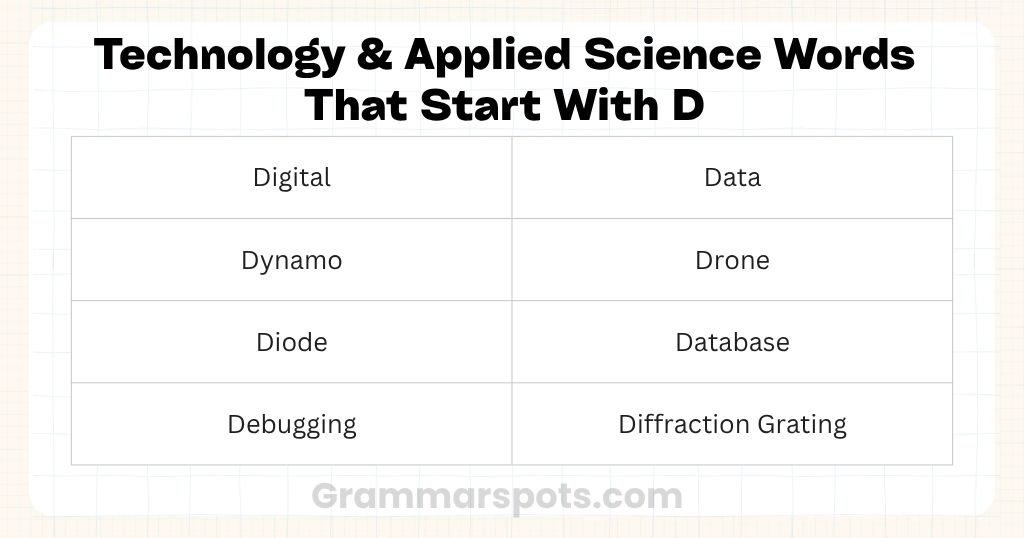
- Digital — Data represented as discrete values (0s and 1s). The basis of modern computing.
- Data — Raw facts or measurements collected for analysis in any experiment or study.
- Dynamo — Generator converting mechanical energy into electrical energy.
- Drone — Unmanned aerial vehicle operated remotely or autonomously. Used in agriculture, delivery, and surveillance.
- Diode — Electronic component allowing current flow in one direction only. Essential in circuits and LEDs.
- Database — Organized system for storing and retrieving structured data electronically.
- Debugging — Process of identifying and correcting errors in software or electronic systems.
- Diffraction Grating — Surface with fine parallel lines that splits light into its spectral components.
- Digital Signal — Signal encoded as discrete binary values rather than continuous variation.
- Differential Pressure — Difference in pressure between two connected points in a system.
Easy Science Words That Start With D (Beginner & Kids Level)
- Day — Time for Earth to complete one full rotation: 24 hours
- Dew — Water droplets forming on cool surfaces as air temperature drops overnight
- Decay — Gradual breakdown of organic matter over time
- Dark — Absence of visible light
- Dissolve — Solid mixing completely and evenly into a liquid
- Drop — Small, round unit of liquid
- Dust — Tiny dry particles floating in air or settling on surfaces
- Damp — Slightly wet; less than fully soaked
- Dawn — First appearance of light in the sky before sunrise
- Dirt — Loose, top-layer soil found on Earth’s surface
Advanced Science Words That Start With D
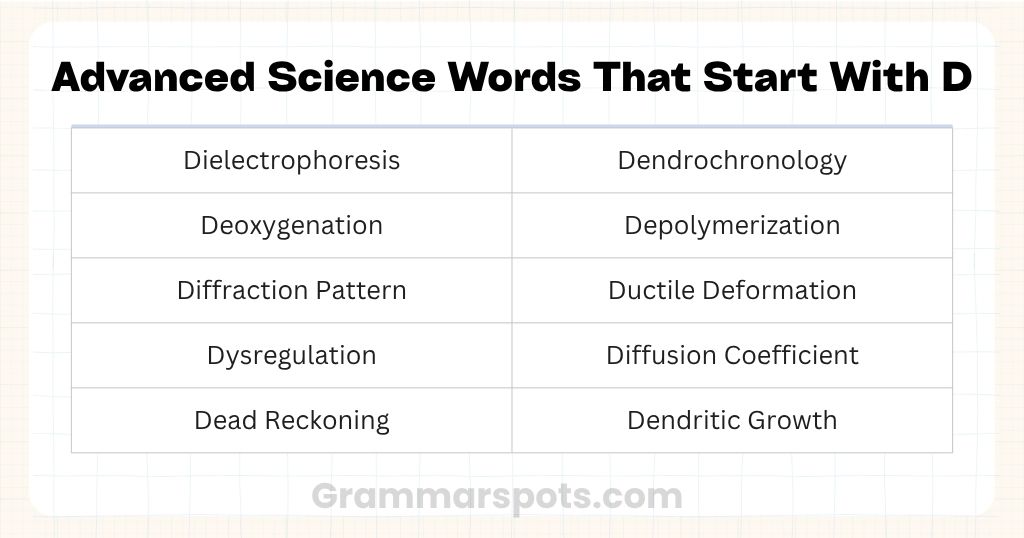
- Dielectrophoresis — Movement of particles in a non-uniform electric field. Used to sort cells in lab-on-chip devices.
- Deoxygenation — Removal of dissolved oxygen from water. A rising problem in climate-affected oceans.
- Diffraction Pattern — Interference pattern formed when waves bend around obstacles. Used to determine molecular structure via X-ray crystallography.
- Dysregulation — Loss of normal biological control in a system. Immune dysregulation underlies autoimmune disease.
- Dendrochronology — Science of using annual tree rings to date events and reconstruct past climate.
- Depolymerization — Breaking large polymer chains into smaller monomer units. Central to plastics recycling research.
- Ductile Deformation — Rock bending and flowing under pressure without fracturing. Happens deep underground.
- Diffusion Coefficient — Number expressing how fast a particular substance diffuses through a medium.
- Dead Reckoning — Navigation method estimating current position based on a known starting point, speed, and direction.
- Dendritic Growth — Branching crystal structure formed when materials solidify rapidly. Seen in snowflakes and metal alloys.
Common Confusions: D Science Words That Get Mixed Up
Diffusion vs. Osmosis
Diffusion = any particles moving from high to low concentration. Osmosis = specifically water moving across a semi-permeable membrane.
Dominant vs. Recessive
Dominant traits appear with just one copy of the gene. Recessive traits need two matching copies. It has nothing to do with which is stronger.
Density vs. Mass vs. Weight
Mass = total matter in an object. Weight = gravitational pull on that mass. Density = how tightly that mass is packed.
Deposition vs. Erosion
Erosion picks up and carries particles. Deposition sets them down somewhere else. Erosion comes first; deposition follows.
Diastole vs. Systole
Diastole = heart relaxes, fills with blood. Systole = heart contracts, pumps blood out. Blood pressure is written as systolic/diastolic (e.g., 120/80).
Dwarf Planet vs. Planet
A planet has cleared other objects from its orbital zone. A dwarf planet has not. Pluto’s reclassification in 2006 came down to this single criterion.
Digital vs. Analog
Analog signals are continuous. Digital signals use discrete steps (0s and 1s). Old vinyl records are analog; streaming audio is digital.
FAQs
How many science words start with D?
Hundreds exist across all scientific fields. This article covers 160+ of the most useful ones across physics, chemistry, biology, earth science, space, medicine, and technology.
Which D words appear most on school exams?
DNA, density, diffusion, decomposition, digestion, and the Doppler Effect are among the most frequently tested at middle and high school levels.
Does “de-” always mean removal in science?
Often, yes. Decompose, denature, decelerate, deoxygenation — the prefix “de-” frequently signals reversal or removal. Recognizing this pattern helps you guess unfamiliar terms.
Are D science words harder than other letters?
Not particularly. Many of the most common science concepts — DNA, density, digestion — start with D, so students encounter them early and often.
Which field has the most D science words?
Biology and chemistry contribute the most, largely because so many biological processes and chemical reactions involve “de-” prefix terms.
Conclusion
You now have 160+ science words that start with D sorted by subject, separated into easy and advanced tiers, with a full alphabetical list and a confusion-clearing section.
Use the subject sections for studying specific topics. Use the full list as a quick reference. Use the confusions section when two terms keep tripping you up.
These words appear in textbooks, exams, labs, and real scientific work. Learning them in context not just memorizing definitions is what makes them stick.

I’m Hazel, and I studied BSC English at GCUF. I focus on explaining word meanings in simple, clear language that anyone can understand. My goal is helping readers grasp everyday English, confusing terms, and slang used in real conversations and social media. I believe language learning works best when definitions connect to actual life situations. Through careful research and straightforward explanations, I make vocabulary accessible for students, learners, and anyone curious about how English really works in daily use.