

You’re studying for a test, building a vocabulary list, or just curious what that word in your textbook actually means. Either way, this is the right place. The letter C covers some of the most important scientific terms across every subject biology, chemistry, physics, space, medicine, and more.
This article gives you 120+ science words that start with C, organized by category, with clear meanings and real-life examples.
Quick Answer: 20 Most-Used Science Words Starting With C
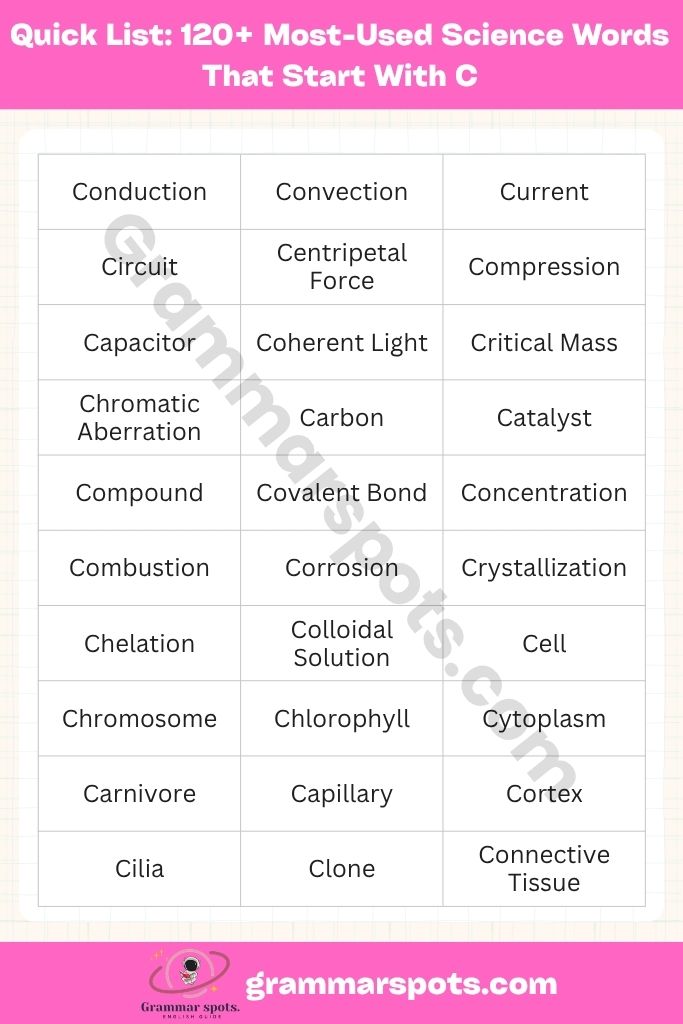
| Word | Meaning |
| Cell | Smallest unit of living things |
| Carbon | Element found in all living organisms |
| Catalyst | Speeds up a chemical reaction |
| Circuit | Closed path for electricity to flow |
| Condensation | Vapor cooling into liquid |
| Chromosome | Carries genetic information in cells |
| Convection | Heat transfer through moving fluid |
| Chlorophyll | Green pigment that captures sunlight |
| Combustion | Burning releases heat and light |
| Current | Flow of electric charge |
| Comet | Icy space rock with a glowing tail |
| Cortex | Outer layer of brain or kidney |
| Covalent Bond | Atoms sharing electrons |
| Capillary | Smallest blood vessels in the body |
| Cytoplasm | Fluid filling the inside of a cell |
| Conduction | Heat moving through direct contact |
| Carnivore | Animal that eats only other animals |
| Calorie | Unit of energy from food |
| Coral | Marine organism building reef structures |
| Cosmos | The universe as an ordered whole |
Physics Science Words That Start With C
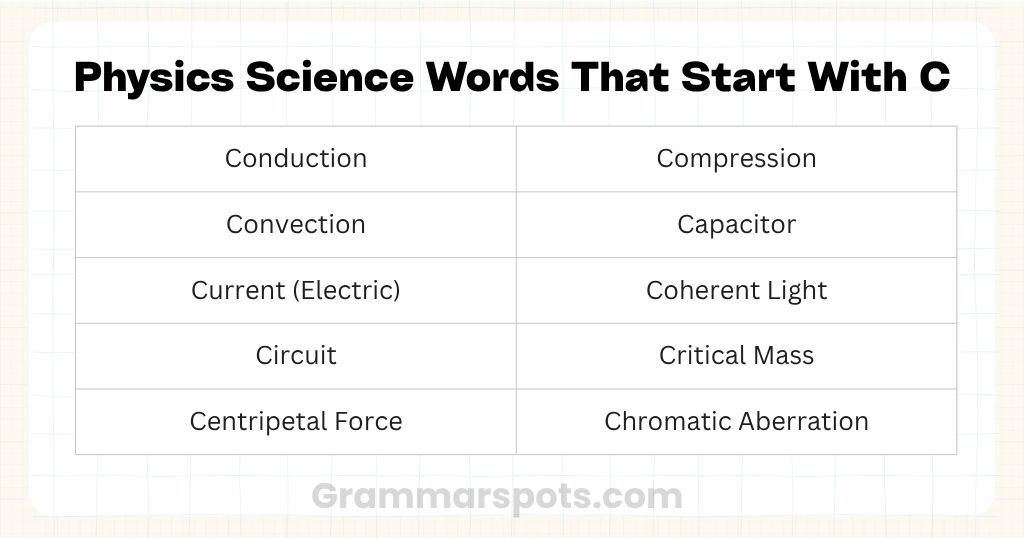
Conduction — Heat moving through direct contact between objects. A metal spoon in hot soup gets warm through conduction.
Convection — Heat transfer through moving fluid or air. Hot water rises, cool water sinks that cycle is convection.
Current (Electric) — The flow of electrons through a conductor. Your phone charges because current travels through the cable.
Circuit — A complete loop allowing electricity to flow. Break the loop, and everything stops.
Centripetal Force — The inward force keeping an object moving in a circle. It’s what stops a spinning ball on a string from flying away.
Compression — Particles being pushed closer together. Springs, shock absorbers, and sound waves all involve compression.
Capacitor — A device that stores electric charge briefly. Camera flashes use capacitors to release energy in a split second.
Coherent Light — Light waves perfectly in sync with each other. Lasers work this way.
Critical Mass — The minimum nuclear material needed to trigger a self-sustaining chain reaction.
Chromatic Aberration — When a lens bends different colors unevenly, causing blurry colored edges in an image.
Chemistry Science Words That Start With C
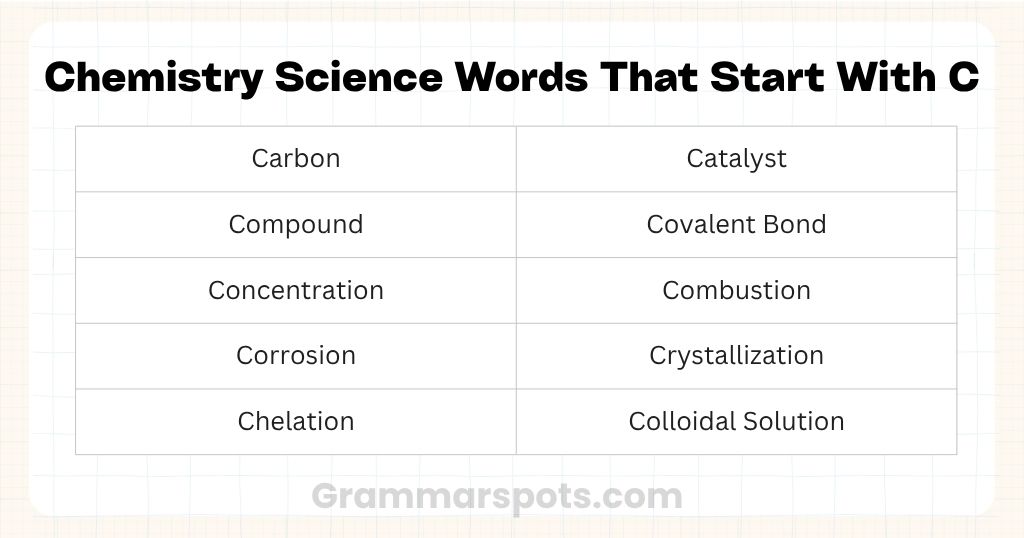
Carbon — Element #6, present in every living thing. It also forms diamonds, graphite, and CO₂.
Catalyst — Speeds up a chemical reaction without being used up. Enzymes in your stomach are natural catalysts.
Compound — Two or more elements bonded chemically. Water (H₂O) is a compound of hydrogen and oxygen.
Covalent Bond — Two atoms sharing electrons. Most molecules in living organisms use this type of bond.
Concentration — How much substance is dissolved in a solution. Strong coffee has a high caffeine concentration.
Combustion — A rapid reaction between a substance and oxygen that produces heat and light. Engines, candles, and firewood all run on combustion.
Corrosion — Gradual chemical breakdown of a material. Rust on iron is the most familiar example.
Crystallization — When a substance forms a solid with a repeating geometric pattern. Salt and snowflakes form this way.
Chelation — A molecule binding tightly to a metal ion. Doctors use this process to treat heavy metal poisoning.
Colloidal Solution — A mixture where tiny particles are suspended but don’t settle. Milk and fog are both colloids.
Biology Science Words That Start With C
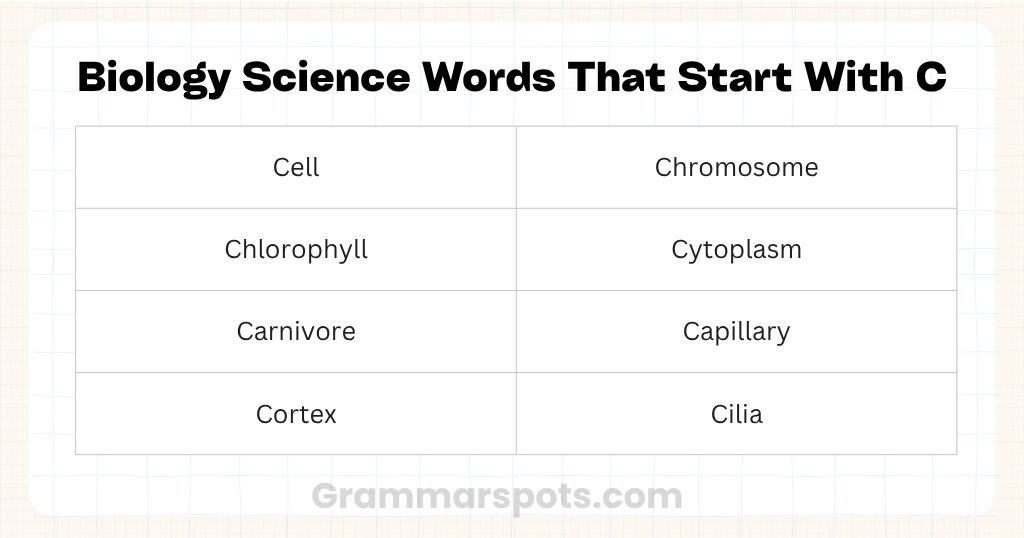
Cell — The basic unit of all life. Some organisms are just one cell; the human body contains trillions.
Chromosome — A coiled structure of DNA inside the nucleus. Humans have 46. They carry every instruction your body runs on.
Chlorophyll — The green pigment in plant leaves. It captures sunlight and drives photosynthesis.
Cytoplasm — The jelly-like fluid inside a cell that holds organelles in place.
Carnivore — An organism that eats other animals for energy. Lions, sharks, and Venus flytraps qualify.
Capillary — Tiny blood vessels where oxygen and nutrients pass directly into body tissues.
Cortex — The outer layer of an organ. The cerebral cortex handles thought and language. The renal cortex sits on the outside of each kidney.
Cilia — Hair-like structures on cell surfaces. In your airways, cilia sweep out dust and mucus to protect your lungs.
Clone — A genetically identical copy of an organism. Dolly the sheep (1996) was the first mammal cloned from an adult cell.
Connective Tissue — Tissue that holds other tissues and organs together. Bone, fat, and cartilage are all forms of it.
Earth Science Words That Start With C
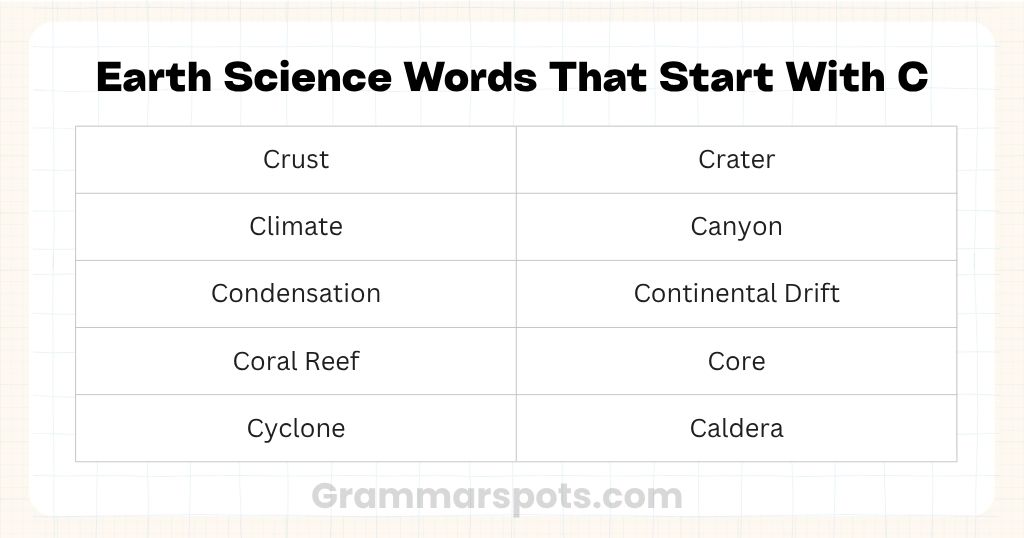
Crust — Earth’s outermost solid layer. Thin compared to what’s below like the skin of an apple relative to the fruit.
Crater — A bowl-shaped hollow from a volcanic eruption or meteorite impact. The Moon’s surface is covered in them.
Climate — The long-term pattern of weather in a region. Weather changes daily; climate takes decades to measure.
Canyon — A deep valley with steep walls, carved by rivers over millions of years. The Grand Canyon formed this way.
Condensation — Water vapor cooling and turning to liquid. Morning dew on glass is condensation.
Continental Drift — The slow movement of Earth’s tectonic plates over millions of years. All continents were once joined as a single landmass.
Coral Reef — A large underwater structure built by coral colonies. Reefs shelter more marine species than almost any other ecosystem.
Core — The deepest layer of Earth, made mostly of iron and nickel. The inner core is solid; the outer core is liquid.
Cyclone — A large rotating storm system around a low-pressure center. Called hurricanes in the Atlantic, typhoons in the Pacific.
Caldera — A large depression left behind after a volcano collapses following a major eruption.
Space & Astronomy Science Words That Start With C
Comet — A frozen body of ice, dust, and rock. Near the Sun, it develops a glowing tail of released gas.
Constellation — A group of stars forming a recognizable pattern from Earth. Orion and the Big Dipper are familiar examples.
Cosmos — The universe understood as an ordered, complete system. The word comes from Greek, meaning “order.”
Cosmic Ray — High-energy particles traveling through space near the speed of light. Earth’s atmosphere blocks most of them.
Corona — The Sun’s outer atmosphere. Visible during a solar eclipse as a glowing ring. Temperatures reach over 1 million°C.
Celestial Body — Any natural object in space stars, planets, moons, asteroids, and comets all qualify.
Cosmic Background Radiation — Faint microwave energy spread across the entire universe. It’s leftover heat from the Big Bang.
Circumference (Orbital) — The total path length an object travels completing one orbit.
Cepheid Variable — A star that pulses in brightness at predictable intervals. Scientists use it to measure distances across the universe.
Coronal Mass Ejection — A large burst of plasma from the Sun’s corona. These can disrupt satellites and power grids on Earth.
Medical & Health Science Words That Start With C
Cortisol — A hormone released during stress. It raises blood sugar and suppresses the immune system temporarily.
Carcinogen — Any substance that can cause cancer. Tobacco smoke and certain chemicals are classified as carcinogens.
Cartilage — Tough, flexible tissue in joints, ears, and the nose. It stops bones from grinding against each other.
Cornea — The transparent front surface of the eye. It bends incoming light toward the retina.
Cerebellum — The brain region at the back of the skull. Controls balance, posture, and movement coordination.
Cochlea — A spiral structure in the inner ear. It converts sound vibrations into nerve signals the brain interprets.
Chronic — A condition that lasts a long time or keeps returning. Diabetes and asthma are chronic conditions.
Congenital — Present at birth. Congenital heart disease develops before a baby is born.
Chemotherapy — Cancer treatment using drugs to destroy fast-dividing cells.
Coagulation — The process by which blood changes from liquid to a solid clot to stop bleeding.
Technology & Applied Science Words That Start With C
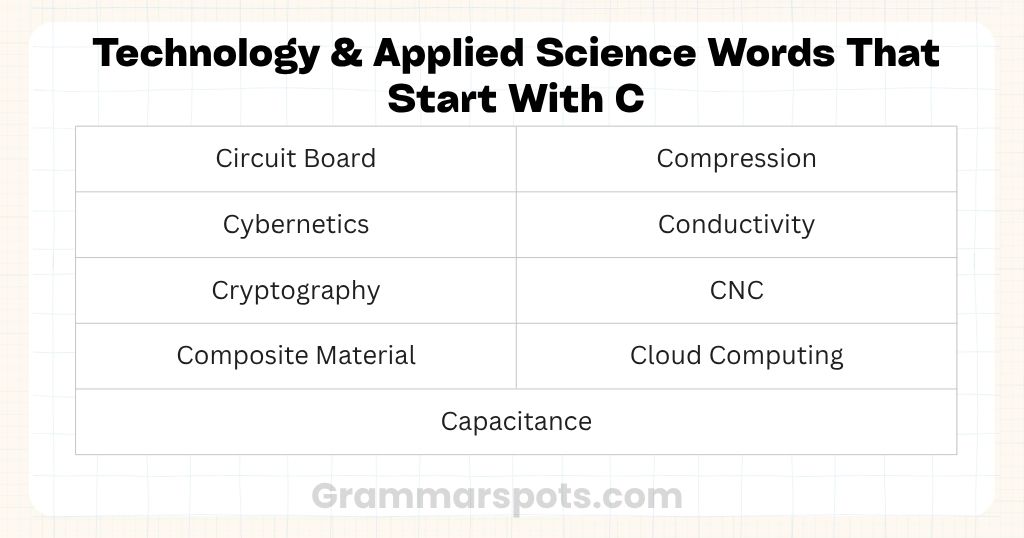
Circuit Board — A flat board connecting electronic components through conductive pathways. Found in every computer, phone, and appliance.
Compression (Data) — Reducing digital file size to save storage or speed up transfer. JPEG and MP3 formats use compression.
Cybernetics — The science of how systems self-regulate through feedback loops. Applies to robots, thermostats, and the human nervous system.
Conductivity — How easily a material allows heat or electricity to pass through it. Copper’s high conductivity makes it ideal for wiring.
Cryptography — Securing information through codes. Every password you enter online is protected by cryptography.
CNC (Computer Numerical Control) — Computer-guided precision cutting and shaping of materials in manufacturing.
Composite Material — A material built from two or more substances that perform better combined than separately. Carbon fiber is a composite used in aircraft.
Cloud Computing — Storing and accessing data over the internet instead of a local device.
Capacitance — How much electric charge a component can hold. Higher capacitance means more energy storage.
Science Words That Start With C for Kids
Simple meanings for early learners:
Cell — Your body is like a city. Cells are the buildings. Every living thing is made from them.
Cloud — Made of tiny water droplets or ice crystals floating in the air. When heavy enough, they fall as rain.
Carnivore — A meat-eater. Wolves, tigers, and sharks are carnivores. So is your cat.
Camouflage — When an animal’s color matches its surroundings so predators can’t spot it. Chameleons are masters of this.
Cocoon — A silky case insects make while transforming. Silkworms make cocoons that’s where silk fabric comes from.
Compost — Rotting plant material that turns into rich soil. Nature’s recycling.
Current — Moving water in a river or electricity in a wire. Both flow in one direction.
Chrysalis — The protective shell a caterpillar builds before becoming a butterfly.
Science Words That Start With C — 7th Grade Level
Words commonly tested in middle school science:
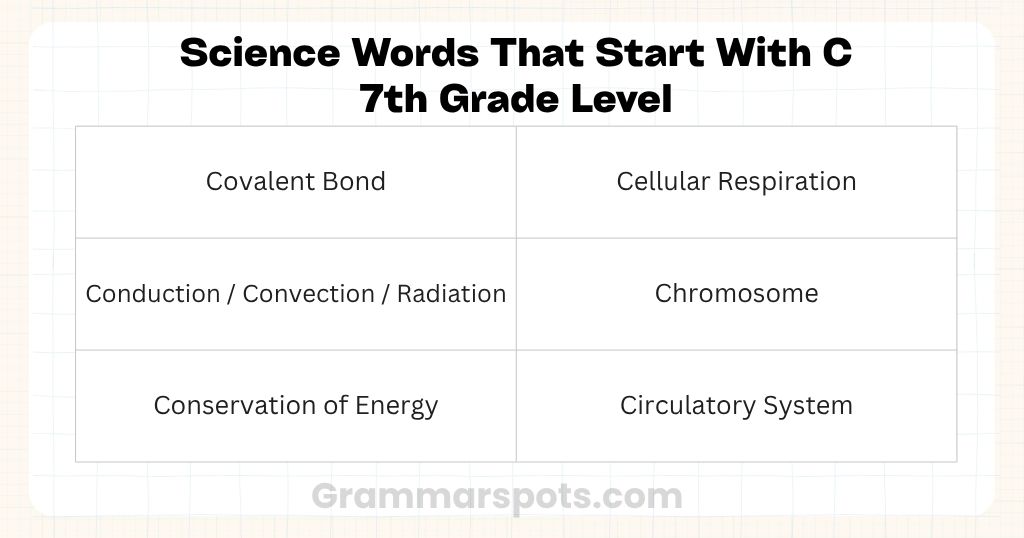
Covalent Bond — Atoms that share electrons. Drawing Lewis dot structures is a standard 7thgrade task.
Cellular Respiration — How cells turn glucose into energy. Equation: Glucose + Oxygen → Carbon dioxide + Water + Energy.
Conduction / Convection / Radiation — The three methods of heat transfer. Teachers test whether you can give a real example of each.
Chromosome — Carries DNA. Humans have 46 (23 pairs). This appears on almost every biology test.
Conservation of Energy — Energy cannot be created or destroyed, only converted. A core physics law at this level.
Circulatory System — Heart, blood, and vessels working together to move oxygen and nutrients throughout the body.
Where You Actually Use These Words
In hospitals
- Cortisol, carcinogen, chronic, coagulation, cornea, cochlea
In classrooms and labs
- Cell, chromosome, circuit, catalyst, covalent bond, combustion
In weather forecasts
- Cyclone, condensation, climate, convection current, Coriolis effect
In space news
- Corona, coronal mass ejection, cosmic ray, comet, cosmic background radiation
In your own body right now
- Capillaries exchanging oxygen, cytoplasm keeping cells functional, cerebellum keeping you balanced
Common Confusions: C-Words People Mix Up
Conduction vs. Convection vs. Radiation
- Conduction = heat through solid contact (metal pan on a stove)
- Convection = heat through fluid movement (boiling water)
- Radiation = heat through empty space (sunlight reaching Earth)
Chromosome vs. Chromatin
- Chromatin is loose DNA floating in the nucleus
- When a cell divides, chromatin coils tightly into chromosomes
- Same material different states
Climate vs. Weather
- Weather = what’s happening outside today
- Climate = what typically happens in that place over decades
Centripetal vs. Centrifugal Force
- Centripetal is real pulls inward, keeps circular motion going
- Centrifugal is what you feel pushing outward it’s inertia, not a true force
Comet vs. Asteroid
- Comets contain ice and grow glowing tails near the Sun
- Asteroids are rocky, no tail, no ice
Carnivore vs. Carcinogen
- Carnivore = eats meat
- Carcinogen = causes cancer
- Completely unrelated just similar spelling
FAQs
How many science words start with C?
Hundreds exist across all scientific fields. This article covers 122 of the most useful ones for students and general learners.
Which subject has the most C-words?
Biology leads, followed closely by chemistry. Carbon alone creates an entire branch of science called organic chemistry.
Are these words hard to learn?
Most are easier than they look. “Condensation” sounds complex but describes the water droplets on a cold glass. Connect the word to something you’ve seen, and it sticks.
What C-words appear most on exams?
- Cell, Chromosome, Combustion, Catalyst, Covalent Bond
- Conduction, Convection, Condensation, Circuit, Cellular Respiration
What does C stand for in science formulas?
- C = Carbon (periodic table)
- c = speed of light (E = mc²)
- °C = Celsius (temperature)
- C = Coulombs (electric charge)
Conclusion
You now have 122 science words that start with C organized by subject, sorted by level, and explained with real-life context.
Use this list before tests, while reading a science article, or anytime a C-word stops you mid-sentence. The more of these you recognize, the faster science starts to make sense.

I’m Hazel, and I studied BSC English at GCUF. I focus on explaining word meanings in simple, clear language that anyone can understand. My goal is helping readers grasp everyday English, confusing terms, and slang used in real conversations and social media. I believe language learning works best when definitions connect to actual life situations. Through careful research and straightforward explanations, I make vocabulary accessible for students, learners, and anyone curious about how English really works in daily use.