


You’re here because you need science words starting with E for a test, a project, homework, or just curiosity. E is one of the most productive letters in science. These words appear in biology labs, physics textbooks, medical reports, and space missions.
This article gives you 140+ words, organized by field, with clear meanings and real-life connections.
Quick Answer: 20 Most-Used Science Words That Start With E
| Word | Meaning |
| Energy | Ability to do work or cause change |
| Ecosystem | Community of living things sharing one environment |
| Evolution | Change in species across generations |
| Electron | Negatively charged particle inside an atom |
| Evaporation | Liquid turning into gas at the surface |
| Erosion | Wearing away of rock or soil by water or wind |
| Enzyme | Protein that speeds up chemical reactions |
| Embryo | Early stage of development after fertilization |
| Element | Pure substance made of one type of atom |
| Equilibrium | State of balance between opposing forces |
| Electromagnet | Magnet created by electric current through wire |
| Epicenter | Surface point directly above an earthquake’s origin |
| Exosphere | Outermost layer of Earth’s atmosphere |
| Exothermic | Reaction that releases heat into surroundings |
| Endothermic | Reaction that absorbs heat from surroundings |
| Estuary | Where a river meets the ocean |
| Eukaryote | Cell with a true membrane-bound nucleus |
| Electrode | Conductor through which electricity enters a substance |
| Extinction | When every member of a species dies out |
| Electromagnetic Spectrum | Full range of all electromagnetic radiation types |
Quick List of 140+ Science Words Starting With E
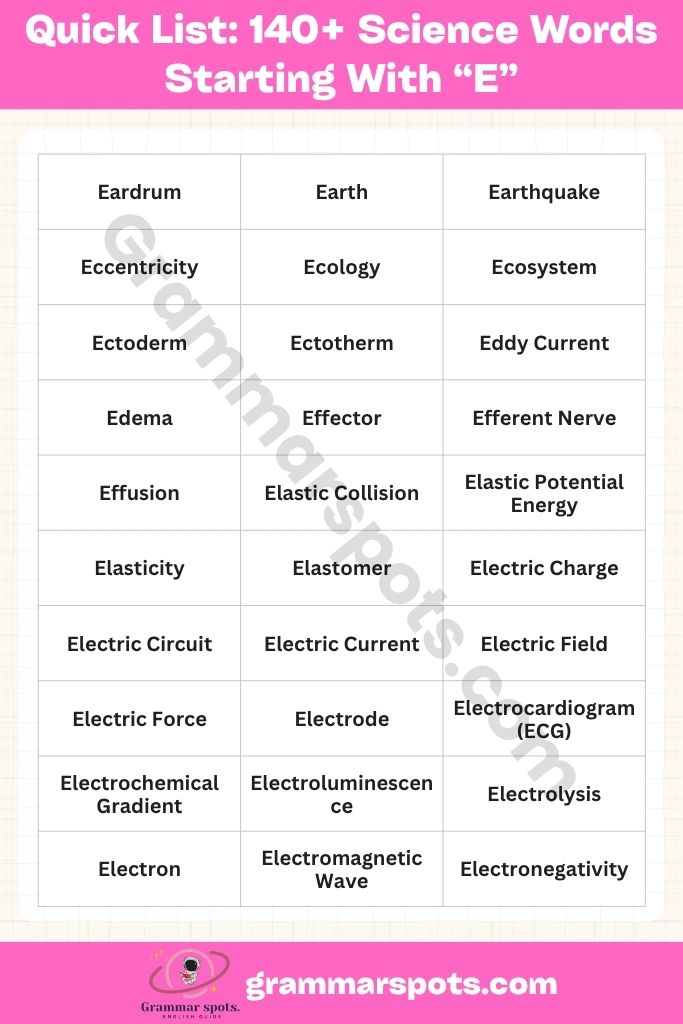
- Eardrum
- Earth
- Earthquake
- Eccentricity
- Ecology
- Ecosystem
- Ectoderm
- Ectotherm
- Eddy Current
- Edema
- Effector
- Efferent Nerve
- Effusion
- Elastic Collision
- Elastic Potential Energy
- Elasticity
- Elastomer
- Electric Charge
- Electric Circuit
- Electric Current
- Electric Field
- Electric Force
- Electrode
- Electrocardiogram (ECG)
- Electrochemical Gradient
- Electroluminescence
- Electrolysis
- Electrolyte
- Electromagnet
- Electromagnetic Spectrum
- Electromagnetic Wave
- Electromagnetism
- Electron
- Electron Cloud
- Electron Configuration
- Electron Transport Chain
- Electronegativity
- Electrophoresis
- Electrostatics
- Element
- Elliptical Orbit
- Embryo
- Embryology
- Emission
- Emulsion
- Endergonic Reaction
- Endocrine System
- Endocytosis
- Endoderm
- Endoplasmic Reticulum
- Endoscopy
- Endoskeleton
- Endosymbiotic Theory
- Endospore
- Endotherm
- Endothermic
- Energy
- Energy Transfer
- Entropy
- Environment
- Enzyme
- Eon
- Eolian
- Epicardium
- Epicenter
- Epidemiology
- Epidermis
- Epiglottis
- Epigenetics
- Equinox
- Equilibrium
- Equivalence Principle
- Erosion
- Estrogen
- Estuary
- Ethanol
- Eukaryote
- Evaporation
- Evapotranspiration
- Event Horizon
- Evolution
- Excretion
- Exocytosis
- Exon
- Exoplanet
- Exoskeleton
- Exosphere
- Exothermic
- Exotoxin
- Expansion
- Experiment
- Exponential Decay
- Exponential Growth
- Extinction
- Eigenvalue
- Eclipse
- Escape Velocity
- Electrical Resistance
- Emission Spectrum
- Endurance (physiology)
- Eosinophil
- Epicycle
- Epidural
- Epithelium
- Erg (unit of energy)
- Erosion Cycle
- Erythrocyte
- Escape Velocity
- Ethylene
- Eukaryotic Cell
- Evaporative Cooling
- Evolution Rate
- Excitation
- Exergonic Reaction
- Exon Shuffling
- Exoplanet Atmosphere
- Exotic Matter
- Expansion of Universe
- Extracellular Matrix
- Extreme Environment
- Eye Lens
- Eyepiece
- Ectoplasm
- Edaphology
- Effluent
- Eigenfrequency
- Elastic Modulus
- Electrocution
- Electrodialysis
- Electromagnetic Induction
- Electromyography (EMG)
- Electron Affinity
- Electroosmosis
- Electroweak Force
- Embryonic Stem Cell
- Emission Nebula
- Endolymph
- Endorphin
- Enthalpy
- Eosinophilia
- Epidemics
- Epitope
- Eruptive Variable
- Eugenics
- Eutrophication
Physics Science Words That Start With E
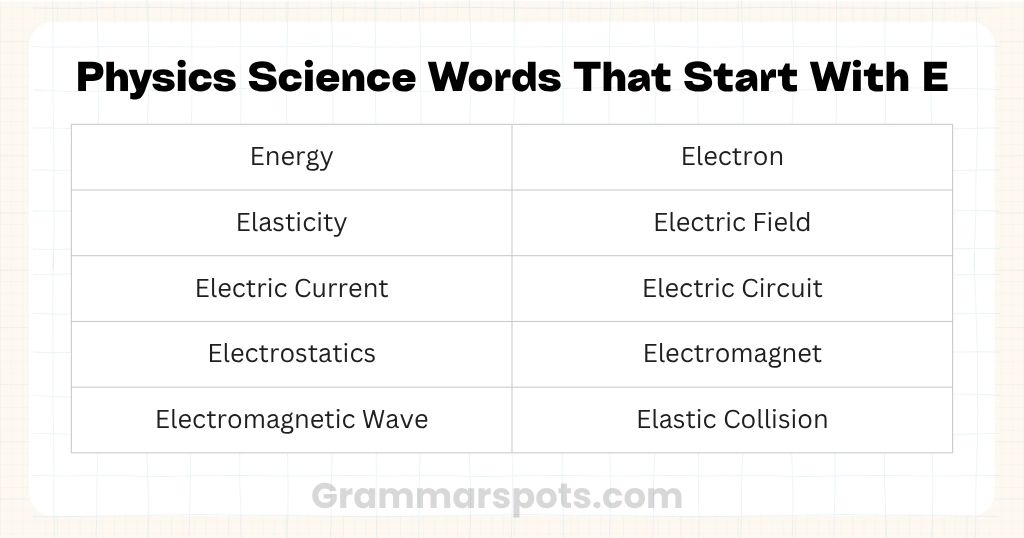
Energy
The ability to do work or cause change. Exists as kinetic, potential, thermal, electrical, and nuclear forms. Every physical event involves an energy change.
Electron
A negatively charged subatomic particle orbiting an atom’s nucleus. When electrons flow through a wire, that movement is electric current.
Elasticity
A material’s ability to return to its original shape after stretching or compression. Rubber is elastic. A crushed can is not.
Electric Field
The invisible region around a charged object where other charges feel a push or pull. A balloon rubbed on hair creates a small electric field.
Electric Current
The flow of electric charge through a conductor. Measured in amperes (amps).
Electric Circuit
A closed path that allows electric current to flow. Open the path — current stops.
Electrostatics
Study of electric charges at rest. Static electricity that shocks you after shuffling on carpet is an electrostatics example.
Electromagnet
A magnet formed by running current through coiled wire. Switch off the current magnetism disappears. Used in junkyards, MRI machines, and maglev trains.
Electromagnetic Wave
A wave that carries energy through space without needing a medium. Light, radio waves, and X-rays are all electromagnetic waves.
Elastic Collision
A collision where both momentum and kinetic energy are fully conserved. Billiard balls come close to this.
Elastic Potential Energy
Energy stored in a stretched or compressed object — a coiled spring or a pulled-back bowstring.
Eddy Current
Loops of current induced inside a conductor by a changing magnetic field. Induction cooktops use this to heat pots.
Emission
When an atom releases energy as light or radiation. Neon signs glow because excited neon atoms emit colored light.
Equilibrium
When all forces on an object balance perfectly. A book resting on a table is in equilibrium.
Entropy
A measure of disorder in a system. Ice melting into water increases entropy. Entropy always tends to increase in closed systems.
Eigenvalue
A number describing how much a vector stretches during a mathematical transformation. Used in quantum mechanics to describe measurable energy levels.
Electrical Resistance
Opposition to the flow of electric current through a material. Measured in ohms.
Expansion
The increase in size of a substance when heated. Thermometers work because liquids expand predictably with temperature.
Electromagnetism
The combined force linking electricity and magnetism. One of the four fundamental forces of nature.
Equivalence Principle
Einstein’s insight that gravity and acceleration produce identical effects. A person in a sealed elevator cannot distinguish between the two.
Chemistry Science Words That Start With E
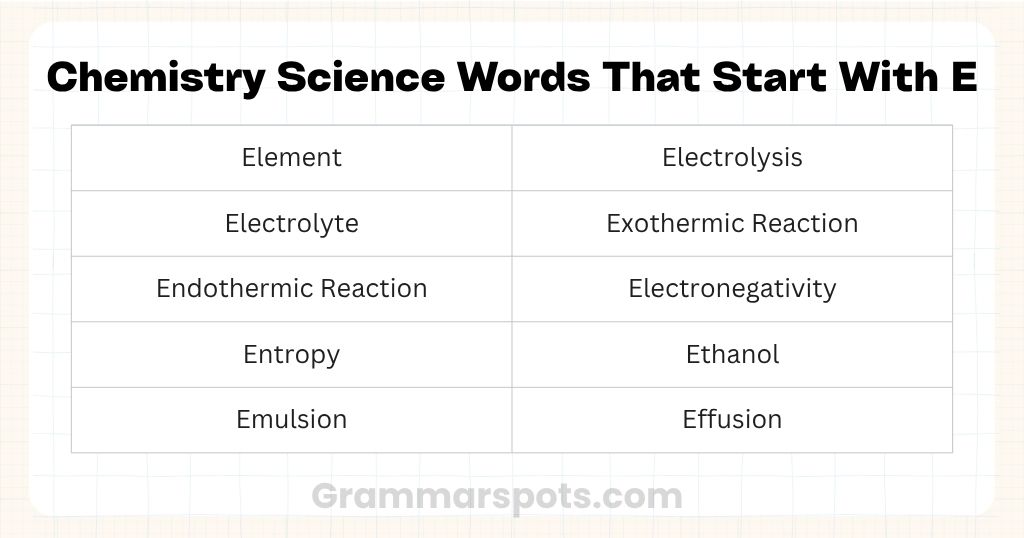
Element
A pure substance made of one type of atom. Cannot be broken down chemically. There are 118 confirmed elements.
Electrolysis
Using electricity to drive a non-spontaneous chemical reaction. Water splits into hydrogen and oxygen gas through electrolysis.
Electrolyte
A substance that conducts electricity when dissolved. Sodium and potassium in sports drinks are electrolytes your nerves depend on.
Exothermic Reaction
A reaction releasing heat to the surroundings. Burning wood and hand warmers are exothermic.
Endothermic Reaction
A reaction absorbing heat from the surroundings. Cold packs and dissolving ammonium nitrate in water are endothermic.
Electronegativity
The strength with which an atom pulls shared electrons toward itself. Fluorine has the highest electronegativity of all elements.
Entropy (chemistry)
How spread out or disordered particles are. Gases have more entropy than liquids; liquids more than solids.
Ethanol
The alcohol found in beverages and used as fuel and solvent. Burns cleanly and is blended into gasoline in many countries.
Emulsion
A stable mixture of two liquids that don’t naturally mix. Milk and mayonnaise are both emulsions.
Effusion
Gas escaping through a tiny hole into a vacuum. Lighter gases effuse faster — a principle used in uranium enrichment.
Endergonic Reaction
A reaction requiring energy input to proceed. Protein synthesis in cells is endergonic — powered by ATP.
Exergonic Reaction
A reaction that releases free energy. Cellular respiration is exergonic.
Enthalpy
Total heat content of a chemical system. Change in enthalpy during a reaction tells you if heat is released or absorbed.
Electron Affinity
Energy released when an atom gains an electron. Elements with high electron affinity grab electrons easily.
Ethylene
A simple hydrocarbon gas that acts as a plant hormone. Fruit ripening is triggered by ethylene why putting a ripe banana near green fruit speeds ripening.
Electrodialysis
A process using electric current to move ions through a membrane. Used to purify water and produce salt.
Biology Science Words That Start With E
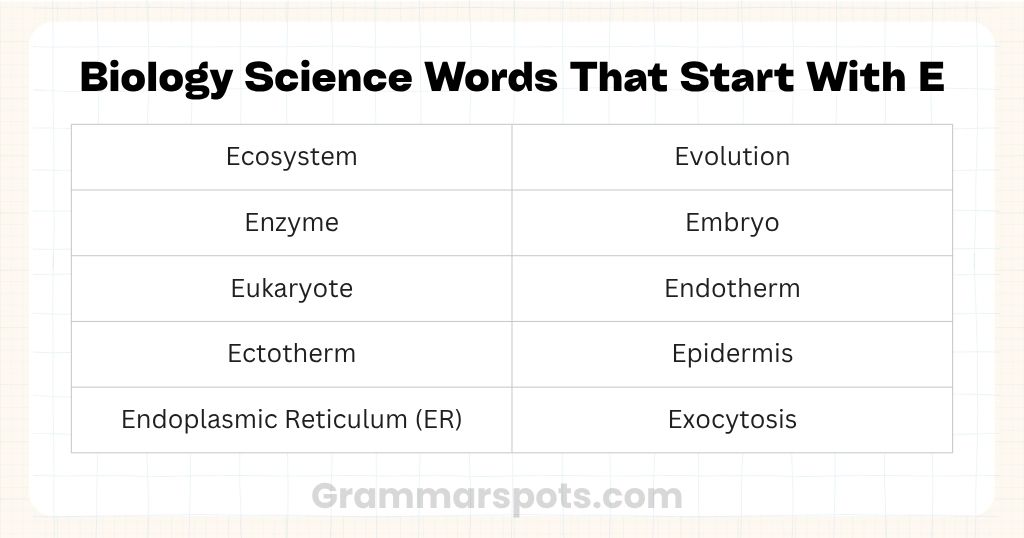
Ecosystem
All living organisms in an area interacting with each other and their physical environment. A pond, a forest, and your gut are all ecosystems.
Evolution
Change in inherited traits across generations through natural selection. The foundation of all modern biology.
Enzyme
A protein catalyst that speeds up biological reactions without being consumed. Amylase in saliva breaks down starch the moment you chew.
Embryo
The early developmental stage after fertilization. In humans, this lasts from week 3 to week 8 of pregnancy.
Eukaryote
An organism whose cells have a membrane-bound nucleus. Animals, plants, fungi, and protists are eukaryotes.
Endotherm
An animal that generates its own body heat internally. Humans, birds, and dogs are endotherms.
Ectotherm
An animal that relies on external sources to regulate body temperature. Lizards, snakes, and fish are ectotherms.
Epidermis
The outermost cell layer of skin in animals, or the outer layer of a plant leaf.
Endoplasmic Reticulum (ER)
A network of membranes inside cells. Rough ER makes proteins; smooth ER processes lipids.
Exocytosis
A cell releasing material outside through vesicles. Salivary glands release saliva this way.
Endocytosis
A cell engulfing material from outside. White blood cells engulf bacteria through endocytosis.
Extinction
When every individual of a species is gone. The dodo, the passenger pigeon, and countless others are permanently lost.
Estrogen
A hormone produced mainly in ovaries. Regulates female reproductive development and the menstrual cycle.
Exponential Growth
Population growth that accelerates because each generation reproduces more than the last. Bacteria doubling every 20 minutes is the classic example.
Ectoderm
The outermost cell layer of a developing embryo. Forms skin, hair, nails, and the nervous system.
Endoderm
The innermost embryonic cell layer. Forms the digestive tract and respiratory lining.
Eosinophil
A type of white blood cell. Elevated during allergic reactions and parasitic infections.
Erythrocyte
The scientific name for a red blood cell. Carries oxygen using hemoglobin.
Epithelium
Tissue that lines body surfaces, organs, and cavities. Skin, the lining of the lungs, and the gut wall are all epithelial tissue.
Endorphin
A chemical released by the brain during exercise, laughter, or pain. Creates feelings of pleasure and reduces pain perception.
Embryonic Stem Cell
An undifferentiated cell from an embryo that can develop into any cell type in the body.
Endosymbiotic Theory
The scientific explanation that mitochondria and chloroplasts were once free-living bacteria absorbed by larger cells. Both still carry their own DNA.
Epigenetics
Changes in gene expression that don’t alter the DNA sequence. Diet, stress, and environment can switch genes on or off.
Extracellular Matrix
The network of proteins and molecules outside cells that gives tissues structure and support.
Eutrophication
Excessive nutrients — usually from fertilizer runoff — entering a water body, causing algae overgrowth and oxygen depletion that kills aquatic life.
Earth Science Words That Start With E
Erosion
The gradual removal and transport of rock, soil, or sediment by water, wind, or ice. The Grand Canyon is one result of millions of years of erosion.
Earthquake
Sudden ground shaking caused by movement along tectonic plate boundaries or faults. Releases energy in seismic waves.
Epicenter
The point on Earth’s surface directly above an earthquake’s underground origin point.
Estuary
Where freshwater rivers meet saltwater oceans. Among the most biologically productive environments on Earth.
Evaporation
Surface liquid converting into water vapor. A key step in Earth’s water cycle.
Evapotranspiration
Combined water loss from ground evaporation and plant transpiration. Used to measure regional water budgets and drought severity.
Exosphere
Earth’s outermost atmospheric layer, extending from around 500 km upward. Satellites orbit here.
Eon
The largest unit of geologic time. Earth’s history is split into four: Hadean, Archean, Proterozoic, and Phanerozoic.
Eolian
Relating to wind-driven geological processes. Sand dunes and loess deposits are eolian formations.
Effluent
Liquid waste discharged into rivers, lakes, or oceans. Industrial effluent is a major water pollution source.
Edaphology
The study of how soil composition and properties affect plant growth and land use.
Erosion Cycle
The full sequence: weathering breaks material down, erosion moves it, deposition places it elsewhere.
Extreme Environment
Any habitat with conditions most life cannot survive — deep sea vents, polar ice, or highly acidic lakes.
Space & Astronomy Science Words That Start With E
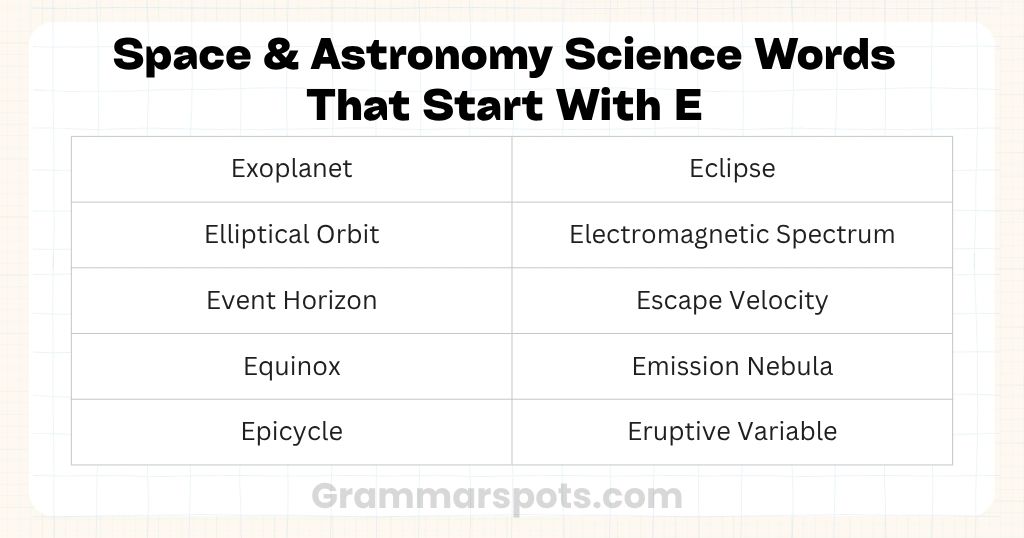
Exoplanet
A planet orbiting a star other than the Sun. Over 5,500 confirmed as of recent counts. Some sit in habitable zones where liquid water could exist.
Eclipse
One celestial body passing through another’s shadow. Solar eclipses occur when the Moon blocks the Sun. Lunar eclipses occur when Earth’s shadow covers the Moon.
Elliptical Orbit
The oval-shaped path planets take around the Sun. Planets move faster when closer to the Sun, slower when farther away.
Electromagnetic Spectrum
The complete range of electromagnetic radiation — from radio waves at the low end to gamma rays at the high end. Visible light is a tiny portion of the middle.
Event Horizon
The boundary surrounding a black hole beyond which nothing escapes — not even light.
Escape Velocity
The minimum speed required to break free from a planet’s gravity. Earth’s is 11.2 km/s. The Moon’s is much lower.
Equinox
The two days each year when day and night are equal length. March equinox marks spring in the Northern Hemisphere; September marks fall.
Emission Nebula
A cloud of ionized gas that glows because nearby hot stars excite its atoms into emitting light.
Epicycle
An older astronomical concept: a small circle whose center moves along a larger circle, used to explain planetary motion before Kepler’s laws.
Eruptive Variable
A star that changes brightness due to explosive surface or atmospheric activity.
Expansion of Universe
The observation that galaxies are moving away from each other in all directions. First confirmed by Edwin Hubble in 1929.
Exotic Matter
Hypothetical matter with negative energy density. Theoretically needed to create stable wormholes in space.
Exoplanet Atmosphere
The layer of gases surrounding a planet outside our solar system. Detecting these atmospheres helps scientists evaluate the possibility of life.
Medical & Health Science Words That Start With E
Epidermis
The skin’s protective outer layer. Has no blood vessels receives nutrients by diffusion from the layer beneath.
Epiglottis
Cartilage flap that covers the windpipe when you swallow. Prevents food from entering the lungs.
Endocrine System
The network of hormone-producing glands: thyroid, adrenal glands, pancreas, and more. Controls metabolism, growth, mood, and reproduction.
Endoscopy
A camera on a flexible tube inserted to view internal organs without surgery.
Edema
Fluid buildup causing tissue swelling. Common after long flights. Also signals heart, kidney, or liver problems.
Electrocardiogram (ECG)
A test recording the heart’s electrical activity. Irregular wave patterns reveal arrhythmias, heart attacks, and other conditions.
Epidemiology
The study of how diseases spread through populations. Epidemiologists tracked COVID-19 spread and identified high-risk groups.
Epidural
An injection of anesthetic into the space around the spinal cord. Commonly used during childbirth to reduce pain.
Endolymph
The fluid inside the inner ear’s cochlea and semicircular canals. Moves when the head moves, helping the brain detect balance and motion.
Eosinophilia
An abnormally high number of eosinophils in the blood. Signals allergic disease or parasitic infection.
Epitope
The specific part of an antigen that an antibody recognizes and binds to. Vaccine design often targets key epitopes.
Epidemics
A disease spreading rapidly through a community at a rate higher than normal. When it spreads globally, it becomes a pandemic.
Electromyography (EMG)
A diagnostic test measuring electrical activity in muscles. Used to detect nerve and muscle disorders.
Endorphin
A brain chemical released during exercise and laughter that reduces pain and creates positive feelings.
Technology & Applied Science Words That Start With E
Electrode
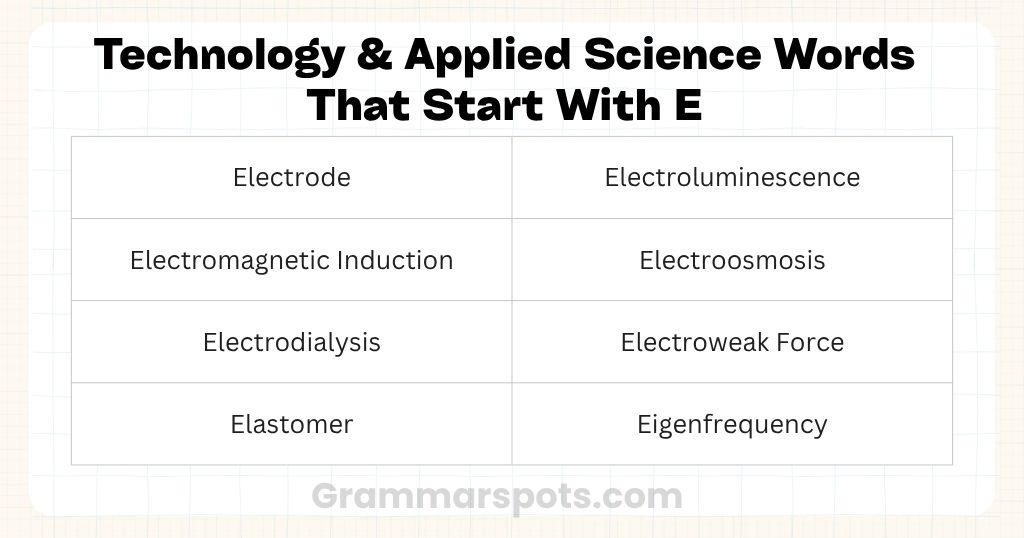
A conductor allowing electricity to enter or exit a substance. Batteries, fuel cells, and electroplating systems all use electrodes.
Electroluminescence
Light emission caused by electric current passing through a material. LED and OLED screens operate on this principle.
Electromagnetic Induction
The generation of electric current in a conductor moving through a magnetic field. How power plant generators and transformers work.
Electroosmosis
Movement of liquid through a porous material under an electric field. Used in microfluidic devices and soil decontamination.
Electrodialysis
Separating ions from water using an electric current and membranes. A water purification method used in desalination.
Electroweak Force
A unified force combining electromagnetism and the weak nuclear force. One of the fundamental forces in particle physics.
Elastomer
A polymer with elastic properties it stretches and recovers. Used in tires, seals, gloves, and phone cases.
Eigenfrequency
The natural frequency at which a structure vibrates when disturbed. Engineers must account for this to avoid resonance failures in buildings and bridges.
Elastic Modulus
A material’s resistance to elastic deformation under stress. High elastic modulus = stiff material. Steel has a very high elastic modulus.
Extrusion
Forcing material through a shaped die to create objects with a fixed cross-section. Plastic pipes, aluminum profiles, and pasta are all extruded.
Easy Science Words That Start With E (Beginners & Kids)
| Word | Simple Meaning |
| Earth | Third planet from the Sun; only known planet with life |
| Echo | Sound bouncing back off a hard surface |
| Egg | Reproductive cell or fertilized structure in birds and reptiles |
| Electricity | Flow of electrons that powers devices and lights |
| Element | A pure substance that cannot be broken down further |
| Ecosystem | All living things in one place plus their environment |
| Evaporation | When liquid turns into invisible water vapor |
| Erosion | Wind or water slowly wearing rock or soil away |
| Extinct | A species that has completely died out |
| Exhale | Breathing air out of the lungs |
| Eye | Organ of vision that focuses light onto the retina |
| Ear | Organ that detects sound vibrations |
Advanced Science Words That Start With E
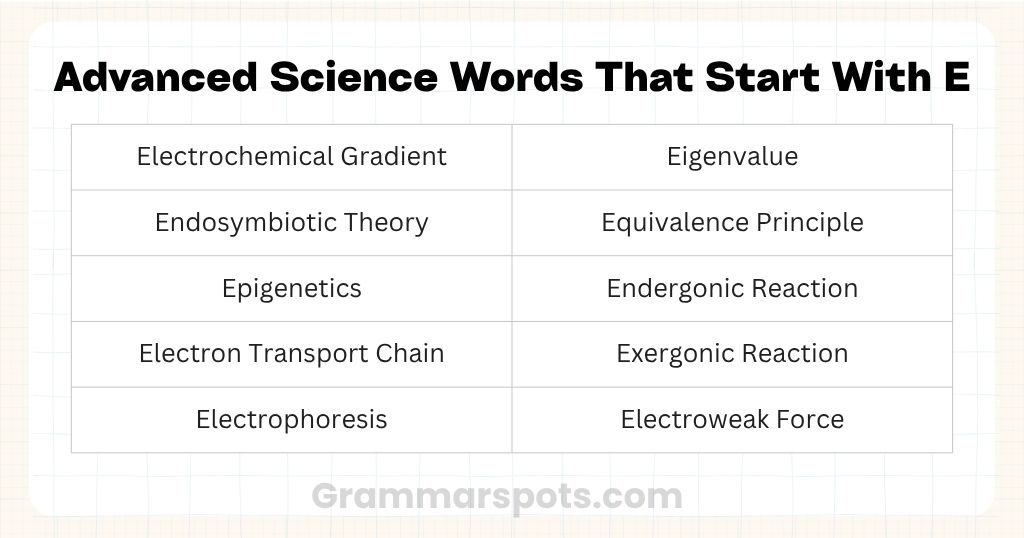
| Word | Meaning |
| Electrochemical Gradient | Combined concentration and charge difference driving ion movement across membranes |
| Endosymbiotic Theory | Mitochondria and chloroplasts evolved from ancient absorbed bacteria |
| Epigenetics | Gene expression changes not involving DNA sequence alteration |
| Electron Transport Chain | Series of proteins in mitochondria generating ATP from electrons |
| Electrophoresis | Separating DNA or proteins by size using electric current |
| Eigenvalue | Number describing vector transformation magnitude in quantum mechanics |
| Equivalence Principle | Gravity and acceleration produce identical physical effects |
| Endergonic Reaction | Chemical reaction requiring energy input to proceed |
| Exergonic Reaction | Reaction releasing free energy spontaneously |
| Electroweak Force | Unified force combining electromagnetism and weak nuclear force |
| Exon Shuffling | Process where exons from different genes combine during evolution |
| Extracellular Matrix | Structural protein network surrounding cells in tissues |
| Eigenfrequency | Natural vibration frequency of a physical structure |
| Electroosmosis | Liquid movement through porous material under electric field |
| Emission Nebula | Glowing gas cloud ionized by nearby hot stars |
Science Words That Start With E for 7th Grade
| Word | What to Know |
| Electromagnetic Waves | Energy waves that travel through space without needing matter |
| Electron Configuration | How electrons are arranged in an atom’s shells |
| Endothermic vs. Exothermic | One absorbs heat; the other releases it |
| Erosion and Deposition | Erosion moves material; deposition drops it elsewhere |
| Eukaryote vs. Prokaryote | Eukaryotes have a nucleus; prokaryotes do not |
| Ecosystem Services | Clean water, clean air, and pollination that ecosystems provide |
| Exponential Growth | Population growing faster and faster each generation |
| Estuary | Where river meets ocean — high biodiversity zone |
| Evapotranspiration | Combined water loss from soil and plants |
| Emission Spectrum | Specific light wavelengths an element releases when excited |
Common Confusions With E Science Words
Evaporation vs. Condensation
- Evaporation: liquid → gas
- Condensation: gas → liquid
- Water droplets on a cold glass are condensation, not evaporation
Endothermic vs. Exothermic
- Endothermic absorbs heat — cold packs, melting ice
- Exothermic releases heat — fire, hand warmers
- Memory trick: Endo = in, Exo = out
Eukaryote vs. Prokaryote
- Eukaryote: has a true nucleus (animals, plants, fungi)
- Prokaryote: no membrane-bound nucleus (bacteria)
- This difference is why antibiotics kill bacteria without harming your cells
Ecosystem vs. Biome
- Ecosystem: a specific place with specific species and conditions
- Biome: a large category defined by climate (rainforest, desert, tundra)
Erosion vs. Weathering
- Weathering: rock breaks down in place
- Erosion: broken pieces get carried away
- Both work together but are separate steps
Excretion vs. Secretion
- Excretion: removing waste from the body (urine, sweat)
- Secretion: releasing useful substances (saliva, hormones)
Where You Actually Use These Words
In hospitals
- ECG monitors heart rhythms
- Edema signals organ problems
- Endoscopy replaces exploratory surgery
- Epidemiology guides outbreak responses
In your kitchen
- Enzymes in meat tenderizers break down proteins
- Emulsification holds salad dressing together
- Ethanol is the active ingredient in hand sanitizer
On Earth’s surface
- Erosion reshapes coastlines every year
- Estuaries filter pollution before it reaches the ocean
- Earthquake monitoring stations track seismic activity globally
In your own body
- Electrons carry nerve signals between neurons
- Endorphins reduce pain after exercise
- Epiglottis protects your airway every single time you eat
In space
- Exoplanet research is one of astronomy’s fastest-growing fields
- Escape velocity determines rocket fuel calculations
- Electromagnetic spectrum is the primary tool for studying distant stars
Common Mistakes Students Make
- Writing “exothermic” when describing cold packs cold packs are endothermic
- Confusing erosion with weathering they are connected but not the same
- Calling bacteria eukaryotes bacteria are prokaryotes
- Using extinction and endangered interchangeably endangered means at risk; extinct means gone
- Mixing up electron (a particle) with element (a type of atom)
FAQs
How many science words start with E?
Hundreds exist across all scientific fields. This article covers 145+ of the most important ones for students and general readers.
Which E words matter most for school?
- Energy, element, ecosystem, evolution, enzyme, electron, erosion, embryo, and electromagnetic spectrum appear most frequently in tests and textbooks.
Are E words common in biology?
Yes, biology has more E words than most other sciences. Evolution, enzyme, embryo, ecosystem, and eukaryote are all foundational terms.
What is the difference between endothermic and exothermic?
Endothermic absorbs heat from surroundings. Exothermic releases heat into surroundings.
Which E words appear on standardized tests?
Erosion, evolution, energy, ecosystem, element, enzyme, electron, and electromagnetic spectrum appear most consistently.
Conclusion
This guide walked through 145+ science words starting with E from everyday terms like energy and erosion to advanced concepts like electrochemical gradient and endosymbiotic theory. Every major scientific field is covered: physics, chemistry, biology, Earth science, space, medicine, and technology.
You now have a numbered master list, category breakdowns, beginner and advanced groupings, real-world connections, and clear comparisons of words that students commonly mix up.
The best way to use this list is simple pick one category, read the word, read the meaning, then ask yourself where you’ve actually seen or experienced that concept. That small mental step is what turns a forgotten vocabulary word into something that genuinely sticks.

I’m Hazel, and I studied BSC English at GCUF. I focus on explaining word meanings in simple, clear language that anyone can understand. My goal is helping readers grasp everyday English, confusing terms, and slang used in real conversations and social media. I believe language learning works best when definitions connect to actual life situations. Through careful research and straightforward explanations, I make vocabulary accessible for students, learners, and anyone curious about how English really works in daily use.