

You’re here because you need science words that start with G for a test, a project, a word list, or just curiosity. G is one of the richest letters in science. Gravity runs the universe. Genes carry life’s instructions. Glaciers reshape continents.
This article gives you 150+ words, organized by subject, with clear meanings and real-world context. No filler. No repetition.
Quick Answer: 20 Most-Used Science Words That Start With G
| Word | Meaning |
| Gravity | Force pulling objects toward each other |
| Gene | DNA segment carrying hereditary instructions |
| Glucose | Simple sugar cells use for energy |
| Geology | Study of Earth’s structure and history |
| Galaxy | System of billions of stars held by gravity |
| Germination | Process of a seed beginning to sprout |
| Gas | Matter with no fixed shape or volume |
| Genome | Complete genetic information of an organism |
| Glacier | Large slow-moving mass of ice |
| Gamete | Reproductive cell — sperm or egg |
| Geothermal | Heat energy from Earth’s interior |
| Gymnosperms | Seed plants that produce no fruit |
| Gestation | Development period inside the womb |
| Gamma ray | Most energetic form of electromagnetic radiation |
| Gland | Organ that produces and releases substances |
| Groundwater | Water stored beneath Earth’s surface |
| Genotype | Genetic code an organism actually carries |
| Green algae | Aquatic photosynthetic organisms |
| Gravitational field | Region where gravitational force acts |
| Greenhouse gas | Gas that traps heat in Earth’s atmosphere |
Quick List of 150+ Science Words That Start With G
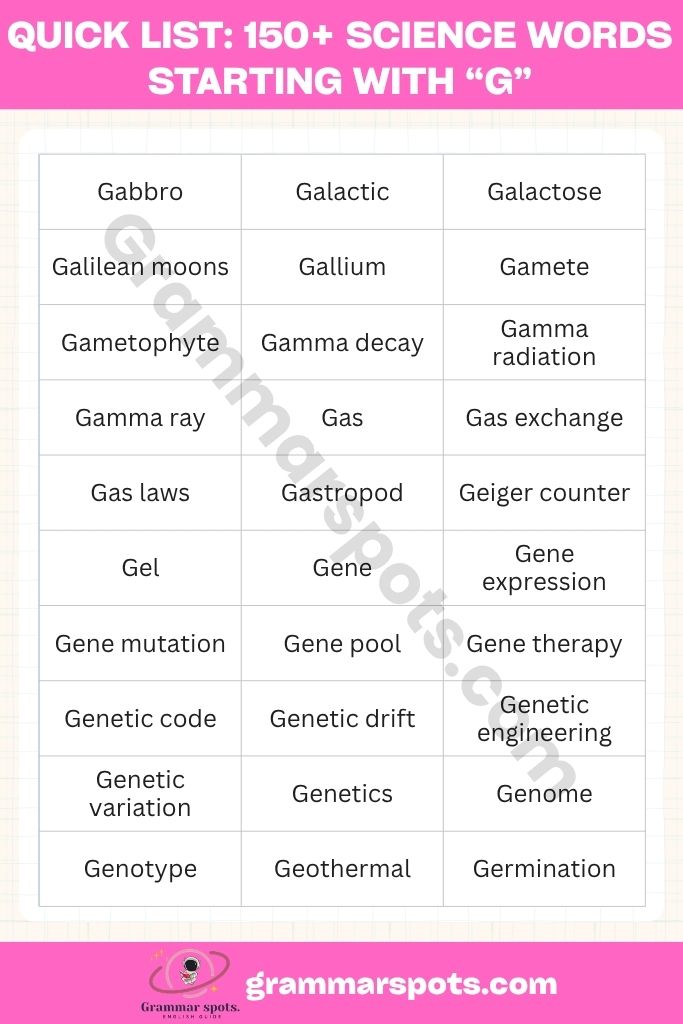
- Gabbro
- Galactic
- Galactose
- Galilean moons
- Gallium
- Gamete
- Gametophyte
- Gamma decay
- Gamma radiation
- Gamma ray
- Gas
- Gas exchange
- Gas laws
- Gastropod
- Geiger counter
- Gel
- Gene
- Gene expression
- Gene mutation
- Gene pool
- Gene therapy
- Genetic code
- Genetic drift
- Genetic engineering
- Genetic variation
- Genetics
- Genome
- Genome-Wide Association Study
- Genotype
- Genus
- Geochemistry
- Geocentric
- Geodesy
- Geode
- Geographic isolation
- Geologic time scale
- Geology
- Geostrophic flow
- Geosynchronous orbit
- Geothermal energy
- Germination
- Gestation
- Gill
- Glacial
- Glaciation
- Glacier
- Gland
- Glial cells
- Global warming
- Globular cluster
- Glomerulonephritis
- Glomerulus
- Glucose
- Glycogen
- Glycolysis
- Glycoprotein
- Gneiss
- Gondwana
- Gonad
- Gradient
- Granite
- Graphene
- Gravitational constant
- Gravitational field
- Gravitational force
- Gravitational lensing
- Gravitational potential energy
- Gravitational waves
- Graviton
- Gravity
- Green algae
- Greenhouse effect
- Greenhouse gas
- Groundwater
- Growth hormone
- Growth rate
- Guanine
- Gymnosperms
- Gyration
- Gyroscope
Physics Science Words That Start With G

Gravity
The attractive force between any two objects with mass. It keeps planets in orbit and keeps you on the ground.
Gravitational Force
The measurable pull between two specific objects. Stronger when masses are larger. Weaker as distance increases.
Gravitational Field
An invisible region around any object where its gravity can act. Earth’s field extends thousands of kilometers into space.
Gravitational Potential Energy
Energy stored due to an object’s height. A ball at the top of a ramp has more of it than a ball at the bottom.
Gravitational Waves
Ripples through space-time caused by massive cosmic events like two black holes merging. First detected in 2015.
Gravitational Lensing
Light bends when it passes near massive objects. A galaxy can act like a natural lens, magnifying objects behind it.
Gravitational Constant (G)
A fixed number 6.674 × 10⁻¹¹ N·m²/kg² used to calculate gravitational force between two objects.
Graviton
A theoretical particle believed to carry the gravitational force. Not yet detected, but predicted by physics models.
Gamma Ray
The highest-energy form of electromagnetic radiation. Produced by nuclear reactions. Penetrates most materials.
Gamma Decay
A type of radioactive decay where an unstable nucleus releases a gamma ray to shed excess energy.
Gas
A state of matter with no fixed shape or volume. Molecules move fast and spread to fill any container.
Gas Laws
Rules describing how gas behaves when pressure, temperature, or volume changes. Includes Boyle’s Law and Charles’s Law.
Gradient
The rate of change of a quantity over distance. Pressure gradients drive wind. Temperature gradients drive heat flow.
Gyroscope
A spinning device that resists changes in its orientation. Used in aircraft, satellites, and smartphones.
Gyration
Circular or spiral motion of an object around an axis.
Chemistry Science Words That Start With G
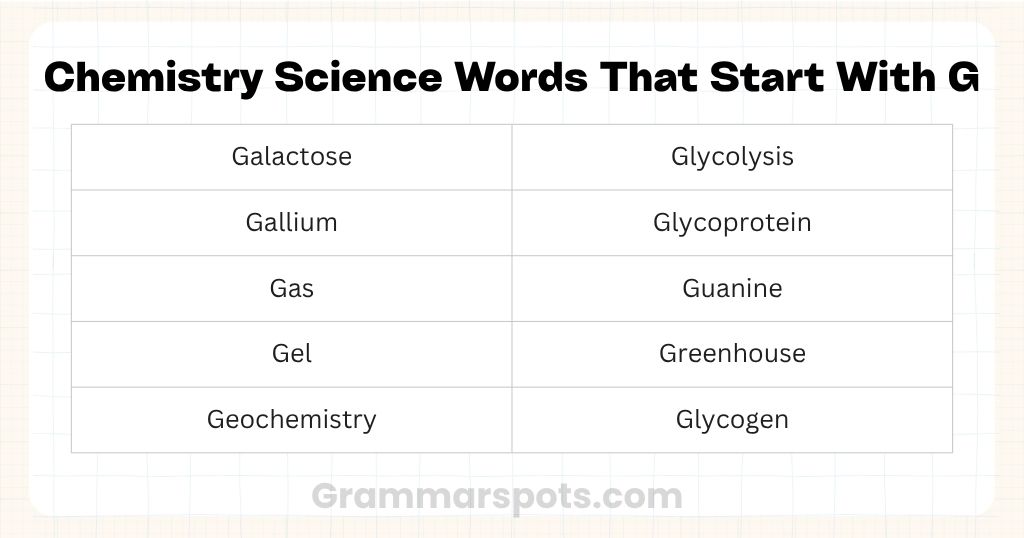
Galactose
A simple sugar found in dairy products. The body converts it into glucose for energy use.
Gallium
A soft metal that melts just above room temperature (29.76°C). Used in semiconductors and LED lights.
Gas Exchange
The swapping of oxygen and carbon dioxide across a membrane. Happens in lungs and plant leaves.
Gel
A substance between liquid and solid. Examples include hair gel, gelatin, and silica gel.
Geochemistry
Study of Earth’s chemical composition what elements exist in rocks, soil, and water, and how they cycle.
Glycogen
The stored form of glucose in animal cells. Packed into the liver and muscles for quick energy release.
Glycolysis
A 10-step chemical process that breaks glucose into smaller molecules, releasing energy. Happens in nearly every living cell.
Glycoprotein
A protein with sugar molecules attached to its surface. Helps cells recognize each other and plays a key role in immunity.
Guanine
One of four DNA bases. Always pairs with cytosine in the double helix. Represented by the letter G in genetic sequences.
Greenhouse Gas
A gas like CO₂ or methane that absorbs and traps heat in Earth’s atmosphere.
Biology Science Words That Start With G
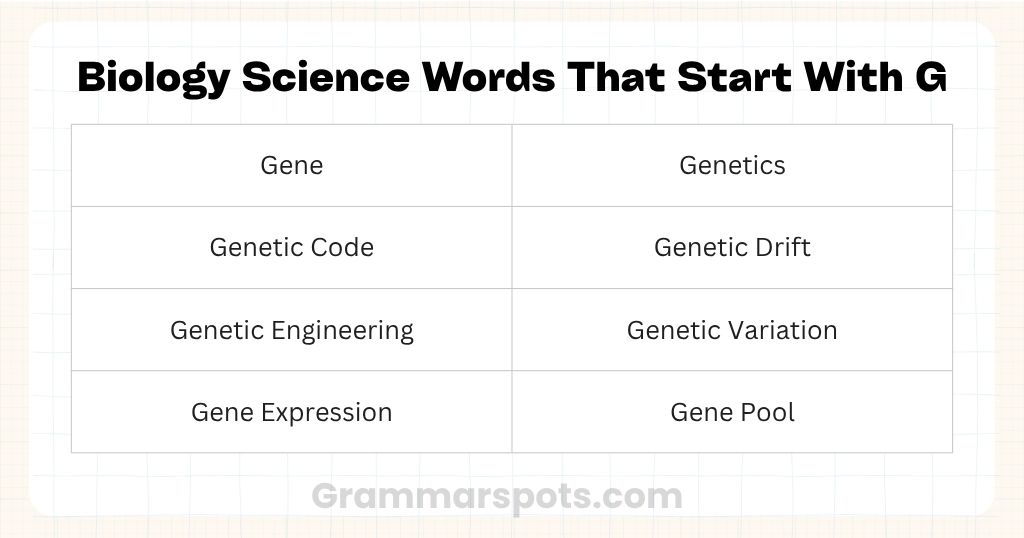
Gene
A specific section of DNA that codes for a protein or trait. Humans carry around 20,000–25,000 genes.
Genetics
The branch of biology that studies inheritance, variation, and genes.
Genetic Code
The set of rules by which DNA sequences are translated into proteins. Universal across almost all living things.
Genetic Drift
Random changes in gene frequency within a population — especially common in small, isolated groups.
Genetic Engineering
Deliberately modifying an organism’s DNA using laboratory techniques like CRISPR.
Genetic Variation
Differences in DNA between individuals of the same species. Drives evolution and adaptation.
Gene Expression
The process by which a gene’s instructions are read and used to make a protein.
Gene Pool
All genetic information present within a population. Larger gene pools mean more adaptability.
Gene Therapy
A medical technique that repairs or replaces faulty genes to treat disease.
Gene Mutation
A change in the DNA sequence. Can be harmless, harmful, or occasionally beneficial.
Genome
The full set of genetic instructions in an organism. The human genome has about 3 billion base pairs.
Genome-Wide Association Study (GWAS)
A method scanning the entire genome to find variants linked to diseases like diabetes or heart disease.
Genotype
The specific genetic makeup an organism carries the actual DNA version, not what appears on the outside.
Genus
A classification level grouping closely related species. Humans belong to the genus Homo.
Gamete
A sex cell carrying half the normal chromosome count. Sperm and egg cells are gametes.
Gametophyte
The gamete-producing stage in a plant’s life cycle. Visible in ferns and mosses.
Germination
The process of a seed activating and beginning to grow triggered by water, warmth, and sometimes light.
Gestation
The time a developing organism spends inside its mother. Humans: ~40 weeks. Elephants: ~22 months.
Gill
A respiratory organ that extracts dissolved oxygen from water. Found in fish, tadpoles, and some crustaceans.
Gland
An organ that produces and secretes specific substances. Types include sweat glands, salivary glands, and endocrine glands.
Glial Cells
Support cells in the nervous system. They protect neurons, deliver nutrients, and remove cellular waste.
Glomerulus
A small bundle of capillaries in the kidney where blood is filtered under pressure.
Glucose
The primary energy source for cells. Comes from digesting carbohydrates. The brain uses ~120 grams per day.
Gonad
The organ producing sex cells and reproductive hormones. Ovaries in females, testes in males.
Green Algae
Aquatic photosynthetic organisms believed to be the ancestors of all land plants.
Growth Hormone
A protein released by the pituitary gland that stimulates bone and tissue growth during development.
Gymnosperms
Plants that produce seeds not enclosed in fruit like pine trees and cycads. “Gymnosperm” means naked seed.
Earth Science Words That Start With G
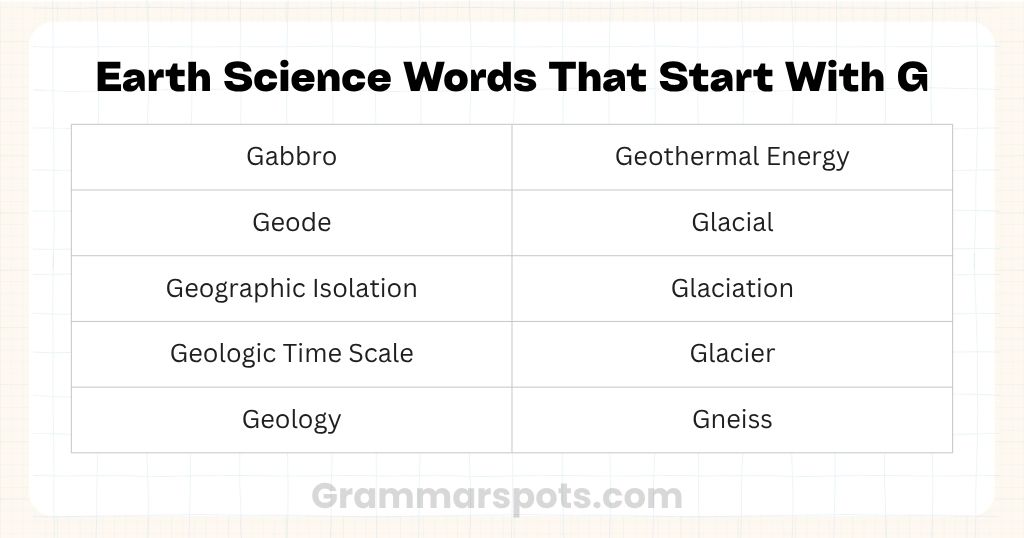
Gabbro
A dark, coarse-grained igneous rock formed when magma cools slowly underground. Makes up much of the ocean floor.
Geode
A rock with a hollow interior lined with crystals usually quartz or amethyst.
Geographic Isolation
When a physical barrier separates a population, allowing it to evolve independently over time.
Geologic Time Scale
A timeline dividing Earth’s 4.6-billion-year history into eons, eras, periods, and epochs.
Geology
The science of Earth’s materials, structure, processes, and history.
Geothermal Energy
Energy drawn from Earth’s internal heat. Used to generate electricity in volcanically active regions.
Glacial
Relating to glaciers. Glacial erosion carved the Great Lakes and shaped many mountain valleys.
Glaciation
A period when glaciers expand across large land areas commonly called an ice age.
Glacier
A massive body of ice that moves slowly under its own weight, shaping the land beneath it.
Gneiss
A banded metamorphic rock formed under extreme heat and pressure. Some gneiss is over 4 billion years old.
Gondwana
An ancient supercontinent that broke apart to form South America, Africa, Antarctica, Australia, and India.
Granite
A hard, coarse-grained igneous rock common in Earth’s continental crust. Often used in construction.
Groundwater
Water that has seeped below the surface into rock pores and underground aquifers.
Geochemistry
Study of the chemical composition of Earth’s rocks, soils, and water systems.
Geodesy
The science of measuring Earth’s shape, gravitational field, and orientation in space.
Space & Astronomy Science Words That Start With G
Galaxy
A massive system of stars, gas, dust, and dark matter held together by gravity. The Milky Way contains 100–400 billion stars.
Galilean Moons
Jupiter’s four largest moons Io, Europa, Ganymede, and Callisto discovered by Galileo in 1610.
Galactic
Anything relating to a galaxy. A galactic year is the time it takes the solar system to orbit the Milky Way center (~225 million years).
Globular Cluster
A dense, spherical group of hundreds of thousands of old stars orbiting around a galaxy’s core.
Geocentric
The outdated model placing Earth at the center of the universe. Replaced by the heliocentric model in the 1500s.
Geosynchronous Orbit
An orbit where a satellite moves at the same speed Earth rotates, staying above the same spot on the ground.
Gravitational Lensing
A massive object bending light from behind it used by astronomers to study distant galaxies and dark matter.
Gravitational Waves
Space-time ripples produced by extreme cosmic events. Travel at the speed of light.
Galactic Rotation Curve
A graph showing that stars far from a galaxy’s center orbit faster than expected key evidence for dark matter.
Medical & Health Science Words That Start With G
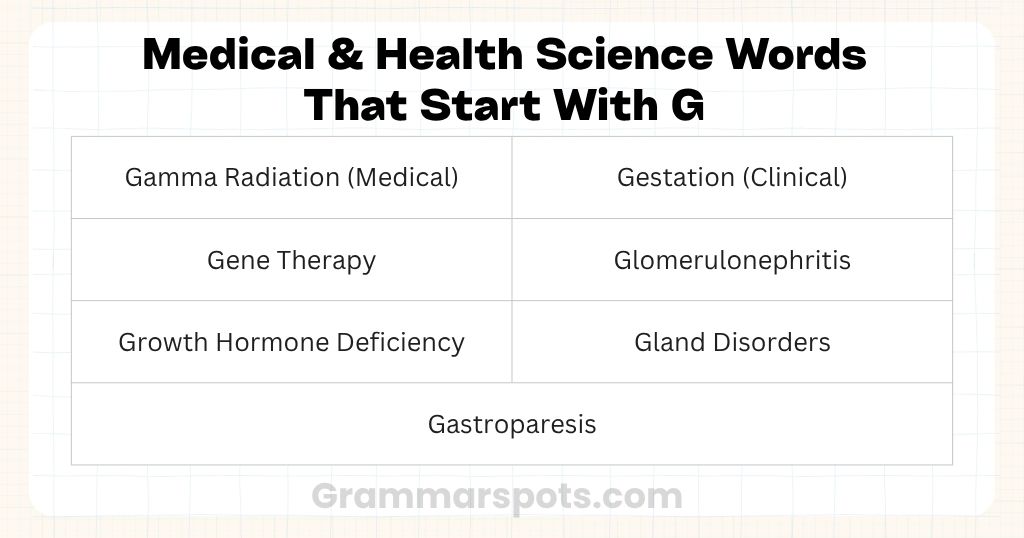
Gamma Radiation (Medical)
Used in radiation therapy to destroy cancer cells. Must be precisely aimed to protect surrounding tissue.
Gene Therapy
Replacing or repairing defective genes to treat inherited conditions. Showing early success in treating certain blindness and immune disorders.
Gestation (Clinical)
Doctors measure gestational age in weeks to track fetal development. Delivery before 37 weeks is classified as premature.
Glomerulonephritis
Inflammation of the glomeruli in the kidneys. Can reduce filtering ability and lead to kidney failure if untreated.
Growth Hormone Deficiency
Insufficient production of growth hormone by the pituitary gland. Causes slower growth in children. Treated with hormone injections.
Gland Disorders
Overactive or underactive glands disrupt body systems. An underactive pancreas leads to diabetes. An overactive thyroid causes hyperthyroidism.
Gastroparesis
A condition where the stomach muscles slow or stop working, preventing food from moving normally into the small intestine.
Technology & Applied Science Words That Start With G
Geiger Counter
A device that detects ionizing radiation by counting particles passing through a sensing tube. More clicks = more radiation.
Geodesy (Applied)
Modern geodesy uses GPS satellites to map Earth’s surface, track tectonic shifts, and support navigation systems.
Geosynchronous Satellites
Satellites placed in geosynchronous orbit for weather monitoring, television broadcasting, and communications.
Graphene
A single layer of carbon atoms arranged in a hexagonal grid. Stronger than steel, highly conductive, and being explored for use in batteries, electronics, and medicine.
GPS (Global Positioning System)
A network of satellites that pinpoints location anywhere on Earth. Requires corrections for both special and general relativity to stay accurate.
Gyroscope (Applied)
Micro-gyroscopes inside phones detect rotation and auto-rotate the screen. Larger versions stabilize aircraft, ships, and spacecraft.
Gel Electrophoresis
A lab technique using electrical current to separate DNA, RNA, or proteins by size through a gel. Used in forensics, medical testing, and genetics research.
Easy Science Words That Start With G (Beginner & Kids Level)
- Gas — Matter that spreads to fill any container. Air and steam are gases.
- Gem — A rare, hard, beautiful mineral. Diamonds and rubies are gems.
- Germ — A tiny organism (bacteria or virus) that can cause illness.
- Germination — When a seed cracks open and begins to grow into a plant.
- Gill — The breathing organ fish use to get oxygen from water.
- Glacier — A huge river of ice that moves slowly over land.
- Gland — A body part that makes and releases useful substances like sweat or saliva.
- Gravity — The force that pulls objects downward and keeps planets in orbit.
- Green algae — Simple water plants that make food using sunlight.
- Growth — The process of getting bigger through new cell production.
- Glucose — The sugar your body makes from food and uses for energy.
- Galaxy — A giant collection of billions of stars in space.
- Geode — A plain-looking rock with beautiful crystals hidden inside.
Advanced Science Words That Start With G
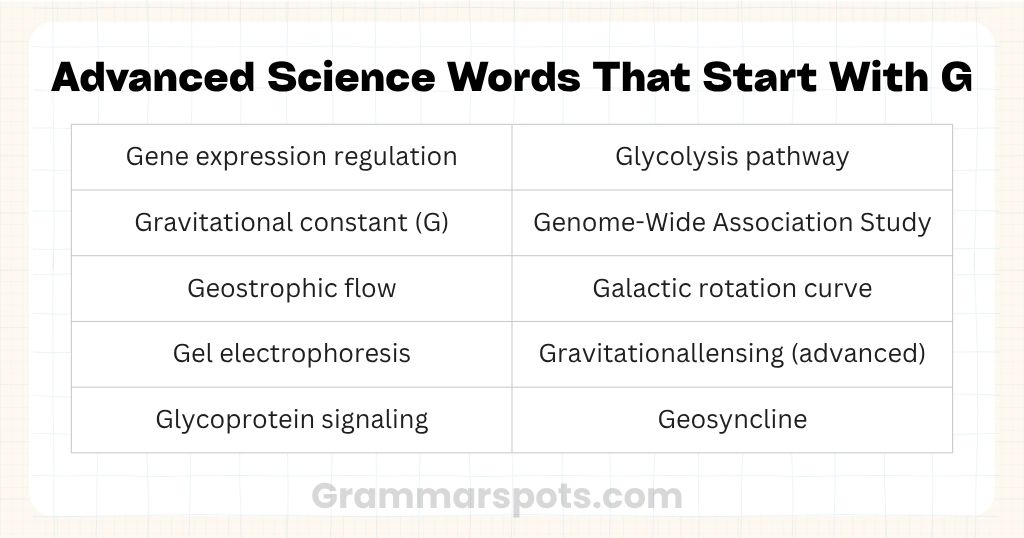
- Gene expression regulation — The control of which genes are active in a cell and when, using transcription factors, epigenetic tags, and RNA interference.
- Glycolysis pathway — A 10-enzyme chain reaction breaking glucose into pyruvate, releasing ATP energy. Occurs in cytoplasm without oxygen.
- Gravitational constant (G) — The universal value 6.674 × 10⁻¹¹ N·m²/kg² used in calculating gravitational force between masses.
- Genome-Wide Association Study — Scanning millions of genetic variants across the genome to identify disease-linked mutations.
- Geostrophic flow — Atmospheric or oceanic movement where the Coriolis effect balances the pressure gradient, producing large-scale wind and current patterns.
- Galactic rotation curve — The unexpected finding that outer stars in galaxies orbit as fast as inner ones, pointing to the existence of dark matter.
- Gel electrophoresis — Separation of biological molecules by size using electrical current through a gel matrix.
- Gravitational lensing (advanced) — Used to calculate the mass of galaxy clusters and detect dark matter by measuring how much light bends.
- Glycoprotein signaling — How sugar-protein complexes on cell surfaces communicate identity and trigger immune responses.
- Geosyncline — A large, elongated depression in Earth’s crust where sediments accumulate over millions of years before being compressed into mountains.
Common Confusions With G Science Words
Genotype vs Phenotype
Genotype is what’s written in the DNA. Phenotype is what shows on the outside eye color, height, blood type. Same genotype can produce different phenotypes in different environments.
Glucose vs Glycogen
Glucose is fuel used right now. Glycogen is fuel saved for later, stored in the liver and muscles.
Galaxy vs Globular Cluster
A galaxy spans hundreds of thousands of light-years and contains billions of stars. A globular cluster is a dense ball of old stars much smaller, orbiting inside a galaxy.
Germination vs Growth
Germination is the moment a seed activates. Growth is everything that follows the plant getting larger over time.
Gravity vs Gravitational Force
Gravity is the concept attraction between masses. Gravitational force is the specific, calculated pull between two objects.
Gymnosperms vs Angiosperms
Both produce seeds. Gymnosperms leave seeds exposed on cones (pines, cedars). Angiosperms enclose seeds inside fruit (apples, roses). About 80% of plant species are angiosperms.
Geothermal vs Greenhouse
Geothermal = heat from inside Earth. Greenhouse = heat trapped in Earth’s atmosphere by gases. Different source, different location.
Where These Words Show Up in Real Life
Hospitals — Gene therapy, gamma radiation, gestation, glomerulonephritis, growth hormone deficiency
Your Body Right Now — Glucose fueling your brain, glycogen stored in your liver, glands releasing hormones, glial cells supporting every thought
Weather & Climate — Greenhouse gases, global warming, geostrophic winds in every forecast
Farming — Germination rates, genetically engineered crops, genetic variation in plant breeding
Space Missions — Gravitational lensing used by James Webb Telescope, geosynchronous satellites for GPS, galactic rotation curves guiding dark matter research
Your Phone — Gyroscope detecting rotation, GPS calculating location, graphene being tested for next-generation screens and batteries
FAQs
How many science words start with G?
Several hundred across all scientific fields. This article covers 150+, selected for relevance across biology, physics, chemistry, earth science, medicine, and technology.
Which G words appear most on school tests?
Gravity, gene, glucose, germination, genome, glacier, greenhouse effect, geology these appear most often from grades 5 through 12.
What does the prefix “geo-” mean?
Earth. It appears in geology, geothermal, geodesy, geocentric, and geochemistry. Learning it unlocks multiple words at once.
What does “gene-” or “geno-” mean?
Origin or birth tied to genetics. Genome, genotype, genetic all branch from this root.
Are advanced G words hard to learn?
Not if you learn in context. Glycolysis is easier to remember when you know glyco = sugar and lysis = breaking apart.
What’s the most important G word in biology?
Gene. It connects inheritance, evolution, medicine, and all of modern biology.
What’s the most important G word in physics?
Gravity. One of the four fundamental forces. It governs everything from falling apples to the structure of the universe.
What This Article Covers
You now have 150+ science words starting with G organized across physics, chemistry, biology, earth science, space, medicine, and technology.
The list works for quick studying, vocabulary building, test prep, and deeper understanding. Each word was chosen because it actually matters in classrooms, labs, hospitals, and the world outside.
Use the subject sections for focused study. Use the alphabetical list for quick reference. Use the confusions section when two words keep mixing you up.

I’m Hazel, and I studied BSC English at GCUF. I focus on explaining word meanings in simple, clear language that anyone can understand. My goal is helping readers grasp everyday English, confusing terms, and slang used in real conversations and social media. I believe language learning works best when definitions connect to actual life situations. Through careful research and straightforward explanations, I make vocabulary accessible for students, learners, and anyone curious about how English really works in daily use.