

You’re here because you need science words starting with I for a test, homework, a project, or just curiosity. Good news: the letter I is one of the richest in all of science. From ion to isotope, these words show up in biology labs, weather maps, hospitals, and space telescopes.
This article gives you 160+ words, organized by field, with clear definitions and real examples. No fluff.
20 Most-Used Science Words That Start With I
| Word | Meaning |
| Ion | Atom with a positive or negative charge |
| Inertia | Object’s resistance to change in motion |
| Isotope | Same element, different number of neutrons |
| Igneous | Rock formed from cooled magma |
| Immunity | Body’s ability to fight off disease |
| Invertebrate | Animal without a backbone |
| Infrared | Light waves longer than visible red light |
| Incubation | Time for an egg or disease to develop |
| Insoluble | Cannot dissolve in a liquid |
| Ionic bond | Bond formed by electron transfer between atoms |
| Isobar | Line on map connecting areas of equal pressure |
| Impulse | Force applied over a short time period |
| Insulator | Material that blocks heat or electricity |
| Inherited | Trait passed from parent to offspring |
| Ignition | Starting point of a combustion reaction |
| Indicator | Substance showing chemical change by color shift |
| Inert | Chemically inactive, does not react |
| Intestine | Organ that digests and absorbs nutrients |
| Inflammation | Body tissue’s response to injury or infection |
| Ionosphere | Charged upper layer of Earth’s atmosphere |
Quick List of 160+ Science Words Starting With I
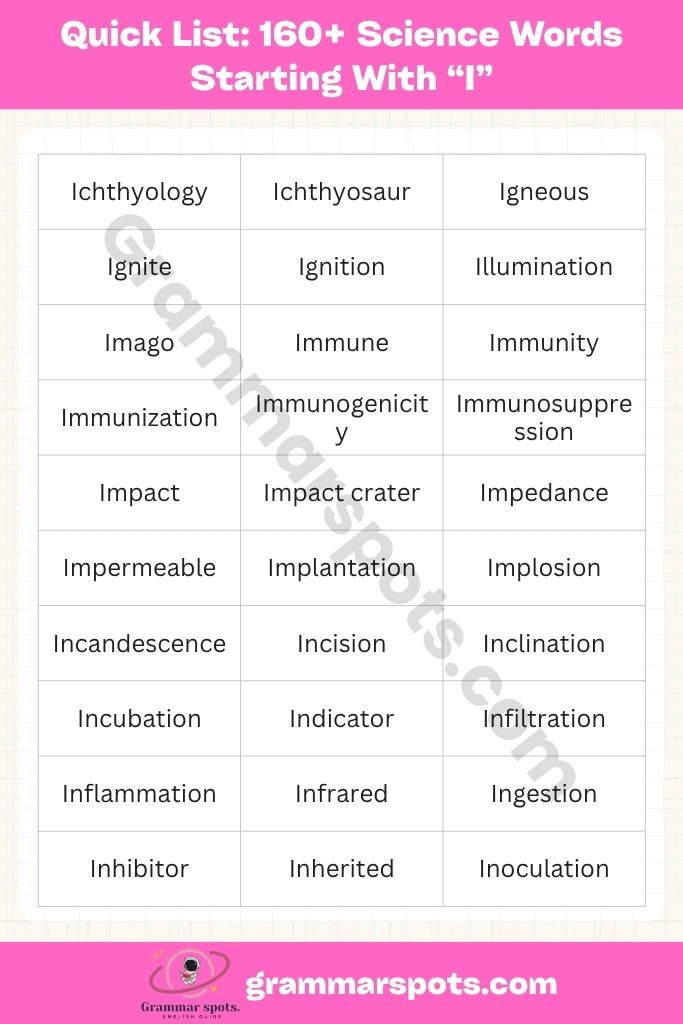
- Ichthyology
- Ichthyosaur
- Igneous
- Ignite
- Ignition
- Illumination
- Imago
- Immune
- Immunity
- Immunization
- Immunogenicity
- Immunosuppression
- Impact
- Impact crater
- Impedance
- Impermeable
- Implantation
- Implosion
- Incandescence
- Incision
- Inclination
- Incubation
- Indicator
- Infiltration
- Inflammation
- Infrared
- Ingestion
- Inhibitor
- Inherited
- Inoculation
- Inorganic
- Inertia
- Inert
- Infarction
- Infection
- Insecticide
- Insoluble
- Instinct
- Insulation
- Insulator
- Insulin
- Integrated circuit
- Interface
- Internal energy
- Interphase
- Interstellar
- Intestine
- Inversion layer
- Invertebrate
- Ion
- Ionic bond
- Ionization
- Ionosphere
- Iris
- Iridescence
- Iridium
- Iron
- Irradiation
- Irregular galaxy
- Isentropic
- Isocline
- Isomer
- Isomerism
- Isobar
- Isostasy
- Isostatic rebound
- Isothermal
- Isotonic
- Isotope
- Isotropy
- Iteration
Physics Science Words That Start With I
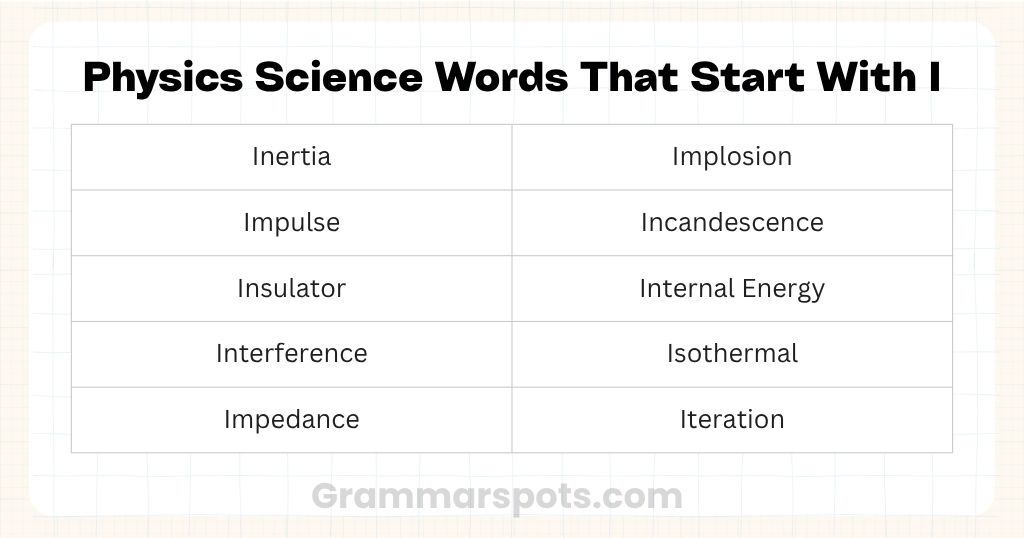
Inertia
An object at rest stays at rest. An object moving keeps moving. That tendency is inertia. When a car brakes hard, your body lurches forward that’s inertia at work.
Impulse
Force applied over a short time. A bat hitting a baseball creates impulse. It equals force multiplied by time duration.
Insulator
A material that resists the flow of heat or electricity. Rubber on electrical wires is an insulator. So is the foam inside a winter coat.
Interference
When two waves meet, they either add together or cancel out. Noise-canceling headphones create a wave that cancels incoming sound that’s interference used on purpose.
Impedance
The total opposition to alternating current in an electrical circuit. Audio engineers deal with this when connecting speakers and amplifiers.
Implosion
A collapse directed inward, opposite of an explosion. When deep-sea pressure overcomes a submarine hull, it implodes instantly.
Incandescence
When a material glows because of extreme heat. Old filament light bulbs worked by heating a wire until it produced visible light.
Internal Energy
The total energy stored in the motion of atoms and molecules inside an object. Heating water raises its internal energy.
Isothermal
A process that happens at a constant temperature throughout. Refrigerators work to maintain isothermal conditions inside.
Iteration
Repeating a process using each result as input for the next step. Weather forecasting models run thousands of iterations to improve accuracy.
Chemistry Science Words That Start With I
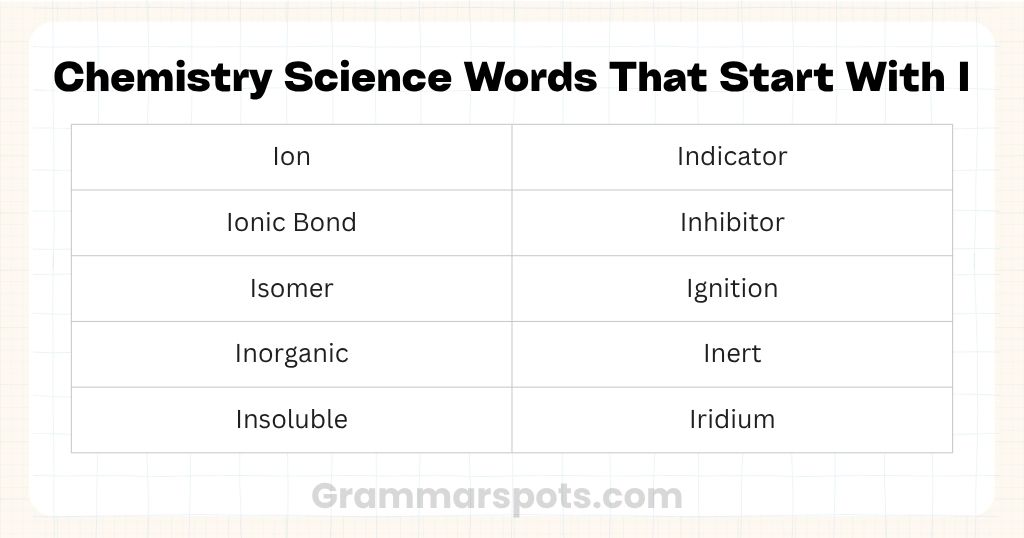
Ion
An atom that has gained or lost one or more electrons. Table salt is made of sodium ions and chloride ions bonded together.
Ionic Bond
Forms when one atom transfers an electron to another. Sodium chloride (NaCl) is the most familiar example.
Isomer
Two molecules with identical chemical formulas but different structural arrangements. Glucose and fructose share the same formula — C₆H₁₂O₆ — but behave very differently in your body.
Inorganic
Compounds that lack carbon-hydrogen bonds. Water, salts, and most minerals are inorganic.
Insoluble
A substance that will not dissolve in a given liquid. Sand is insoluble in water. This property matters in water treatment and drug design.
Indicator
A substance that changes color to signal a chemical change — most often pH. Litmus paper turns red in acid and blue in base.
Inhibitor
A substance that slows or blocks a chemical reaction. Antioxidants in food packaging are inhibitors that slow spoilage reactions.
Ignition
The temperature or event that starts combustion. Car engines have ignition systems. Without reaching ignition temperature, fuel won’t burn.
Inert
Describes an element or compound that won’t react chemically under normal conditions. Noble gases like argon and helium are inert used inside light bulbs for that exact reason.
Iridium
A dense, silvery metal highly resistant to corrosion. A global layer of iridium in ancient rock provided key evidence for the asteroid impact that ended the dinosaur era.
Ionization
The process of converting an atom or molecule into an ion by adding or removing electrons. Ionization energy measures how much energy that process requires.
Biology Science Words That Start With I
Immunity
The body’s ability to identify and destroy a specific pathogen faster after the first encounter. Vaccines work by creating this memory before the real disease arrives.
Invertebrate
Any animal without a backbone. Insects, jellyfish, worms, crabs, and octopuses are all invertebrates. They make up about 97% of all animal species on Earth.
Inherited
A trait passed from parent to child through genes. Eye color, blood type, and some disease risks are inherited.
Ingestion
Taking food or liquid into the body through the mouth — the first step in digestion. Cells also perform ingestion at a microscopic level through phagocytosis.
Incubation
- In eggs: the warm period before hatching
- In disease: the time between exposure and first symptoms
Interphase
The phase a cell spends preparing before it divides. The cell grows, copies its DNA, and checks for errors. Often misunderstood as a “resting” phase — the cell is very active.
Instinct
A behavior an animal is born with, not one it learned. Newborn sea turtles crawling toward the ocean at night pure instinct.
Inoculation
Introducing a weakened or inactive pathogen to trigger immune memory. The basis of all vaccination programs.
Inflammation
The body’s response to injury or infection marked by redness, swelling, warmth, and pain. Short-term inflammation is protective. Long-term (chronic) inflammation is linked to heart disease and cancer.
Ichthyology
The branch of biology focused on fish their anatomy, behavior, ecology, and classification.
Ichthyosaur
An extinct marine reptile from the Mesozoic Era that resembled a dolphin in shape. Not a dinosaur a completely separate evolutionary line.
Imago
The final adult stage of an insect after metamorphosis. A butterfly is the imago of a caterpillar.
Earth Science Words That Start With I
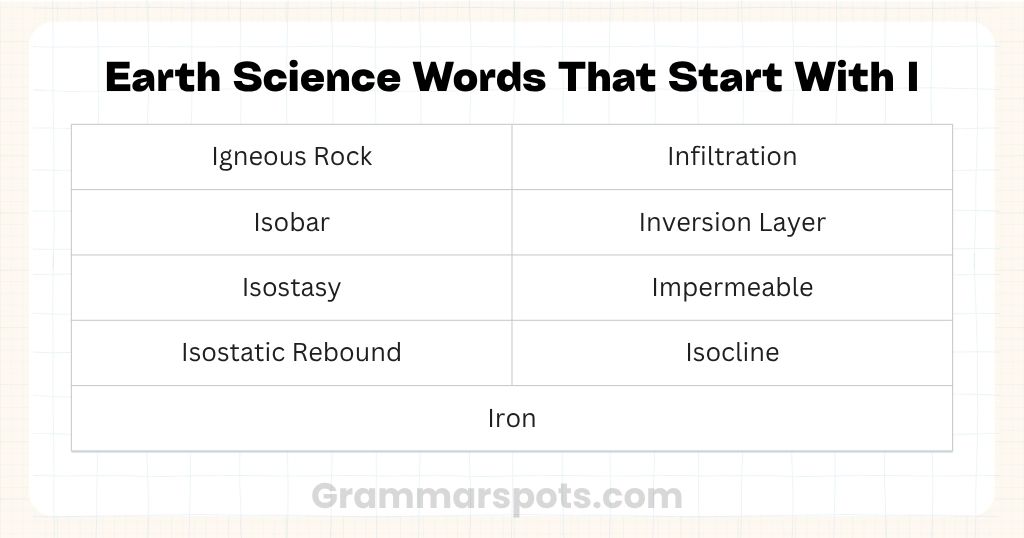
Igneous Rock
Rock formed when magma or lava cools and hardens. Granite cools slowly underground and has large crystals. Basalt cools quickly above ground and has small crystals.
Isobar
A curved line on a weather map connecting locations with equal atmospheric pressure. Tightly packed isobars = strong winds.
Isostasy
Earth’s crust floats on the denser mantle below it, similar to an iceberg floating in water. This balance between crust and mantle is isostasy.
Isostatic Rebound
After glaciers melt, the land beneath slowly rises. Scandinavia is still rising several millimeters per year from the weight of ancient ice sheets.
Infiltration
Rainwater soaking into the ground rather than running off the surface. Pavement blocks infiltration — one reason heavy rain floods cities faster than forests.
Inversion Layer
A warm air layer sitting above a cooler layer — the opposite of normal. This traps pollution near the ground. Los Angeles smog is largely caused by a persistent inversion layer.
Impermeable
Rock or soil that doesn’t let water pass through. Clay is impermeable. This matters for dam construction, landfill design, and flood control.
Isocline
Rock layers folded so tightly that both limbs are nearly parallel. Also used in physics for lines of equal magnetic inclination on a map.
Iron (Earth science context)
Earth’s inner and outer core is mostly iron. Movement of molten iron in the outer core generates the magnetic field that shields Earth from solar radiation.
Space & Astronomy Science Words That Start With I
Infrared
Electromagnetic radiation with wavelengths longer than visible red light. The James Webb Space Telescope uses infrared to see through gas clouds where stars are forming.
Ionosphere
A layer of Earth’s upper atmosphere, 60–1,000 km above the surface, filled with ions and free electrons. AM radio waves bounce off it, which is why you can pick up distant stations at night.
Interstellar
The space between star systems. Voyager 1 crossed into interstellar space in 2012 — the first human-made object to do so.
Impact Crater
A bowl-shaped depression formed when a meteorite strikes a planetary surface. The Moon is covered with them. Arizona’s Meteor Crater is one of Earth’s best-preserved examples.
Inclination (orbital)
The tilt of an orbit relative to a reference plane. The ISS orbits at 51.6 degrees inclination so it passes over most populated regions of Earth.
Irradiation
Exposure to radiation from the sun, cosmic rays, or other space sources. One of the major health risks for astronauts on long missions.
Irregular Galaxy
A galaxy that doesn’t fit the spiral or elliptical categories. The Large and Small Magellanic Clouds near the Milky Way are irregular galaxies.
Medical & Health Science Words That Start With I
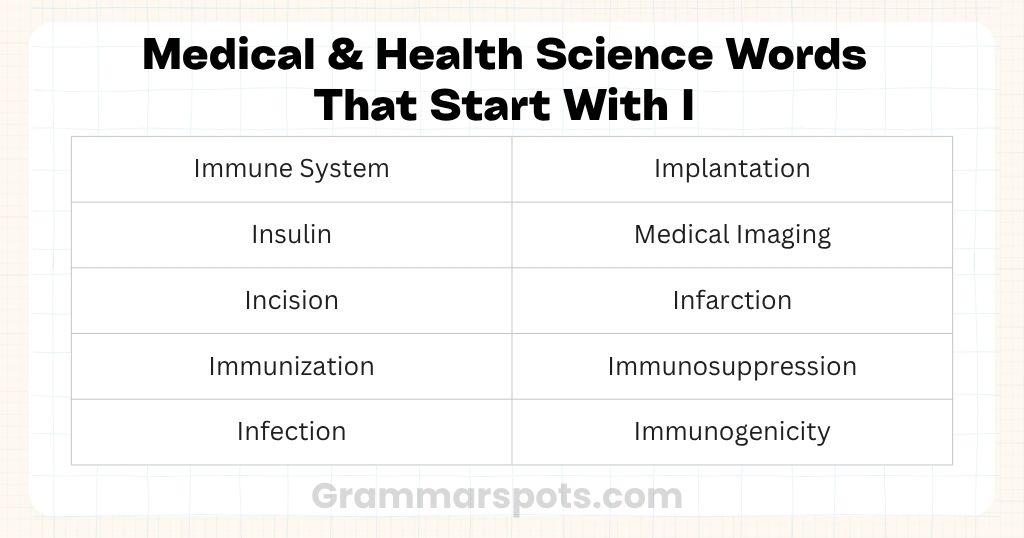
Immune System
The network of cells, tissues, and organs defending the body against pathogens. White blood cells are the primary soldiers in this system.
Insulin
A hormone produced by the pancreas that regulates blood sugar. In type 1 diabetes, the body makes none. In type 2, the body stops responding to it effectively.
Incision
A deliberate, controlled cut made during surgery. Surgeons plan incision placement to reduce tissue damage and speed recovery.
Immunization
The process of making a person immune to a disease usually through vaccination. Smallpox was eradicated worldwide through immunization programs.
Infection
The invasion and multiplication of a pathogen virus, bacteria, fungus, or parasite inside the body.
Implantation
- In reproduction: when a fertilized egg attaches to the uterine wall
- In surgery: placing a device inside the body, such as a pacemaker or joint replacement
Medical Imaging
Tools like X-ray, MRI, CT scan, and ultrasound that let doctors see inside the body without surgery.
Infarction
Tissue death caused by a blocked blood supply. A myocardial infarction is the medical term for a heart attack.
Immunosuppression
Deliberate reduction of immune system activity. Used after organ transplants to prevent the body from rejecting the new organ.
Immunogenicity
How strongly a substance triggers an immune response. Vaccine developers test this to ensure the immune reaction is strong enough to protect.
More Post: 120+ Foods That Start With I: Complete List of Fruits, Vegetables, Drinks, Desserts, and More
Technology & Applied Science Words That Start With I
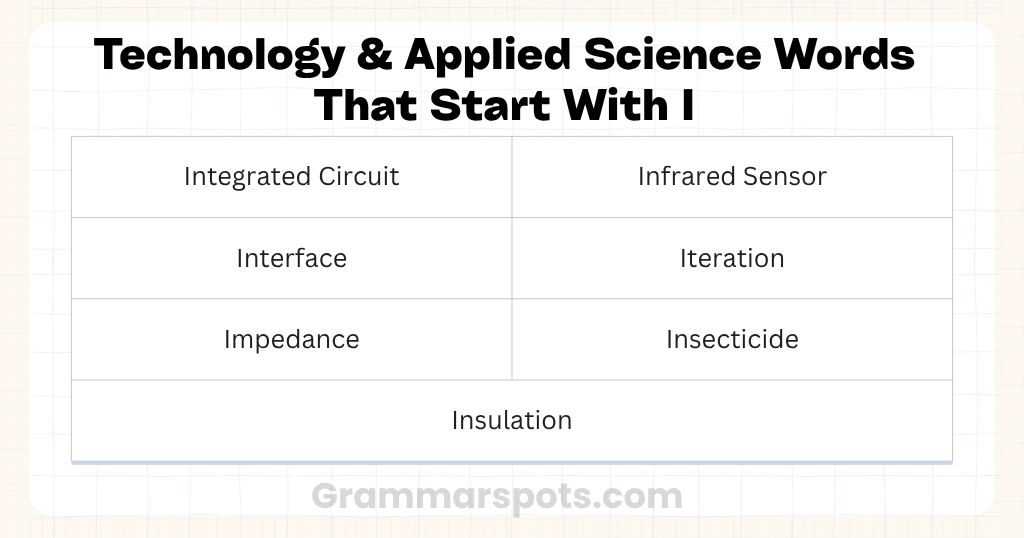
Integrated Circuit
A tiny chip containing millions of miniaturized electronic components. Every computer, phone, and modern appliance depends on integrated circuits. Jack Kilby won the Nobel Prize for the invention.
Interface
The point where two systems connect. A screen is a human-computer interface. An API is a software-to-software interface.
Impedance (electronics)
Opposition to signal flow in a circuit. Mismatched impedance causes signal loss important in audio, broadcasting, and telecommunications.
Insulation (thermal)
Material placed in walls, roofs, and floors to slow heat transfer. Better insulation reduces energy bills and carbon footprint.
Infrared Sensor
A device that detects heat signatures using infrared radiation. Used in security cameras, TV remotes, and night-vision equipment.
Iteration (programming)
A repeated loop of instructions in code. Almost every app from search engines to social media feeds depends on iteration.
Insecticide
A chemical substance used to kill or repel insects. Used in agriculture, public health, and pest control.
Easy Science Words That Start With I (For Kids)
Perfect for grades 3–6. Each one connects to something you already know.
- Ice — Water in solid form, below 0°C or 32°F
- Insect — A six-legged animal with three body segments
- Iris — The colored ring in your eye that controls how much light enters
- Iron — A common metal found in rocks and in your blood
- Inherit — To receive traits from your parents through genes
- Incubate — To keep eggs warm so a baby animal can develop inside
- Invisible — Cannot be seen with the naked eye
- Immature — Not fully grown or developed yet
- Impact — A forceful collision between two objects
- Instinct — A behavior an animal is born with, not taught
Advanced Science Words That Start With I
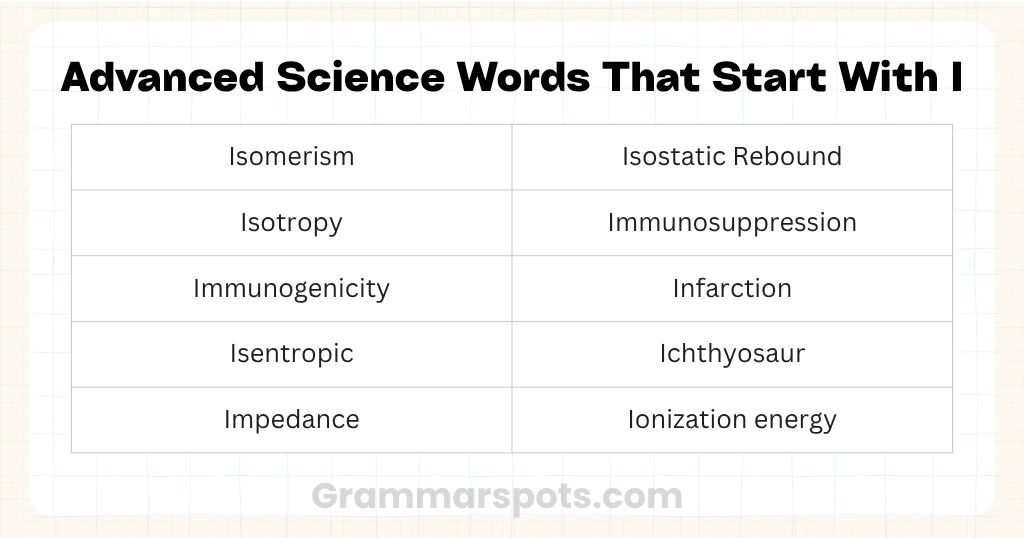
For high school, AP classes, or anyone who wants to go deeper.
- Isomerism — The condition where two molecules share the same formula but differ in structure and properties
- Isotropy — When a material has identical properties in every direction; most metals are isotropic, wood is not
- Immunogenicity — A substance’s ability to provoke an immune response; critical in drug and vaccine development
- Isentropic — A thermodynamic process that is both adiabatic and reversible; used in ideal turbine models
- Isostatic Rebound — Land rising after glacial weight is removed; Scandinavia is still experiencing this today
- Immunosuppression — Intentional lowering of immune response; used in organ transplant medicine
- Infarction — Death of tissue from loss of blood supply; most recognized form is a heart attack
- Ichthyosaur — Extinct marine reptile resembling a dolphin; lived during the Mesozoic Era, separate from dinosaurs
- Impedance — Total opposition to AC current in a circuit, combining resistance and reactance
- Ionization energy — Energy needed to remove an electron from an atom; increases across a period in the periodic table
Science Words Starting With I — For 7th Grade
These words appear in 7th grade life science, earth science, and physical science units.
- Ion — Atomic structure and bonding unit
- Inertia — Newton’s Laws of Motion
- Igneous rock — The rock cycle
- Immunity — Body systems and disease unit
- Invertebrate — Animal classification
- Isotope — Atomic structure
- Inherited traits — Genetics and heredity
- Inflammation — Health and body systems
- Indicator — Chemistry lab work with pH
- Interphase — Cell division cycle
Common Confusions & Mistakes
Ion vs. Isotope
- Ion = different number of electrons than protons
- Isotope = different number of neutrons than the standard atom
Both deal with atoms — different parts being changed.
Inertia vs. Momentum
- Inertia = a property (tendency to resist change)
- Momentum = a measurement (mass × velocity)
A parked bus has high inertia. A moving bus has high momentum.
Igneous vs. Metamorphic
- Igneous = rock formed from cooling magma or lava
- Metamorphic = existing rock changed by heat and pressure, without melting
Immunity vs. Immunization
- Immunity = the state of being protected
- Immunization = the process that creates that protection
Insulator vs. Conductor
- Insulator = blocks electricity or heat flow
- Conductor = allows electricity or heat flow
A power cord uses both: copper wire (conductor) wrapped in rubber (insulator).
Infection vs. Inflammation
- Infection = a pathogen is present and multiplying
- Inflammation = the body’s response, which can happen with or without an infection
Real-Life Places These Words Appear
At the doctor’s office
- Immunity, infection, inflammation, insulin, incision, imaging, inoculation, infarction
In your kitchen
- Insoluble (flour in water), ignition (lighting a stove), indicator (red cabbage tests pH)
Outside in nature
- Igneous rocks near rivers, invertebrates in the garden, infiltration when it rains
On weather apps
- Isobars on pressure maps, inversion layers in air quality alerts
In the news
- Interstellar (space stories), inflammation (health research), irradiation (nuclear or space coverage)
In school labs
- Indicators for pH testing, ionic bonds in chemistry, invertebrate dissections, interphase in microscopy
FAQs
How many science words start with I?
Hundreds exist across all fields. This article covers 160+ of the most important ones for school and everyday science.
Which science words starting with I show up most on exams?
- Middle school: ion, inertia, igneous, immunity, invertebrate, isotope, inherited
- High school: ionic bond, isomer, ionosphere, interphase, ionization energy
What does the prefix “iso-” mean in science?
It comes from Greek, meaning equal or same.
- Isobar = equal pressure
- Isotope = same element
- Isothermal = same temperature
Knowing this one prefix unlocks a whole group of science terms instantly.
What does “in-” mean at the start of science words?
Usually means not or without.
- Insoluble = not soluble
- Inert = not active
- Invertebrate = without a vertebra (backbone)
Are I-words hard to learn?
Not really. Most follow Latin or Greek root patterns. Once you know a handful of prefixes, the definitions become predictable.
Which science field uses the most I-words?
Biology and chemistry have the largest collections. Medicine adds more with im- prefix words: immune, immunization, implantation, infarction.
Conclusion
This article covered 160+ science words starting with I, organized by field physics, chemistry, biology, earth science, space, medicine, and technology. You found easy words for younger students, advanced terms for high school, common confusions cleared up, and real-world places these words actually appear.
Science vocabulary is not about memorizing lists. Each word here is a tool. When you know inertia, seatbelts make more sense. When you know immunity, vaccines make more sense. The words connect to the real world and that connection is what makes them stick.

I’m Hazel, and I studied BSC English at GCUF. I focus on explaining word meanings in simple, clear language that anyone can understand. My goal is helping readers grasp everyday English, confusing terms, and slang used in real conversations and social media. I believe language learning works best when definitions connect to actual life situations. Through careful research and straightforward explanations, I make vocabulary accessible for students, learners, and anyone curious about how English really works in daily use.