


You searched for science words starting with K probably for a school project, vocabulary list, or exam prep. Good news: K is one of the more productive letters in science. From kinetic energy on a roller coaster to keratin in your fingernails, these words appear in real textbooks, real labs, and real life.
This article gives you 130+ words, organized by field, with clean definitions and zero filler.
Quick Answer: 20 Most-Used Science Words That Start With K
| Word | Meaning (Under 15 Words) |
| Kinetic Energy | Energy an object has because it is moving |
| Kelvin | SI base unit of temperature measurement |
| Keratin | Tough protein found in hair, nails, and skin |
| Kidney | Organ that filters waste from blood |
| Krypton | Noble gas, element 36 on periodic table |
| Krebs Cycle | Energy-releasing cycle inside cell mitochondria |
| Ketone | Organic compound with a carbon-oxygen double bond |
| Kinase | Enzyme that transfers phosphate to molecules |
| Karst | Rocky landscape formed by dissolving limestone |
| Karyotype | Visual map of all chromosomes in a cell |
| Katabatic | Cold downhill wind driven by gravity |
| Kilohertz | Unit of frequency equal to 1,000 cycles per second |
| Kilogram | Base SI unit of mass |
| Kinetics | Study of rates and speeds of chemical reactions |
| Keystone Species | Species that keeps an entire ecosystem balanced |
| Kelp | Large brown seaweed growing in cold ocean water |
| Kinesiology | Science of human body movement |
| Kyphosis | Abnormal outward curve of the upper spine |
| Kinesin | Protein that transports cargo inside cells |
| Kuiper Belt | Ring of icy bodies beyond Neptune |
Quick List of 130+ Science Words That Start With K
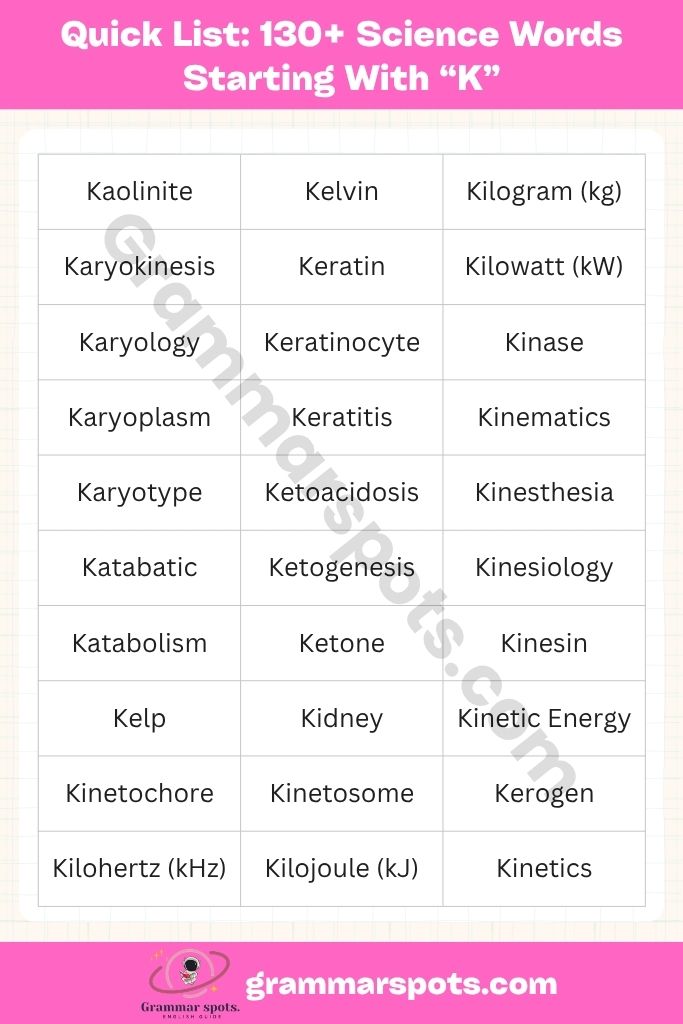
- Kaolinite
- Karyokinesis
- Karyology
- Karyolysis
- Karyoplasm
- Karyorrhexis
- Karyosome
- Karyotype
- Katabatic
- Katabolism
- Kelp
- Kelvin
- Kepler’s Laws
- Keratin
- Keratinization
- Keratinocyte
- Keratitis
- Keratosis
- Ketoacidosis
- Ketogenesis
- Ketone
- Ketosis
- K-feldspar
- K-Pg Boundary
- Kidney
- Kilohertz (kHz)
- Kilojoule (kJ)
- Kilogram (kg)
- Kilowatt (kW)
- Kilowatt-hour (kWh)
- Kinase
- Kinematic Viscosity
- Kinematics
- Kinesthesia
- Kinesiology
- Kinesin
- Kinetic Energy
- Kinetic Theory
- Kinetics
- Kinin
- Kirkwood Gaps
- Koilocyte
- Kreb’s Cycle
- Krypton (Kr)
- Kupffer Cells
- Kuru
- Kevlar
- K-selection
- K-strategist
- Kyphosis
- Kyphoscoliosis
- Karst
- Karyon
- Karyoplasm
- Kinoplasm
- Kerogen
- Keel (biology)
- Keel (geology)
- Knot (unit)
- Knock (engine)
- K-wave
- Keto-enol Tautomerism
- Ketohexose
- Ketopentose
- Ketosteroid
- Kinetochore
- Kinetosome
- Kinetic Molecular Theory
- Kinetoplast
- Klinostat
Physics Science Words That Start With K

Kinetic Energy
Energy that comes from motion. Formula: KE = ½mv². A heavier, faster object carries more kinetic energy. A rolling boulder has far more than a rolling marble.
Kelvin (K)
The official temperature scale in physics. Absolute zero 0 K is the coldest anything can ever be: −273.15°C. Atoms stop vibrating at absolute zero.
Kinematics
Studies how objects move speed, distance, acceleration without asking why. Projectile motion problems use kinematics.
Kinetic Molecular Theory
Explains gas behavior through particle motion. Gas particles move randomly, collide constantly, and their speed determines temperature.
Kinetic Friction
Resistance force between two surfaces already sliding against each other. Less than static friction it’s easier to keep sliding than to start.
Kinetic Theory
Gas pressure, temperature, and volume all explained through particle movement. Foundational in thermodynamics.
Kilojoule (kJ)
One thousand joules of energy. Food energy is measured in kilojoules — one food calorie equals about 4.18 kJ.
Kilowatt (kW)
One thousand watts of power. A standard microwave uses about 1 kW.
Kilowatt-hour (kWh)
Energy unit on electricity bills. Using 1,000 watts for one hour = 1 kWh.
Knoop Hardness
A test measuring how resistant a material is to scratching, using a diamond indenter under controlled force.
Knudsen Number
Ratio comparing molecular mean free path to a physical length scale. Used in microfluidics and gas dynamics.
K-shell
The innermost electron shell in an atom, closest to the nucleus. Holds a maximum of two electrons.
K-shell Electron
An electron occupying the K-shell. These electrons have the lowest energy level in the atom.
K-capture
A type of radioactive decay where a nucleus absorbs a K-shell electron, converting a proton into a neutron.
Klystron
A vacuum tube device that amplifies microwave signals. Used in radar systems and particle accelerators.
K-wave
A long economic or atmospheric cycle, roughly 40–60 years, also used in atmospheric wave physics.
K-space
Mathematical space used in MRI physics to store raw image frequency data before processing.
Kelvin Wave
An atmospheric or oceanic wave that travels along a boundary, like the equator or a coastline. Important in El Niño patterns.
Chemistry Science Words That Start With K
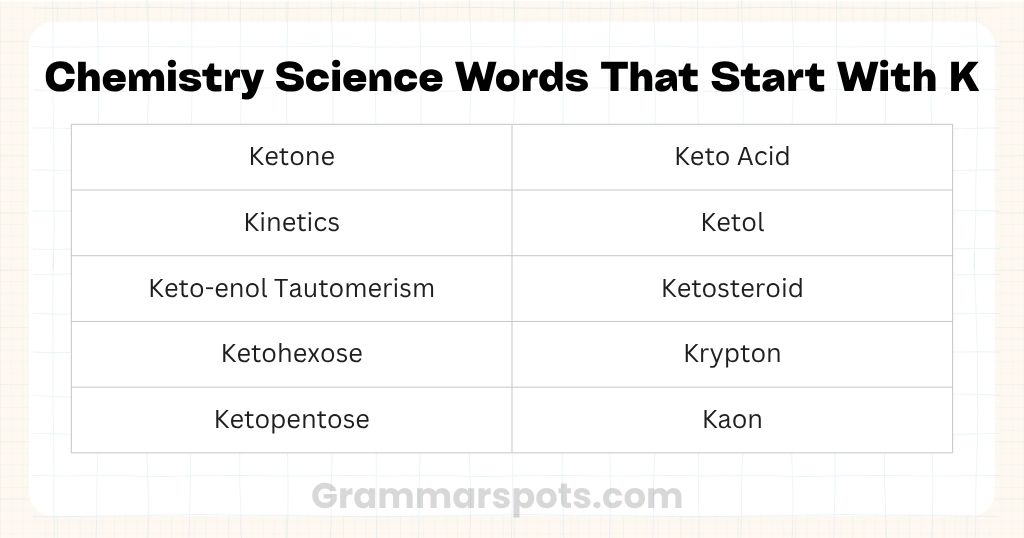
Ketone
Organic molecule with a C=O group in the middle of a carbon chain. Acetone — nail polish remover is the simplest example.
Kinetics (Chemical)
Studies how fast reactions happen and what factors control speed: temperature, concentration, surface area, catalysts.
Keto-enol Tautomerism
A chemical equilibrium where a molecule switches between a ketone form and an enol form. Common in organic chemistry reactions.
Ketohexose
A six-carbon sugar containing a ketone group. Fructose the sugar in fruit is a ketohexose.
Ketopentose
A five-carbon sugar with a ketone group. Ribulose, involved in photosynthesis, is one example.
Keto Acid
An organic acid containing both a ketone and a carboxyl group. Pyruvic acid key in metabolism is a keto acid.
Ketol
A compound with both ketone and alcohol functional groups. Appears in metabolic pathways.
Ketosteroid
A steroid with a ketone group. Many sex hormones, including testosterone, contain ketosteroid structures.
Krypton (Kr)
Element 36. Noble gas, almost completely non-reactive. Used in specialized lighting, some lasers, and energy-efficient window insulation.
Kaon (K-meson)
A subatomic particle containing a strange quark. Studied in particle physics experiments.
Kosmotrope
An ion or molecule that stabilizes water structure and protein folding. Opposite of a chaotrope.
Kosmotropic Effect
The tendency of certain ions to strengthen water molecule interactions, affecting protein stability.
Kilocalorie (kcal)
One thousand calories. Nutritional calories on food labels are actually kilocalories.
Kilodalton (kDa)
Unit of molecular mass equal to 1,000 daltons. Proteins and large molecules are measured in kilodaltons.
Katharometer
A device that measures gas composition by detecting changes in thermal conductivity. Used in gas chromatography.
Kaolin
Soft white clay mineral. Used in paper manufacturing, porcelain, and pharmaceuticals.
Kaolinite
The primary mineral in kaolin clay. Forms when feldspar rock weathers over long periods.
K-feldspar
Potassium feldspar a common rock-forming mineral in granite and other igneous rocks.
Kerogen
Solid organic material found in sedimentary rock. Heated under pressure, it becomes petroleum or natural gas.
Biology Science Words That Start With K
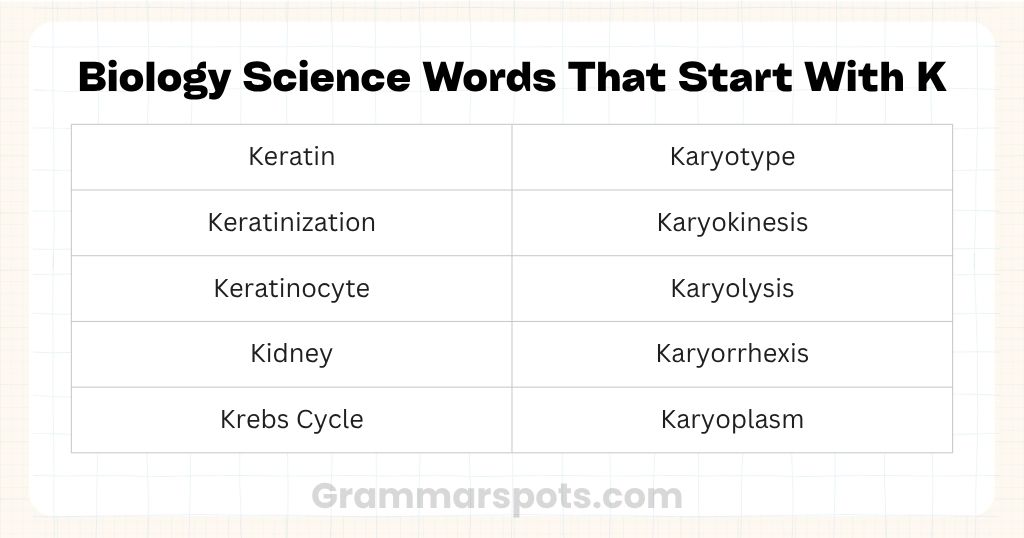
Keratin
Structural protein in hair, nails, skin, feathers, scales, and horns. Waterproof and mechanically strong.
Keratinization
Process where skin cells fill with keratin and harden, forming the tough outer skin layer.
Keratinocyte
The most common cell in the outer skin layer. Produces and contains keratin.
Kidney
Filters about 200 liters of blood per day. Removes waste, balances water and salt, produces urine.
Krebs Cycle
Circular series of reactions in mitochondria that extract energy from nutrients. Requires oxygen. Discovered by Hans Krebs in 1937.
Karyotype
Complete set of chromosomes photographed, arranged, and analyzed. Used to detect chromosomal conditions like Down syndrome.
Karyokinesis
Division of the cell nucleus during mitosis. Happens before the rest of the cell divides.
Karyolysis
Complete dissolution of the nucleus during cell death. Marker of necrosis.
Karyorrhexis
Fragmentation of the nucleus during programmed cell death (apoptosis).
Karyoplasm
Liquid filling the cell nucleus. Supports chromosomes and nuclear activities.
Karyosome
A dense region inside the nucleus, often seen in protozoan cells.
Karyogamy
Fusion of two cell nuclei during sexual reproduction in fungi and some other organisms.
Karyology
Scientific study of cell nuclei, including chromosome structure and behavior.
Karyon
Greek term meaning “nucleus.” Root for all karyo- biology words.
Kinase
Enzyme that attaches a phosphate group to a protein, switching cell processes on or off.
Kinesin
Motor protein that walks along microtubule tracks carrying cargo organelles, vesicles, proteins inside cells.
Kinetochore
Protein structure on a chromosome where spindle fibers attach during cell division.
Kinetochore Microtubule
Spindle fiber connected directly to a kinetochore, pulling chromosomes apart during mitosis.
Kinetoplast
DNA-containing structure found in the mitochondria of kinetoplastid parasites like Trypanosoma.
Kinetoplastida
Group of flagellated parasites with a kinetoplast. Includes the organisms causing sleeping sickness and Leishmaniasis.
Kinetosome
Another name for basal body the structure at the base of a flagellum or cilium.
Kinesiology
Scientific study of human movement, including muscle mechanics, joint function, and motion patterns.
Kinesthesia
Sense of body position and movement without visual input. Receptors in muscles and joints send signals to the brain.
Klinokinesis
A type of movement where an organism changes direction more often in unfavorable conditions.
Klinostat
A rotating device used in plant experiments to eliminate the effect of gravity, studying how plants respond without directional cues.
Keystone Species
A species whose removal causes dramatic collapse of the ecosystem around it. Sea otters are a famous example.
Kelp
Giant brown seaweed. Grows up to 60 cm per day. Forms underwater forests sheltering fish, otters, and invertebrates.
Krill
Small, shrimp-like crustaceans. Foundation of Antarctic food chains. Whales, penguins, and seals depend on them.
K-selection
Evolutionary strategy favoring fewer offspring with high parental investment. Elephants and humans are K-selected species.
K-strategist
An organism following K-selection slow reproduction, long lifespan, stable environment specialist.
Keel (Biology)
A ridge-like structure on a bird’s sternum where flight muscles attach. Well-developed in strong fliers.
Knotgrass
A low-growing weed plant studied in botany for its growth patterns and resistance to trampling.
Kohlrabi (Botany)
A plant in the Brassica genus, studied in botany for its stem modification and growth patterns.
Koniology
Study of atmospheric dust and its effects on living organisms.
Kranz Anatomy
A leaf structure in C4 plants where bundle sheath cells wrap tightly around vascular tissue. Key to efficient photosynthesis in hot climates.
Kranz Cell
The bundle sheath cell in C4 plant leaves. Contains most of the plant’s rubisco enzyme.
Kallima
A genus of butterfly that mimics dead leaves a classic example of camouflage studied in biology.
Kanamycin
An antibiotic used to treat bacterial infections, also used in lab research to select genetically modified cells.
Earth Science Words That Start With K
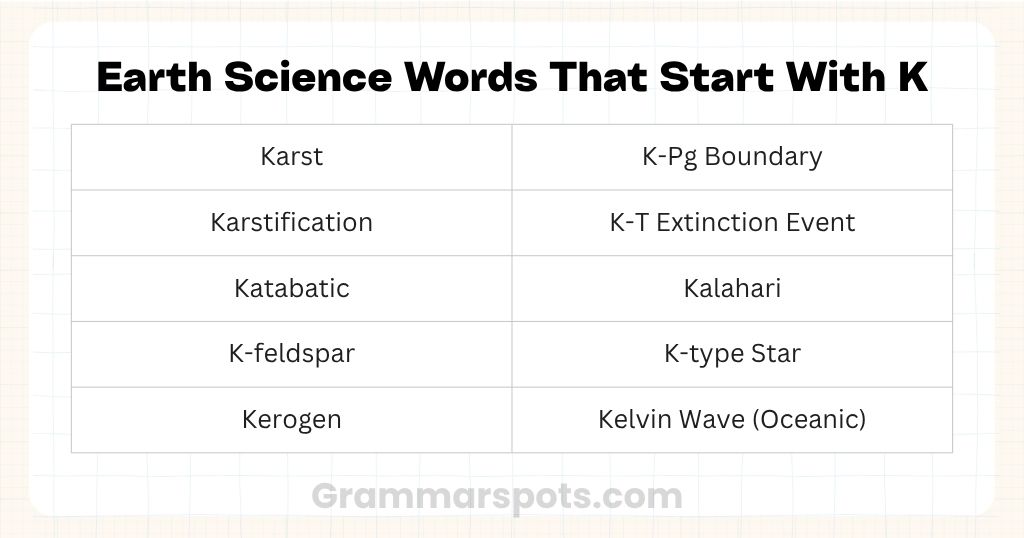
Karst
Landscape shaped by water dissolving limestone over thousands of years. Creates caves, sinkholes, and underground rivers.
Karstification
The process by which karst landscapes form through chemical weathering of soluble rock.
Katabatic
Describes cold, dense air that flows downhill under gravity. Antarctica produces some of the strongest katabatic winds on Earth.
K-feldspar
Potassium-rich feldspar mineral. Abundant in granite, pegmatite, and many sedimentary rocks.
Kerogen
Organic material in sedimentary rock that becomes oil or gas under heat and pressure.
K-Pg Boundary
The geological layer marking mass extinction 66 million years ago. Thin, iridium-rich band found worldwide in rock strata.
K-T Extinction Event
The mass extinction at the end of the Cretaceous period. Wiped out non-bird dinosaurs. Caused by asteroid impact and volcanic activity.
Kalahari
A semi-arid geological basin in southern Africa. Studied for its unique sedimentary deposits and fossil record.
K-type Star
An orange dwarf star slightly cooler and smaller than our Sun. Considered a prime candidate for hosting habitable planets.
Kelvin Wave (Oceanic)
A large ocean wave that travels along the equator, important in understanding El Niño climate events.
Space & Astronomy Science Words That Start With K
Kepler’s Laws
Three rules of planetary motion:
- Orbits are ellipses, not circles
- Planets move faster when closer to the Sun
- Orbital period relates mathematically to orbit size
Kepler Orbit
The path of one body around another under gravity alone, following Kepler’s Laws.
Kepler Space Telescope
NASA’s planet-hunting telescope (2009–2018). Discovered 2,600+ confirmed exoplanets.
Kelvin (Astronomy)
Star temperatures measured in Kelvin. Sun’s surface: ~5,778 K. Cosmic background radiation: ~2.7 K.
Kuiper Belt
Disk of icy bodies beyond Neptune, from 30–50 AU from the Sun. Pluto orbits here.
Kirkwood Gaps
Empty zones in the asteroid belt caused by Jupiter’s gravitational resonance. Asteroids cannot maintain stable orbits there.
K-type Main Sequence Star
Orange dwarf stars between 3,900–5,200 K surface temperature. Longer-lived than our Sun.
K-correction
An adjustment astronomers apply to account for how redshift changes the observed brightness of distant galaxies.
K-line
A specific spectral absorption line of calcium, used by astronomers to measure stellar activity and composition.
Kaon
A subatomic particle (K-meson) produced in high-energy collisions. Studied in particle physics and astrophysics.
Kymoscope
An instrument for measuring and recording wave motion. Used in some astrophysical wave analysis tools.
Medical & Health Science Words That Start With K
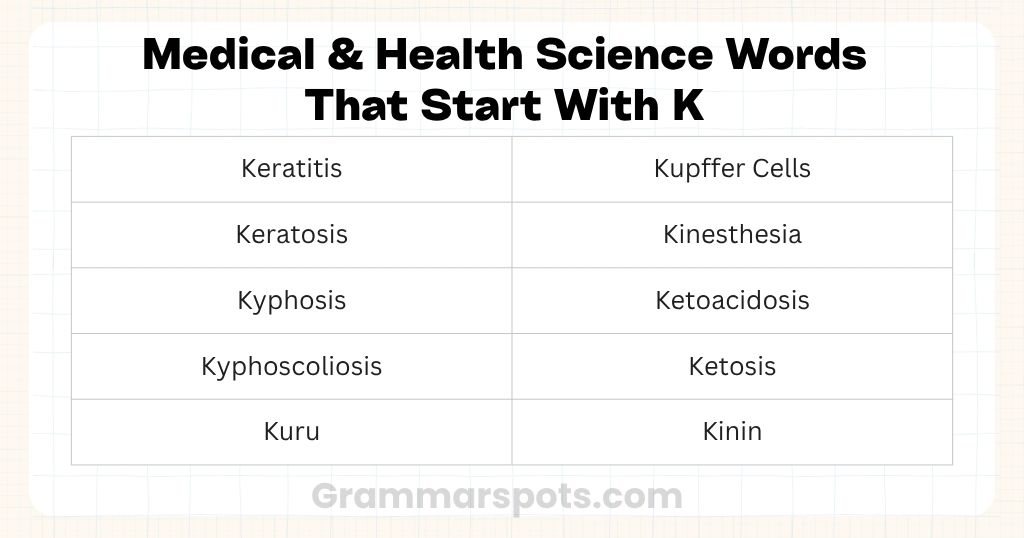
Keratitis
Cornea inflammation. Causes pain, light sensitivity, and vision blurring. Often from infection or contact lens overuse.
Keratosis
Abnormal keratin buildup on skin. Actinic keratosis (sun damage) can become cancerous. Seborrheic keratosis is benign.
Kyphosis
Excessive rounding of the upper spine. Mild cases from poor posture. Severe cases affect breathing.
Kyphoscoliosis
Combined kyphosis and scoliosis. More complex spinal deformity that can impair lung function.
Kuru
Fatal prion brain disease. Found in Papua New Guinea. Linked to ritual cannibalism. Led to discoveries about prion diseases.
Kupffer Cells
Immune cells stationed in the liver. Engulf bacteria, dead cells, and debris from blood passing through liver tissue.
Kinesthesia
Body awareness of its own position without looking. Essential for balance, coordination, and movement.
Ketoacidosis
Dangerous accumulation of ketones in blood, making it acidic. Common in uncontrolled Type 1 diabetes. Requires emergency treatment.
Ketosis
Normal metabolic state where the body burns fat and produces ketones for energy. Not dangerous for most people.
Kinin
Small proteins in blood that regulate inflammation, blood pressure, and pain signals after tissue damage.
Koilocyte
Abnormal cell caused by HPV infection. Detected during cervical cancer screening under microscope.
Kanamycin
Antibiotic targeting bacterial ribosomes. Used to treat serious infections and in laboratory genetic research.
Krenotherapy
Therapeutic use of mineral spring water for treating various health conditions.
Kymatology
Study of wave motion and its effects, including sound waves used in medical ultrasound imaging.
Technology & Applied Science Words That Start With K
Kilohertz (kHz)
1,000 cycles per second. AM radio operates in kHz range. Human hearing tops out at 20 kHz.
Kilowatt-hour (kWh)
Standard unit on electricity bills. 1 kWh = using 1,000 watts for one hour.
Kevlar
Synthetic fiber five times stronger than steel by weight. Used in bulletproof vests, helmets, and aerospace parts.
Kinematic Chain
A series of connected links or joints that transmit motion. Used in robotics and mechanical engineering design.
Kinematic Pair
Two connected mechanical elements that allow specific constrained motion between them.
Klystron Oscillator
A specialized vacuum tube that generates or amplifies microwave signals. Used in radar and satellite communication.
Kelvin Bridge
An electrical circuit used to measure very low resistance values with high accuracy.
Kymograph
A device that records motion or pressure changes over time on a rotating drum. Used in physiology labs.
Kymography
The technique of using a kymograph to record body function measurements — breathing, blood pressure, muscle movement.
Knoop Hardness Test
A microhardness test for brittle or thin materials using a specific diamond geometry indenter.
Katharometer
Instrument measuring gas mixture composition through thermal conductivity differences. Used in lab gas analysis.
Easy Science Words That Start With K (For Kids & Beginners)
| Word | Simple Meaning |
| Kinetic Energy | Energy from moving |
| Kidney | Body part that cleans blood |
| Keratin | Protein in hair and nails |
| Kelvin | Temperature scale scientists use |
| Kelp | Giant seaweed in the ocean |
| Kilogram | Unit for measuring weight |
| Keystone Species | Animal that holds its ecosystem together |
| Krill | Tiny ocean animal whales eat |
| Keel | Ridge on a bird’s chest bone |
| Kinesthesia | Knowing where your body is without looking |
Memory trick — Kinetic Energy: Kinetic starts with K, and so does “Kick.” Moving things carry kinetic energy.
Memory trick — Kelvin: Scientists are Keen on Kelvin. It never drops below zero.
Memory trick — Krebs Cycle: Krebs is like a wheel it spins inside your cells to release energy from food.
Advanced Science Words That Start With K

| Word | Field | What It Means |
| Karyorrhexis | Cell Biology | Nucleus fragmenting during apoptosis |
| Kinetochore | Cell Biology | Chromosome attachment point for spindle fibers |
| Kinetoplast | Parasitology | Mitochondrial DNA in flagellate parasites |
| Krebs-Henseleit Cycle | Biochemistry | Urea cycle producing urea from ammonia in the liver |
| Kranz Anatomy | Botany | C4 plant leaf structure for efficient photosynthesis |
| Kinase Inhibitor | Pharmacology | Drug blocking kinase enzymes to stop cancer cell growth |
| K-correction | Astronomy | Adjusting galaxy brightness for redshift effects |
| Knudsen Number | Fluid Physics | Ratio measuring when fluid behaves like individual molecules |
| Keto-enol Tautomerism | Chemistry | Molecule switching between ketone and enol forms |
| Kyphoscoliosis | Medicine | Combined spinal curvature deformity |
| Kinetosome | Cell Biology | Base structure of cilia and flagella |
| Klinokinesis | Biology | Direction-change movement response to environmental stress |
Common Confusions: K Science Words
Kinetic Energy vs Potential Energy
Kinetic = energy while moving. Potential = stored energy waiting to release. A ball at the top of a ramp has potential energy. Rolling down, it becomes kinetic.
Ketosis vs Ketoacidosis
Ketosis is normal fat-burning metabolism. Ketoacidosis is dangerous ketones spike to toxic blood levels in diabetics. Never confuse them in health conversations.
Kelvin vs Celsius
Celsius starts at 0° for freezing water. Kelvin starts at −273.15°C (absolute zero). Converting: K = °C + 273.15. Kelvin never goes negative that’s why scientists prefer it.
Karyokinesis vs Cytokinesis
Karyokinesis = nucleus divides. Cytokinesis = whole cell divides. Karyokinesis always comes first.
Krebs Cycle vs Glycolysis
Glycolysis happens in the cytoplasm, needs no oxygen, breaks glucose. The Krebs Cycle happens in mitochondria, requires oxygen, extracts more energy. Both are part of cellular respiration.
Kidney vs Liver
Kidneys filter blood waste into urine. The liver processes toxins, produces bile, and manages nutrients. Different organs, different roles both vital.
Keratin vs Collagen
Keratin builds surface structures hair, nails, skin outer layer. Collagen builds internal structures tendons, cartilage, bone matrix. Both are structural proteins, completely different jobs.
FAQs
How many science words start with K?
Over 130 recognized scientific terms across all fields. Biology and chemistry contribute the most.
What does the prefix “karyo-” mean?
From Greek, meaning “nucleus.” Every karyo- word in science involves a cell nucleus.
What does “kine-” or “kineto-” mean?
From Greek kinesis, meaning “movement.” Kinetics, kinase, kinesin, kinematics — all relate to motion or movement.
Which K word appears most in high school science?
Kinetic energy appears in almost every physics unit. Krebs Cycle is central to all biology courses.
Are K science words hard to remember?
Not when grouped by prefix. Learn what “karyo-,” “kine-,” and “keto-” mean — dozens of words become easier instantly.
What K words appear on standardized tests?
Kinetic energy, Kelvin, Krebs Cycle, karyotype, keystone species, and kidney appear most frequently in SAT, ACT, and AP science exams.
Conclusion
This article covered 130+ science words starting with K across physics, chemistry, biology, earth science, astronomy, medicine, and technology. Each word is defined once, clearly, without repetition.
The most practical next step: pick the words from your current science unit. Look at the prefix. Understand one root and you unlock a family of terms instantly.
Science vocabulary is not about memorizing lists it’s about recognizing patterns. K-words, especially, are built on a handful of Greek and Latin roots that repeat across every field.

I’m Hazel, and I studied BSC English at GCUF. I focus on explaining word meanings in simple, clear language that anyone can understand. My goal is helping readers grasp everyday English, confusing terms, and slang used in real conversations and social media. I believe language learning works best when definitions connect to actual life situations. Through careful research and straightforward explanations, I make vocabulary accessible for students, learners, and anyone curious about how English really works in daily use.