


You’re studying for a science test. You hit a word like luminescence or lithosphere and freeze. Or your teacher asked you to find science vocabulary starting with L and you need real definitions not vague summaries.
This article gives you 150+ science words starting with L, organized by subject, with clear meanings and real-world context. No padding. No repetition.
Quick Answer 20 Most-Used Science Words Starting With L
| Word | Meaning |
| Laser | Focused beam of amplified light energy |
| Lava | Molten rock that flows from a volcano |
| Lens | Curved surface that bends light rays |
| Ligament | Tissue connecting bone to bone at joints |
| Lipid | Fat or oil molecule that stores energy |
| Lithosphere | Earth’s rigid outer shell of rock |
| Luminescence | Light produced without heat |
| Larva | Early worm-like stage of an insect |
| Leukocyte | White blood cell that fights infection |
| Latitude | Angular distance north or south of the equator |
| Liquid | State of matter with no fixed shape |
| Load | Force or weight applied to a structure |
| Logic Gate | Circuit element that processes binary signals |
| Lysosome | Cell organelle that digests waste material |
| Lignin | Compound that gives wood its rigid strength |
| Lumen | Inner hollow space of a tube-shaped organ |
| Lunar | Relating to the Moon |
| Lethal | Sufficient to cause death |
| Lepton | Elementary subatomic particle, such as an electron |
| Luminosity | Total energy output of a star per second |
Quick List of 150+ Science Words Starting With L
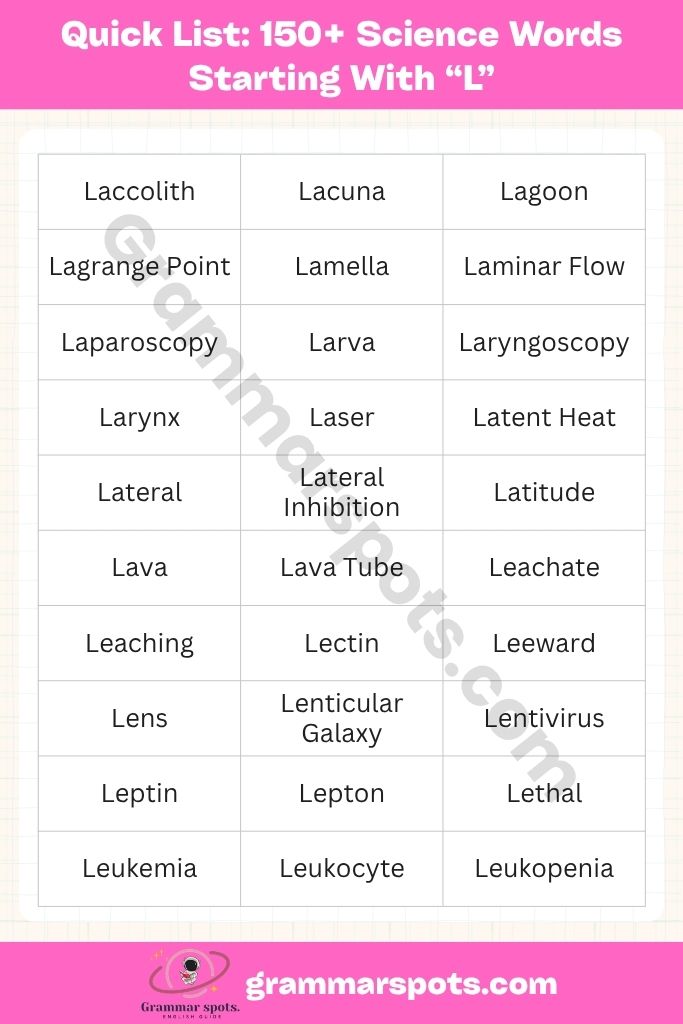
- Laccolith
- Lacuna
- Lagoon
- Lagrange Point
- Lamella
- Laminar Flow
- Laparoscopy
- Larva
- Laryngoscopy
- Larynx
- Laser
- Latent Heat
- Lateral
- Lateral Inhibition
- Latitude
- Lava
- Lava Tube
- Leachate
- Leaching
- Lectin
- Leeward
- Lens
- Lenticular Galaxy
- Lentivirus
- Leptin
- Lepton
- Lethal
- Leukemia
- Leukocyte
- Leukopenia
- Lever
- Lichen
- Ligament
- Ligase
- Light
- Light Spectrum
- Light-Year
- Lignin
- Limestone
- Linear Momentum
- Lineage
- Lipase
- Lipid
- Lipophilic
- Liposome
- Liquid
- Liquefaction
- Lithification
- Lithic
- Lithology
- Lithosphere
- Littoral Zone
- Load
- Loam
- Lodestone
- Locus
- Logic Gate
- Logistic Growth
- Longitudinal Wave
- Lophophore
- Luminescence
- Luminiferous
- Luminosity
- Lunar
- Lunar Eclipse
- Lung
- Lux
- Lytic Cycle
- Laccolith
- Lacertilia
Physics Science Words That Start With L
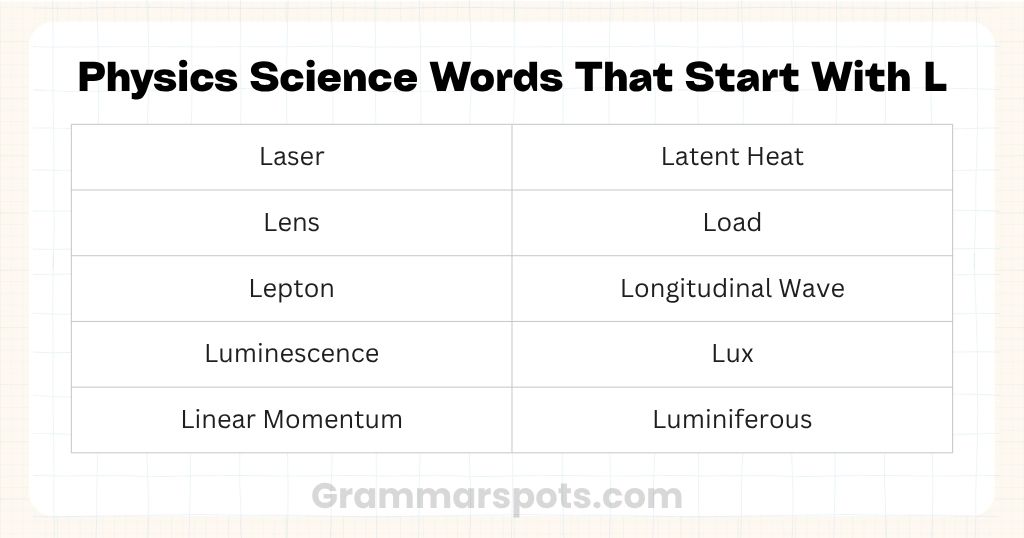
Laser
Stands for Light Amplification by Stimulated Emission of Radiation. Produces a tight, single-direction beam of light. Used in surgery, barcode scanners, and fiber optics.
Latent Heat
Energy absorbed or released when a substance changes state — solid to liquid, liquid to gas — without any temperature change. Refrigerators and air conditioners run on this principle.
Lens
A curved transparent surface that bends light. Convex lenses converge light (magnifying glass). Concave lenses diverge it (eyeglasses for nearsightedness).
Load
The force or weight a structure carries. Engineers calculate load to prevent bridges and buildings from failing.
Lepton
A fundamental particle that cannot be broken down further. Electrons and neutrinos are both leptons. Billions pass through your body every second undetected.
Longitudinal Wave
A wave where particles move parallel to the direction of travel — compressing and expanding. Sound is a longitudinal wave.
Luminescence
Light emitted without heat. Fireflies, glow-in-the-dark stickers, and deep-sea organisms all use luminescence.
Lux
The SI unit of illuminance. One lux equals one lumen of light spread over one square meter. Used in lighting design and photography.
Linear Momentum
Mass multiplied by velocity. A heavy slow object and a light fast object can have equal momentum.
Luminiferous
Carrying or producing light. Historically used in luminiferous ether — a now-disproven medium scientists once thought light traveled through.
Levitation
Suspension of an object with no physical contact — achieved through magnetic fields, sound waves, or air pressure in scientific experiments.
Chemistry Science Words That Start With L
Lactic Acid
Produced in muscles during intense exercise when oxygen is limited. Also used to preserve fermented foods like yogurt and cheese.
Lactase
An enzyme that breaks down lactose (milk sugar) into simpler sugars. People who lack enough lactase experience lactose intolerance.
Lactate
The ionized form of lactic acid found in blood. Doctors measure lactate levels in emergencies to assess how well cells are producing energy.
Lattice
The regular, repeating three-dimensional arrangement of atoms or ions in a crystal. Determines a material’s hardness, melting point, and solubility.
Ligase
An enzyme that joins broken DNA strands by forming chemical bonds. Critical in DNA replication and used in genetic engineering.
Lipase
An enzyme that breaks down dietary fats during digestion. Released by the pancreas. Enables absorption of fat-soluble vitamins A, D, E, and K.
Lipid
A fat or oil molecule. Insoluble in water. Makes up cell membranes and stores long-term energy.
Lipophilic
Describes a molecule that dissolves in fats rather than water. Many drugs must be lipophilic to cross cell membranes.
Liposome
A tiny sphere made of lipid bilayers. Used in medicine to deliver drugs or genetic material directly into cells.
Lyophilization
Freeze-drying. Water is removed from a frozen substance by reducing pressure until ice converts directly to vapor. Used for vaccines, medications, and food preservation.
Lyase
A class of enzymes that break chemical bonds without adding water or oxygen. Important in metabolic pathways throughout the body.
Lectin
A protein that binds specifically to sugar molecules on cell surfaces. Involved in cell recognition and immune signaling.
Lipogenesis
The biological process of converting excess carbohydrates into fat for storage. Happens mainly in the liver and fat tissue.
Laccase
A copper-containing enzyme that oxidizes compounds. Used in industrial processes like paper bleaching and textile dye removal.
Biology Science Words That Start With L
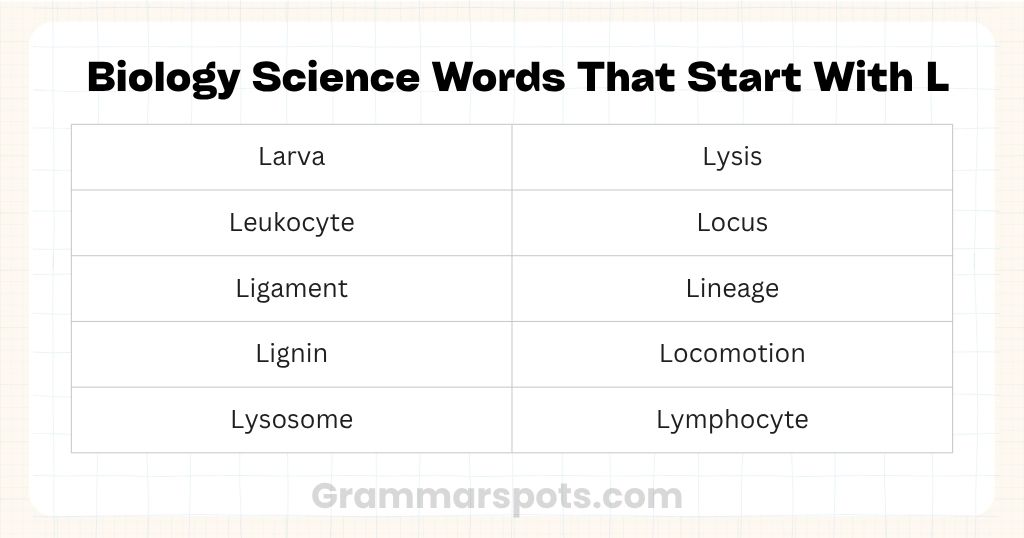
Larva
The juvenile, worm-like stage of an insect before metamorphosis. Caterpillars and maggots are both larvae.
Leukocyte
The scientific term for white blood cell. Defends the body against infection. Several subtypes exist — each with a specific immune role.
Ligament
Strong fibrous tissue connecting bone to bone. Keeps joints stable. Distinct from tendons, which connect muscle to bone.
Lignin
The compound that fills plant cell walls, making wood stiff and hard. Removed during paper production — its absence keeps paper white.
Lysosome
The organelle that digests cellular waste, old cell parts, and invading bacteria using digestive enzymes.
Lysis
The destruction and bursting of a cell. Viruses trigger lysis when they replicate and break out of host cells.
Locus
The precise location of a gene on a chromosome. Like a street address for genetic information.
Lineage
The evolutionary line of descent from a common ancestor. Used to trace species relationships and population history.
Locomotion
The ability of an organism to move from place to place. Fish swim, snakes slither, some bacteria use rotating flagella.
Lymphocyte
A type of white blood cell central to the immune response. B lymphocytes produce antibodies. T lymphocytes destroy infected cells.
Lenticel
A small pore in the bark of woody plants that allows gas exchange — similar to stomata in leaves.
Lateral Meristem
Plant tissue located along the sides of stems and roots that produces secondary growth — making plants wider over time.
Leaf Stomata
Tiny pores on the leaf surface that open and close to regulate gas exchange and water loss.
Limb Bud
An early embryonic structure that develops into an arm or leg. Appears in the first weeks of vertebrate development.
Lipid Bilayer
The double-layered membrane made of phospholipid molecules that encloses every living cell.
Loop of Henle
A U-shaped section of the kidney tubule that concentrates urine by reabsorbing water and salts.
Luteinizing Hormone
A hormone released by the pituitary gland that triggers ovulation in females and testosterone production in males.
Lytic Cycle
The viral replication process that ends with cell destruction. The virus takes over the host cell, replicates, and bursts out.
Lacertilia
The scientific suborder containing lizards. Includes over 6,000 species worldwide.
Lacrimal Gland
The gland located above each eye that produces tears for lubrication and protection.
Lancelet
A small, blade-shaped marine animal considered a living link between invertebrates and vertebrates.
Leucoplast
A colorless plant organelle that stores starch, fats, or proteins — found in roots and seeds away from light.
Leukotrienes
Signaling molecules released by immune cells during inflammation and allergic reactions. Targeted by some asthma medications.
Lobe
A rounded section of an organ. Lungs, liver, and brain all have distinct lobes with specific functions.
Logistic Growth
Population growth that starts fast, then slows as resources become limited — forming an S-shaped curve.
Loricfera
A phylum of microscopic marine invertebrates that live between ocean sediment particles.
Lung Surfactant
A substance coating the inner surface of the lungs that reduces surface tension and prevents air sacs from collapsing.
Lymphatic System
A network of vessels, nodes, and organs that circulates lymph fluid, removes waste, and supports immune defense.
Lymph Node
Small, bean-shaped structures that filter lymph fluid and trap bacteria and viruses for immune cells to destroy.
Lysosomal Storage Disorder
A group of inherited diseases caused by malfunctioning lysosomes that allow waste to accumulate in cells.
Earth Science Words That Start With L

Lava
Magma that has reached the surface through a volcanic eruption. Hardens into igneous rock as it cools.
Lithosphere
Earth’s rigid outer shell, made of the crust and uppermost mantle. Broken into tectonic plates that move slowly.
Latitude
Angular measurement of distance north or south of the equator. Determines climate zones across the planet.
Leaching
The downward movement of dissolved nutrients through soil caused by water. Removes fertility from topsoil in heavy rainfall.
Limestone
A sedimentary rock made of calcium carbonate, often containing fossils. Used in cement, construction, and soil conditioning.
Lithification
The process converting loose sediment into solid rock through compaction and cementation over millions of years.
Laccolith
A dome-shaped igneous rock body formed underground when magma pushed between rock layers and solidified.
Lagoon
A shallow coastal water body separated from the ocean by a reef or sandbar. Highly productive marine ecosystem.
Littoral Zone
The shallow nearshore area of a lake or sea where sunlight reaches the bottom and aquatic life is most dense.
Loam
The ideal agricultural soil — a balanced mix of sand, silt, and clay with strong water retention and drainage.
Lodestone
A naturally magnetized piece of magnetite. Historically the first magnetic compass material used by navigators.
Leachate
The liquid produced when water percolates through waste material, picking up dissolved contaminants. A major concern in landfills.
Lava Tube
A natural tunnel formed when the outer crust of a lava flow solidifies while molten lava continues flowing underneath.
Lacustrine
Relating to lakes. Lacustrine sediments are deposits formed in lake environments, often preserving ancient climate records.
Landslide
The rapid downslope movement of soil, rock, or debris. Triggered by rain, earthquakes, or erosion.
Lithology
The physical characteristics of a rock — texture, color, mineral composition. Used to identify and classify rock types.
Lithoclase
A natural fracture or crack in rock. Different from a fault — no significant movement has occurred along it.
Long-Shore Drift
The movement of sand and sediment along a coastline, carried by waves hitting at an angle. Shapes beaches over time.
Loop Current
A warm ocean current in the Gulf of Mexico that influences Gulf Coast weather and hurricane intensification.
Low-Pressure System
A region of the atmosphere where air pressure is lower than surrounding areas. Associated with clouds, rain, and storms.
Lower Mantle
The deeper layer of Earth’s mantle, extending from about 660 km to 2,900 km depth. Under extreme pressure.
Liminal Zone
A transitional boundary zone between two distinct ecosystems — also called an ecotone. High in biodiversity.
Space & Astronomy Science Words That Start With L
Light-Year
A unit of distance — how far light travels in one year: about 9.46 trillion kilometers. Not a unit of time.
Luminosity
The total energy a star emits per second. Used to classify stars and estimate distances across the universe.
Lunar
Relating to the Moon. Lunar cycle, lunar eclipse, lunar surface — all Moon-related.
Lagrange Point
A location in space where two bodies’ gravitational forces balance, allowing a third object to remain stable. The James Webb Space Telescope sits at L2.
Lenticular Galaxy
A galaxy shaped like a lens — has a disk like a spiral galaxy but lacks spiral arms.
Lunar Eclipse
When Earth passes between the Sun and Moon, casting a shadow on the Moon. Visible from half of Earth at once.
Local Group
The cluster of galaxies that includes the Milky Way, Andromeda, and about 50 other smaller galaxies.
Lunar Maria
The large dark plains on the Moon’s surface, formed by ancient volcanic eruptions. Latin for “seas,” though waterless.
Lunar Regolith
The loose layer of fragmented rock and dust covering the Moon’s surface, created by billions of years of meteorite impacts.
Lithopause
The theoretical boundary where a planet’s rocky surface properties end and space environment begins — used in planetary science.
Medical & Health Science Words That Start With L
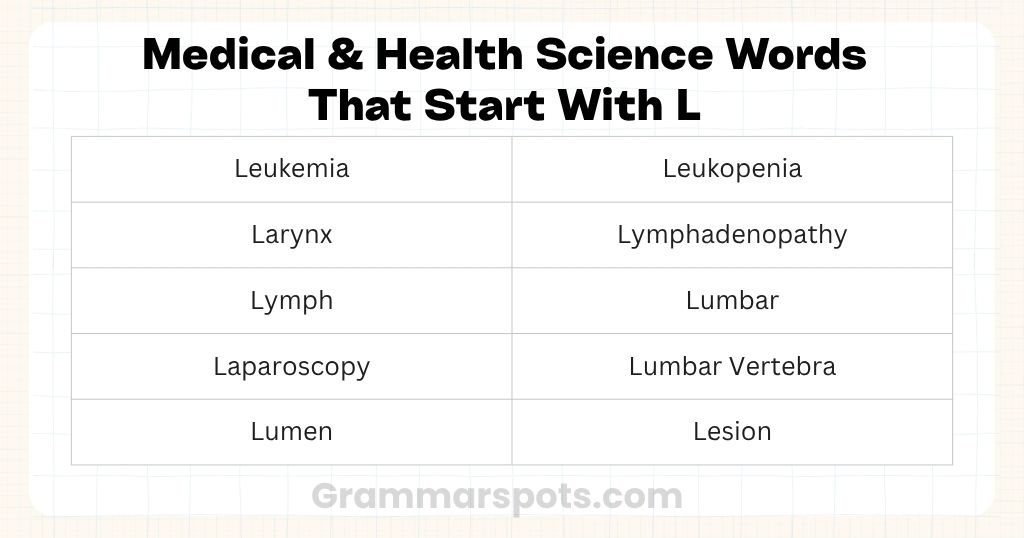
Leukemia
Cancer of blood-forming tissue causing overproduction of abnormal white blood cells. Multiple types exist.
Larynx
The voice box in the throat, housing vocal cords. Inflammation = laryngitis. Injury can affect speech permanently.
Lymph
A clear fluid flowing through the lymphatic system. Carries immune cells and removes cellular waste from tissues.
Laparoscopy
Minimally invasive surgery using a small camera inserted through tiny cuts. Faster recovery than open surgery.
Lumen (Medical)
The inner cavity of a tube-like structure — artery, intestine, or airway. Narrowing reduces flow and causes serious problems.
Leukopenia
Abnormally low white blood cell count. Leaves the body highly vulnerable to infection. Common chemotherapy side effect.
Lymphadenopathy
Swollen or enlarged lymph nodes — usually a sign the immune system is responding to infection or disease.
Lumbar
Relating to the lower back region of the spine. Lumbar vertebrae bear most of the body’s upper weight.
Lumbar Vertebra
One of five vertebrae in the lower spine. Largest vertebrae in the body — built for load-bearing.
Lesion
Any area of damaged or abnormal tissue — caused by injury, disease, or infection.
Lacrimal Gland
Produces tears that lubricate and protect the eye surface. Located above the outer corner of each eye.
Lordosis
The natural inward curve of the lower spine. Excessive lordosis causes back pain and postural problems.
Locus Coeruleus
A brain nucleus involved in the stress response, attention, and regulation of the sleep-wake cycle.
Lung Capacity
The total volume of air the lungs can hold. Measured in liters. Reduced in conditions like asthma and emphysema.
Lysosomal Enzyme
A digestive protein housed inside lysosomes. Deficiencies in these enzymes cause lysosomal storage disorders.
Lysosomal Membrane
The protective boundary enclosing a lysosome, keeping its acidic digestive contents from destroying the cell itself.
Loop of Henle (see also Biology)
In nephrology, specifically studied for its role in producing concentrated or dilute urine based on the body’s hydration needs.
Technology & Applied Science Words That Start With L
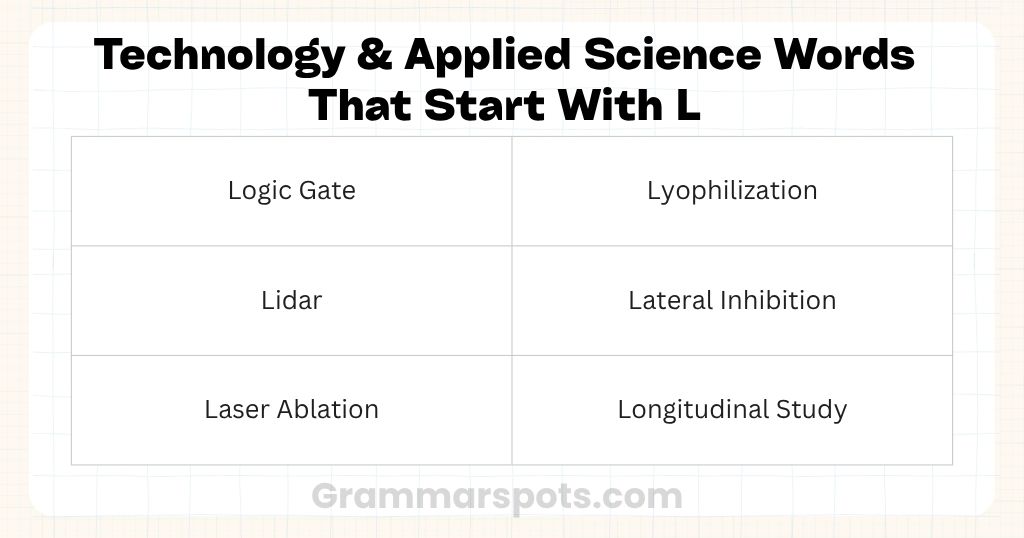
Logic Gate
The fundamental unit of digital circuits. Takes binary inputs (0 or 1) and produces a defined output. AND, OR, NOT are the basic types. Every digital device runs on billions of these.
Lidar
Light Detection and Ranging. Uses laser pulses to map environments in 3D. Used in self-driving cars, archaeology, and topographic mapping.
Laser Ablation
The removal of material from a surface using a focused laser beam. Used in manufacturing, dentistry, and analytical chemistry.
Lyophilization (Applied)
Industrial freeze-drying used to extend shelf life of pharmaceuticals, vaccines, and emergency food supplies.
Lateral Inhibition (Applied)
A neural mechanism where active neurons suppress neighboring ones — sharpens edges in vision and touch perception. Used in designing image-processing algorithms.
Longitudinal Study
A research method where the same subjects are observed over an extended time period. Common in medicine, psychology, and climate science.
Easy Science Words That Start With L — Kids & Beginners
- Leaf — The flat plant part that captures sunlight for photosynthesis
- Lung — The organ that moves oxygen into your blood
- Light — Energy that travels in waves and makes things visible
- Liquid — Matter that flows and takes the container’s shape
- Larva — The worm-like baby stage of an insect
- Lava — Hot melted rock from a volcano
- Lever — A simple machine — a bar on a fixed pivot point
- Lab — Short for laboratory, where experiments are done
- Layer — A distinct level — like rock layers or atmosphere layers
- Lens — Curved glass that bends light
Advanced Science Words That Start With L
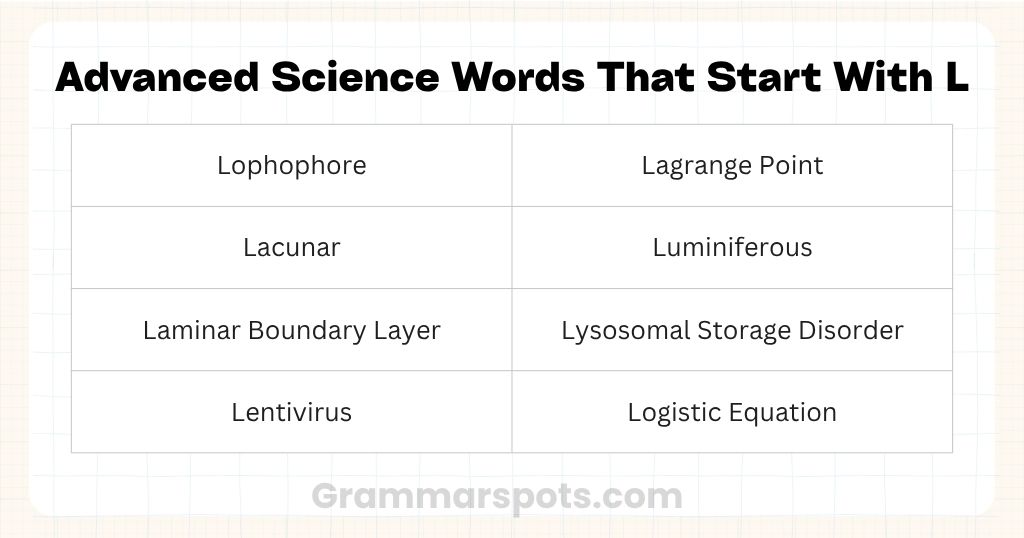
- Lophophore — A crown-shaped feeding structure in marine invertebrates that filters food particles from water
- Lacunar — Relating to lacunae, the small cavities found in bone and cartilage tissue
- Laminar Boundary Layer — The thin, smooth fluid layer directly against a surface where viscous forces dominate
- Lentivirus — A slow-acting retrovirus. HIV is a lentivirus — it can remain dormant for years before causing disease
- Lagrange Point — Gravitational equilibrium positions in space between two massive bodies
- Luminiferous — Light-producing or light-carrying — used in classical physics before the wave-particle theory replaced ether models
- Lysosomal Storage Disorder — Inherited disease caused by enzyme failure inside lysosomes, leading to toxic buildup in cells
- Logistic Equation — The mathematical formula describing population growth with resource limits: dN/dt = rN(1 – N/K)
- Lamella — A thin plate-like structure found in bone, gills, and chloroplasts. Plural: lamellae
Common Confusions — L Science Words
Ligament vs. Tendon
- Ligament → bone to bone
- Tendon → muscle to bone
- Spraining your ankle = ligament injury. Pulling a hamstring = tendon issue.
Lava vs. Magma
- Underground = magma
- Reaches the surface = lava
- Same material. Location determines the name.
Luminescence vs. Incandescence
- Luminescence = light without heat (fireflies, deep-sea fish)
- Incandescence = light from heat (a hot metal filament)
Latitude vs. Longitude
- Latitude = horizontal lines = north/south position
- Longitude = vertical lines = east/west position
- Memory trick: latitude = flat lines
Lysosome vs. Ribosome
- Lysosome = breaks down waste
- Ribosome = builds proteins
- Both are organelles. Completely different jobs.
Leukocyte vs. Lymphocyte
- Leukocyte = all white blood cells (umbrella term)
- Lymphocyte = one specific type of white blood cell
- All lymphocytes are leukocytes. Not all leukocytes are lymphocytes.
Lux vs. Lumen
- Lumen = total light emitted by a source
- Lux = how much of that light hits a surface per square meter
- A bright bulb has high lumens. A well-lit desk has high lux.
Science Words Starting With L for Kids
- Leaf — Makes food using sunlight
- Lung — Helps you breathe
- Larva — Baby insect stage
- Lever — Simple lifting machine
- Liquid — Flows like water
- Light — Makes things visible
- Lava — Hot volcano rock
- Lab — Science room
- Lens — Bends light
Science Words Starting With L — 7th Grade Level
- Lithosphere — Earth’s rigid outer shell
- Leukocyte — White blood cell
- Luminescence — Cold light production
- Locus — Gene’s location on a chromosome
- Latent Heat — Energy for state change
- Lymphocyte — Immune response cell
- Lysosome — Cell’s waste digestion organelle
- Longitude — East-west position on Earth
- Lipid — Fat molecule
- Larynx — Voice box
- Lava — Surface volcanic rock
- Laser — Focused amplified light beam
- Load — Applied force on a structure
- Lineage — Line of biological descent
FAQs
How many science words start with L?
Hundreds exist across all disciplines. This article covers 150+. Biology and medicine alone account for the largest share.
Are L science words hard to learn?
Less hard once you learn the roots:
- Lyso- = breaking or dissolving
- Leuko- = white
- Litho- = stone or rock
- Lumen- = light or inner space
Knowing four roots unlocks dozens of words instantly.
Which L science words appear most on exams?
Middle school: lipid, larva, lava, lithosphere, leukocyte, lysosome, laser
High school: lactic acid, latent heat, locus, lepton, luminosity, ligase
What’s the difference between luminosity and brightness?
Luminosity = total energy a star produces. Brightness = how much reaches us, affected by distance. A distant luminous star can appear dimmer than a closer, weaker one.
Why do so many science words start with L come from Latin?
Because early scientists wrote in Latin. Words like lumen (light), larva (ghost or mask), and locus (place) come directly from Latin vocabulary adopted into science.
Conclusion
This article walked you through 150+ science words starting with L from simple words like leaf and liquid to advanced terms like lysosomal storage disorder and lophophore. Every word is organized by subject, so whether you’re studying biology, physics, earth science, or medicine, you can go straight to the section that matches your need.
The common confusions section clears up mistakes most students make on tests, and the kids and 7th grade sections make this useful across different learning levels.
Keep this page bookmarked science vocabulary builds over time, and L has more depth than most people expect.

I’m Hazel, and I studied BSC English at GCUF. I focus on explaining word meanings in simple, clear language that anyone can understand. My goal is helping readers grasp everyday English, confusing terms, and slang used in real conversations and social media. I believe language learning works best when definitions connect to actual life situations. Through careful research and straightforward explanations, I make vocabulary accessible for students, learners, and anyone curious about how English really works in daily use.