


You’re here because you need real science words starting with F with meanings that actually make sense. Whether it’s for a test, homework, or just curiosity, this list covers every major field: biology, chemistry, physics, space, medicine, and more.
F is one of the most word-rich letters in science. Let’s get into it.
Quick Answer: 20 Most-Used Science Words Starting With F
| Word | Meaning |
| Force | A push or pull that changes motion |
| Friction | Resistance between two touching surfaces |
| Frequency | Number of wave cycles per second |
| Fission | Splitting an atom to release energy |
| Fusion | Joining atoms to release energy |
| Fossil | Preserved remains of an ancient organism |
| Fermentation | Breaking down sugars without oxygen |
| Filtration | Separating solids from liquids through a filter |
| Fluid | Any substance that flows |
| Flux | Rate of flow through an area or surface |
| Fauna | All animal life in a region |
| Flora | All plant life in a region |
| Fetus | Unborn mammal in late development stage |
| Fiber | Thread-like structure in biology or materials |
| Food chain | Sequence showing who eats whom in nature |
| Freezing point | Temperature at which liquid becomes solid |
| Fungus | Organism that absorbs nutrients from its environment |
| Fluorescence | Light emitted after absorbing radiation |
| Fault | A crack in Earth’s crust where movement occurs |
| Fertilization | Union of sperm and egg to form new life |
Quick List of 170+ Science Words Starting With F
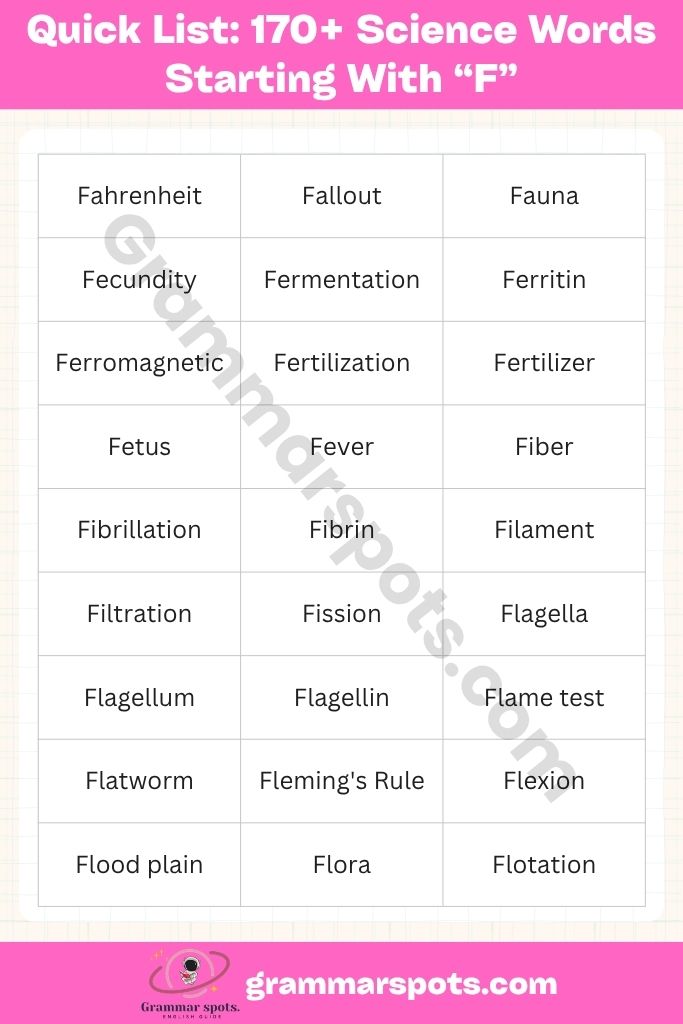
- Fahrenheit — Temperature scale; water freezes at 32°F and boils at 212°F
- Fallout — Radioactive particles that settle after a nuclear explosion
- Fauna — All animal life found in a specific region or time period
- Fecundity — An organism’s capacity to produce many offspring
- Fermentation — Energy-producing process that works without oxygen
- Ferritin — Blood protein that stores and releases iron in the body
- Ferromagnetic — Material strongly attracted to magnets, such as iron
- Fertilization — Union of a sperm cell and egg cell to begin new life
- Fertilizer — Substance added to soil to supply nutrients to plants
- Fetus — Developing human or animal in the womb after organ formation begins
- Fever — Body temperature rising above normal as an immune response
- Fiber — Thin, thread-like structure found in plants, muscles, or materials
- Fibrillation — Rapid, irregular electrical activity in heart muscle
- Fibrin — Protein that forms a mesh to seal wounds during blood clotting
- Filament — Thin wire or strand that glows when electricity passes through it
- Filtration — Passing a mixture through a filter to separate solids from liquids
- Fission — Splitting a heavy atomic nucleus to release large amounts of energy
- Flagella — Plural of flagellum; whip-like tails used by cells to move
- Flagellum — Tail-like structure that spins to propel a cell forward
- Flagellin — The protein that builds and forms a bacterial flagellum
- Flame test — Lab technique that identifies elements by the color of their flame
- Flatworm — Simple invertebrate animal with a flat, ribbon-like body
- Fleming’s Rule — Hand rule used to find direction of force or current in electromagnetism
- Flexion — Bending movement at a joint, such as bending the elbow
- Flood plain — Flat land alongside a river that floods during high water levels
- Flora — All plant life found in a specific region or time period
- Flotation — Ability of an object to remain on the surface of a liquid
- Fluid — Any substance — liquid or gas — that flows and takes the shape of its container
- Fluid dynamics — Study of how liquids and gases move and behave
- Fluorescence — Visible light released by a material after it absorbs radiation
- Fluoride — Compound of fluorine used in toothpaste and water treatment
- Fluorine — Most reactive element on the periodic table; pale yellow gas
- Fluorocarbon — Compound of fluorine and carbon; extremely stable and non-reactive
- Fluoroscopy — Real-time X-ray imaging used during medical procedures
- Flux — Measure of how much of a field or substance passes through an area
- Flux density — Concentration of a magnetic or electric field in a given area
- Flyby — Spacecraft passing close to a planet without landing or orbiting
- Fog — Cloud that forms at ground level, reducing visibility
- Food chain — Linear sequence showing energy transfer from one organism to another
- Food web — Network of all overlapping food chains in an ecosystem
- Foraminifera — Tiny ocean organisms with shells used to study ancient climates
- Force — Any push or pull that causes an object to accelerate or change direction
- Force field — Region in space where a force acts on objects within it
- Fossil — Preserved remains or imprint of an ancient organism found in rock
- Fossil fuel — Energy source formed from ancient organisms; coal, oil, and natural gas
- Fossil record — Collection of all known fossils showing history of life on Earth
- Fracture — A break or crack in a bone or rock
- Fracture zone — Long cracks on the ocean floor formed by tectonic plate movement
- Free energy — Energy available in a system to do useful work
- Free fall — Motion under gravity alone with no other forces acting
- Free radical — Unstable molecule with an unpaired electron that damages cells
- Freezing — Phase change from liquid to solid when temperature drops
- Freezing point — Exact temperature at which a substance changes from liquid to solid
- Frequency — Number of complete wave cycles that pass a point per second
- Frequency modulation — FM radio; encoding audio by varying the carrier wave frequency
- Friction — Force that resists motion between two surfaces in contact
- Frontal lobe — Front section of the brain controlling decisions and personality
- Frontal system — Weather boundary where two air masses of different temperatures meet
- Fuel cell — Device that converts hydrogen and oxygen into electricity and water
- Fulcrum — The pivot point of a lever
- Fullerene — Carbon molecule shaped like a hollow ball or tube; used in nanotechnology
- Functional group — Cluster of atoms in a molecule that determines its chemical behavior
- Fundamental force — One of the four basic forces: gravity, electromagnetism, strong, weak nuclear
- Fungicide — Chemical that kills or prevents the growth of fungi
- Fungus — Kingdom of organisms that absorb nutrients by decomposing organic matter
- Fuselage — Main body of an aircraft that holds passengers and cargo
- Faraday constant — Electric charge of one mole of electrons; about 96,485 coulombs
- Faraday’s law — A changing magnetic field produces an electric current
- Fermi level — Energy level with 50% probability of finding an electron in a solid
- Fermi paradox — Question of why we haven’t detected intelligent alien life despite probability
- Feral — Domestic animal that has returned to wild behavior
- Fermentation rate — Speed at which fermentation occurs under given conditions
- Ferrite — Ceramic magnetic material used in electronics and transformers
- Fetal development — Stages of growth an organism undergoes inside the womb
- Fibula — Thinner of the two lower leg bones, running beside the tibia
- Fission products — Smaller atoms and particles left after nuclear fission occurs
- Fixed point — Reference point that does not change, used in measurements
- Flame retardant — Chemical that slows or prevents materials from catching fire
- Flocculation — Process where tiny particles clump together in liquid for removal
- Floe — Large floating sheet of sea ice
- Fluvial — Relating to rivers and the processes they cause
- Focal length — Distance between a lens and the point where light converges
- Focus (seismic) — Underground point where an earthquake originates
- Fog bow — White arc seen in fog, similar to a rainbow but colorless
- Follicle — Small sac in skin or ovary that produces hair or egg cells
- Food energy — Energy stored in food, measured in calories or joules
- Foramen — Natural opening or hole in a bone that allows nerves or vessels through
- Forensic science — Application of science to solve crimes and legal questions
- Formation (geological) — Layer of rock with consistent characteristics and origin
- Fossil cast — Replica formed when minerals fill a mold left by a decayed organism
- Fossil mold — Impression left in rock after an organism dissolves away
- Fovea — Central part of the retina with the highest concentration of cone cells
- Fractional distillation — Separating a liquid mixture by differences in boiling point
- Fracture toughness — Material’s ability to resist cracking under stress
- Free convection — Heat movement driven by density differences, not external force
- Free nerve ending — Simple sensory receptor in skin that detects pain and temperature
- Freezing rain — Rain that freezes on contact with cold surfaces
- Frequency spectrum — Full range of electromagnetic frequencies from radio to gamma rays
- Freshwater — Water with very low salt content found in lakes, rivers, and glaciers
- Frontal bone — Bone that forms the forehead and upper part of the eye socket
- Frost — Ice crystals that form on surfaces when air temperature drops below freezing
- Fructose — Simple sugar found naturally in fruits and honey
- Fumigation — Using gas or smoke to kill pests or disinfect an area
- Fundamental frequency — Lowest frequency produced by a vibrating object
- Fundamental particle — Most basic unit of matter that cannot be broken down further
- Furrow — Groove made in soil for planting seeds
- Fusion reactor — Device designed to produce energy by fusing atomic nuclei together
Physics Science Words That Start With F
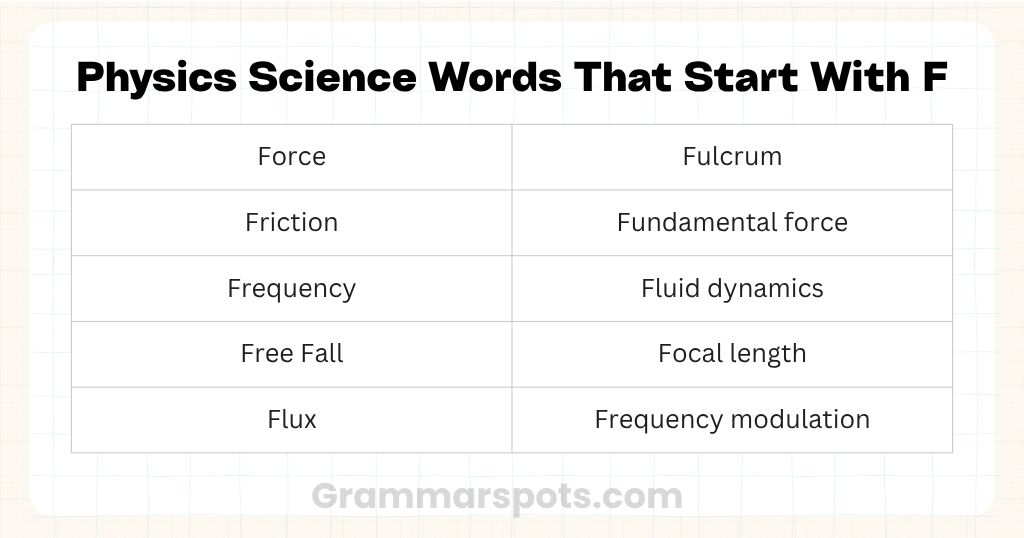
- Force — Measured in Newtons. Every push, pull, kick, or throw involves force.
- Friction — Slows objects down when surfaces meet. Rubber soles on shoes rely on it.
- Frequency — Higher frequency = more waves per second. Measured in Hertz (Hz).
- Free fall — Gravity acting alone on a falling object. Astronauts in orbit experience it constantly.
- Flux — Measures how much of a field passes through a surface area.
- Fulcrum — The pivot point in any lever system. Move it closer to the load and lifting becomes easier.
- Fundamental force — Physics runs on four: gravity, electromagnetism, strong nuclear, weak nuclear.
- Fluid dynamics — Explains how water flows through pipes and how airplane wings generate lift.
- Focal length — The distance from a lens to the point where light rays converge.
- Frequency modulation — FM radio uses this to carry clearer audio signals than AM.
Chemistry Science Words That Start With F
- Filtration — Basic lab technique. Solid stays in filter paper; liquid passes through.
- Fluorine — Element #9 on the periodic table. Most reactive of all elements.
- Fermentation — Yeast converts sugar into alcohol and CO₂. No oxygen required.
- Fractional distillation — Crude oil gets separated into gasoline, diesel, and kerosene this way.
- Free radical — Unstable molecule that damages cells. Antioxidants neutralize them.
- Functional group — The -OH group makes a molecule an alcohol. The -COOH makes it an acid.
- Flocculation — Tiny particles clump together in water treatment to remove impurities.
- Fluorescence — Material absorbs UV light and releases it as visible glow.
- Faraday constant — Used in electrochemistry. Equals the charge of one mole of electrons.
- Flame test — Hold a sample in a flame. Potassium burns violet. Sodium burns bright yellow.
Biology Science Words That Start With F
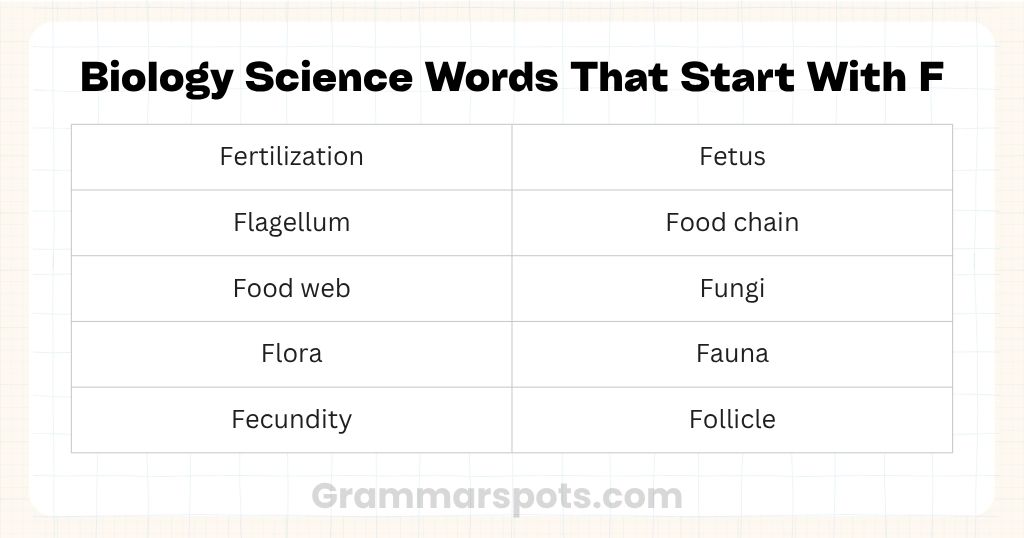
- Fertilization — One sperm cell meets one egg cell. A new organism begins.
- Fetus — Developing human after 8 weeks in the womb, when organs start forming.
- Flagellum — Spinning tail that moves bacteria and sperm cells through liquid.
- Food chain — Grass → grasshopper → frog → hawk. Energy flows up the line.
- Food web — Multiple overlapping food chains showing real ecosystem connections.
- Fungi — Their own kingdom. They break down dead matter and recycle nutrients.
- Flora — All plant life in a region or habitat.
- Fauna — All animal life in a region or habitat.
- Fecundity — How many offspring an organism can produce. Rabbits: high. Elephants: low.
- Follicle — Sac in skin that produces hair, or in the ovary that contains an egg.
- Fovea — The spot on your retina where vision is sharpest.
- Fibula — The thinner bone running alongside the tibia in the lower leg.
- Fructose — Natural sugar found in fruit. Sweeter than table sugar.
Earth Science Words That Start With F
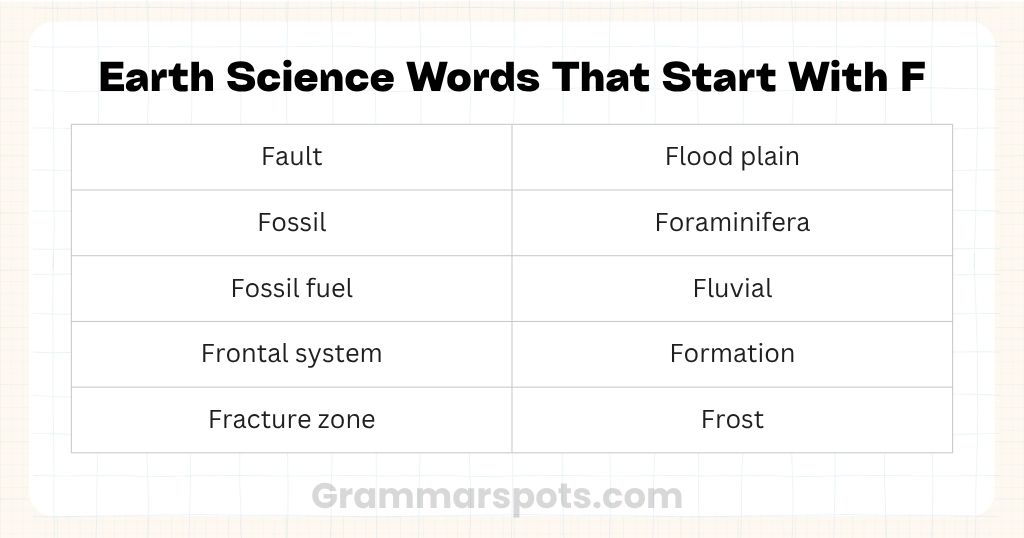
- Fault — A crack in Earth’s crust where blocks of rock have moved. Earthquakes happen here.
- Fossil — Ancient organism preserved in rock over millions of years.
- Fossil fuel — Coal, oil, and gas formed from organisms buried under pressure.
- Frontal system — Boundary between cold and warm air masses. Drives most weather changes.
- Fracture zone — Long cracks on the ocean floor from tectonic activity.
- Flood plain — Flat land next to a river that floods regularly and collects rich soil.
- Foraminifera — Tiny ocean creatures whose fossilized shells reveal ancient ocean temperatures.
- Fluvial — Any process or feature shaped by river activity.
- Formation — A rock layer with consistent origin and characteristics.
- Frost — Ice crystals on surfaces when temperature drops below 0°C.
- Floe — A large, flat piece of floating sea ice.
- Focus (seismic) — The underground point where an earthquake starts.
Space & Astronomy Science Words That Start With F
- Fusion — The sun’s power source. Two hydrogen atoms combine to form helium and energy.
- Free fall — Satellites orbit Earth in continuous free fall, moving too fast to hit the surface.
- Flyby — Spacecraft passes close to a planet for observation without stopping.
- Fireball — A meteor brighter than Venus. Sometimes explodes with a visible flash.
- Frequency spectrum — Full range of electromagnetic radiation from radio waves to gamma rays.
- Fusion reactor — Still in development. Could produce near-unlimited clean energy on Earth.
- Fermi paradox — If the universe is so large, why haven’t we found other intelligent life?
Medical & Health Science Words That Start With F

- Fever — Immune system raises body temperature to fight pathogens.
- Fibrillation — Chaotic electrical signals make the heart quiver instead of pump properly.
- Fluoroscopy — Real-time X-ray that shows moving structures during surgery or procedures.
- Fracture — A broken or cracked bone. Dozens of types classified by pattern and severity.
- Fibrin — Protein mesh that traps blood cells and seals a wound.
- Ferritin — Iron-storage protein in blood. Low levels signal anemia.
- Follicle — In reproductive health, it’s the sac in the ovary that releases an egg.
- Fetal development — Stages of growth from fertilized egg to birth.
- Foramen — A natural hole in bone that lets nerves and blood vessels pass through.
- Fumigation — Using chemical gas to kill pathogens or pests in a space.
Technology & Applied Science Words That Start With F
- Frequency modulation (FM) — Varies wave frequency to carry audio. Less interference than AM.
- Fiber optics — Data travels as light through glass fibers. Backbone of modern internet.
- Fullerene — Hollow carbon molecule shaped like a soccer ball. Used in nanotechnology.
- Fuel cell — Converts hydrogen and oxygen into electricity. Waste product is just water.
- Faraday’s law — Every electric generator on Earth works because of this principle.
- Flame retardant — Added to materials to slow fire spread in buildings and fabrics.
- Forensic science — Applies chemistry, biology, and physics to analyze crime evidence.
- Fixed point — A stable reference value used in calibrating instruments.
Easy Science Words That Start With F (For Kids & Beginners)
| Word | Simple Meaning |
| Float | Stay on top of liquid |
| Freeze | Change from liquid to solid |
| Force | A push or pull |
| Fossil | Old creature remains turned to rock |
| Flower | Reproductive part of a plant |
| Fog | Cloud that forms at ground level |
| Fruit | Seed-holding part of a plant |
| Frog | Amphibian that lives in water and on land |
| Food chain | Who eats what in nature |
| Fluid | Anything that flows |
Advanced Science Words That Start With F
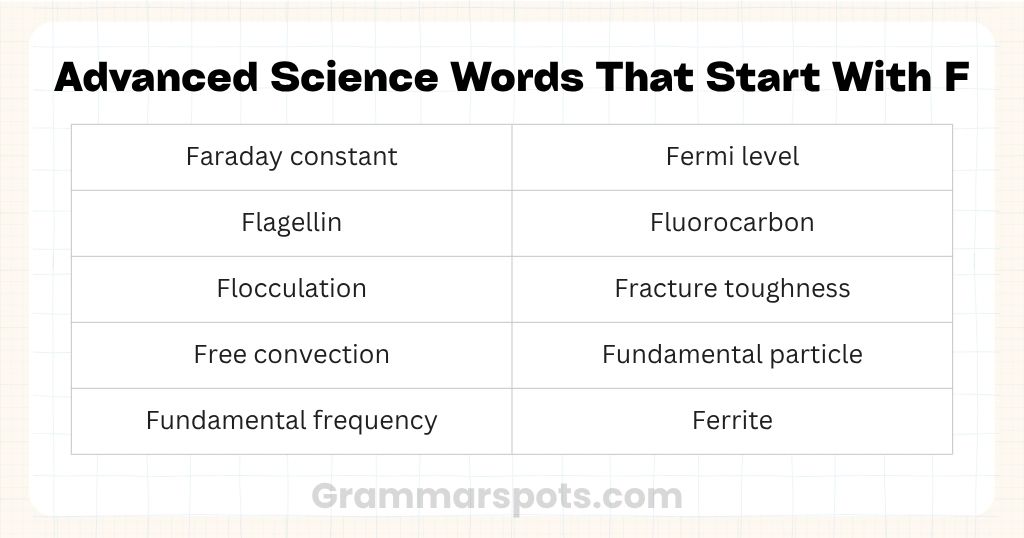
| Word | Meaning |
| Faraday constant | Charge of one mole of electrons (~96,485 coulombs) |
| Fermi level | Energy level with 50% electron-finding probability in a solid |
| Flagellin | Protein that builds bacterial flagella |
| Fluorocarbon | Stable carbon-fluorine compound; some damaged the ozone layer |
| Flocculation | Particle clumping used in water treatment and mining |
| Fracture toughness | A material’s resistance to crack propagation under stress |
| Free convection | Heat transfer driven purely by density differences in fluid |
| Fundamental particle | Most basic unit of matter; cannot be divided further |
| Fundamental frequency | Lowest natural frequency a vibrating object produces |
| Ferrite | Magnetic ceramic used in electronics and signal transformers |
Common Confusions & Mistakes

Fission vs. Fusion
Both release nuclear energy but work oppositely.
- Fission = splitting a large atom apart
- Fusion = joining two small atoms together
- Memory trick: Fission = fracture. Fusion = fuse together.
Flora vs. Fauna
- Flora = plants
- Fauna = animals
- Memory trick: Fauna sounds like fawn — a baby deer, which is an animal.
Frequency vs. Wavelength
- High frequency = short wavelength
- Low frequency = long wavelength
- They move in opposite directions. Always.
Fungus vs. Plant
- Plants make food from sunlight
- Fungi absorb nutrients by breaking down dead matter
- Genetically, fungi are closer to animals than plants
Fertilization vs. Germination
- Fertilization = sperm meets egg (or pollen meets plant egg)
- Germination = a seed sprouts and begins to grow
- These are two separate stages, not the same event
Fluid vs. Liquid
- All liquids are fluids
- But gases are also fluids because they flow
- Fluid = anything that flows. Liquid = one specific state of matter
Real-Life Places You’ll Find These F Science Words
| Setting | Words in Use |
| Hospital | Fever, Fracture, Fibrillation, Fluoroscopy, Fibrin, Ferritin |
| Kitchen | Fermentation, Freezing point, Filtration, Fructose |
| Weather forecast | Frontal system, Fog, Frost, Flood plain |
| Power plant | Fission, Fusion, Fuel cell, Faraday’s law |
| Ocean floor | Fault, Fracture zone, Foraminifera, Floe |
| Internet & phones | Fiber optics, Frequency, FM signals |
| Garden or forest | Flora, Fauna, Fungi, Food web, Fertilization |
FAQs About Science Words That Start With F
How many science words start with F?
Hundreds exist across all scientific fields. This article covers 170+ of the most useful ones for students and curious learners.
Which F science words appear most on tests?
Force, friction, frequency, fertilization, fission, fusion, food chain, fossil, and fermentation appear most often in middle and high school exams.
Are any F words shared across multiple science subjects?
- Frequency — physics, chemistry, biology, and technology
- Fluid — physics and medicine
- Filtration — chemistry, biology, and environmental science
What’s the hardest F science word to understand?
Faraday constant, Fermi level, and Flagellin top the list. All three require understanding physics and chemistry together.
Which F words work well for science fair projects?
Fermentation, filtration, friction, and fluorescence. All four are visual, testable, and easy to present.
Conclusion
This list covers 170+ science words starting with F organized by subject, defined clearly, and connected to real-world use. The quick answer section handles fast lookups. The category sections support deeper study. The confusion section helps before any exam.
Science vocabulary builds on itself. Learn one word, and three more start making sense around it.

I’m Hazel, and I studied BSC English at GCUF. I focus on explaining word meanings in simple, clear language that anyone can understand. My goal is helping readers grasp everyday English, confusing terms, and slang used in real conversations and social media. I believe language learning works best when definitions connect to actual life situations. Through careful research and straightforward explanations, I make vocabulary accessible for students, learners, and anyone curious about how English really works in daily use.