

You need science words starting with N for a test, a project, a vocabulary assignment, or just to finally understand what your textbook is saying.
“N” is one of the richest letters in science. It covers atoms, nerve cells, space clouds, soil bacteria, ocean tides, and more. This article gives you every major term, organized so you can find exactly what you need.
Quick Answer: Most-Used Science Words Starting With N
| Word | Meaning (under 15 words) |
| Nucleus | Control center of a cell or an atom |
| Neuron | Nerve cell that carries electrical signals |
| Nitrogen | Gas making up 78% of Earth’s atmosphere |
| Newton | Unit used to measure force |
| Nebula | Giant gas and dust cloud in space |
| Neutron | Neutral particle inside an atom’s nucleus |
| Niche | A species’ specific role in its ecosystem |
| Nanometer | One billionth of a meter |
| Nocturnal | Active at night |
| Nutrient | Substance living things need to grow |
| Noble gas | Unreactive gas such as helium or neon |
| Natural selection | Survival of organisms best suited to their environment |
| Nitrogen cycle | Natural recycling of nitrogen through ecosystems |
| Nucleotide | Building block of DNA and RNA |
| Nervous system | Body-wide network of nerves controlled by the brain |
| Normal force | A surface’s push back against an object pressing on it |
| Nuclear fusion | Joining of atoms releasing enormous energy |
| Nuclear fission | Splitting of atoms to release energy |
| Nonrenewable | Resources that cannot be replaced in a human lifetime |
| Nanotechnology | Engineering at a billionth-of-a-meter scale |
Quick List of 140+ Science Words Starting With N
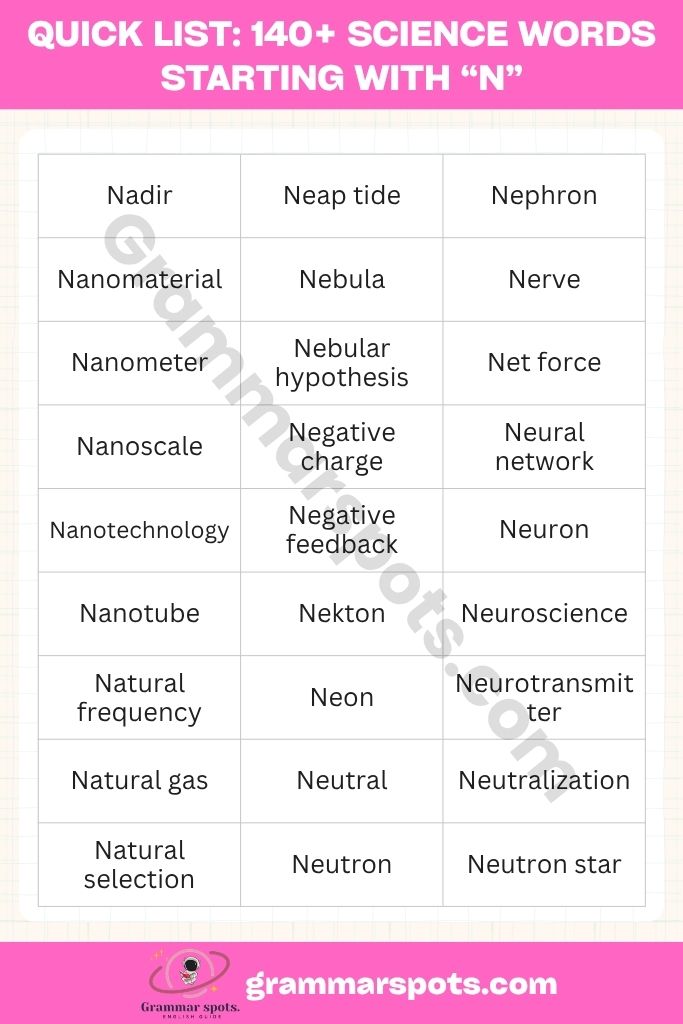
- Nadir
- Nanomaterial
- Nanometer
- Nanoscale
- Nanotechnology
- Nanotube
- Natural frequency
- Natural gas
- Natural selection
- Neap tide
- Nebula
- Nebular hypothesis
- Negative charge
- Negative feedback
- Nekton
- Neon
- Nephron
- Nerve
- Net force
- Neural network
- Neuron
- Neuroscience
- Neurotransmitter
- Neutral
- Neutralization
- Neutron
- Neutron star
- Niche
- Nickel
- Nitrate
- Nitrification
- Nitrite
- Nitrogen
- Nitrogen cycle
- Nitrogen fixation
- Noble gas
- Nociception
- Nociceptor
- Node
- Nonlinear
- Nonlinear dynamics
- Nonmetal
- Nonpolar molecule
- Nonrenewable
- Normal
- Normal distribution
- Normal force
- Northern lights
- Nuclear energy
- Nuclear fission
- Nuclear fusion
- Nuclear membrane
- Nuclear reaction
- Nuclease
- Nucleic acid
- Nucleolus
- Nucleon
- Nucleosynthesis
- Nitrogen dioxide
Physics Science Words That Start With N
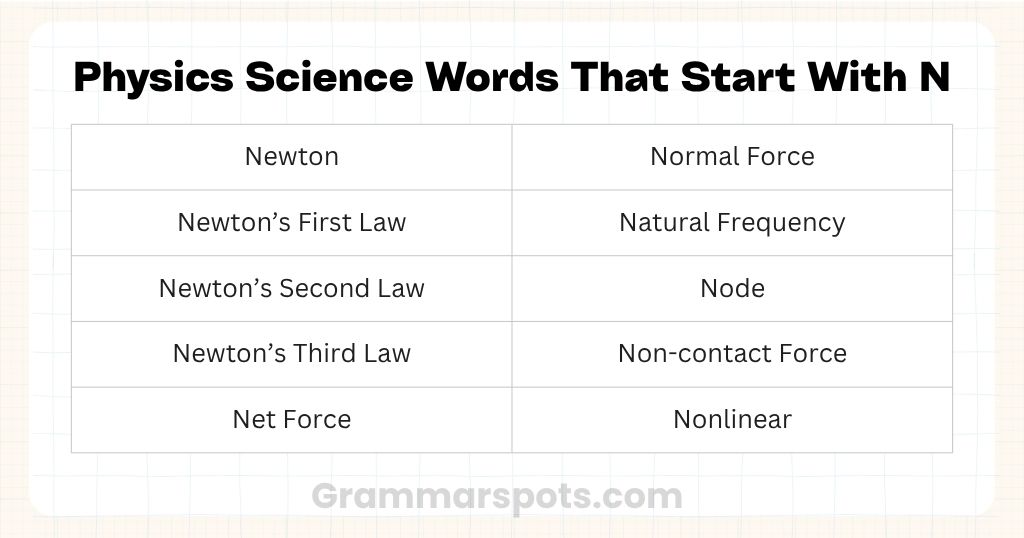
Newton
The standard unit of force. One newton is the force needed to accelerate a 1 kg object by 1 meter per second squared. Named after Sir Isaac Newton.
Newton’s First Law
An object at rest stays at rest. An object in motion stays in motion unless an outside force acts on it. This is also called the law of inertia.
Newton’s Second Law
Force equals mass multiplied by acceleration (F = ma). A heavier object needs more force to accelerate at the same rate as a lighter one.
Newton’s Third Law
Every action has an equal and opposite reaction. A rocket pushes gas downward; the gas pushes the rocket upward.
Net Force
The combined result of all forces acting on an object. Equal forces in opposite directions produce zero net force the object doesn’t move.
Normal Force
The force a surface pushes back with when something presses on it. It always acts perpendicular to the surface.
Natural Frequency
Every object vibrates at its own specific speed when disturbed. Bridges can fail when wind hits them at their natural frequency a phenomenon called resonance.
Node
A point in a wave or vibrating object that stays completely still. On a guitar string, the fixed ends are nodes.
Non-contact Force
A force that acts without physical touch. Gravity, magnetism, and electric fields are all non-contact forces.
Nonlinear
A system where output doesn’t scale evenly with input. Small changes can produce huge, unpredictable effects.
Negative Acceleration
Slowing down. When a car brakes, it experiences negative acceleration (also called deceleration).
Non-Newtonian Fluid
A fluid that doesn’t follow standard flow rules. Cornstarch mixed with water is a classic example it acts like a solid under pressure and a liquid at rest.
Numerical Aperture
In optics, this measures how much light a lens can collect. Higher numerical aperture means sharper, more detailed images.
Nutation
A small wobble in the axis of a spinning object, like Earth’s axis over a 18.6-year cycle, layered on top of its larger precession.
Chemistry Science Words That Start With N
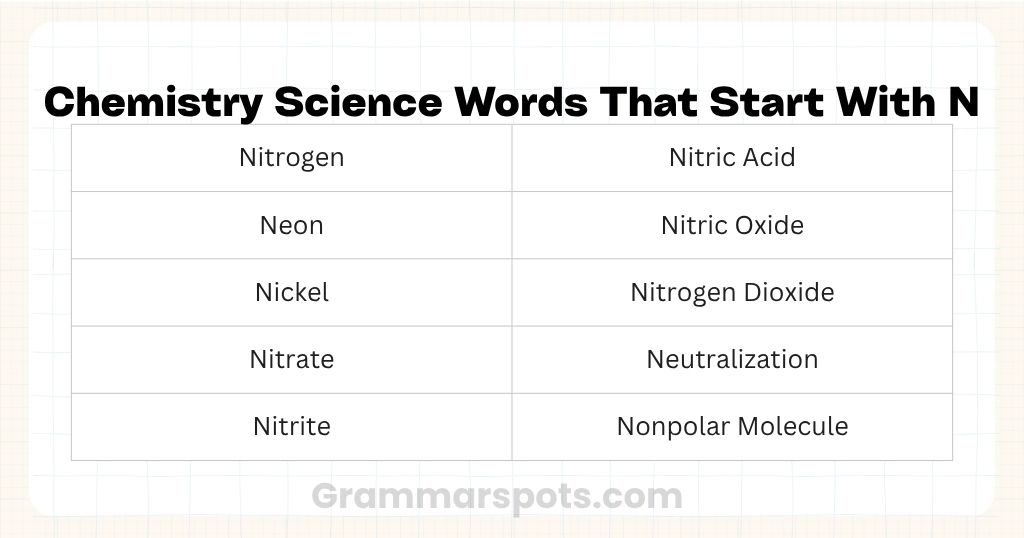
Nitrogen
Element symbol N, atomic number 7. Colorless and odorless. Makes up about 78% of air. Essential for proteins and DNA.
Neon
Element symbol Ne, atomic number 10. A noble gas that glows orange-red when electricity passes through it. Used in signs and lasers.
Nickel
Element symbol Ni, atomic number 28. A hard, silver-colored metal used in batteries, coins, and stainless steel alloys.
Nitrate
A compound (NO₃⁻) found in fertilizers and soil. Critical for plant growth, but excess nitrates in water cause harmful algae blooms.
Nitrite
A compound (NO₂⁻) closely related to nitrate but with one fewer oxygen atom. Used in food preservation. Formed during the nitrogen cycle.
Nitric Acid
Formula HNO₃. A highly corrosive acid used in fertilizer production, explosives, and industrial processes.
Nitric Oxide
Formula NO. A colorless gas produced in the human body that helps regulate blood pressure. Also a component of air pollution.
Nitrogen Dioxide
Formula NO₂. A reddish-brown gas and major air pollutant. Produced by cars and power plants; contributes to smog.
Neutralization
When an acid and a base react, they cancel each other out, producing water and a salt. Antacid tablets neutralize stomach acid this way.
Nonpolar Molecule
A molecule with evenly distributed electrical charge. Oil is nonpolar. Water is polar. That’s why they don’t mix.
Nonmetal
Elements that don’t conduct electricity well and aren’t shiny or malleable. Oxygen, carbon, and sulfur are nonmetals.
Noble Metal
Metals that resist corrosion and oxidation gold, platinum, and silver. Valued in jewelry, electronics, and medicine.
Nucleophile
A chemical species that donates electrons to form a new bond. It attacks positively charged atoms in chemical reactions.
Nucleation
The first step in forming a crystal or a bubble when a tiny cluster of molecules comes together as a starting point for larger growth.
Nitrous Oxide
Formula N₂O. Also called laughing gas. Used as an anesthetic in dentistry and as a fuel oxidizer in racing engines.
Natrium
The Latin name for sodium. This is why sodium’s chemical symbol is Na on the periodic table.
Nitrogen Narcosis
A disorienting, intoxicating effect experienced by divers breathing compressed air at depth. Caused by dissolved nitrogen affecting the nervous system.
Biology Science Words That Start With N
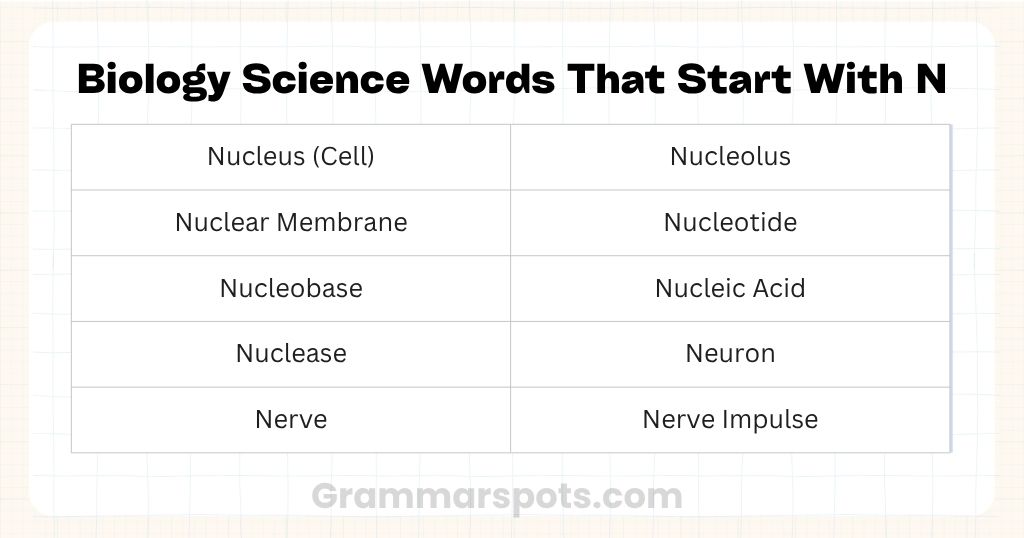
Nucleus (Cell)
The membrane-bound structure inside a cell that contains DNA. It controls what the cell does and how it reproduces.
Nucleolus
A small structure inside the cell nucleus. Its job is producing ribosomes the machines that build proteins.
Nuclear Membrane
The double-layered envelope surrounding the cell nucleus. It controls what enters and exits the nucleus.
Nucleotide
The basic building unit of DNA and RNA. Each has three parts: a sugar, a phosphate group, and a nitrogen base.
Nucleobase
The nitrogen-containing portion of a nucleotide. The four DNA bases — adenine, thymine, cytosine, and guanine are nucleobases.
Nucleic Acid
DNA and RNA are both nucleic acids. They store, copy, and transmit genetic information.
Nuclease
An enzyme that cuts nucleic acids. Scientists use nucleases as molecular scissors in genetic engineering.
Neuron
A cell specialized for transmitting electrical signals. The brain contains approximately 86 billion neurons.
Nerve
A bundle of many neurons wrapped together like a cable made of individual wires.
Nerve Impulse
The electrical signal that travels along a neuron. Travels at speeds up to 120 meters per second in the fastest nerve fibers.
Neurotransmitter
Chemical released by a neuron that carries a signal to the next neuron or to a muscle. Dopamine, serotonin, and adrenaline are examples.
Nervous System
The complete network of neurons and nerves in the body. Divided into the central nervous system (brain and spinal cord) and peripheral nervous system.
Neuroplasticity
The brain’s ability to reorganize itself by forming new connections throughout life. Learning a new skill physically changes the brain.
Neurogenesis
The process of creating new neurons. It happens during development and continues in specific brain regions in adults.
Natural Selection
The process by which organisms better adapted to their environment reproduce more successfully. Drives evolutionary change over generations.
Niche
The specific role a species plays in its ecosystem what it eats, when it’s active, and how it interacts with other species.
Niche Partitioning
When two species divide up resources to avoid direct competition. Different bird species eating insects at different tree heights is one example.
Nocturnal
Active at night, sleeping during the day. Owls, bats, and many rodents are nocturnal.
Nekton
Free-swimming aquatic organisms that move independently of water currents. Fish, whales, and squid are nekton.
Nymph
The juvenile stage of insects like grasshoppers and dragonflies. Nymphs look like smaller adults no cocoon stage involved.
Natural Immunity
Immunity developed after infection rather than vaccination. The immune system produces antibodies that remember the pathogen.
Natural Killer Cell
A white blood cell that attacks and destroys infected or cancerous cells without needing prior exposure to them.
Nutrient
Any substance an organism needs for energy, growth, or repair. Proteins, carbohydrates, fats, vitamins, and minerals are all nutrients.
Nutrient Cycle
The movement of nutrients (nitrogen, carbon, phosphorus) through an ecosystem. Decomposition returns nutrients to the soil.
Nonvascular Plant
A plant without a vascular system for transporting water. Mosses and liverworts are nonvascular they absorb water directly through their surfaces.
Earth Science Words That Start With N
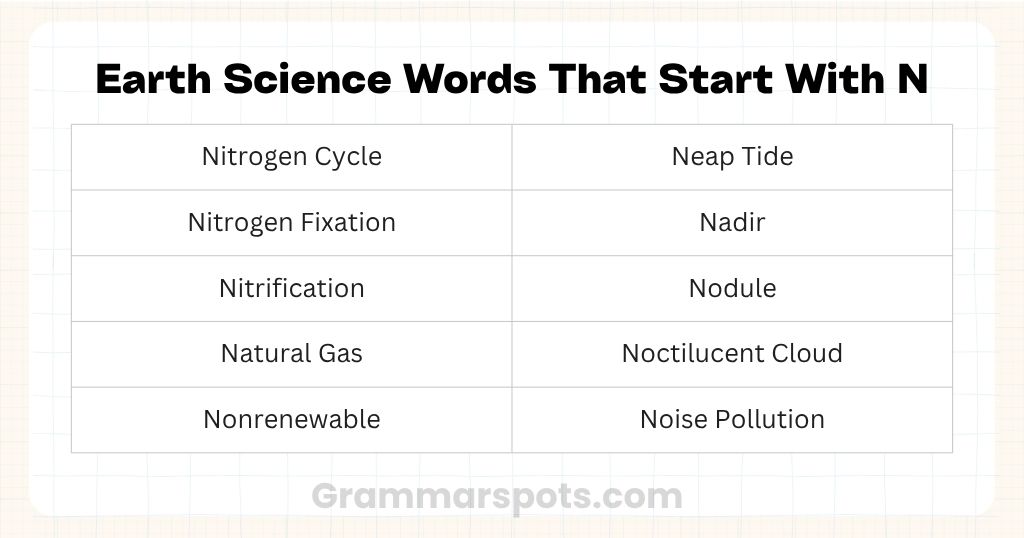
Nitrogen Cycle
The process by which nitrogen moves between atmosphere, soil, plants, and animals. Bacteria convert atmospheric nitrogen into usable compounds.
Nitrogen Fixation
Bacteria (especially in legume roots) convert atmospheric nitrogen gas (N₂) into ammonia (NH₃) that plants can absorb.
Nitrification
Soil bacteria convert ammonia into nitrates. An essential step in the nitrogen cycle that makes nitrogen available to plants.
Natural Gas
A fossil fuel composed mainly of methane. Extracted from underground deposits, used for heating, cooking, and electricity generation.
Nonrenewable
Resources formed over millions of years that humans use far faster than they form. Oil, coal, and natural gas are primary examples.
Neap Tide
A weaker-than-average tide occurring when the Sun, Earth, and Moon form a right angle. Occurs twice each month.
Nadir
The point directly below an observer opposite of the zenith. In geography and astronomy, it marks the lowest directional point.
Nodule
A small rounded lump of mineral found in rock or soil. Manganese nodules on the ocean floor are a well-known example.
Noctilucent Cloud
Extremely high-altitude clouds (around 80 km up) visible at twilight in polar regions. The highest clouds in Earth’s atmosphere.
Noise Pollution
Unwanted or harmful sound in the environment. Damages hearing, disrupts wildlife behavior, and affects human health.
Natural Convection
The movement of fluid caused by temperature differences rather than mechanical pumping. Warm air rising and cool air sinking is natural convection.
Natural Abundance
The percentage of a given isotope found naturally in an element. Carbon-12 makes up about 98.9% of all natural carbon.
Space & Astronomy Science Words That Start With N
Nebula
A cloud of gas and dust in space. Some are star-forming regions; others are remnants of dead stars. The Orion Nebula is visible without a telescope.
Nebular Hypothesis
The widely accepted explanation for how our solar system formed from a rotating cloud of gas and dust that collapsed under gravity.
Neutron Star
The dense remnant left after a massive star explodes. A teaspoon of neutron star material weighs billions of tons.
Neutrino
An almost massless particle produced in nuclear reactions. Billions pass through your body every second without interacting with anything.
Nucleosynthesis
The process of creating new atomic nuclei inside stars. Elements heavier than hydrogen were built this way inside stellar cores.
Nucleogenesis
The formation of atomic nuclei in the early universe and inside stars. Related to nucleosynthesis but refers to the broader origin process.
Nuclear Fusion (stellar)
Stars produce energy by fusing hydrogen into helium. The Sun burns around 600 million tons of hydrogen per second this way.
Northern Lights
Also called Aurora Borealis. Colorful light displays near the poles caused by charged solar particles interacting with Earth’s magnetic field.
Nutation
A periodic wobble in Earth’s rotational axis, with a cycle of about 18.6 years, caused by gravitational pull from the Moon.
More Post: 150+ Foods That Start With N: Complete List of Fruits, Vegetables, Snacks, Drinks and More
Medical & Health Science Words That Start With N
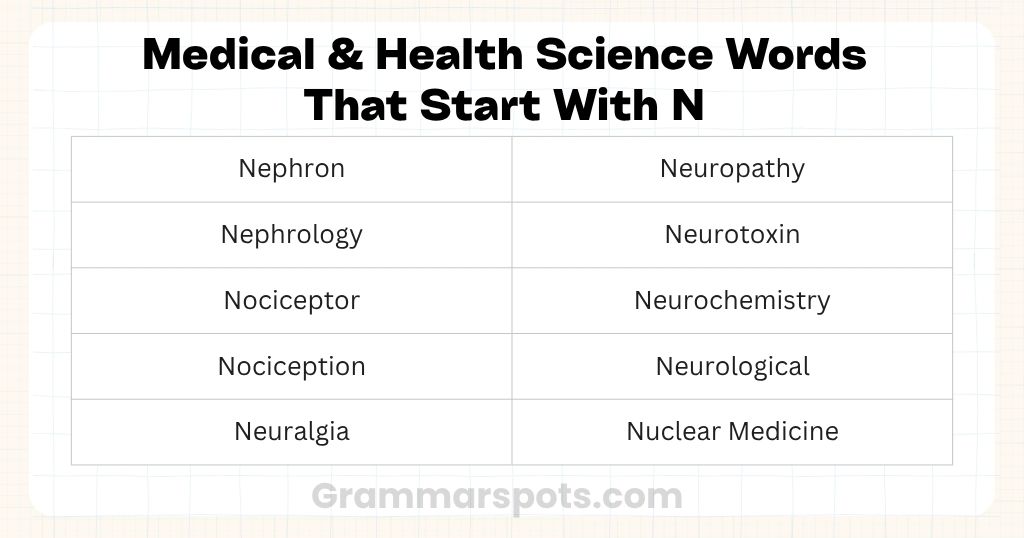
Nephron
The microscopic filtering unit inside the kidney. Each kidney holds about one million nephrons. They filter blood and produce urine.
Nephrology
The branch of medicine focused on kidney diseases and kidney function.
Nociceptor
A sensory receptor that detects pain or potential tissue damage. Immediately signals the brain when something harmful is detected.
Nociception
The body’s system for detecting and processing harmful stimuli. It’s the biological foundation of the pain experience.
Neuralgia
Sharp, intense pain along the path of a nerve. Often caused by nerve damage or irritation.
Neuropathy
Damage or dysfunction of one or more nerves. Causes numbness, weakness, or pain, commonly in hands and feet.
Neurotoxin
A substance that damages or destroys nerve tissue. Found in some snake venoms, industrial chemicals, and certain plants.
Neurochemistry
The study of chemicals in the nervous system including neurotransmitters, hormones, and how they influence behavior and health.
Neurological
Relating to the nervous system. A neurological disorder affects the brain, spinal cord, or nerves.
Nuclear Medicine
A medical field using radioactive substances to diagnose and treat disease. PET scans and radioactive iodine treatment are examples.
Nuclear Magnetic Resonance (NMR)
A technique that detects how atomic nuclei respond to magnetic fields. The basis of MRI scanners used in hospitals.
Nystagmus
Involuntary, repetitive eye movement. Can be caused by inner ear problems, neurological conditions, or certain medications.
Nocturia
Waking at night to urinate. Can signal diabetes, kidney issues, or other medical conditions.
Nyctalopia
Night blindness difficulty seeing in low light. Often caused by vitamin A deficiency or retinal conditions.
Technology & Applied Science Words That Start With N
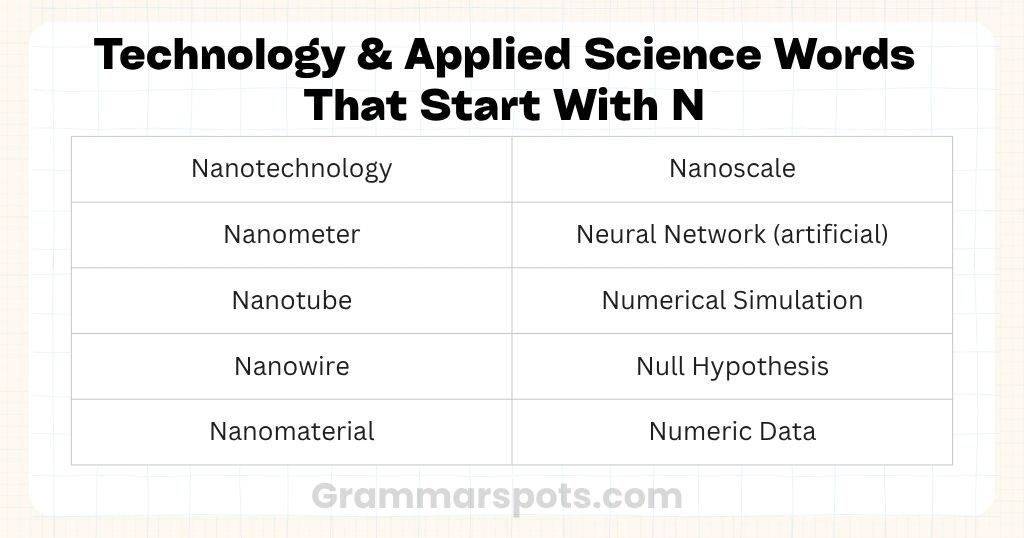
Nanotechnology
Engineering and manipulating materials at the scale of nanometers. Used in medicine, electronics, and materials manufacturing.
Nanometer
One billionth of a meter. DNA is about 2.5 nm wide. A human hair is roughly 80,000 nm wide.
Nanotube
Cylindrical carbon structures a few nanometers wide. Stronger than steel, lighter than aluminum. Used in electronics and materials science.
Nanowire
A wire-shaped nanostructure just a few nanometers in diameter. Used in transistors, sensors, and solar cells.
Nanomaterial
Any material engineered at the nanoscale with properties different from its bulk form. Titanium dioxide nanoparticles in sunscreen is one example.
Nanoscale
The size range of 1–100 nanometers where quantum effects become significant. Materials behave differently than they do in larger quantities.
Neural Network (artificial)
A computing system modeled loosely on the brain. Used in image recognition, language processing, and AI applications.
Numerical Simulation
Using computers and mathematical models to simulate real-world systems. Used in weather forecasting, engineering design, and physics research.
Null Hypothesis
In scientific testing, the assumption that there is no effect or no relationship. An experiment tries to disprove it.
Numeric Data
Measurements expressed as numbers. Temperature, speed, mass, and pH values are all numeric data.
Normalization
Adjusting data to a standard scale so different measurements can be compared fairly. Essential in statistics and machine learning.
Numerical Aperture
A number describing how much light a microscope or fiber optic cable can collect. Higher value means better resolution.
Net Energy
The energy available from a source after subtracting the energy required to produce it. A measure of real-world energy efficiency.
Noise (signal)
Unwanted interference in an electrical or data signal. Reducing noise is a major challenge in electronics and communications.
Non-ohmic Conductor
A material that doesn’t follow Ohm’s law its resistance changes with voltage. Diodes and transistors are non-ohmic.
Common Confusions: N Words People Mix Up
Neutron vs. Neuron
- Neutron — a subatomic particle with no charge, found inside an atom’s nucleus (physics)
- Neuron — a nerve cell in the brain and nervous system (biology)
Nucleus (atom) vs. Nucleus (cell)
- Atomic nucleus — contains protons and neutrons, holds the atom together
- Cell nucleus — contains DNA, controls cell activity
Nitrate vs. Nitrite
- Nitrate (NO₃⁻) — three oxygen atoms, used in fertilizers
- Nitrite (NO₂⁻) — two oxygen atoms, used in food preservation
Niche vs. Habitat
- Habitat — where an organism lives
- Niche — what it does there (its role, diet, behavior)
Nuclear Fission vs. Nuclear Fusion
- Fission — splits atoms apart; used in nuclear power plants
- Fusion — joins atoms together; powers the Sun
Nocturnal vs. Diurnal
- Nocturnal — active at night
- Diurnal — active during the day
Nerve vs. Neuron
- Neuron — a single nerve cell
- Nerve — a bundle of thousands of neurons
Nucleotide vs. Nucleobase
- Nucleotide — complete unit with sugar, phosphate, and base
- Nucleobase — just the nitrogen-containing part of a nucleotide
FAQs About Science Words That Start With N
How many science words start with N?
Hundreds across all science fields. This article covers 140+ of the most important ones used in biology, chemistry, physics, earth science, space science, medicine, and technology.
Which science branch uses the most N words?
Biology and chemistry both have very large collections neuron, nucleus, nucleotide, nitrogen, nitrate, nitrification, and dozens more. Physics contributes newton, node, net force, and nonlinear.
Are N science words hard to remember?
The roots help a lot:
- “Neuro” always relates to nerves or the brain
- “Nucleo” relates to a center or core
- “Nitro” relates to nitrogen compounds
- “Nano” always means extremely small scale
What’s the hardest N science word for students?
Nucleosynthesis and non-Newtonian fluid confuse many students. Nucleosynthesis sounds complex but just means “building atomic nuclei inside stars.” Non-Newtonian just means a fluid that doesn’t follow normal flow rules.
Which N words show up most on science exams?
- Newton’s laws (physics)
- Natural selection (biology)
- Nitrogen cycle (earth science / ecology)
- Nucleus (biology and chemistry both)
- Neutralization (chemistry)
Conclusion
This article walked through 140+ science words starting with N, organized across physics, chemistry, biology, earth science, space and astronomy, medicine, and technology. Each word appears once with a clear explanation no repetition, no filler.
Use the alphabetical list to find any term fast, then jump to its section for context. Science vocabulary builds on itself. Once you know what “nucleo” means, half the biology chapter gets easier. Once you understand “Newton,” all of mechanics starts to click.

I’m Hazel, and I studied BSC English at GCUF. I focus on explaining word meanings in simple, clear language that anyone can understand. My goal is helping readers grasp everyday English, confusing terms, and slang used in real conversations and social media. I believe language learning works best when definitions connect to actual life situations. Through careful research and straightforward explanations, I make vocabulary accessible for students, learners, and anyone curious about how English really works in daily use.