


You need science words starting with O for a test, a worksheet, a project, or just curiosity. This list gives you 160+ words organized by subject, with clear meanings and real examples. No fluff, no repetition.
Quick Answer: 20 Most-Used Science Words Starting With O
| Word | Meaning |
| Oxygen | Gas essential for breathing and life |
| Osmosis | Water moving through a membrane by concentration |
| Orbit | Curved path of one object around another |
| Organism | Any living thing |
| Oxidation | Chemical reaction involving electron or oxygen loss |
| Ovum | Female egg cell |
| Optics | Study of light behavior |
| Osmium | Densest naturally occurring metal element |
| Omnivore | Animal eating both plants and meat |
| Ozone | Three-atom oxygen molecule protecting Earth |
| Organ | Tissue group performing one specific function |
| Ovary | Reproductive organ that produces eggs |
| Oscillation | Repeated back-and-forth regular movement |
| Ohm | Unit measuring electrical resistance |
| Olfaction | The sense of smell |
| Organelle | Tiny structure inside a cell with a specific job |
| Outcrop | Rock exposed at Earth’s surface |
| Oxidizer | Substance that triggers or speeds up oxidation |
| Oncology | Medical study and treatment of cancer |
| Observation | Careful watching to gather scientific information |
Quick List of 160+ Science Words Starting With O
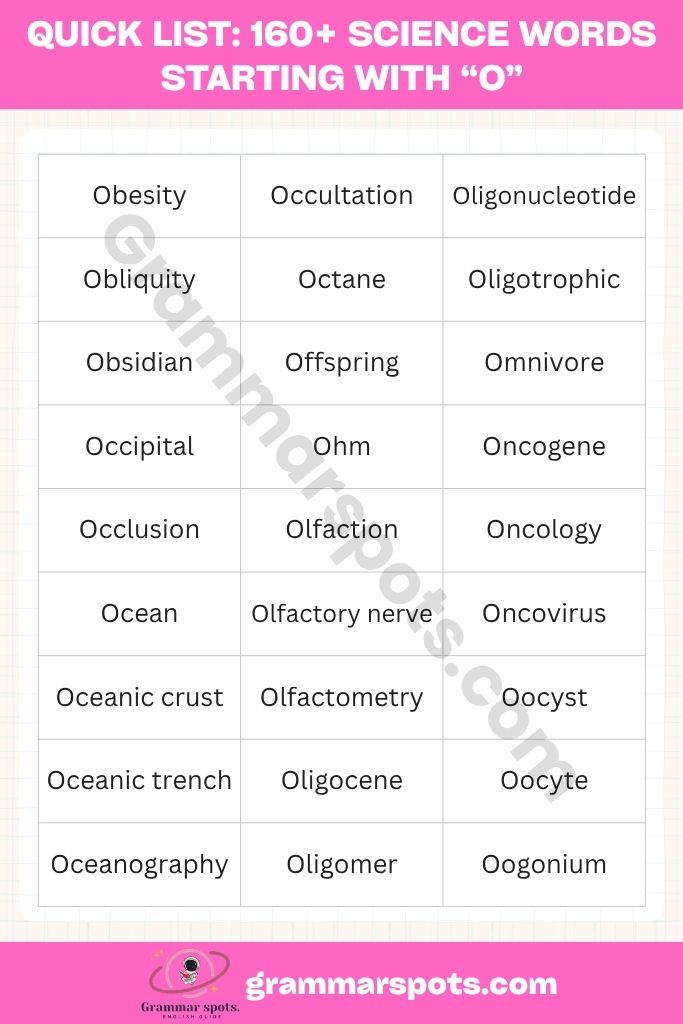
- Obesity
- Object
- Obliquity
- Observation
- Obsidian
- Occipital
- Occlusion
- Ocean
- Oceanic crust
- Oceanic trench
- Oceanography
- Occultation
- Octane
- Offspring
- Ohm
- Olfaction
- Olfactory nerve
- Olfactometry
- Oligocene
- Oligomer
- Oligonucleotide
- Oligotrophic
- Omnivore
- Oncogene
- Oncology
- Oncovirus
- Oocyst
- Oocyte
- Oogonium
- Oogenesis
- Oort Cloud
- Open cluster
- Open-source science
- Opaque
- Operant conditioning
- Operon
- Ophthalmology
- Opposition
- Opsonization
- Optics
- Optical coherence tomography
- Optical fiber
- Optical illusion
- Optical tweezers
Physics Science Words That Start With O
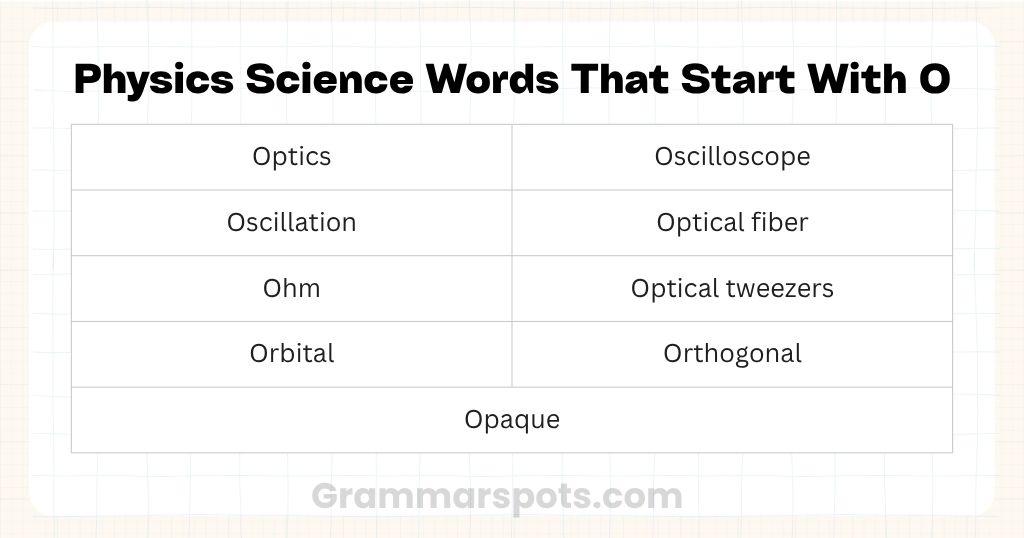
Optics
Study of how light travels, bends, and reflects. Every camera, lens, and telescope is built on optics principles.
Oscillation
Any motion repeating in a regular cycle. Pendulums, sound waves, and radio signals all oscillate. The rate of oscillation is called frequency.
Ohm
Unit of electrical resistance. Named after Georg Ohm, who proved that voltage, current, and resistance follow a fixed relationship: V = IR.
Orbital
A region around an atom’s nucleus where an electron is most likely found. Not a fixed path — more like a probability zone.
Opaque
Material that blocks light completely. Critical in optics, photography, and engineering design.
Oscilloscope
A lab instrument that shows electrical signals as visible wave patterns on a screen. Engineers use it to diagnose circuits.
Optical fiber
A thin glass strand carrying light signals across long distances. Most modern internet infrastructure runs on this.
Optical tweezers
A focused laser beam used to hold or move microscopic objects like individual cells. The 2018 Nobel Prize in Physics was awarded for this invention.
Orthogonal
Describes two things at exactly 90 degrees to each other. Widely used in physics, mathematics, and engineering design.
Chemistry Science Words That Start With O
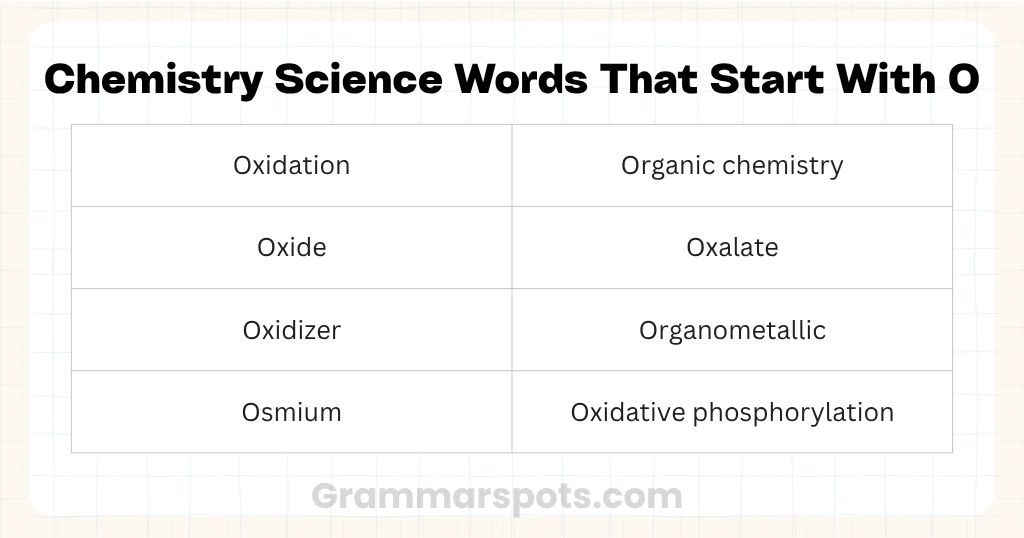
Oxidation
A reaction where a substance loses electrons or gains oxygen. Rust, browning fruit, and fire are all oxidation just at very different speeds.
Oxide
A compound formed when oxygen bonds with another element. Water is a hydrogen oxide. Rust is an iron oxide.
Oxidizer
A chemical that supplies oxygen to a reaction. Rocket fuel requires liquid oxygen as an oxidizer since there’s no air in space.
Osmium
The densest naturally occurring element. Silvery-blue in color, used in fountain pen tips and electrical contacts for extreme durability.
Organic chemistry
The branch studying carbon-containing compounds. Proteins, fats, DNA — all fall under organic chemistry.
Oxalate
A natural compound in plants like spinach and rhubarb. High levels in the human body can contribute to kidney stones.
Organometallic
Compounds containing a carbon-to-metal bond. Widely used in industrial catalysts and pharmaceutical manufacturing.
Oxidative phosphorylation
The process cells use to produce ATP energy by moving electrons through a protein chain inside mitochondria.
Oxalic acid
A simple organic acid found naturally in many vegetables. Used industrially for cleaning and bleaching.
Oleic acid
A monounsaturated fatty acid found in olive oil and many animal fats. Important in nutrition and industrial chemistry.
Organochloride
An organic compound containing chlorine. Many pesticides belong to this group. Several are persistent environmental pollutants.
Organophosphate
Chemicals used in pesticides that block nerve enzyme function. Highly toxic at elevated concentrations.
Oxidoreductase
An enzyme that drives oxidation-reduction reactions inside living cells. Central to metabolism.
Oxalate
Salt or ester of oxalic acid. Found in kidney stones and many plant defense systems.
Biology Science Words That Start With O
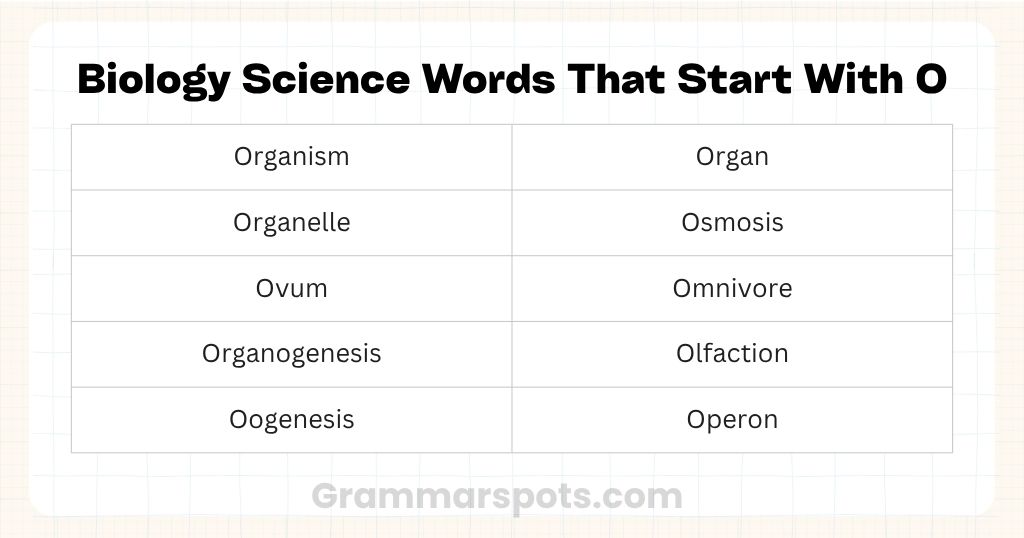
Organism
Any living thing that grows, responds to its environment, reproduces, and processes energy.
Organ
A group of tissues working together for one purpose. Your skin is the largest organ you have.
Organelle
A tiny structure inside a cell with a specific job:
- Mitochondria — produces energy
- Nucleus — stores DNA
- Ribosome — builds proteins
- Endoplasmic reticulum — transports materials
Osmosis Water moving through a semi-permeable membrane from low to high solute
. How plant roots absorb water from soil. Why drinking seawater dehydrates you.
Ovum
The female egg cell — the largest cell in the human body. Fertilization by a sperm cell begins embryo development.
Omnivore
An animal eating both plants and other animals. Humans, bears, and raccoons are omnivores.
Organogenesis
The embryonic stage when organs begin forming from basic cell layers. Errors here can cause birth defects.
Olfaction
The sense of smell. The olfactory system connects directly to memory and emotion centers in the brain.
Oogenesis
The production and maturation of female egg cells. Begins before birth and continues through puberty.
Operon
A group of bacterial genes controlled as one unit. The lac operon is the standard textbook example of gene regulation.
Oocyte
An immature egg cell in the process of development. Primary oocytes begin forming in fetal ovaries.
Oogonium
The earliest-stage female germ cell, present in embryonic development before becoming an oocyte.
Offspring
The young produced by any organism through reproduction.
Oviparity
Reproduction by laying eggs that develop outside the mother’s body. Birds, reptiles, and most fish reproduce this way.
Ovoviviparity
A mix of egg-laying and live birth — eggs hatch inside the mother’s body. Some sharks and snakes do this.
Ovulation
The release of a mature egg from the ovary. Marks the most fertile point in the female reproductive cycle.
Ovule
A structure in seed plants that develops into a seed after fertilization.
Opsonization
The process where antibodies coat a pathogen so immune cells can recognize and destroy it more easily.
Organoid
A tiny lab-grown organ-like structure made from stem cells. Used to study diseases and test drugs without human patients.
Organotroph
An organism that uses organic compounds as its energy source. Most animals and fungi are organotrophs.
Oocyst
A hardy, thick-walled stage in the life cycle of certain parasites like Toxoplasma and Plasmodium. Responsible for disease transmission.
Operant conditioning
A learning method where behavior is shaped by rewards and punishments. Studied by B.F. Skinner.
Earth Science Words That Start With O
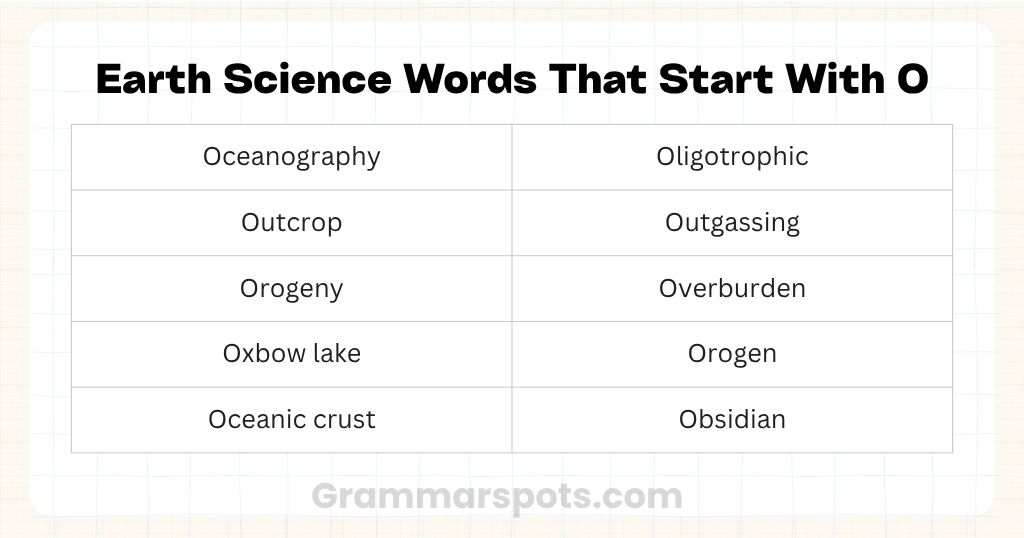
Oceanography
The scientific study of Earth’s oceans chemistry, currents, ecosystems, and seafloor geology.
Outcrop
A rock formation exposed at Earth’s surface. Geologists read outcrops like history books of the planet.
Orogeny
Mountain-building caused by tectonic plate collisions over millions of years. The Himalayas are an active example.
Oxbow lake
A curved lake formed when a river bend gets cut off from the main channel. Shaped like the U-collar once placed on oxen.
Oceanic crust
The Earth’s crust beneath ocean floors. Thinner and denser than continental crust — about 5–10 km thick.
Oligotrophic
A water body with very low nutrient levels. Usually very clear. Low algae growth. Lakes in this state are often visually striking.
Outgassing
The release of gases trapped inside rocks or volcanic material. Plays a role in how planets form their atmospheres.
Overburden
Rock, soil, or material sitting above a mineral deposit that must be removed before mining.
Orogen
A belt of deformed rock created during a mountain-building event. The Appalachian orogen stretches across the eastern U.S.
Obsidian
A naturally occurring volcanic glass formed when lava cools extremely fast. Black, glassy, and very sharp when fractured.
Oceanic trench
A deep, narrow depression in the ocean floor formed at subduction zones. The Mariana Trench is the deepest point on Earth.
Oligocene
A geological epoch lasting from about 34 to 23 million years ago. Characterized by the spread of grasslands and early mammal diversification.
Space & Astronomy Science Words That Start With O
Orbit
The curved path one object travels around another due to gravity. Earth orbits the Sun. The Moon orbits Earth.
Orbital period
The time needed to complete one full orbit. Earth’s is 365.25 days — which creates the need for leap years.
Oort Cloud
A vast, spherical shell of icy bodies at the far edge of our solar system. The source of long-period comets.
Opposition
When Earth sits directly between the Sun and another planet. That planet appears brightest and closest from Earth.
Obliquity
The tilt of a planet’s axis relative to its orbit. Earth’s 23.5-degree tilt creates the four seasons.
Occultation
When one celestial body passes in front of another and temporarily hides it from view.
Open cluster
A loose group of stars born from the same gas cloud. The Pleiades is the most recognized open cluster in the night sky.
Outer planet
Any planet beyond the asteroid belt — Jupiter, Saturn, Uranus, Neptune. All are massive compared to inner rocky planets.
Orbit decay
The gradual lowering of a satellite’s orbit due to atmospheric drag. Without correction burns, satellites eventually re-enter and burn up.
Outgassing (space context)
The release of trapped gases from a comet or planetary body when warmed by solar radiation. Creates the visible tail of a comet.
Medical & Health Science Words That Start With O
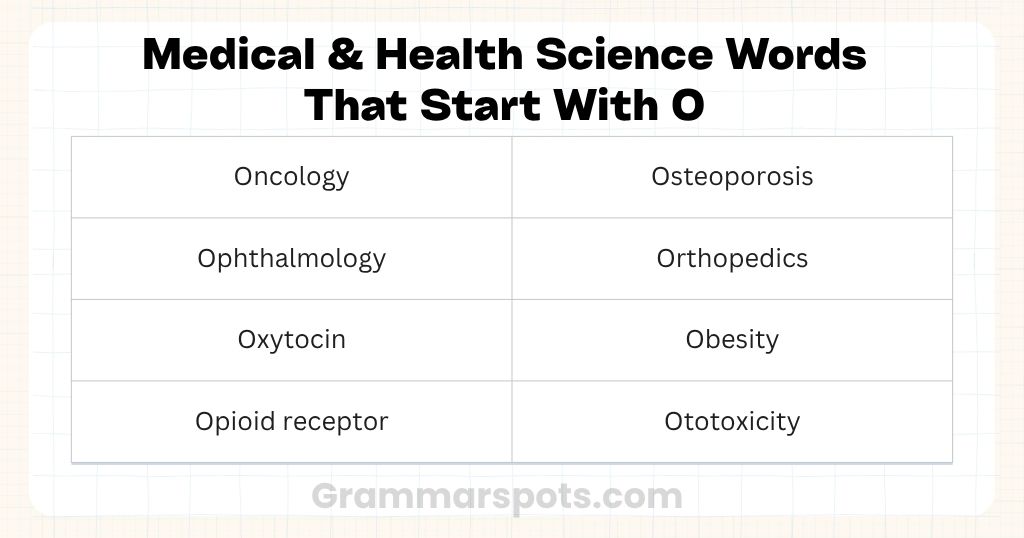
Oncology
The medical field studying, diagnosing, and treating cancer.
Osteoporosis
A condition where bones lose density and become brittle. Common in older adults. Prevented partly through calcium and weight-bearing exercise.
Ophthalmology
The medical specialty covering eyes diseases, vision problems, and surgical treatment.
Orthopedics
Medicine focused on bones, joints, muscles, and ligaments. Covers fractures, joint replacements, and sports injuries.
Oxytocin
A brain hormone tied to bonding, childbirth contractions, and social connection. Released during physical touch and interaction.
Obesity
A medical condition defined by excess body fat that raises health risks. Measured clinically using BMI, though BMI has known limitations.
Opioid receptor
Protein sites in the brain responding to opioid compounds — natural (endorphins) or synthetic (pain medications). Regulate pain and reward.
Ototoxicity
Inner ear damage caused by certain drugs or chemicals. Can result in hearing loss or balance problems.
Oxidative stress
An imbalance between harmful free radicals and the body’s antioxidant defenses. Linked to aging, heart disease, and cancer.
Oncogene
A gene that can trigger cancer when mutated or over-expressed. Under normal conditions it helps regulate cell growth.
Oncovirus
A virus capable of causing cancer. Hepatitis B and HPV are well-known examples.
Oncoprotein
A protein produced by an oncogene that promotes uncontrolled cell division.
Osmoreceptor
Brain cells detecting changes in blood salt concentration. They trigger thirst and hormone release to maintain fluid balance.
Occipital
Relating to the back of the skull. The occipital lobe of the brain processes visual information.
Technology & Applied Science Words That Start With O
Optical coherence tomography
A medical imaging method using light waves to produce detailed cross-section images of the retina. Standard in modern eye exams.
Optogenetics
A technique using light to control specific neurons in the brain. Scientists can switch individual brain cells on and off — valuable in neurological research.
Organ-on-chip
A small device lined with living human cells that mimics a real organ’s function. Used to test drugs without animal or human subjects.
Open-source science
A model where research data, methods, and findings are freely shared publicly. Speeds up global scientific progress.
Oscillometric
Relating to blood pressure measurement by detecting pressure oscillations in an inflated cuff. in most automatic blood pressure monitors.
Optical fiber
Thin glass or plastic strands transmitting data as light pulses. The backbone of modern internet infrastructure.
Oscilloscope
An instrument displaying electrical signals as visible waveforms. Standard in electronics labs and engineering diagnostics.
Easy Science Words That Start With O (Beginners & Kids)
| Word | Simple Meaning |
| Oxygen | The gas you breathe — 21% of Earth’s air |
| Orbit | The path a planet or moon takes around another object |
| Organism | Any living thing — plant, animal, or microbe |
| Ocean | A massive saltwater body covering most of Earth |
| Omnivore | An animal that eats both plants and other animals |
| Opaque | Something you cannot see through |
| Observation | Watching something carefully to learn from it |
| Organ | A body part with one main job — heart, lungs, stomach |
| Ozone | A gas layer in the sky that blocks harmful sun rays |
| Offspring | The young produced by any living thing |
Advanced Science Words That Start With O
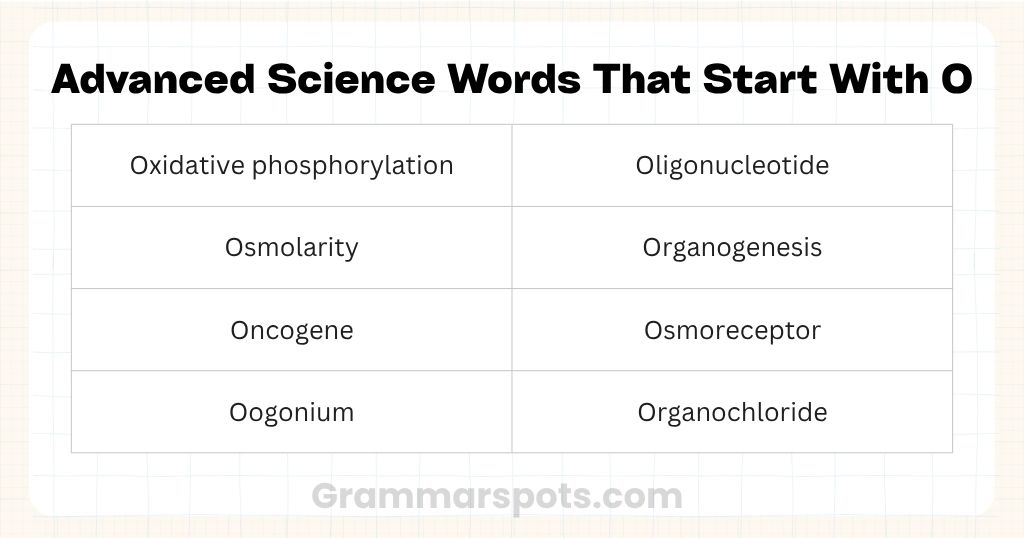
| Word | What It Means |
| Oxidative phosphorylation | ATP production via electron transport in mitochondria |
| Oligonucleotide | Short DNA or RNA sequence used in genetic research |
| Osmolarity | Total dissolved particle concentration in a solution |
| Organogenesis | Embryonic organ formation from basic cell layers |
| Oncogene | A gene that drives cancer when mutated |
| Osmoreceptor | Brain cell detecting blood salt concentration changes |
| Oogonium | Earliest-stage female germ cell in embryonic development |
| Organochloride | Chlorine-containing organic compound, often a pollutant |
| Operant conditioning | Behavior shaping through rewards and punishments |
| Orbital hybridization | Mixing of atomic orbitals to form new bonding orbitals |
| Oocyst | Parasite’s protective transmission stage |
| Opsonization | Antibody coating of pathogens for immune destruction |
Common Confusions: “O” Words People Mix Up
Osmosis vs. Diffusion
Diffusion = any substance spreading from high to low concentration. Osmosis = only water, only through a semi-permeable membrane. Osmosis is a specific type of diffusion.
Orbit vs. Rotation
Orbit = one object moving around another. Rotation = an object spinning on its own axis. Earth does both simultaneously one takes 365 days, the other takes 24 hours.
Organ vs. Organelle
Organ = a structure in a whole body (heart, liver). Organelle = a structure inside a single cell (mitochondria, nucleus). Same root word, completely different scale.
Oxidation vs. Combustion
Combustion is fast, visible oxidation with flames and heat. Rusting iron is slow oxidation with no flames. All combustion is oxidation not all oxidation is combustion.
Ozone vs. Oxygen
Oxygen (O₂) = two atoms, what you breathe. Ozone (O₃) = three atoms, mildly toxic at ground level but protective in the upper atmosphere.
Oncology vs. Oncogene
Oncology = the medical field treating cancer. Oncogene = a specific gene molecule linked to cancer. One is a profession, one is a biological structure.
Where You Actually Use These Words
In class and on exams:
- Osmosis, organelle, oxidation — biology and chemistry tests, 6th grade through AP level
At the doctor:
- Oncology, ophthalmology, osteoporosis, oxidative stress — diagnoses, checkups, treatment plans
Looking at the night sky:
- Orbit, Oort Cloud, obliquity, opposition, occultation — understanding how space objects move
In nature:
- Osmosis (tree roots drinking water), omnivore (what a bear eats), organism (everything alive around you)
In science news:
- Optogenetics (brain research), organoids (drug testing), open-source science (global collaboration)
FAQs About Science Words That Start With O
How many science words start with O?
This article covers 160+. Across all scientific disciplines, the total reaches into the thousands.
Which O words appear most in school?
Osmosis, oxygen, organism, organelle, orbit, oxidation, and organ show up most in grades 6–12.
Are O science words hard to learn?
Knowing root words helps a lot:
- osteo = bone
- onco = tumor or mass
- omni = all
- optic = sight
- osmo = push or impulse
What’s the most complex O science word?
Oxidative phosphorylation and orbital hybridization are both multi-step concepts that take time to fully understand.
Which subject has the most O words?
Biology leads, followed closely by chemistry. Earth science and astronomy both have strong representation too.
Conclusion
This article walked through 160+ science words starting with O sorted by subject, explained with real context, and organized by difficulty. The alphabetical list gives you a fast reference. The subject sections give you depth. The confusion section saves you from the most common mix-ups, and the FAQ covers what students actually ask.
Science vocabulary works best when words connect to meaning, not just memorized definitions. Osmosis sticks better when you picture a plant root pulling water from damp soil. Orbit decay makes sense when you imagine a satellite slowly spiraling toward Earth’s atmosphere.
Start with the words from your subject. Learn the ones that keep appearing. The rest will follow.

I’m Hazel, and I studied BSC English at GCUF. I focus on explaining word meanings in simple, clear language that anyone can understand. My goal is helping readers grasp everyday English, confusing terms, and slang used in real conversations and social media. I believe language learning works best when definitions connect to actual life situations. Through careful research and straightforward explanations, I make vocabulary accessible for students, learners, and anyone curious about how English really works in daily use.