

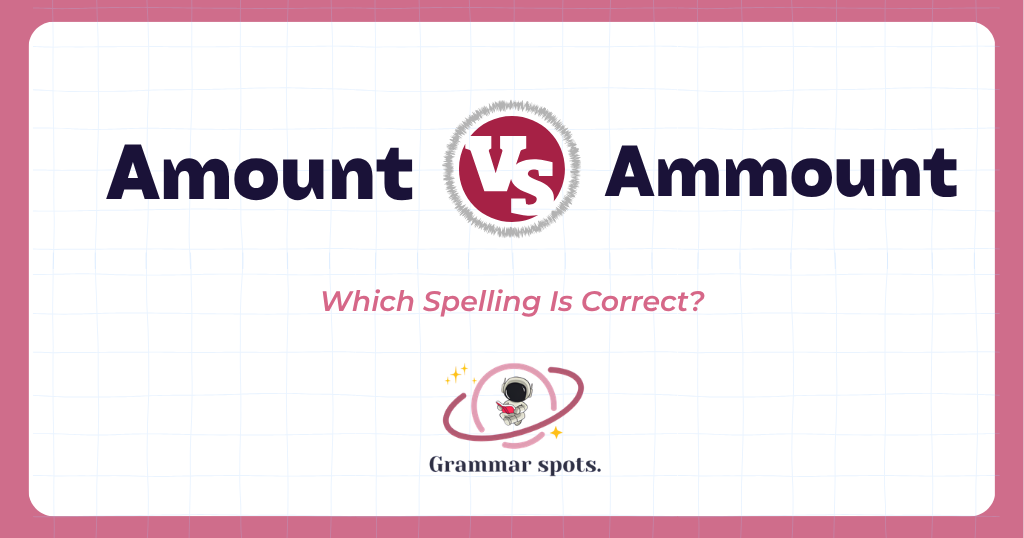
The correct spelling is amount, with one m. Ammount is a misspelling, and Merriam-Webster, Cambridge, Oxford, and Collins all list only the single-m form.
If you’ve been switching between amount or ammount in emails and invoices, keep the one with a single m. The harder question usually comes next: when to say amount and when to say number.
One M, and How Rare the Typo Really is
In books published in 2022, amount appears about 48,000 times for every ammount, according to Google Books Ngram data. In 1985, the gap was closer to 15,600 to 1. So the typo shows up in print about a third as often as it did then.
It still slips into careful work. In 2010, a Linux kernel patch cleaned “ammount” out of code comments and error messages across the project.
Amount for What You Measure, Number for What You Count
Use amount with nouns for stuff you measure rather than count one by one. Grammar books call these uncountable or mass nouns: overtime, storage, saline, coffee.
Use number with count nouns, which are words for things you can count and make plural: passengers, sprints, browser tabs.
- The app limits the amount of storage on free accounts.
- The nurse checked the amount of saline left in the bag.
- A surprising number of passengers missed the connecting flight.
- The coach tracked the number of sprints each player ran.
If “how much” fits the noun, use amount. If “how many” fits, use number. The same split shows up in less/fewer and much/many.
The slip editors flag most often is “amount of people.” In formal writing, it’s “number of people.”
When a Plural Noun Takes “Amount” Anyway
The measure-or-count rule handles most sentences. A few plural nouns sit right on the line, and the sources split on them.
| Case | Example | What sources say | Safer choice |
| A big heap of small items | the amount of rice grains in the sack | Merriam-Webster says amount with count nouns usually appears when the items are pictured as one mass. | the amount of rice, or the number of grains |
| Money in plural units | the amount of dollars raised | Merriam-Webster and Random House both name money as a common exception. | the amount of money raised, or the dollar amount |
| Units of measure | the amount of square feet in the office | Arizona State University’s brand guide calls this correct. The strict count rule says number. | the office’s floor space, or how many square feet |
| People in a small group | the amount of guests at the party | Style guides mark this incorrect. | the number of guests at the party |
| People at huge scale | the amount of commuters in Tokyo | Grammarist notes it sounds less wrong at large scale, but many readers still object. | the number of commuters in Tokyo |
| Chemistry | the amount of substance in a sample | An official science term that measures a count of particles. | Keep it as written. |
The heap case has a long paper trail. Merriam-Webster quotes a New Yorker line: “glad to furnish any amount of black pebbles” (Merriam-Webster). Nobody pictures those pebbles one at a time.
The units case is the one most guides skip. ASU’s guide treats square feet as a single measured space, not a pile of separate squares. A stricter editor would still change it.
How to Decide for Your Own Sentence
- Formal writing, tests, or anything an editor will see: use number with every plural noun. Garner’s Modern American Usage, The Chicago Manual of Style, and Hacker’s A Writer’s Reference all state the rule with no exceptions, per Quick and Dirty Tips.
- Money: swap the plural for money, funds, or the dollar amount. Both camps accept those.
- Measurements: reach for a mass word like space, area, or distance, or switch to “how many.”
- Casual speech: you’ll hear amount with plurals often. Merriam-Webster’s usage dictionary argues the critics give no solid reason against it (Grammarphobia’s summary).
- Lab reports: keep “amount of substance.” It’s the correct technical term.
Dictionaries and Style Guides Split on “Amount Of” With Plurals
Here’s where each major source lands on phrases like “amount of people.”
| Source | Position |
| Collins | Avoid a plural noun after “amount of.” |
| Merriam-Webster | Often criticized; usually shows up with collections or money. |
| Merriam-Webster’s Dictionary of English Usage | The critics offer no convincing reason. |
| Oxford Learner’s | Sometimes used, mostly in informal speech; some people call it wrong. |
| Random House (Dictionary.com) | Objected to, but found in both speech and writing. |
| Garner’s, Chicago, Hacker | Wrong, with no exceptions. |
| Fowler’s | Notes the exception but dislikes it. |
| Episcopal Church style guide | Lists “the amount of people” as incorrect. |
The dictionaries don’t even agree on how old the word is.
| Source | Verb first recorded | Noun first recorded |
| Merriam-Webster | 14th century | 15th century |
| Oxford Learner’s | Middle English | Early 18th century |
| Collins | 13th century | Not given separately |
Merriam-Webster explains the gap. The medieval noun is barely recorded, and the modern noun probably grew straight from the verb. A dictionary that dates the modern noun lands centuries later.
Amount in Chemistry, Banking, and Newsrooms
Chemistry. “Amount of substance” is one of the seven base quantities in the SI, measured in moles. The IUPAC defines it as a measure of the number of specified particles. That wording took effect on May 20, 2019.
So in a lab report, amount describes a count. “The sample’s amount of substance is 2 moles” is standard science English.
Banking. On a paper check, the written line is called the legal amount. The box of digits is the courtesy amount. When the two disagree, the words win under UCC § 3-114.
That makes this sentence more than a spelling tip: write the amount in words on the long line of the check, and check it twice.
Newsrooms and health writing. Journalism style guides flag “amount of lawyers” and similar phrases. Correct mass-noun use looks like this line from STAT, about surgeons who “take a small amount of lymph node tissue” (STAT, Oct. 2026).
Other Slips Around Amount and Number
- “Fewer number” repeats itself. Fewer already means a smaller number. Write “fewer late assignments” or “a smaller number of late assignments.”
- It’s “an amount,” never “a amount.” Amount starts with a vowel sound, so it takes an.
- Match the verb to the right word. “The amount of overtime was high” is singular. “A number of nurses were on call” is plural.
- “The number” takes a singular verb. “The number of seats on the shuttle is capped at 12.”
Where “Amount” Came From
Amount comes from Anglo-French amunter, “to rise.” That verb grew from a mont, meaning “upward” or literally “to the mountain,” from Latin ad montem. The mont part has one m, and so does every standard spelling since.
The early English verb meant to go up, then to add up to a total. The noun followed later.
Pairing amount with plural nouns isn’t new either. Samuel Johnson wrote “the amount of moments” in 1751, according to The New European, which cites the Oxford English Dictionary. Writers have used the pattern for more than 270 years.
Is “Amount” Itself Countable?
Yes. The word amount is countable even when it describes uncountable stuff. You can have one amount, two amounts, or different amounts of coffee.
- Please confirm the amount due before you sign.
- The landlord asked for the full amount in one payment.
- The refund amount showed up two days late.
- No amount of coffee fixed that Monday.
Cambridge labels the noun countable only. Oxford Learner’s labels it both countable and uncountable. Either way, “amounts” is a normal plural.
Before You Hit Send
Spell it with one m, and save amount for things you measure, like money, storage, or overtime. The moment the noun after “of” is plural, switch to number in anything formal. If the plural feels like one big heap, rewrite it with a mass word and the problem goes away.
Discover More Grammar Guides:

I’m Hazel, and I studied BSC English at GCUF. I focus on explaining word meanings in simple, clear language that anyone can understand. My goal is helping readers grasp everyday English, confusing terms, and slang used in real conversations and social media. I believe language learning works best when definitions connect to actual life situations. Through careful research and straightforward explanations, I make vocabulary accessible for students, learners, and anyone curious about how English really works in daily use.