

GP usually means “good point” in texting and online chats. It’s a quick way to agree with someone or show you think what they said makes sense.
You See “GP” and Have No Clue What It Means
You’re scrolling through comments and see “GP” under someone’s argument. Or maybe your friend drops it in the group chat after you explain something. It’s short, vague, and honestly? It could mean a bunch of things.
That’s the annoying part about two-letter shortcuts. They don’t come with instructions. One person’s using it for “good point,” another’s talking about their doctor (general practitioner), and someone on Wattpad’s probably using it for something way different. You’re left guessing based on vibes.
The trick is reading the room—or the screen, really. Context tells you everything.
The Real Deal Behind “GP” When People Actually Use It
When someone types “GP” after you make an argument, they’re basically nodding through the keyboard. It’s the text version of “yeah, you’re right” without typing out a whole sentence.
People use it because it’s fast and feels less formal than “I agree with you” or “that’s a valid point.” It keeps the conversation moving. You made your case, they acknowledged it, done.
There’s also something neutral about it. It doesn’t sound overly excited or dramatic. It’s similar to how people use “NM” in casual texts quick, low-effort, and gets the job done without overthinking it. You’re not screaming “OMG YOU’RE SO RIGHT!!!” You’re just saying “yeah, that tracks.”
In gaming, GP can mean something totally different like “good play” when someone pulls off a smart move. In medical texts or emails, it’s shorthand for a general practitioner (your family doctor). The letters stay the same, but the meaning shifts completely based on where you see it.
Where “GP” Shows Up in Your Daily Texting Life
You’ll see GP pop up when people are debating something online. Someone posts their take, another person responds with “GP” in the comments. That’s it. Clean, simple, conversation keeps rolling.
In group chats, it shows up when someone drops a fact or makes a suggestion that actually makes sense. Like if your friend says “we should leave early to avoid traffic” and someone replies “gp,” they’re backing the idea without writing a paragraph.
Gamers throw out “gp” after clutch moments—when a teammate lands the perfect shot or makes a risky call that works. It’s basically saying “nice job, that was smart.”
Sometimes it’s just a lazy acknowledgment. You send a long explanation about why you can’t make plans, and they hit you with “gp.” They’re not arguing, not asking follow-ups, just accepting what you said.
More Post: What Does “ND” Mean in Text? It’s Not Always What You Think
Why “GP” Doesn’t Always Mean What You Think
Here’s the thing: “GP” sounds pretty neutral most of the time, but tone can flip it.
If you’re mid-argument with someone and they respond with just “GP,” it might feel dismissive. Like they’re ending the conversation because they don’t want to keep going—not because they actually agree. Pay attention to what came before. If things were tense, “GP” can sound like “whatever, moving on.”
With friends, it’s usually chill. You’re not overthinking it. But if someone you barely know hits you with “GP” after you share something personal or serious, it can feel cold. It’s too short for the moment.
Warning: Don’t use GP when someone’s venting about something that matters to them. If your friend just told you about a bad day or a real problem, responding with “gp” looks like you’re not paying attention. Save it for debates, casual chats, or light topics.
Sarcasm’s another layer. Someone could type “GP” after you say something they think is ridiculous. Without tone of voice, you can’t always tell if they mean it or they’re mocking you. Check their usual texting style. If they normally joke around, they might be teasing.
Times When “GP” Makes You Look Clueless (or Rude)
Don’t use GP at work unless you’re texting a coworker you’re actually friends with. In professional emails or Slack messages with managers or clients, it looks too casual. Stick with “That’s a good point” or “I agree.”
Skip it during serious conversations. If someone’s talking about health issues, family problems, or anything emotionally heavy, “GP” feels lazy and uncaring. They need real words, not shortcuts.
Avoid it with people who don’t text like you. Older relatives, formal contacts, or anyone who writes in complete sentences probably won’t get it—or they’ll think you’re being rude.
Don’t overuse it in one conversation. If you keep replying “gp” to everything someone says, it stops meaning anything. It starts looking like you’re not really reading their messages.
Public comments on sensitive posts? Nope. If someone’s sharing something meaningful on Instagram or Twitter, “GP” can seem flippant. Read the vibe first.
Read Also: OTT Meaning: What It Really Means in Texts, Streaming, and Everyday Life
Say “GP” Better: Other Ways to Get Your Point Across
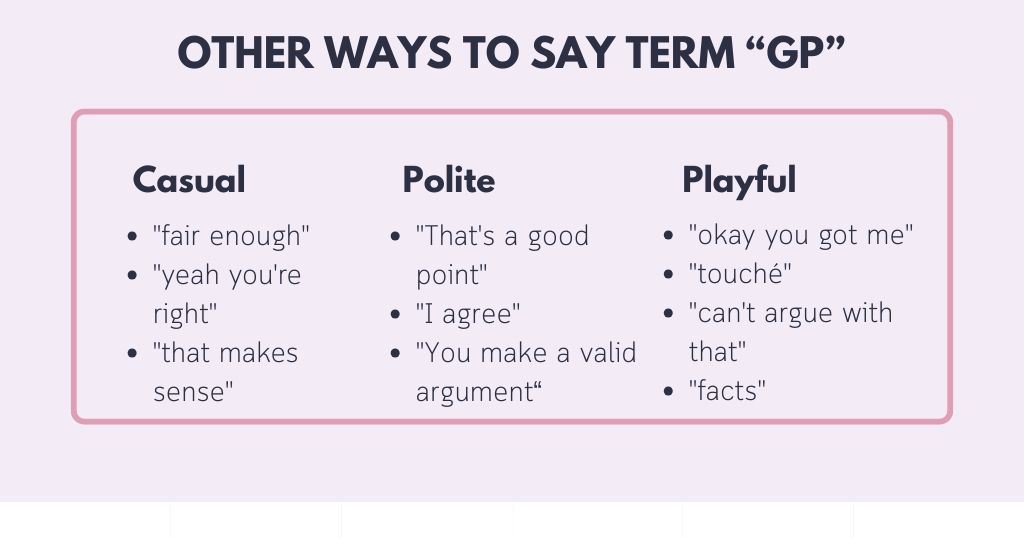
Casual/Friendly:
- “true”
- “fair enough”
- “yeah you’re right”
- “that makes sense”
Polite/Professional:
- “That’s a good point”
- “I agree”
- “You make a valid argument”
- “I see what you mean”
Playful/Joking:
- “okay you got me”
- “touché”
- “can’t argue with that”
- “facts”
“GP” in Example Messages That Actually Happen
Online debate: “Raising minimum wage helps local economies.” “GP, more spending power means more business.”
Group chat planning: “We should order pizza instead of cooking.” “gp, nobody wants to deal with dishes.”
Gaming: teammate clutches the round “gp dude, that flank was perfect”
Friend giving advice: “Maybe just text her first instead of waiting.” “gp, I’ve been overthinking it.”
Comment section: “The movie’s pacing was off in the second act.” “GP, it dragged for like 20 minutes.”
Quick agreement: “The 7pm showing’s better, parking’s easier.” “gp see you then”
Read Also: OT Meaning in Chat: The Real Guide Behind This Confusing Slang
Different Screens, Different Meanings for “GP”
On Instagram and Twitter, GP usually means “good point” in comment sections—especially under posts where people are arguing or sharing opinions.
Snapchat users might say GP for “group” like “add me to the gp” when talking about group chats. It’s less common but it happens.
TikTok comments lean toward “good point” when people are responding to video takes or discussions in the caption.
Gamers across platforms (Discord, in-game chat, Twitch) often use GP for “good play.” It’s quicker than typing congratulations when things are moving fast.
Medical contexts—texts from doctors’ offices, appointment reminders—will use GP for general practitioner. If you’re booking a checkup, that’s what it means.
Younger people tend to assume slang meanings first. Older folks or people outside internet culture might default to professional definitions (doctor, business terms).
Why People Get “GP” Wrong (And What Actually Happened)
People sometimes think GP is sarcastic when it’s not. If you’re used to everyone being ironic online, a plain “GP” might feel suspicious. But most of the time, it’s genuine.
Others read it as lazy or uninterested. They shared something they care about, got “gp” back, and felt brushed off. That’s why context matters—match your response to the conversation’s energy.
Some folks don’t know GP has multiple meanings, so they get confused when it pops up in different settings. Seeing “I saw my GP today” in a medical forum vs “GP bro” in a game chat throws them off.
There’s also the Wattpad thing. In fanfiction communities, GP can mean something completely unrelated (and not appropriate for all audiences). If you stumble into that corner of the internet, don’t assume it’s about agreeing with someone.
Overuse kills the meaning. If someone responds “gp” to literally everything, it stops feeling like actual agreement and starts feeling automated.
Read More: What Does NP Mean in Text? The Real Meaning (And When It Feels Wrong)
Your Burning Questions About “GP”, Answered
Is GP rude?
Not usually, but it depends. In casual chats with friends, it’s fine. In serious or emotional conversations, it can seem dismissive.
Can GP be sarcastic?
Yeah. If someone disagrees with you but doesn’t want to argue, they might drop a sarcastic “GP” to end it. Tone’s hard to read in text, so watch for other clues.
Does GP mean the same thing everywhere?
Nope. Gaming communities use it for “good play,” medical people use it for general practitioner, and texters use it for “good point.” The platform and topic tell you which one.
Should I use GP with people I don’t know well?
Probably not. Stick with clearer responses until you know how they text. GP works best with people who share your texting style.
What if someone sends me GP and I don’t know what they mean?
Just ask. “Wait, what do you mean by GP?” It’s better than guessing wrong and replying weird.
Is it okay to use GP at school or work?
Only in super casual settings, like texting a classmate or work friend. Don’t put it in emails to teachers or bosses.
Final Thoughts on Cracking the “GP” Code
GP’s one of those shortcuts that works great when everyone’s on the same page. It speeds things up, keeps conversations light, and gets your point across without extra typing. But like most slang, it’s not one-size-fits-all. Know who you’re talking to, read the vibe, and don’t lean on it when the moment needs actual words.

I’m Hazel, and I studied BSC English at GCUF. I focus on explaining word meanings in simple, clear language that anyone can understand. My goal is helping readers grasp everyday English, confusing terms, and slang used in real conversations and social media. I believe language learning works best when definitions connect to actual life situations. Through careful research and straightforward explanations, I make vocabulary accessible for students, learners, and anyone curious about how English really works in daily use.