

Math vocabulary starting with I covers a wide range from basic arithmetic to advanced calculus. Whether you’re a student, teacher, or parent, this guide gives you every important math term beginning with I, with clear definitions, examples, and real uses.
No fluff. No repeated content. Just accurate, useful math vocabulary.
Quick List: 40+ Math Words That Start With I
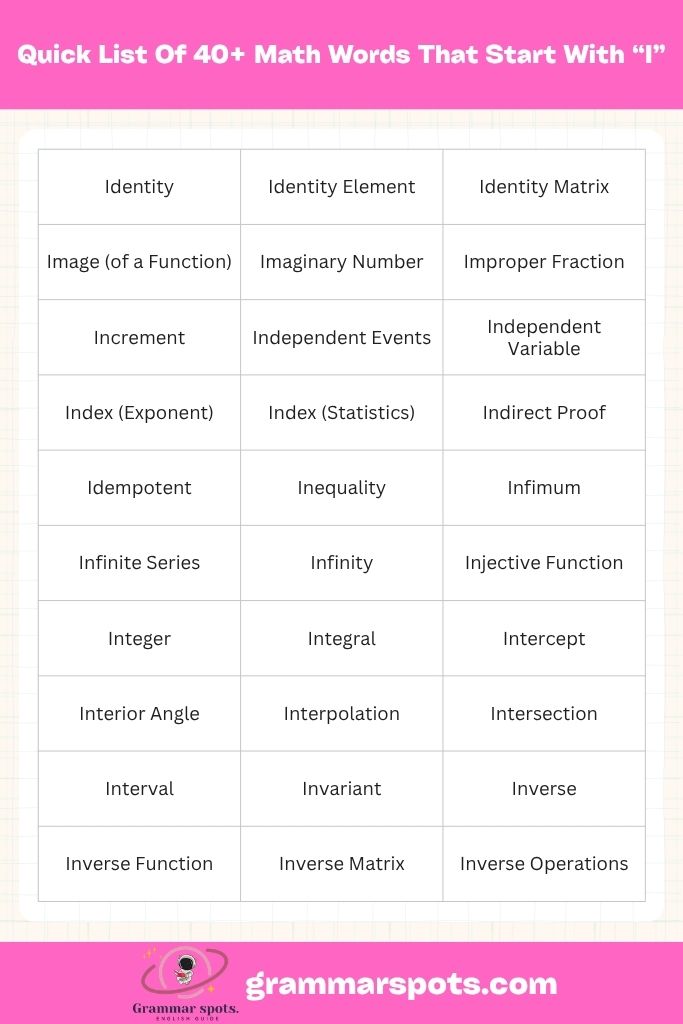
- Identity
- Identity Element
- Identity Matrix
- Image (of a Function)
- Imaginary Number
- Improper Fraction
- Increment
- Independent Events
- Independent Variable
- Index (Exponent)
- Index (Statistics)
- Indirect Proof
- Idempotent
- Inequality
- Infimum
- Infinite Series
- Infinity
- Injective Function
- Integer
- Integral
- Intercept
- Interior Angle
- Interpolation
- Intersection
- Interval
- Invariant
- Inverse
- Inverse Function
- Inverse Matrix
- Inverse Operations
- Inverse Proportion
- Irrational Number
- Isometry
- Isomorphism
- Isosceles Triangle
- Iteration
Common Math Words That Start With I
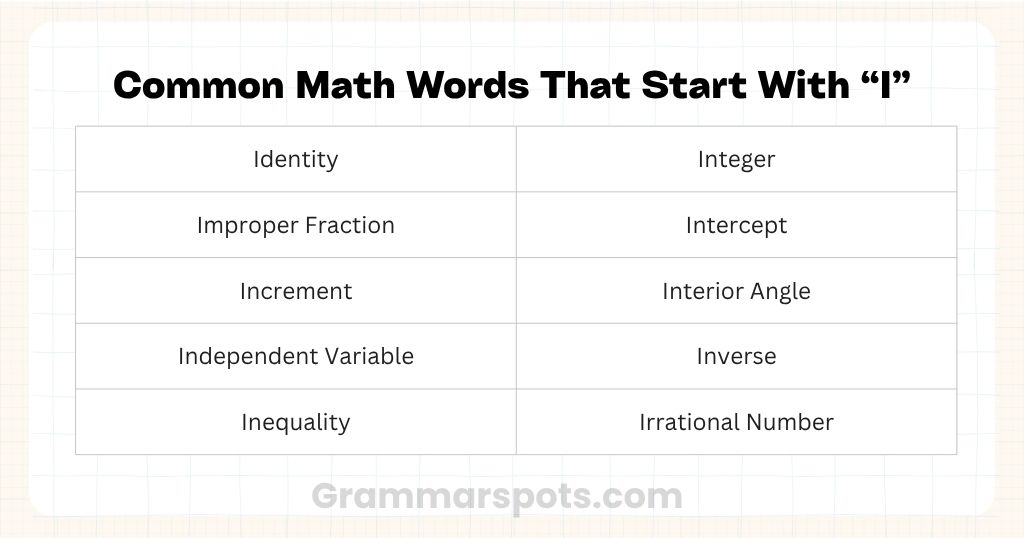
1. Identity
Example: a + 0 = a is always true, no matter what a is.
Why It Matters: Identifies equations that always hold, unlike conditional equations that work only for specific values.
2. Improper Fraction
Meaning: A fraction where the numerator is greater than or equal to the denominator.
Example: 9/4 is improper. It equals the mixed number 2¼.
Why It Matters: Essential for fraction arithmetic, especially when multiplying or adding mixed numbers.
3. Increment
Meaning: A small, positive increase in a variable.
Example: If x moves from 4 to 7, the increment is 3.
Why It Matters: Leads into the concept of derivatives in calculus measuring how functions respond to tiny changes.
4. Independent Variable
Meaning: The input variable in a function or experiment the one you control.
Example: In y = 5x − 2, x is the independent variable.
Why It Matters: Correctly identifying the independent variable determines how graphs are drawn and how relationships are interpreted.
5. Inequality
Meaning: A statement that two values are not equal, using <, >, ≤, or ≥.
Example: 2x + 1 > 9 means x > 4.
Why It Matters: Used in algebra, budgeting, engineering, and anywhere a range of values matters more than one exact answer.
6. Integer
Meaning: Any whole number positive, negative, or zero. No fractions or decimals.
Example: −5, 0, 3, and 100 are integers. 2.7 is not.
Why It Matters: Integers are the foundation of the number system and appear in every branch of mathematics.
7. Intercept
Meaning: The point where a line or curve crosses a coordinate axis.
Example: In y = 3x + 6, the y-intercept is 6. Setting y = 0 gives the x-intercept.
Why It Matters: Used to graph linear equations and interpret starting values in applied problems.
8. Interior Angle
Meaning: An angle formed inside a polygon between two adjacent sides.
Example: Each interior angle of an equilateral triangle is 60°.
Why It Matters: The formula (n − 2) × 180° gives the total interior angles of any polygon with n sides.
9. Intersection
Meaning:
- Sets: Elements that belong to both sets. Written A ∩ B.
- Geometry: The point or line where two shapes meet.
Example: If A = {1, 2, 3} and B = {2, 3, 4}, then A ∩ B = {2, 3}.
Why It Matters: Appears in set theory, probability, and geometry.
10. Interval
Meaning: A continuous set of numbers between two endpoints.
Example:
- [3, 8] includes 3 and 8 (closed interval)
- (3, 8) excludes 3 and 8 (open interval)
Why It Matters: Used to describe domains, ranges, and solution sets in algebra and calculus.
11. Inverse
Meaning: The opposite value or operation.
Example:
- Additive inverse of 6 is −6 (because 6 + (−6) = 0)
- Multiplicative inverse of 4 is ¼ (because 4 × ¼ = 1)
Why It Matters: Every equation-solving strategy relies on applying inverses to isolate variables.
12. Inverse Operations
Meaning: Operation pairs that undo each other.
Example:
- Addition ↔ Subtraction
- Multiplication ↔ Division
- Squaring ↔ Square root
Why It Matters: The core strategy behind solving any equation at any level.
13. Inverse Proportion
Meaning: A relationship where one quantity increases as the other decreases, and their product stays constant.
Example: 4 workers finish a job in 6 hours. 8 workers finish it in 3 hours. (4 × 6 = 8 × 3 = 24)
Why It Matters: Models real-world relationships like speed and time, or pressure and volume.
14. Irrational Number
Meaning: A number that cannot be written as a simple fraction. Its decimal never ends and never repeats.
Example: √2 ≈ 1.41421… and π ≈ 3.14159… are irrational.
Why It Matters: Irrational numbers appear in geometry (circle calculations, diagonals) and must be handled differently from fractions.
15. Isosceles Triangle
Meaning: A triangle with exactly two equal sides and two equal base angles.
Example: A triangle with sides 6 cm, 6 cm, and 9 cm is isosceles.
Why It Matters: Symmetric properties make it common in geometry proofs, architecture, and design.
16. Independent Events
Meaning: Two events are independent when the outcome of one does not affect the probability of the other.
Example: Flipping a coin and rolling a die are independent. The coin result doesn’t change the die probability.
Why It Matters: P(A and B) = P(A) × P(B) but only when events are truly independent.
17. Index (Exponent)
Meaning: The power to which a number is raised. Also called the exponent.
Example: In 2⁵ = 32, the index is 5.
Why It Matters: Index laws govern how to multiply, divide, and simplify powers throughout algebra.
18. Infinity (∞)
Meaning: A concept representing something without any bound or limit not a number itself.
Example: The sequence 1, 2, 3, 4… continues without end toward infinity.
Why It Matters: Appears in limits, asymptotes, and series. Infinity is a concept not a value you can calculate with directly.
19. Indirect Proof
Meaning: A proof method where you assume the opposite of what you want to prove, then show it leads to a contradiction.
Example: Proving √2 is irrational uses indirect proof assuming it’s rational produces a logical contradiction.
Why It Matters: An essential logical tool in geometry and number theory.
20. Index (Statistics)
Meaning: A composite number that represents a combined measure of several related values.
Example: A consumer price index combines the prices of many goods into one representative number.
Why It Matters: Used in economics, demographics, and data analysis to summarize complex information simply.
Related Post: 55+ Math Words That Start With J (With Meanings and Examples)
Advanced Math Words That Start With I
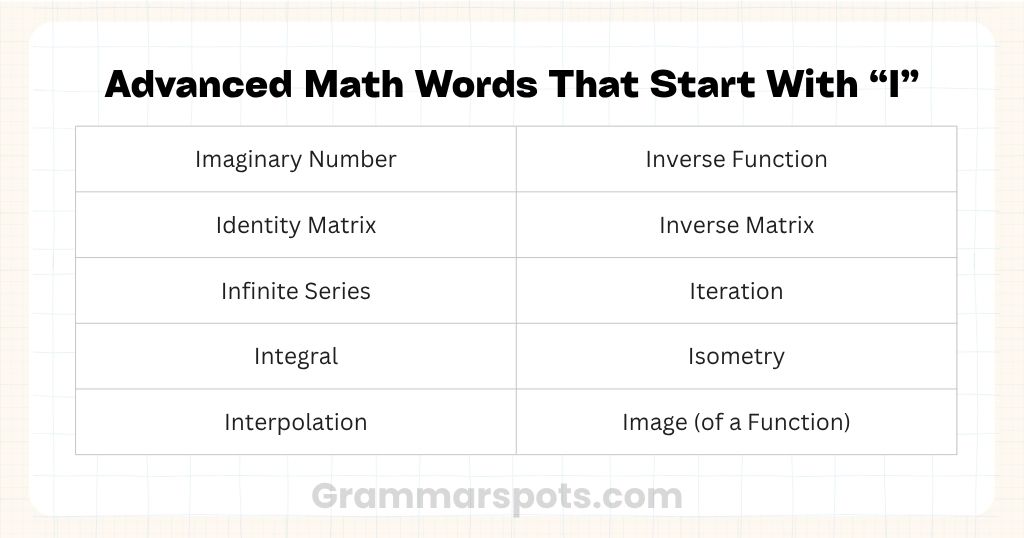
21. Imaginary Number
Meaning: A multiple of i, where i = √(−1).
Example: √(−16) = 4i
Math Branch: Complex Numbers
Application: Used in electrical engineering to analyze AC circuits and in physics for wave equations.
22. Identity Matrix
Meaning: A square matrix with 1s on the main diagonal and 0s everywhere else. Multiplying any matrix by it leaves the matrix unchanged.
Example:
| 1 0 |
| 0 1 |
Math Branch: Linear Algebra
Application: The neutral element of matrix multiplication used in graphics, robotics, and data systems.
23. Infinite Series
Meaning: The sum of infinitely many terms in a sequence.
Example: 1 + ½ + ¼ + ⅛ + … converges to 2.
Math Branch: Calculus / Analysis
Application: Used to compute values of π, e, and trigonometric functions in calculators and software.
24. Integral
Meaning: The accumulated total under a curve. The reverse process of differentiation.
Example: The integral of f(x) = 3x² is x³ + C.
Math Branch: Calculus
Application: Used to calculate area, work, distance, volume, and total change across physics and engineering.
25. Interpolation
Meaning: Estimating an unknown value that falls between two known data points.
Example: If a plant was 10 cm on Day 1 and 20 cm on Day 5, interpolating estimates ~15 cm on Day 3.
Math Branch: Statistics / Numerical Analysis
Application: Used in weather forecasting, image scaling, and financial modeling.
26. Inverse Function
Meaning: A function that reverses the output of the original function. If f maps a → b, then f⁻¹ maps b → a.
Example: If f(x) = 2x + 4, then f⁻¹(x) = (x − 4)/2.
Math Branch: Functions / Algebra
Application: Used in cryptography, unit conversion, and engineering design.
27. Inverse Matrix
Meaning: A matrix A⁻¹ such that A × A⁻¹ = I (the identity matrix).
Example: Every non-singular square matrix has an inverse matrix.
Math Branch: Linear Algebra
Application: Used to solve systems of equations and in 3D computer graphics.
28. Iteration
Meaning: Repeating a calculation using each result as the input for the next step.
Example: Newton’s Method refines an initial guess for a square root by iterating until the answer is accurate.
Math Branch: Numerical Methods / Computing
Application: Powers computer algorithms, machine learning training, and numerical approximations.
29. Image (of a Function)
Meaning: The complete set of output values a function can produce also called the range.
Example: For f(x) = x², the image is all non-negative real numbers.
Math Branch: Functions / Abstract Algebra
Application: Determines whether an inverse function is valid and maps the full behavior of a function.
30. Isometry
Meaning: A transformation that preserves distances shape and size stay exactly the same.
Example: Reflections, rotations, and translations are all isometries.
Math Branch: Geometry
Application: Used in tiling design, architecture, crystallography, and computer animation.
Related Post: 50+ Math Words That Start With H (With Meanings and Examples)
Rare and Specialized Math Terms Starting With I
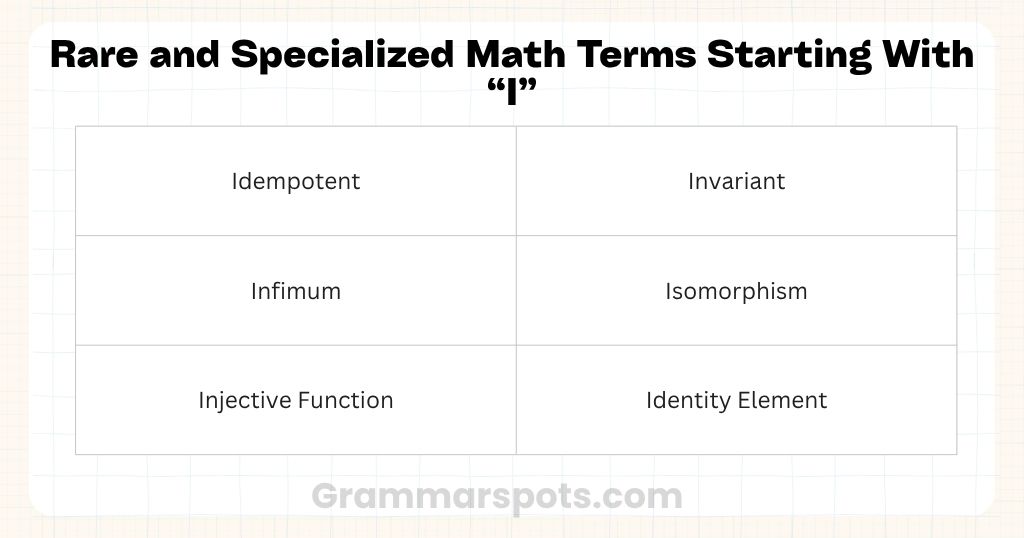
31. Idempotent
Meaning: An element or operation is idempotent if applying it multiple times gives the same result as applying it once.
Example: In Boolean algebra: 1 AND 1 = 1. Repeating AND with 1 never changes the result.
Math Branch: Abstract Algebra / Logic
32. Infimum
Meaning: The greatest lower bound of a set the largest value that is still less than or equal to every element in the set.
Example: The infimum of {x : x > 3} is 3, even though 3 is not in the set.
Math Branch: Real Analysis
33. Injective Function
Meaning: A function where every output comes from exactly one unique input. Also called a one-to-one function.
Example: f(x) = 2x is injective no two different x values produce the same output.
Math Branch: Set Theory / Functions
34. Invariant
Meaning: A property that remains unchanged under a given transformation or operation.
Example: Angles are invariant under rotation they stay the same when you rotate a shape.
Math Branch: Geometry / Abstract Algebra
35. Isomorphism
Meaning: A structure-preserving, reversible mapping between two mathematical systems they are structurally identical even if their elements look different.
Example: The integers under addition and the even integers under addition are isomorphic.
Math Branch: Abstract Algebra
36. Identity Element
Meaning: The unique element in a set that leaves any other element unchanged under a given operation.
Example:
- 0 is the identity element for addition (a + 0 = a)
- 1 is the identity element for multiplication (a × 1 = a)
Math Branch: Abstract Algebra
Geometry Terms That Start With I
- Interior Angle angle inside a polygon
- Isosceles Triangle triangle with two equal sides
- Isometry distance-preserving transformation
- Intersection where two shapes or lines meet
- Invariant property unchanged by transformation
Algebra Terms That Start With I
- Identity equation true for all values
- Inequality statement using <, >, ≤, ≥
- Integer whole number including negatives
- Inverse opposite operation or value
- Inverse Proportion one grows, one shrinks
- Index the power in an expression like xⁿ
Calculus Terms That Start With I
- Integral area under a curve; antiderivative
- Increment small positive change in a variable
- Infinite Series sum of infinite sequence terms
- Interpolation estimating between data points
- Iteration repeated application of a process
Probability and Statistics Terms That Start With I
- Independent Events outcomes that don’t affect each other
- Index (Statistics) composite numerical measure
- Interpolation estimating within a data range
Number Theory Terms That Start With I
- Integer whole numbers including negatives and zero
- Irrational Number non-repeating, non-terminating decimal
- Imaginary Number multiple of √(−1)
Related Post: 60+ Math Words That Start With C (With Meanings and Examples)
Abstract Algebra and Analysis Terms That Start With I
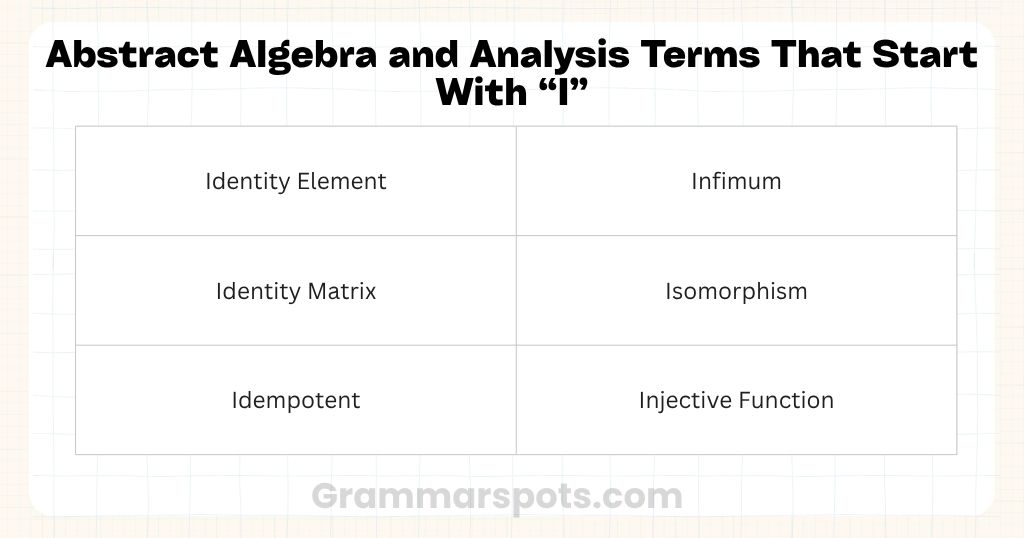
- Identity Element neutral element of an operation
- Identity Matrix matrix equivalent of the number 1
- Idempotent operation that produces the same result when repeated
- Infimum greatest lower bound of a set
- Isomorphism structure-preserving map between systems
- Injective Function one-to-one mapping
Real-World Applications
Geometry
- Interior angles are used in structural design and architecture
- Isometry appears in floor tiling, fabric patterns, and crystal structures
Algebra
- Inequalities model budgets, speed limits, and load tolerances
- Inverse proportion governs gear ratios and mechanical advantage
Calculus
- Integrals calculate distance, work, and fluid flow in physics and engineering
- Iteration drives machine learning, search engine ranking, and data compression
Statistics
- Interpolation is used in weather forecasting and medical growth charts
- Independent event probability is applied in insurance risk models
Number Theory
- Integers are used in computer memory and data storage
- Irrational numbers appear in precision engineering with π and √2
Complex Numbers
- Imaginary numbers model electrical AC circuits and quantum states
Learning Tips for Math Words That Start With I
- Group by number type: Integer → Irrational → Imaginary builds a logical sequence
- Use contrast: Inequality vs. Equation one is exact, one gives a range
- Connect to English: “Inverse” means opposite in everyday language same in math
- Sketch it: Draw interior angles, isosceles triangles, and intersections to make them visual
- Make flashcards: Front = word, Back = definition + one example
- Practice with sentences: “The integers between −3 and 3 are…” using terms actively locks them in
Commonly Confused Terms
Integer vs. Whole Number
- Whole numbers: 0, 1, 2, 3… (no negatives)
- Integers: …−3, −2, −1, 0, 1, 2, 3… (includes negatives)
- All whole numbers are integers. Not all integers are whole numbers.
Irrational vs. Imaginary Number
- Irrational: exists on the real number line (π, √2)
- Imaginary: does not exist on the real number line (involves √−1)
- These are completely different types of numbers.
Identity vs. Equation
- Equation: true for specific values only (x + 3 = 7, only when x = 4)
- Identity: true for all values (x + 0 = x, always)
Intercept vs. Intersection
- Intercept: where a graph meets a coordinate axis specifically
- Intersection: where any two lines, curves, or sets meet
Inverse Function vs. Reciprocal
- Reciprocal of f(x) = 2x is 1/(2x)
- Inverse function of f(x) = 2x is f⁻¹(x) = x/2
- Different operations mixing them up causes algebra errors.
Independent Variable vs. Independent Events
- Independent variable: the input (x) in a function
- Independent events: two outcomes in probability that don’t influence each other
- Same word completely different mathematical contexts.
FAQs About Math Words That Start With I
Q: What are the most important math words starting with I for middle school?
The most tested terms are:
- Integer
- Inequality
- Improper Fraction
- Inverse Operations
- Intercept
- Interior Angle
- Independent Variable
Q: Is infinity a number?
No. Infinity is a concept, not a value. It describes something without limit. You cannot use it in standard arithmetic.
Q: What makes a number irrational?
It cannot be written as a fraction p/q. Its decimal never ends and never repeats. If a square root doesn’t simplify to a whole number, it is irrational.
Q: Why are imaginary numbers useful?
Despite the name, they have real applications in:
- Electrical engineering (AC circuit analysis)
- Quantum mechanics (particle behavior)
- Signal processing (audio and image compression)
Q: What is the difference between an integral and a derivative?
- Derivative: measures the rate of change (slope) at any point
- Integral: measures accumulated total under a curve (area)
- They are inverse operations the Fundamental Theorem of Calculus connects them.
Q: What is the difference between an injective, surjective, and bijective function?
- Injective (one-to-one): each output has exactly one input
- Surjective (onto): every possible output is reached
- Bijective: both injective and surjective a perfect pairing
Q: What does identity element mean?
The value that leaves any number unchanged under an operation:
- Addition: 0 (a + 0 = a)
- Multiplication: 1 (a × 1 = a)
Q: What is the difference between infimum and minimum?
- Minimum: the smallest value actually inside the set
- Infimum: the greatest lower bound, which may not be in the set
- Example: {x : x > 2} has an infimum of 2 but no minimum, since 2 is not in the set.
Conclusion
This guide covers 36 verified math terms starting with I from beginner essentials like integer and inequality, to advanced concepts like isomorphism and infimum.
Key takeaways:
- Easy terms to master first: Integer, Improper Fraction, Inequality, Inverse Operations, Intercept, Interior Angle
- Core algebra and functions: Identity, Inverse, Independent Variable, Interval, Inverse Function
- Calculus essentials: Integral, Increment, Infinite Series, Iteration, Interpolation
- Advanced and abstract: Imaginary Number, Isometry, Isomorphism, Idempotent, Injective Function, Infimum
Each term has a specific role. Learning them by category rather than in isolation builds genuine mathematical understanding.

I’m Hazel, and I studied BSC English at GCUF. I focus on explaining word meanings in simple, clear language that anyone can understand. My goal is helping readers grasp everyday English, confusing terms, and slang used in real conversations and social media. I believe language learning works best when definitions connect to actual life situations. Through careful research and straightforward explanations, I make vocabulary accessible for students, learners, and anyone curious about how English really works in daily use.