

MMF usually means “male-male-female” in dating and texting contexts, describing a romantic or physical situation with two guys and one girl. In finance, it stands for Money Market Fund. The meaning depends completely on where you see it—kind of like how OTP has totally different meanings depending on whether you’re talking about relationships or security codes.
People Search This For a Reason
You probably saw MMF somewhere and felt that little panic of “wait, what does this mean?” Maybe it popped up in a TikTok comment, a dating profile, or someone mentioned it in a work email about investments. The confusion makes sense because MMF lives in totally different worlds.
If you’re scrolling romance book recommendations and see “#MMF,” that’s one thing. If your boss sends you a message about “the MMF portfolio,” that’s completely different. The awkward part? Search results often show the dating meaning first, which can get weird fast if you’re just trying to understand a finance term at work.
Breaking Down What “MMF” Really Signals
In Dating and Relationships
When people use MMF in dating contexts, they’re talking about a specific dynamic between three people. It’s not just “two guys and a girl hanging out.” The term describes situations where both men might be involved with each other too, not just focused on the woman. That’s the key detail most explanations skip.
Think of it like this: if you’re reading romance novels on BookTok, MMF is a genre tag. It tells you the story includes a relationship where the guys aren’t just tolerating each other—they’ve got their own connection going on. It’s become popular enough that authors now market books specifically as “MMF romance” because readers actively search for it.
The feeling behind using this term? It’s direct. People use it because saying “polyamorous relationship with bisexual dynamics” takes too long, and MMF gets the point across in three letters.
In Finance
Money Market Funds are where people park cash when they want safety. If someone mentions MMF in a business context, they’re talking about a low-risk investment that’s almost like a savings account but usually pays better interest. MMFs often pay competitive interest rates compared to regular savings accounts, depending on current market conditions.
People pick this term because “MMF” sounds professional in emails and reports. Nobody wants to type out “Money Market Fund” fifteen times in a presentation.
In Medical Settings
Mycophenolate Mofetil is an anti-rejection drug for transplant patients. Doctors and pharmacists use MMF as shorthand because the full name is a mouthful. If you see this on a prescription bottle or medical chart, that’s what it means. Patients usually take 1-2 grams daily, and it’s typically lifelong.
You Like This Also: What Does STTM Mean in Text? Acronym That Changes With Context
Where You’ll Actually See This Term Pop Up
In Texts and DMs
On dating apps like Feeld or Tinder, you might see “looking for MMF” in someone’s bio. They’re being upfront about what kind of relationship they want. It saves time compared to explaining everything in messages.
In group chats with close friends, someone might say “just finished an MMF book and wow” when talking about what they’re reading. Everyone in that conversation probably knows what genre they mean.
On Social Media
BookTok creators use #MMFRomance or #WhyChoose to tag their content. If you search those hashtags, you’ll find thousands of book recommendations. The term works like a filter—readers know exactly what they’re getting into.
Finance Twitter (or X, whatever we’re calling it now) uses MMF when discussing investment strategies. You’ll see tweets like “moving funds into MMF until market stabilizes” during volatile periods.
In Professional Settings
At work, MMF almost always means Money Market Fund. A colleague might email “can you pull the MMF data for Q1?” or “let’s discuss MMF allocation in tomorrow’s meeting.” The context makes it clear they’re talking money, not relationships.
Context Switches the Entire Meaning
Here’s the important part: MMF only makes sense once you look at who’s using it and in what setting.
The Workplace Risk
If you get a Slack message saying “check the MMF numbers” and you search it on your work computer, the top results might be… not what your boss meant. This happens more than you’d think. Similar to how ND can throw you off if you don’t know whether someone means ‘and’ or something else. Always look at context clues first—who sent the message, what project you’re working on, what industry you’re in.”
The Dating App Clarity
On dating platforms, MMF is pretty straightforward. But there’s still room for confusion because people sometimes mix up MMF and MFM. That difference matters to people searching for specific dynamics. MFM means the two men don’t interact with each other—they’re both there for the woman. MMF includes potential interaction between everyone involved.
The Friend Group Assumption
If your friend texts “reading an MMF” and you don’t know what BookTok is, you might think they’re talking about something way different than a romance novel. If you’re not familiar with that space, the abbreviation can sound more dramatic than it actually is.
Times to Skip Using “MMF” Completely
Skip It At Work (Unless You’re In Finance)
Don’t drop MMF in professional emails if you’re talking about anything except Money Market Funds. Even if you’re discussing diversity initiatives or relationship benefits, spell things out. The abbreviation carries too much potential for misunderstanding.
Avoid It With People You Don’t Know Well
If you’re texting someone new and want to recommend a book, maybe say “polyamorous romance” instead of just “MMF book.” Save the shorthand for people who already speak your language.
Don’t Use It In Public Comments
Commenting “love MMF!” on a public Instagram post about books might confuse people scrolling by who don’t know the romance novel context. Your friends get it, but strangers might not.
Wrong For Formal Writing
School papers, professional articles, or official documents need spelled-out terms. Even in finance, write “Money Market Fund” the first time, then use MMF after that.
Better Words That Won’t Confuse Anyone
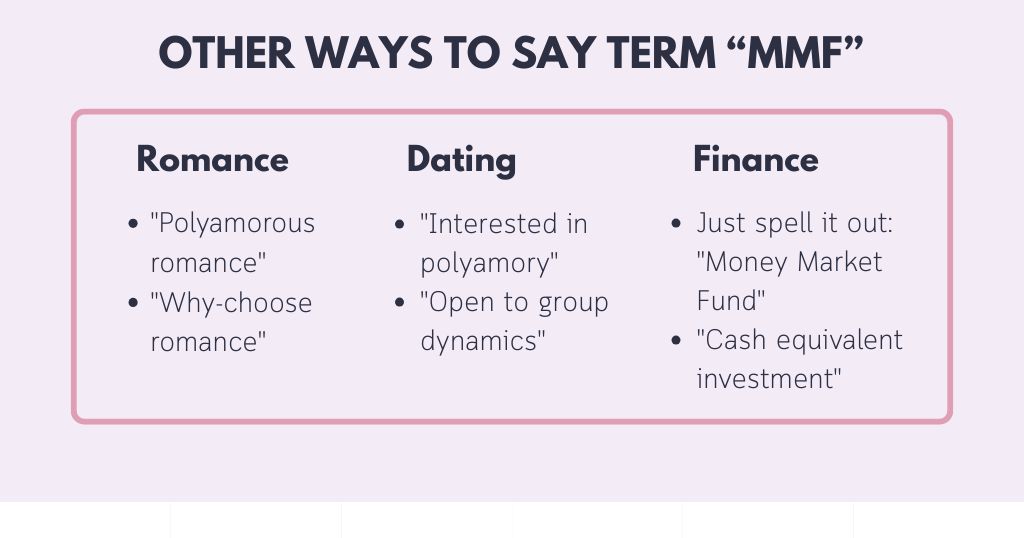
For Romance Books (Clearer Options)
- “Polyamorous romance”
- “Why-choose romance” (another BookTok term for multiple love interests)
- “Three-person relationship story”
For Dating Contexts (More Descriptive)
- “Interested in polyamory”
- “Open to group dynamics”
- “Looking for a triad relationship”
For Finance (Professional)
- Just spell it out: “Money Market Fund”
- “Cash equivalent investment”
- “Short-term fund”
For Medical (Patient-Friendly)
- “My anti-rejection medication”
- “Immunosuppressant drug”
Read More: BGC Meaning: What It Really Means in Texts, Dating & Real Life (2026)
Examples That Sound Like Real Conversations
Dating/Romance Context:
- “Just added another MMF to my TBR and I’m so excited”
- “Anyone got MMF recommendations? Preferably with good character development”
- “Profile says MMF but I think they mean MFM based on the description”
Finance Context:
- “Moved 50K into an MMF last week, yields are decent right now”
- “Boss wants the MMF report by Friday”
- “Thinking about MMF vs bonds for short-term parking”
Medical Context:
- “Taking MMF twice daily, morning and night”
- “Doc adjusted my MMF dose after labs came back”
Casual Confusion:
- “Wait, are you talking about the book thing or the money thing?”
- “Had to explain to HR that MMF in my search history was for work lol”
Different Spaces Use It Differently
TikTok and BookTok
This is where MMF as a romance term really exploded. Before 2020, people mostly saw it on Goodreads or romance forums. Now it’s mainstream enough that major publishers use #MMF in their marketing. Younger readers (teens to thirties) recognize it instantly in book contexts—much like how slang terms like “Thicc” spread through social media and became part of everyday vocabulary.
Dating Apps
Feeld, Bumble, and even Tinder now have enough users familiar with polyamory terms that MMF shows up regularly. Five years ago, people would’ve written out full explanations. The abbreviation signals you’re part of a community that gets it.
Finance Circles
MMF has meant Money Market Fund since the 1970s in professional settings. This usage hasn’t changed, but it’s created funny situations now that the dating meaning is more common online. Finance Twitter users sometimes joke about the confusion.
Read Also: TTG Meaning in Text, Rap, and More: The Complete Guide
Mistakes People Make With This Term
Mixing Up MMF and MFM
This is the biggest one. People use them interchangeably, but they describe different dynamics. If you tell someone you’re into MMF when you actually mean MFM, you’re setting up expectations that don’t match reality. The difference matters to people living these relationships.
Thinking It’s Always Sexual
In romance novels, MMF often describes the relationship structure, not just sexual encounters. These books have plots, character development, and emotional storylines. Reducing MMF to only physical stuff misses the point of why readers love the genre.
Assuming Everyone Knows
Just because you and your friends understand MMF doesn’t mean your mom does, or your coworker, or that person you matched with on a dating app. Context clues don’t always translate through screens.
The Work Computer Trap
People forget search histories exist at work. If you need to look up what MMF means and you’re in an office, maybe use your phone. Even if you’re searching for legitimate finance information, the results can look questionable to IT departments.
Questions That Come Up About “MMF”
Is MMF the same as a threesome?
Not exactly. A threesome is usually a one-time thing. MMF often describes ongoing relationships or, in books, the central romance structure. It implies a deeper connection than just a hookup.
Can MMF be used sarcastically?
Not really. It’s too specific and technical to work as sarcasm. Unlike terms like “sure” or “fine,” MMF has clear definitions that don’t lend themselves to ironic usage.
Do older people understand MMF?
Depends on the context. Older folks in finance? Absolutely, they’ve used it for decades. Older people not in finance or online book communities? Probably not, unless they’re actively involved in polyamory spaces.
Is it rude to ask what someone means by MMF?
Not at all. If you’re unsure whether they’re talking about books, finance, or relationships, just ask. “MMF—do you mean the romance genre?” or “Are you talking about investments?” Nobody will think you’re rude for seeking clarity.
Does MMF mean the same thing everywhere online?
Nope. Subreddits about polyamory, BookTok, and finance forums all use the same letters for different things. You’ve got to read the room—or the bio, or the tweet thread—to figure out which meaning applies. It’s the same deal with abbreviations like TBC—the letters stay the same but the meaning shifts based on who’s talking.
Why don’t people just spell things out?
Speed and community signaling. If you know what MMF means in a specific context, using it shows you’re part of that group. It’s like insider language that makes communication faster once everyone’s on the same page.
Understanding “MMF” Comes Down to Context
MMF is one of those terms that proves context is everything. Three letters can describe an investment strategy, a romance novel subgenre, or a medication depending on who’s talking and why. The confusion isn’t your fault—it’s just the internet cramming multiple meanings into the same abbreviation.
Your best move? Pay attention to where you see it and who’s using it. Dating profile? Probably relationships. Work email? Probably finance. BookTok comment? Probably romance novels. And if you’re still not sure, there’s zero shame in asking for clarification. People would rather explain than watch you guess wrong and feel awkward about it.

I’m Hazel, and I studied BSC English at GCUF. I focus on explaining word meanings in simple, clear language that anyone can understand. My goal is helping readers grasp everyday English, confusing terms, and slang used in real conversations and social media. I believe language learning works best when definitions connect to actual life situations. Through careful research and straightforward explanations, I make vocabulary accessible for students, learners, and anyone curious about how English really works in daily use.