

You’re here because you need science words starting with V for a test, homework, or just curiosity. The letter V is rich in science vocabulary. From velocity to virus to volcano, these words appear in labs, hospitals, classrooms, and space missions.
This article gives you 150+ words, organized by field, with clear definitions and real-life context.
20 Most-Used Science Words That Start With V
| Word | Meaning |
| Vacuum | Space with no matter or air |
| Velocity | Speed in a specific direction |
| Vertebra | One bone in the spine |
| Virus | Particle that infects living cells |
| Voltage | Electrical pressure driving current |
| Volume | Amount of space an object occupies |
| Vein | Vessel carrying blood toward the heart |
| Vaporization | Liquid changing into gas |
| Valence | Bonding power of an atom |
| Viscosity | Resistance of a liquid to flow |
| Vertebrate | Animal with a backbone |
| Vacuole | Storage compartment inside a cell |
| Variable | Something that changes in an experiment |
| Vapor | Gas form of a normally liquid substance |
| Ventricle | Heart chamber that pumps blood |
| Vesicle | Small fluid-filled sac inside a cell |
| Volatile | Substance that evaporates quickly |
| Vascular | Related to fluid-carrying vessels |
| Vibration | Rapid back-and-forth movement |
| Vaccine | Substance that trains the immune system |
Quick List of 150+ Science Words Starting With V
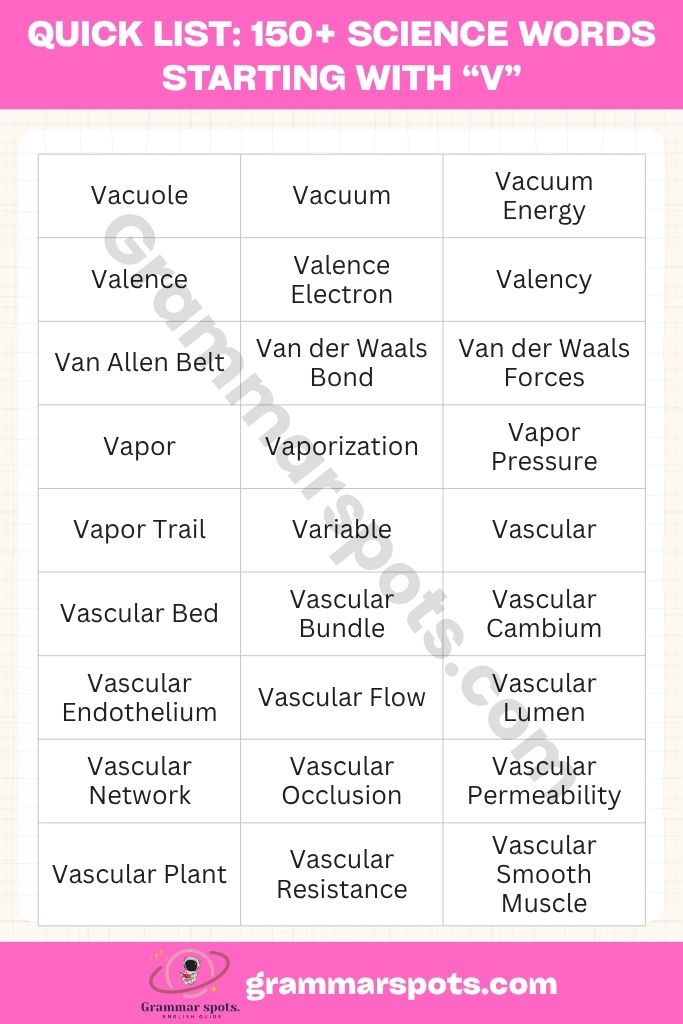
Vacuole
Vacuum
Vacuum Energy
Valence
Valence Electron
Valency
Van Allen Belt
Van der Waals Bond
Van der Waals Forces
Vapor
Vaporization
Vapor Pressure
Vapor Trail
Variable
Vascular
Vascular Bed
Vascular Bundle
Vascular Cambium
Vascular Endothelium
Vascular Flow
Vascular Lumen
Vascular Network
Vascular Occlusion
Vascular Permeability
Vascular Plant
Vascular Resistance
Vascular Smooth Muscle
Vascular Tissue
Vascular Tone
Vasodilation
Vasoconstriction
Vasopressin
Vector
Vein
Vein Graft
Velocity
Velocity Vector
Physics Science Words That Start With V
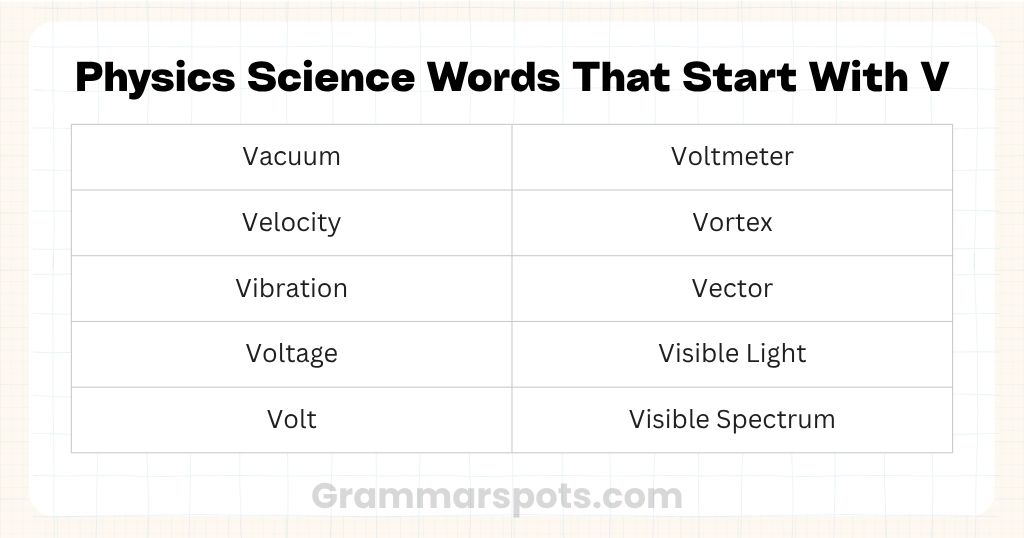
| Word | Definition |
| Vacuum | A region with no matter outer space is the closest natural example |
| Velocity | Speed with direction 60 mph north is different from 60 mph south |
| Vibration | Particles moving back and forth rapidly around a fixed point |
| Voltage | The electrical pressure that pushes current through a circuit |
| Volt | SI unit of electric potential phone chargers use 5V, car batteries use 12V |
| Voltmeter | Device that measures voltage between two points in a circuit |
| Vortex | A spinning, spiraling mass of fluid or gas tornadoes are air vortexes |
| Vector | A quantity with both size and direction force and velocity are vectors |
| Visible Light | The portion of the electromagnetic spectrum human eyes can detect |
| Visible Spectrum | Wavelengths from ~380 to 700 nanometers what a prism splits into a rainbow |
| Void | An essentially empty region of space |
| Vacuum Energy | Quantum energy fluctuations present even in empty space |
| Vibrational Energy | Energy stored in the back-and-forth motion of atoms |
| Vibrational Frequency | Number of complete vibration cycles per second |
| Vibrational Mode | A specific pattern in which a molecule vibrates |
| Vibrational Resonance | When an external vibration matches an object’s natural frequency and amplifies it |
| Velocity Vector | A vector describing exact speed and direction used in spacecraft navigation |
| Vortex Ring | A doughnut-shaped spinning fluid structure smoke rings are one example |
| Voltage Gradient | Rate of voltage change over distance drives how lightning and spark plugs work |
| Voltage Drop | Loss of electrical pressure across a component in a circuit |
Chemistry Science Words That Start With V
| Word | Definition |
| Valence | The combining power of an atom determines how many bonds it can form |
| Valence Electron | Outermost shell electrons that participate in bonding |
| Valency | Number of hydrogen atoms an element can bond with or replace |
| Vapor | Gas form of a substance normally liquid at room temperature |
| Vaporization | Process of liquid becoming gas includes both boiling and evaporation |
| Vapor Pressure | Pressure created by vapor above a liquid in a closed container |
| Van der Waals Forces | Weak attractive forces between molecules geckos use these to climb walls |
| Van der Waals Bond | A bond formed through van der Waals attractions between molecules |
| Volatile | Easily evaporates at room temperature nail polish remover, perfume, gasoline |
| Volatile Compound | Any compound that readily turns into vapor |
| Volatile Organic Compound | Carbon-containing chemicals that evaporate into air found in paints and cleaners |
| Volatile Matter | Gases released from coal when heated without air |
| Viscosity | How thick a fluid is honey has high viscosity, water has low viscosity |
| Viscosity Index | A number showing how much viscosity changes with temperature |
| Voltaic Cell | Device that generates electricity through a chemical reaction |
| Voltaic Pile | The first battery stacked zinc and copper discs with saltwater cloth between them |
| Volumetric Flask | Lab flask with precise volume marking for preparing exact solutions |
| Volumetric Analysis | Finding solution concentration by measuring reacting volumes |
| Vitrification | Turning a material into glass-like solid through rapid cooling |
| Void Space | Empty regions between atoms or molecules in a material |
Biology Science Words That Start With V
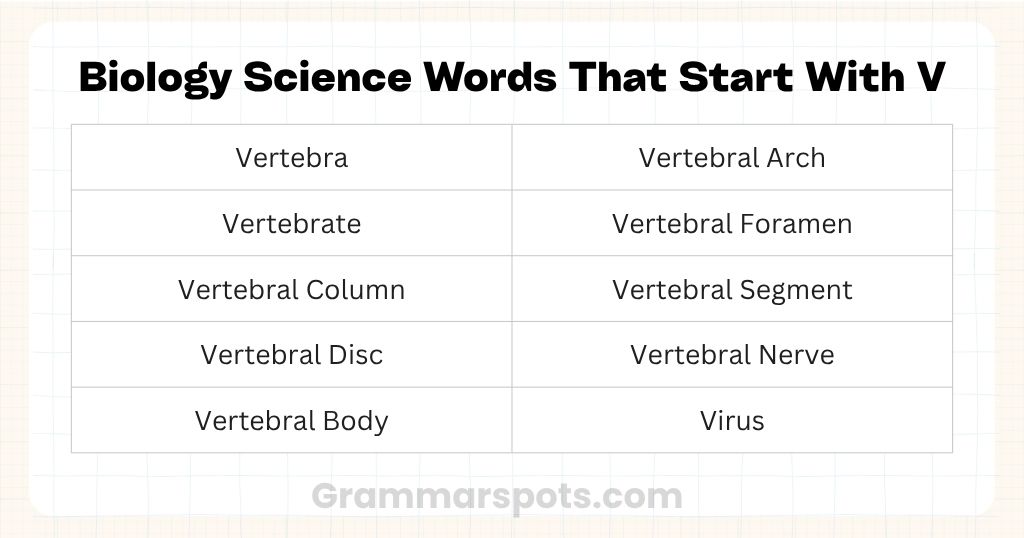
| Word | Definition |
| Vertebra | One bone of the spinal column humans have 33 total |
| Vertebrate | Animal with a backbone fish, frogs, birds, mammals are all vertebrates |
| Vertebral Column | The full spine protects the spinal cord and supports the body |
| Vertebral Disc | Cushion pad between vertebrae absorbs shock and allows bending |
| Vertebral Body | The solid front part of each vertebra that bears body weight |
| Vertebral Arch | The bony arch at the back of each vertebra enclosing the spinal cord |
| Vertebral Foramen | The hole inside each vertebra through which the spinal cord passes |
| Vertebral Segment | One vertebra, its discs, and associated nerves |
| Vertebral Nerve | Nerve exiting the spinal cord through a vertebral gap |
| Virus | Not technically alive a strand of genetic material in a protein coat |
| Virion | A single complete virus particle the infectious unit |
| Virulence | How effectively a pathogen establishes infection |
| Virulence Factor | A molecule that helps a pathogen infect or evade the immune system |
| Viral Load | Amount of virus present in a patient’s blood |
| Viral Replication | Process of a virus copying itself inside a host cell |
| Viral Vector | Modified virus used to deliver therapeutic genes into cells |
| Viral Envelope | Outer membrane some viruses have, made from host cell material |
| Virion Assembly | The process of new virus particles being constructed inside a host cell |
| Viremia | Virus circulating in the bloodstream |
| Virology | The scientific study of viruses |
| Vacuole | Membrane-bound storage compartment inside a cell |
| Vacuolar Membrane | Thin membrane surrounding a vacuole that controls what enters and exits |
| Vascular | Relating to vessels carrying fluids in animals or plants |
| Vascular Tissue | Plant tissue network — xylem moves water up, phloem moves sugar down |
| Vascular Bundle | Tightly packed strands of xylem and phloem inside plant stems |
| Vascular Plant | Plant with a proper transport system — trees, ferns, and flowering plants |
| Vascular Cambium | Layer of dividing cells that makes plants grow wider |
| Vein | Carries blood toward the heart in animals; transports nutrients in plant leaves |
| Venule | Tiny vein collecting blood from capillaries |
| Ventricle | Lower heart chamber that pumps blood out to the body or lungs |
| Vesicle | Small membrane-bound transport sac inside a cell |
| Vesicle Transport | Movement of vesicles carrying materials inside a cell |
| Vesicle Fusion | When a vesicle merges with a cell membrane to release its contents |
| Vesicular Transport System | The cell’s full internal delivery network using vesicles |
| Vesicular | Having the structure of multiple small sac-like compartments |
| Vestigial | A structure that lost its original function through evolution |
| Vestigial Organ | Non-functional organ kept through evolution human appendix, whale leg bones |
| Vestigial Structure | Any physical feature reduced over evolutionary time |
| Vital Signs | Heart rate, blood pressure, breathing rate, and temperature |
| Vital Capacity | Maximum air volume exhaled after the deepest possible breath |
| Vitreous Humor | Clear jelly filling the back chamber of the eye |
| Vitreous Body | The gel structure behind the eye lens that holds eye shape |
| Visual Cortex | Brain region at the back of the skull that processes visual information |
| Visual Field | Total area visible without moving the eyes |
| Visual Pathway | The neural route from retina to visual cortex |
| Vestibular System | Inner ear system that detects balance, motion, and spatial orientation |
Earth Science Words That Start With V
| Word | Definition |
| Volcano | An opening in Earth’s crust where magma and gases escape |
| Volcanic Eruption | Release of lava, ash, gas, and rock from a volcano |
| Volcanism | All geological processes involving magma movement and volcanic activity |
| Volcanology | Scientific study of volcanoes and eruption patterns |
| Volcanic Rock | Rock formed from cooled lava or ash basalt, obsidian, pumice |
| Volcanic Arc | A chain of volcanoes above a subducting tectonic plate |
| Volcanic Gas | Gases released during eruptions mainly water vapor, CO₂, sulfur dioxide |
| Volcanic Island | Island built up from the ocean floor by repeated volcanic activity |
| Volcanic Lava | Magma that has reached Earth’s surface temperatures 700°C to 1,200°C |
| Volcanic Plume | Column of ash and gas shot into the atmosphere during an eruption |
| Volcanic Vent | The opening through which lava and gases exit a volcano |
| Vernal Equinox | When day and night are equal length marks start of spring in March |
| Vernal | Relating to spring used in terms like vernal equinox and vernal pool |
| Vapor Trail | White streak airplanes leave forms when hot exhaust hits cold high-altitude air |
| Void Space | Empty pores and fractures in rock that can hold water, oil, or gas |
Space & Astronomy Science Words That Start With V
| Word | Definition |
| Van Allen Belt | Two zones of charged particles trapped by Earth’s magnetic field |
| Vacuum (Space) | Near-empty space no atmosphere, no sound, heat moves only by radiation |
| Velocity (Orbital) | Speed needed to stay in orbit ISS travels at ~7.66 km/s |
| Visible Light (Astronomy) | The wavelengths telescopes like Hubble use to image stars and galaxies |
| Void (Cosmic) | Massive near-empty regions between galaxy clusters Boötes Void spans 330 million light-years |
| Vernal Equinox (Astronomy) | Sky reference point where the Sun crosses the celestial equator starting point for sky coordinates |
| Velocity Vector | Exact speed and direction of a spacecraft tiny changes affect the whole mission |
| Volatiles (Planetary Science) | Easily-vaporized compounds like water, methane, CO₂ form comet tails near the Sun |
| Vacuum Energy (Cosmology) | Energy present in empty space possibly connected to dark energy and universe expansion |
| Vortex (Planetary) | Large spinning storm systems on planets Saturn’s polar hexagon, Jupiter’s Great Red Spot |
Medical & Health Science Words That Start With V
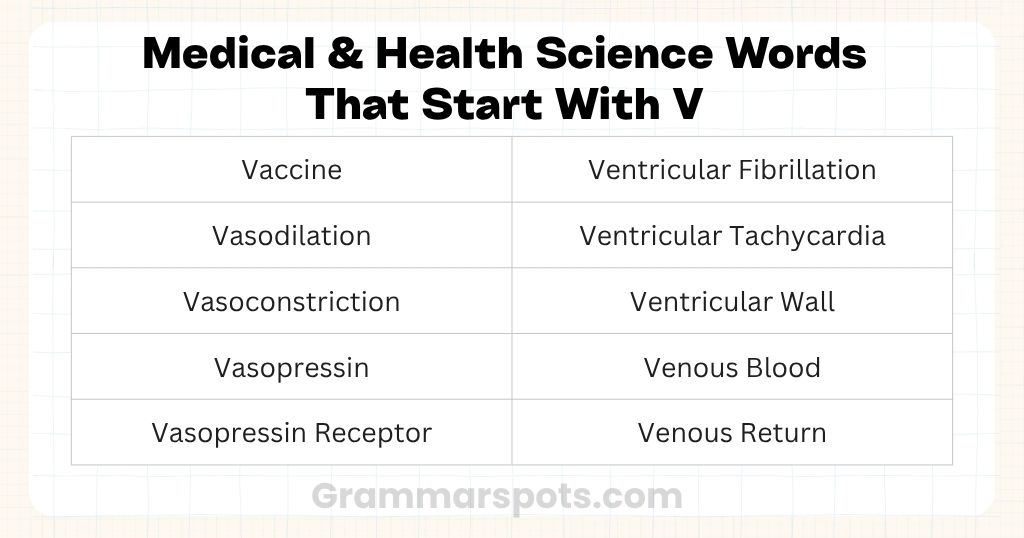
| Word | Definition |
| Vaccine | Trains the immune system to fight a specific pathogen before infection |
| Vasodilation | Blood vessels widening happens during exercise and in hot weather |
| Vasoconstriction | Blood vessels narrowing happens in cold weather and during stress |
| Vasopressin | Hormone that tells kidneys to retain water also controls blood pressure |
| Vasopressin Receptor | Protein that receives vasopressin signals two types control different organs |
| Ventricular Fibrillation | Life-threatening quivering of ventricles heart stops pumping effectively |
| Ventricular Tachycardia | Abnormally fast heartbeat originating in the ventricles |
| Ventricular Wall | Muscular wall of the ventricle that contracts to push blood out |
| Venous Blood | Blood in veins generally deoxygenated and returning to the heart |
| Venous Return | Flow of blood back to the heart through the veins |
| Venous Pressure | Low blood pressure in veins much lower than arterial pressure |
| Vascular Resistance | Opposition blood faces flowing through vessels contributes to blood pressure |
| Vascular Permeability | How easily fluids pass through vessel walls increases during inflammation |
| Vascular Occlusion | Blockage in a blood vessel causes heart attacks and strokes |
| Vascular Endothelium | Thin cell layer lining the inside of blood vessels |
| Vascular Smooth Muscle | Muscle in vessel walls that controls diameter automatically |
| Vascular Adhesion | White blood cells attaching to vessel walls before entering tissue to fight infection |
| Vascular Tone | Baseline level of vessel constriction determines resting blood flow |
| Vascular Lumen | The hollow channel inside a blood vessel where blood flows |
| Vascular Flow | Rate and pattern of blood movement measured by ultrasound |
| Vascular Bed | Network of capillaries within a specific organ |
| Vascular Impedance | Resistance to pulsatile blood flow accounts for heartbeat pressure waves |
| Vascular Smooth Muscle Tone | The resting contraction level of muscle in blood vessel walls |
| Vein Graft | Transplanted vein used to bypass a blocked artery common in heart surgery |
| Vein Pressure | Pressure inside veins lower than arterial, important in circulation assessment |
| Visceral Fat | Fat stored around internal organs raises risk of heart disease and diabetes |
| Visceral Organ | Organs in body cavities liver, stomach, intestines, kidneys |
| Visceral Sensation | Sensations from internal organs often dull and hard to localize precisely |
| Visceral Peritoneum | Membrane covering abdominal organs allows smooth organ movement |
| Visceral Pleura | Membrane directly covering the lungs inflamed in pleuritis |
| Visceral Nervous System | The part of the nervous system controlling internal organs automatically |
| Visual Acuity | Clarity and sharpness of vision measured in the standard eye test |
| Vital Signs | Heart rate, blood pressure, respiratory rate, and temperature checked first in any exam |
| Vital Capacity | Maximum exhaled breath volume used to diagnose asthma and COPD |
| Vitreous Body | Gel filling the eye behind the lens shrinkage causes floaters |
| Vitreous Gel | The jelly-like substance filling the vitreous chamber of the eye |
| Viral Load | Virus quantity in blood used to monitor HIV, COVID-19, and other viral infections |
Technology & Applied Science Words That Start With V
| Word | Definition |
| Voltage Regulator | Keeps voltage constant regardless of load changes inside every phone charger |
| Voltage Drop | Reduction in voltage across a circuit component as current passes through |
| Voltage Divider | Two-resistor circuit that produces a lower voltage from a higher one |
| Voltage Amplifier | Circuit that boosts weak voltage signals used in microphone processing |
| Voltage Source | Any device producing electrical potential batteries, generators, solar cells |
| Voltage Spike | Sudden, brief surge in voltage that can damage electronic components |
| Voltaic Arc | Sustained electrical discharge through air used in arc welding |
| Vibrational Spectroscopy | Identifies chemicals by how molecular bonds vibrate used in food safety and forensics |
| Vibrational Raman Spectroscopy | A laser-based version of vibrational spectroscopy used in pharmaceutical analysis |
| Volatile Memory | Computer memory that loses data when power is off RAM is volatile |
| Volatile Organic Compound (Industrial) | VOCs in manufacturing that require filters and scrubbers to control air quality |
| Vortex Ring | Doughnut-shaped vortex studied for fluid mixing and propulsion applications |
| Void Fraction | Proportion of empty space in a packed chemical reactor affects fluid flow |
| Voltage-Gated Ion Channel | Membrane protein that opens with voltage change triggers all nerve signals |
| Void Volume | Volume of empty space inside a chromatography column or packed system |
Easy Science Words That Start With V (Beginners & Kids)
| Word | Simple Definition |
| Vein | Tube that carries blood back to your heart |
| Vertebra | One bone in your backbone |
| Virus | Tiny particle smaller than bacteria that can make you sick |
| Vaccine | A shot that teaches your body to fight disease before you catch it |
| Volume | How much space something takes up |
| Vapor | When liquid becomes gas steam is water vapor |
| Vibration | Fast shaking guitar strings vibrate to make sound |
| Variable | Anything that can change in a science experiment |
| Vacuum | Space with no air inside like sealed empty space |
| Vertebrate | Any animal with a backbone you, your dog, birds, fish |
| Vacuole | A storage bubble inside a cell plant cells have one large one |
| Vascular | Related to tubes that carry fluids like blood vessels |
Advanced Science Words That Start With V
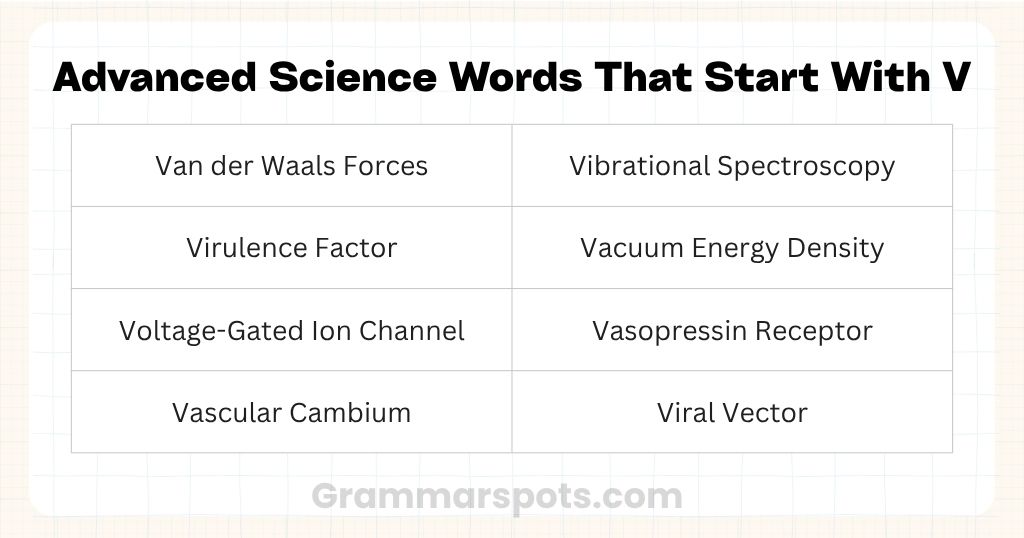
| Word | Definition |
| Van der Waals Forces | Weak forces between molecules caused by temporary shifts in electron clouds |
| Virulence Factor | Specific molecule that helps a pathogen infect, survive, or evade immunity |
| Voltage-Gated Ion Channel | Membrane protein opening in response to voltage — basis of all nerve function |
| Vascular Cambium | Lateral meristem producing new xylem and phloem — makes woody plants grow wider |
| Viral Vector | Modified virus carrying therapeutic DNA into patient cells for gene therapy |
| Vibrational Spectroscopy | Identifies molecular structure through characteristic infrared absorption frequencies |
| Vacuum Energy Density | Energy per unit volume in empty space — one of physics’ biggest unsolved problems |
| Vasopressin Receptor | V1 and V2 receptors with different roles — V2 in kidneys controls water retention |
| Vestibular System | Fluid-filled inner ear canals detecting motion, gravity, and head position |
| Vascular Impedance | Opposition to pulsatile blood flow accounting for heartbeat wave dynamics |
| Vitrification (Cell Biology) | Ultra-rapid cooling preventing ice crystal formation — used in embryo freezing |
| Void Fraction | Empty space ratio in a packed reactor bed — affects industrial chemical processes |
| Virion Assembly | Step-by-step construction of new virus particles inside an infected host cell |
| Vesicular Transport System | The complete vesicle-based internal delivery network within a cell |
| Viral Envelope | Lipid layer surrounding some viruses — acquired from the host cell membrane |
Common Confusions
Velocity vs. Speed
Speed is how fast. Velocity is how fast and in which direction. Same number, different meanings in physics.
Vein vs. Artery
Veins carry blood toward the heart. Arteries carry it away. Most veins carry deoxygenated blood except pulmonary veins, which carry oxygenated blood from lungs to heart.
Virus vs. Bacteria
Viruses are not alive no cell, no metabolism. Bacteria are living single-celled organisms. Antibiotics kill bacteria. They do not work on viruses.
Volatile vs. Flammable
Volatile means evaporates easily. Flammable means catches fire easily. Many volatile liquids are flammable, but not all. They are not the same word.
Vacuole vs. Vesicle
Vacuoles are large storage chambers especially prominent in plant cells. Vesicles are small transport sacs that carry cargo around inside a cell.
Ventricle vs. Atrium
Atria are the upper heart chambers that receive blood. Ventricles are the lower chambers that pump it out.
Vaporization vs. Evaporation
Evaporation is slow surface vaporization below boiling point. Boiling is rapid vaporization throughout the entire liquid. Both are forms of vaporization.
Volume vs. Mass
Volume is space occupied. Mass is amount of matter. A balloon has high volume but very low mass.
FAQs
How many science words start with V?
Hundreds exist across all scientific fields. This article covers 155+ of the most useful and commonly tested ones.
Which V words appear most on science exams?
- Velocity
- Voltage
- Volume
- Variable
- Vaporization
- Vaccine
- Vertebrate
- Vacuole
Know these eight well and you’re ahead of most students.
Do V science words come from Latin?
Most do. “Vein” comes from vena, “vapor” from vapor, “virus” from virus (Latin for poison). Knowing the Latin root helps words stick in memory.
Which V words are most important in chemistry?
Valence, valence electron, vapor pressure, viscosity, volatile, van der Waals forces, voltaic cell, and vaporization.
Which V words are most important in biology?
Vertebrate, virus, vacuole, vascular, vesicle, vestigial, and vital signs.
Are these words hard to learn?
Not when grouped by topic. Learn them by field biology V words together, physics V words together rather than alphabetically.
Conclusion
This list covers 155+ science words starting with V across physics, chemistry, biology, earth science, space, medicine, and technology.
The most useful approach: don’t try to memorize everything at once. Find your subject area, learn 8–10 words with their meanings and real-world connections, then expand from there.
These words appear in textbooks, standardized tests, medical settings, and everyday science. Knowing them gives you a real advantage not just for exams, but for understanding how the world actually works.

I’m Hazel, and I studied BSC English at GCUF. I focus on explaining word meanings in simple, clear language that anyone can understand. My goal is helping readers grasp everyday English, confusing terms, and slang used in real conversations and social media. I believe language learning works best when definitions connect to actual life situations. Through careful research and straightforward explanations, I make vocabulary accessible for students, learners, and anyone curious about how English really works in daily use.