

SMN in text usually means “So Much Noise” (overwhelm/chaos). It can also mean “Send Me Now” or “Simón” (yes in Spanish) depending on context.
Why Everyone’s Confused About This Three-Letter Code
You’re scrolling through Instagram comments and see “SMN” under a wild party video. Or a friend texts it after you shared a crazy story about your day. What are they actually saying?
SMN isn’t a fixed acronym it changes meaning based on context. That’s why it’s often misunderstood, especially when the tone isn’t clear.
The biggest mix-up? People constantly confuse SMN with SNM (which means “Say No More”). They look similar when you’re typing fast, but they mean completely different things. Getting them backwards will leave someone genuinely puzzled about what you’re trying to say.
Just like how people mix up what NP means in text or confuse RT with other acronyms, SMN gets mistaken for SNM all the time.
What “SMN” Actually Says About Your Vibe
Most commonly, SMN is a quick reaction to chaos or overload.
It’s shorthand for: “that’s a lot” or “this is messy.”
The “Send Me Now” version hits different. It’s pure impatience. Someone sees something they want—a photo, a song link, a meme—and they don’t want to wait. They’re excited or desperate enough to demand it right that second. There’s urgency baked into those three letters.
In Spanish-speaking circles, “SMN” is just a quick way to type “Simón,” which is slang for “yes” or “yeah.” It’s not formal. It carries that casual, street-smart vibe that makes texting feel less stiff. You wouldn’t use it in a professional email, but with friends? Perfect.
The feeling behind all these meanings is speed. Nobody’s typing SMN when they have time to write full sentences. It’s for moments when you need to react fast, show you get it, or make a quick request without explanation. It’s similar to how IGHT or WSP work quick reactions that save time.”
Where You’ll Spot “SMN” in Your Daily Texts
In text messages: Someone shares a screenshot of 47 unread work emails. You text back “SMN 😵” because you understand that drowning feeling without needing a paragraph.
In comments: Under a TikTok of a packed mall during holiday shopping, you’ll see “SMN” scattered everywhere. People are reacting to the visible chaos—the crowds, the noise, the stress.
In DMs: Your friend posts a Story showing off new shoes. You slide into their DMs with “SMN the link!!” because you need those shoes in your life immediately.
In group chats: Someone’s venting about their roommate drama, their midterm stress, and their part-time job schedule all at once. Another person just types “SMN” because it captures the whole situation without making them write an essay.
Read Also: SFLR Meaning: What It Means in Texts and Why People Use It
How Context Flips SMN’s Meaning
Context isn’t just important with SMN—it’s everything.
Between close friends, “SMN” after a vent session feels supportive. You’re acknowledging their stress. But if you use it with someone you barely know, it might come across as dismissive, like you’re not really listening to their problem.
The “Send Me Now” version can sound demanding or even rude if you’re not careful about who you’re talking to. Texting “SMN” to a classmate you need notes from? Fine. Texting it to your boss asking for a file? Probably not your best move.
Emojis change the whole vibe. “SMN 💀” clearly means you’re overwhelmed or laughing at chaos. “SMN 😍” with heart eyes? That’s definitely “Send Me Now” because you’re excited about something. Without those emoji clues, people are left guessing. The same way SUS meaning changes with tone or thicc can sound complimentary or creepy depending on context, SMN needs visual clues to land right.
Sarcasm is tricky here. If someone’s complaining about a minor inconvenience—like waiting five minutes for coffee—and you reply “SMN,” they might think you’re mocking them. Tone doesn’t translate well through three letters, so misunderstandings happen.
Age matters too. Younger users (Gen Z, younger millennials) will instantly recognize “So Much Noise” as the chaos meaning. Older folks might not get it at all and assume you’re talking about actual sound.
Places Where “SMN” Will Make You Look Bad
At work or in professional settings: Just don’t. Even if your coworker is cool and young, typing “SMN” in a work chat feels unprofessional. Say “That sounds overwhelming” or “Could you send that to me?” instead.
With people you don’t text regularly: If you’re messaging someone for the first time, or it’s been months since you talked, SMN will confuse them. They don’t know your texting style yet.
In serious conversations: Someone’s sharing something personal or difficult, and you hit them with “SMN”? It can feel cold, like you’re brushing off their feelings. Use actual words when the situation deserves them.
When asking authority figures for things: Teachers, parents, bosses—these people expect a certain level of respect in requests. “Can you SMN the assignment details?” sounds bratty. “Could you please send me the assignment details?” works way better.
On LinkedIn or professional platforms: This should be obvious, but slang acronyms don’t belong where people are job hunting or networking. Keep it professional. Just like you wouldn’t use NSFW in a work email or drop OTP references in a client meeting, SMN stays in casual spaces only.
With international friends who don’t speak Spanish or English as a first language: They might not know the acronym at all, and you’ll just create confusion where none needed to exist.
More Post: What Does HML Mean in Text? The One Thing Nobody Tells You
Better Words When “SMN” Feels Too Casual
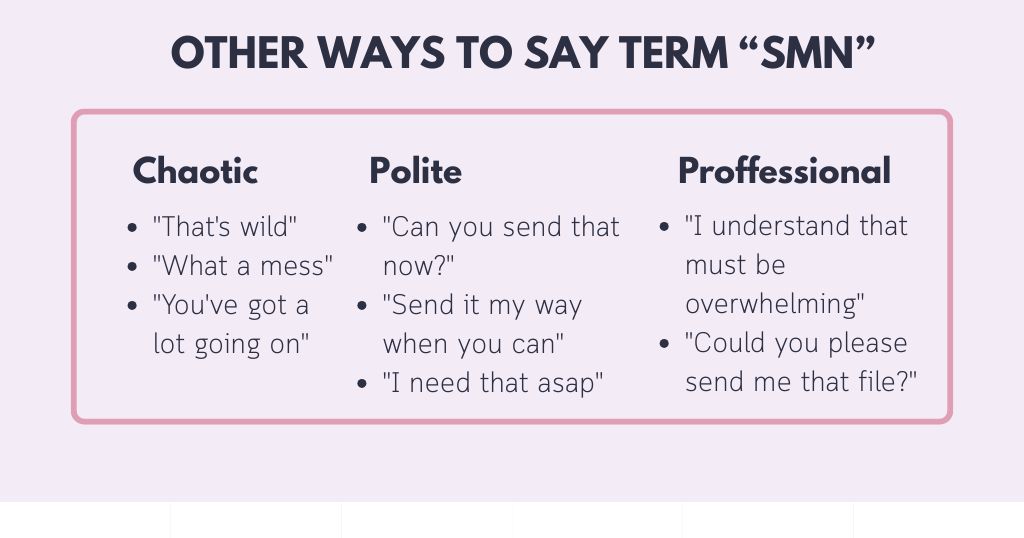
If you mean “that sounds chaotic”:
- “That’s wild”
- “Sounds like a lot”
- “What a mess”
- “You’ve got a lot going on”
If you’re requesting something:
- “Can you send that now?”
- “Send it my way when you can”
- “I need that asap”
- “Mind sharing that?”
If you’re agreeing (instead of Spanish “Simón”):
- “Yeah”
- “For sure”
- “Definitely”
- “Yep”
For professional contexts:
- “I understand that must be overwhelming”
- “Could you please send me that file?”
- “I’d appreciate receiving that soon”
You don’t always need alternatives. Sometimes typing out full words just makes more sense, especially when clarity matters more than speed. Similar to choosing when to use YW instead of ‘you’re welcome’ or NM versus actually explaining, picking the right level of casual matters.
Real Text Threads Showing “SMN” in Action
Text 1:
Friend: “I’ve got three essays due, my car’s making a weird noise, and my mom keeps calling me about Thanksgiving”
You: “SMN girl 😭”
Text 2:
You: “Just saw the cutest jacket on your Story”
Friend: “SMN I’ll drop the link”
Text 3:
Group Chat Member: “Did anyone else see the drama in the comments on Jake’s post?”
You: “SMN, I can’t keep up with all of it”
Text 4:
Friend: “¿Vas a la fiesta?”
You: “SMN” (meaning Simón/yes)
Text 5:
Comment on TikTok showing a chaotic family dinner: “SMN but looks fun 😂”
Text 6:
DM: “Your Halloween costume was sick”
Them: “SMN a pic of yours!”
Text 7:
You: “The subway was packed, I missed my stop, and I’m late”
Friend: “SMN dude”
Text 8:
Text: “Can you believe she said that in the meeting?”
You: “SMN, I was trying not to react”
Read More: IHH Meaning in Text: What It Means in Chats, DMs, and TikTok
Different Crowds, Different SMN Meanings
TikTok is where “So Much Noise” thrives. The platform is all about fast reactions to videos, and SMN captures that “this is chaos” feeling perfectly. You’ll see it most under videos showing crowds, arguments, or overwhelming situations.
Instagram leans toward “Send Me Now” in DMs. People see something they like in a Story and immediately ask for it. The request is visual—someone’s outfit, their food spot, their playlist—and SMN becomes the quick demand.
WhatsApp and regular texting apps get both meanings pretty equally. It depends on your friend group and what you’re talking about. Spanish speakers will almost always mean “Simón” (yes) when they use it.
In Spanish-speaking communities, especially in Mexico and parts of the U.S., SMN as “Simón” has been around longer than the English meanings. It’s not new slang—it’s just the texted version of street slang that’s existed for years. Younger Latinx users switch between the Spanish and English meanings depending on who they’re texting.
Older millennials and Gen X might not recognize SMN at all. It’s not part of their texting vocabulary, so using it with them creates more confusion than connection. They’re more likely to know what BFF means or ROFL than newer slang like SMN or what wig means.
Mistakes That Make Your “SMN” Texts Backfire
Thinking it’s always about literal noise: When someone says “SMN,” they’re almost never talking about actual sound. It’s about mental noise, chaos, or feeling bombarded. Missing this makes the whole message confusing.
Using it interchangeably with SNM: These are different acronyms. It’s like mixing up what WTV means with DTM—close enough to confuse people, different enough to change your whole message. SNM is “Say No More” (agreement). SMN is “So Much Noise” or “Send Me Now” (reaction or request). Swapping them makes you look like you don’t know what you’re saying.
Assuming everyone knows the Spanish meaning: Even in the U.S., not everyone will connect SMN to “Simón.” If you’re texting someone who doesn’t speak Spanish or isn’t familiar with that slang, they’ll be lost.
Overusing it until it loses meaning: Some people type SMN for every mildly busy moment. “I have two homework assignments, SMN.” That’s not chaos—that’s just life. When you overuse it, people stop taking it seriously.
Expecting it to work in formal writing: SMN is texting slang, full stop. It doesn’t belong in emails, essays, cover letters, or anything remotely professional. This should be obvious, but people still make this mistake.
Reading it as rude when it’s not: Someone typing “SMN” after you share a stressful story isn’t dismissing you. They’re usually empathizing in shorthand. Don’t assume the worst unless their overall tone suggests it.
Answers to Your Burning SMN Questions About SMN Mean in Text
Is SMN rude to use?
Not usually, but it can feel dismissive if you use it wrong. Between friends reacting to chaos, it’s fine. With someone you don’t know well, or in a serious moment, it might come off as careless.
Can SMN be sarcastic?
Absolutely. If someone’s complaining about something tiny and you reply “SMN,” you’re probably mocking how dramatic they’re being. Sarcasm is all about context. Think about how GG can sound genuine or mocking or TFTI feels passive-aggressive—same principle applies here.
Does SMN mean the same thing everywhere?
Not even close. Spanish speakers will think “yes.” English speakers might think “chaos” or “send it now.” Your friend group and platform create the real meaning.
What if someone uses SMN and I don’t know which meaning they meant?
Just ask. “Wait, do you mean send it or you’re overwhelmed?” It’s better to clarify than to guess wrong and look confused.
Is this a new term?
The Spanish “Simón” version has been around for decades as spoken slang. The texted “SMN” version and the “So Much Noise” meaning are more recent, picking up steam around 2020 and beyond.
Do guys and girls use it differently?
Not really based on gender alone, but based on how they communicate. Some people use it more for requests (Send Me Now), others for empathy (So Much Noise). It’s about personal style, not whether you’re a guy or girl.
The Science Side: When “SMN” Isn’t Slang At All
If you’re searching “SMN meaning” and landing in medical forums or research articles, you’re seeing a completely different world. In medicine, SMN stands for Survival Motor Neuron—a gene and protein linked to Spinal Muscular Atrophy (SMA), a serious genetic condition.
This has nothing to do with texting slang. If you’re in a healthcare setting, a biology class, or reading about genetics, SMN is technical and important. Don’t confuse the two contexts.
You might also see SMN used in other professional ways: Statement of Medical Necessity in insurance paperwork, or even Santa Maria Novella (a train station in Italy). The letters get reused a lot, so always check what field you’re in before assuming a meaning.
Does SMN Work If They Don’t Get It?
SMN works when both people understand the same meaning. That’s it. If you’re not sure your friend will get what you mean—or if the situation calls for actual clarity—just type the full words. Three letters save time, but they’re not worth the confusion when real communication matters.

I’m Hazel, and I studied BSC English at GCUF. I focus on explaining word meanings in simple, clear language that anyone can understand. My goal is helping readers grasp everyday English, confusing terms, and slang used in real conversations and social media. I believe language learning works best when definitions connect to actual life situations. Through careful research and straightforward explanations, I make vocabulary accessible for students, learners, and anyone curious about how English really works in daily use.