

Math vocabulary that starts with “G” covers a wide range from basic geometry and graphing to advanced algebra and statistics. Whether you’re a student preparing for a test, a teacher building a word wall, or a parent helping with homework, this guide gives you clear definitions, examples, and real uses for every term.
Every word in this list is a genuine math term. Nothing is included just to fill space.
Quick List: 35+ Math Words That Start With G
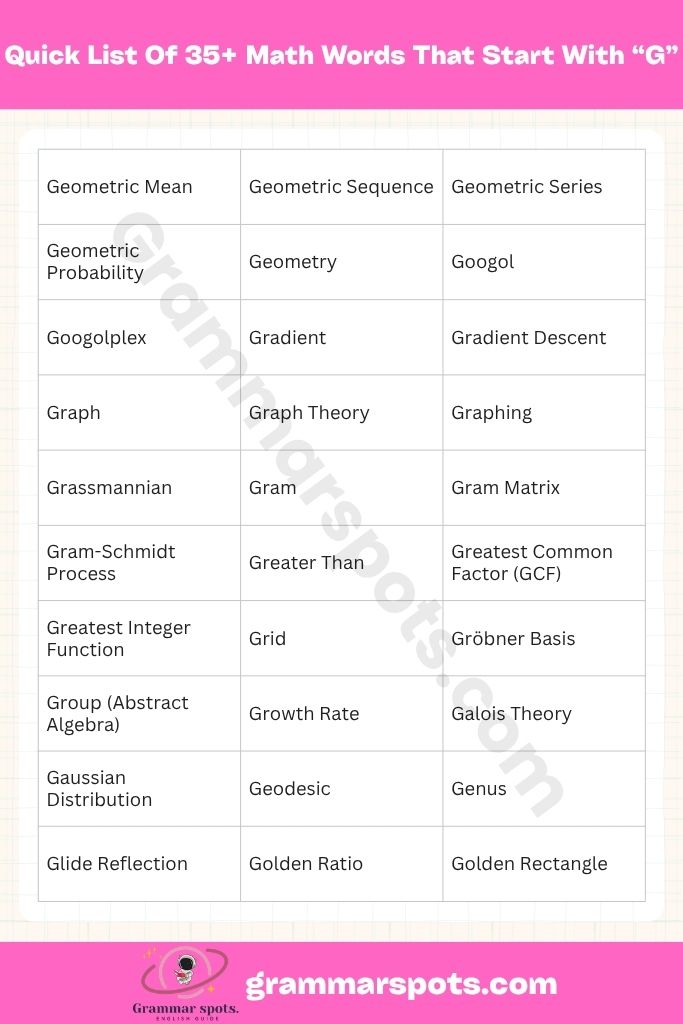
- Geometric Mean
- Geometric Sequence
- Geometric Series
- Geometric Probability
- Geometry
- Googol
- Googolplex
- Gradient
- Gradient Descent
- Graph
- Graph Theory
- Graphing
- Grassmannian
- Gram
- Gram Matrix
- Gram-Schmidt Process
- Greater Than
- Greatest Common Factor (GCF)
- Greatest Integer Function
- Grid
- Gröbner Basis
- Group (Abstract Algebra)
- Growth Rate
- Galois Theory
- Gaussian Distribution
- Geodesic
- Genus
- Glide Reflection
- Golden Ratio
- Golden Rectangle
- Gyration (Radius of)
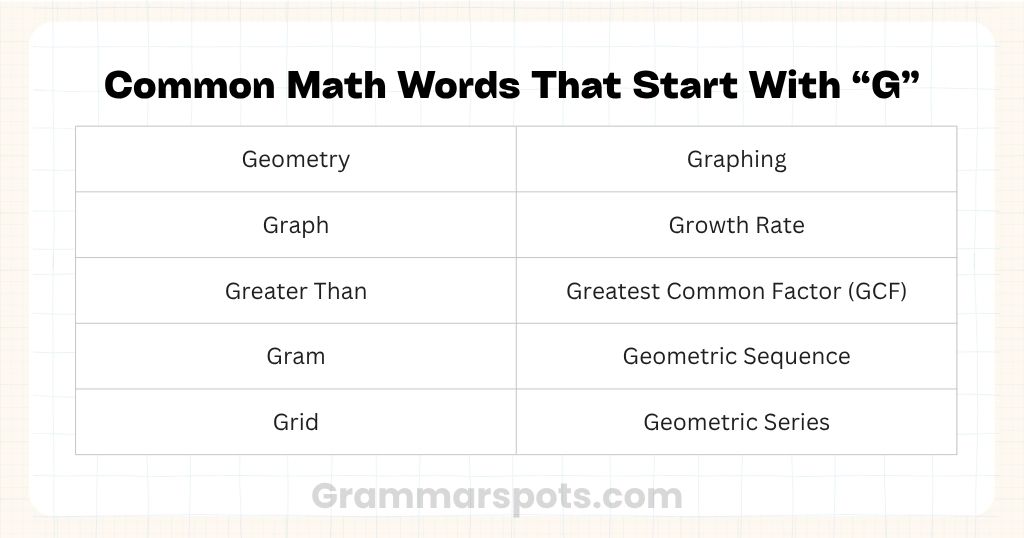
Common Math Words That Start With G
Geometry
Meaning: The branch of math that studies shapes, sizes, angles, and spatial relationships.
Example: We used geometry to find the area of the triangle.
Why It Matters: It is one of the oldest and most widely applied areas of mathematics.
Graph
Meaning: A visual display of data or a mathematical relationship, plotted on axes or drawn as a network.
Example: The line graph showed rising temperatures over a week.
Why It Matters: Graphs make abstract data and equations visible and easier to interpret.
Greater Than
Meaning: A comparison symbol (>) showing one value is larger than another.
Example: 9 > 4 means nine is greater than four.
Why It Matters: Essential for comparing numbers and writing mathematical inequalities.
Gram
Meaning: A metric unit of mass. 1,000 grams equals one kilogram.
Example: The coin weighed 5 grams.
Why It Matters: Used constantly in measurement problems and real-world science applications.
Grid
Meaning: A pattern of evenly spaced horizontal and vertical lines used to locate points or organize data.
Example: Plot the point (2, 5) on the coordinate grid.
Why It Matters: Grids form the foundation of coordinate geometry and graphing.
Graphing
Meaning: The process of plotting equations, functions, or data sets onto a coordinate system.
Example: Graphing y = 2x + 1 produces a straight line.
Why It Matters: Connects algebra to visual understanding of functions and equations.
Growth Rate
Meaning: The rate at which a quantity increases over a period of time, usually expressed as a percentage.
Example: A population rising from 5,000 to 5,500 has a 10% growth rate.
Why It Matters: Used in exponential functions, finance, and real-world data modeling.
Greatest Common Factor (GCF)
Meaning: The largest positive integer that divides two or more numbers without a remainder.
Example: The GCF of 12 and 18 is 6.
Why It Matters: Used for simplifying fractions, factoring expressions, and number theory problems.
Geometric Sequence
Meaning: A sequence where each term is found by multiplying the previous term by a fixed number called the common ratio.
Example: 2, 6, 18, 54 is a geometric sequence with a common ratio of 3.
Why It Matters: Models exponential growth and decay in science, finance, and nature.
Geometric Series
Meaning: The sum of all terms in a geometric sequence.
Example: 2 + 6 + 18 + 54 = 80 is a geometric series.
Why It Matters: Used in financial calculations, physics problems, and calculus.
Geometric Mean
Meaning: A type of average found by multiplying numbers together and taking the nth root.
Example: The geometric mean of 4 and 9 is √36 = 6.
Why It Matters: More accurate than arithmetic mean when averaging ratios, rates, or growth figures.
Gradient
Meaning: A measure of steepness or rate of change. In basic algebra, it equals slope. In advanced math, it is a vector of partial derivatives.
Example: A gradient of 4 means the line rises 4 units for every 1 unit across.
Why It Matters: Appears in algebra as slope and in calculus and physics as a measure of directional change.
Golden Ratio
Meaning: An irrational constant approximately equal to 1.618, written as φ (phi). Two quantities are in the golden ratio if their total divided by the larger equals the larger divided by the smaller.
Example: Dividing a line so that the whole to the larger part equals the larger to the smaller gives the golden ratio.
Why It Matters: Appears in geometry, Fibonacci numbers, classical architecture, and natural spiral patterns.
Golden Rectangle
Meaning: A rectangle whose length to width ratio equals the golden ratio (≈ 1.618).
Example: An 8 × 13 rectangle closely approximates a golden rectangle.
Why It Matters: Connects geometry to the golden ratio and Fibonacci sequence; widely studied in art and design.
Glide Reflection
Meaning: A geometric transformation combining a reflection over a line followed by a translation along that same line.
Example: Left and right footprints in a straight line demonstrate a glide reflection.
Why It Matters: One of the four rigid transformations in geometry; essential for understanding symmetry.
Geometric Probability
Meaning: A method of calculating probability using lengths, areas, or volumes instead of counting outcomes.
Example: If a 2×2 target sits on a 10×10 board, the probability of a random hit is 4/100 = 4%.
Why It Matters: Connects geometry and probability; used in engineering simulations and modeling.
Googol
Meaning: The number 10¹⁰⁰ the digit 1 followed by 100 zeros.
Example: A googol is larger than the estimated number of atoms in the observable universe.
Why It Matters: Illustrates the concept of astronomically large numbers in number theory and combinatorics.
Googolplex
Meaning: The number 10^(googol) the digit 1 followed by a googol of zeros.
Example: A googolplex could not be written out even if every particle in the universe were a digit.
Why It Matters: Helps students understand the concept of incomprehensibly large numbers and the nature of infinity.
Related Post: 40+ Math Words That Start With F (With Meanings and Examples)
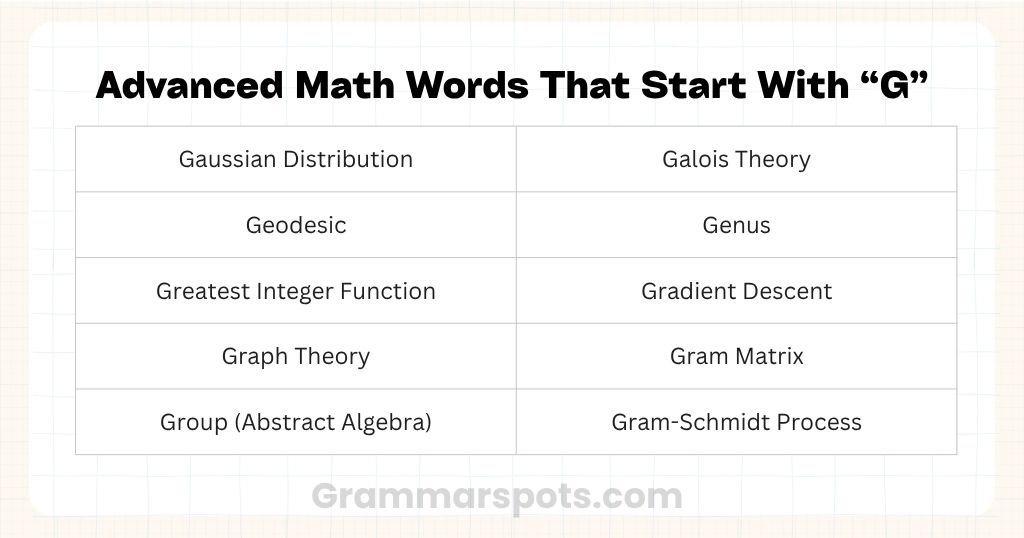
Advanced Math Words That Start With G
Gaussian Distribution
Meaning: A symmetric, bell-shaped probability distribution where most values cluster near the mean.
Math Branch: Statistics
Example: Human height in a large population follows a Gaussian distribution.
Real-World Use: Used in statistics, psychology, finance, and natural sciences to model variation.
Geodesic
Meaning: The shortest path between two points on a curved surface.
Math Branch: Differential Geometry
Example: Intercontinental flight routes follow geodesic lines on the globe.
Real-World Use: Navigation, general relativity, and geodesic dome architecture.
Greatest Integer Function
Meaning: Written as ⌊x⌋, this function returns the largest integer that is less than or equal to x. Also called the floor function.
Math Branch: Functions / Analysis
Example: ⌊4.9⌋ = 4 and ⌊−2.3⌋ = −3.
Real-World Use: Computer science, scheduling, and rounding-down calculations.
Graph Theory
Meaning: A branch of discrete mathematics studying graphs structures made of vertices (points) connected by edges (lines).
Math Branch: Discrete Mathematics
Example: Social networks and road systems are both modeled using graph theory.
Real-World Use: Internet routing, logistics, social network analysis, and circuit design.
Group (Abstract Algebra)
Meaning: A set combined with an operation satisfying four properties: closure, associativity, an identity element, and invertibility.
Math Branch: Abstract Algebra
Example: Integers under addition form a group zero is the identity, and every integer has a negative inverse.
Real-World Use: Cryptography, quantum physics, and the study of symmetry.
Galois Theory
Meaning: A branch of abstract algebra linking field theory and group theory to determine which polynomial equations can be solved using radicals.
Math Branch: Abstract Algebra
Example: Galois theory proves no general algebraic formula exists for polynomials of degree five or higher.
Real-World Use: Foundation for modern algebra, coding theory, and theoretical physics.
Genus
Meaning: A topological property counting the number of holes in a surface. A sphere has genus 0; a donut shape has genus 1.
Math Branch: Topology
Example: A coffee mug and a donut both have genus 1 because each has exactly one hole.
Real-World Use: Classifying surfaces in pure mathematics, complex analysis, and string theory.
Gradient Descent
Meaning: An optimization algorithm that moves in the direction of steepest decrease of a function to find its minimum value.
Math Branch: Applied Math / Optimization
Example: Training a neural network uses gradient descent to minimize prediction error.
Real-World Use: Machine learning, artificial intelligence, and engineering optimization.
Gram Matrix
Meaning: A matrix where each entry is the dot product of two vectors from a given set.
Math Branch: Linear Algebra
Example: Gram matrices are used in machine learning style-transfer algorithms.
Real-World Use: Functional analysis, computer vision, and machine learning.
Gram-Schmidt Process
Meaning: A method for converting a set of linearly independent vectors into an orthogonal or orthonormal set.
Math Branch: Linear Algebra
Example: The Gram-Schmidt process is used in quantum mechanics to simplify vector calculations.
Real-World Use: Computer graphics, signal processing, and physics.
Gyration (Radius of)
Meaning: A value describing how the mass or area of an object is distributed around a given axis.
Math Branch: Applied Mathematics / Mechanics
Example: Engineers calculate the radius of gyration when designing columns to resist buckling.
Real-World Use: Structural engineering, mechanical design, and physics.
Grassmannian
Meaning: A geometric space representing all subspaces of a fixed dimension within a larger vector space.
Math Branch: Algebraic / Differential Geometry
Example: The Grassmannian G(2,4) represents all 2D planes passing through the origin in 4D space.
Real-World Use: Algebraic geometry, theoretical physics, and computer vision.
Gröbner Basis
Meaning: A specific generating set for a polynomial ideal, used to simplify and solve systems of polynomial equations.
Math Branch: Computational Algebra
Example: Computer algebra systems use Gröbner bases to solve polynomial equation systems efficiently.
Real-World Use: Robotics, cryptography, and symbolic computation software.
Related Post: 50+ Math Words That Start With H (With Meanings and Examples)
Geometry Terms That Start With G
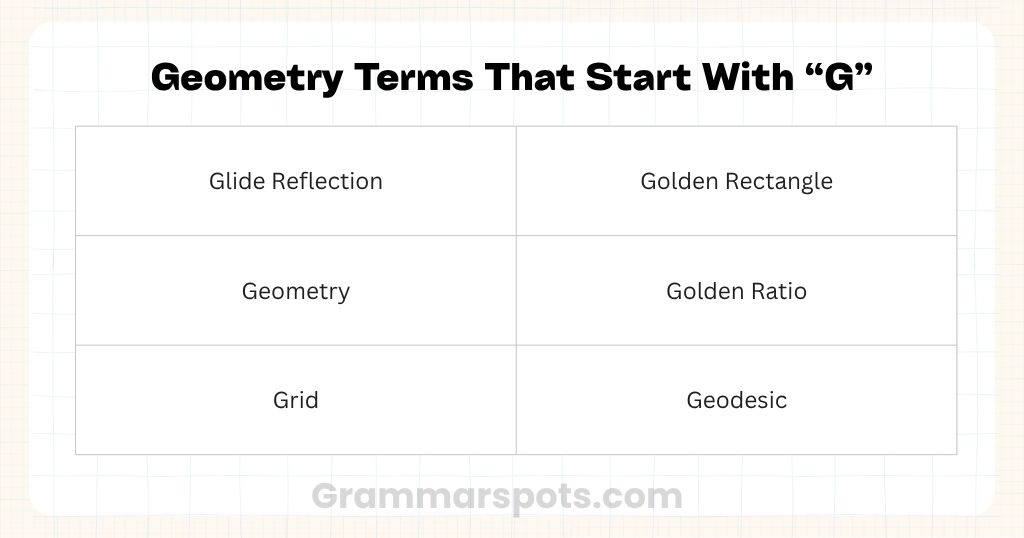
- Geometry Study of shapes, sizes, and space
- Grid Coordinate plane background
- Glide Reflection Reflection combined with translation
- Golden Ratio Proportion φ ≈ 1.618
- Golden Rectangle Rectangle with golden ratio dimensions
- Geodesic Shortest path on a curved surface
- Genus Number of holes in a topological surface
Algebra Terms That Start With G
- Geometric Sequence Fixed-ratio number pattern
- Geometric Series Sum of a geometric sequence
- Gradient Slope or rate of change
- Growth Rate Rate of increase over time
- Greatest Integer Function Floor function ⌊x⌋
- Group Set with closure, associativity, identity, inverse
Statistics and Probability Terms That Start With G
- Gaussian Distribution Symmetric bell-curve distribution
- Geometric Mean Multiplicative average
- Geometric Probability Probability based on area or length
Number Theory Terms That Start With G
- Greatest Common Factor (GCF) Largest shared divisor
- Googol 10¹⁰⁰
- Googolplex 10^(googol)
- Golden Ratio Irrational constant φ
Measurement Terms That Start With G
- Gram Metric unit of mass
- Gradient Measure of steepness or incline
Related Post: 40+ Math Words That Start With I (With Meanings and Examples)
Advanced and Pure Mathematics Terms That Start With G
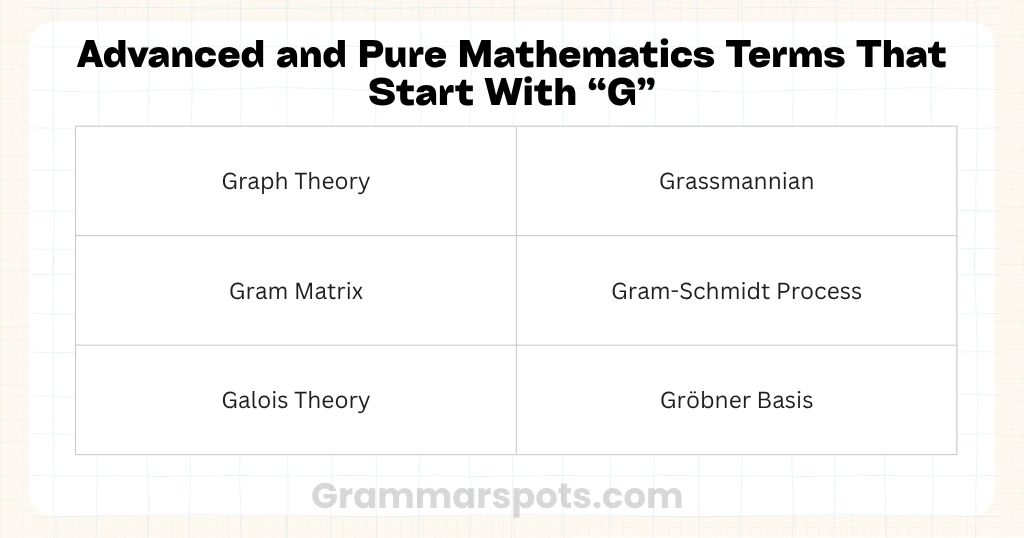
- Galois Theory Algebra of polynomial solvability
- Graph Theory Networks of vertices and edges
- Gradient Descent Iterative optimization method
- Gram Matrix Dot product matrix
- Gram-Schmidt Process Orthogonalization of vectors
- Grassmannian Space of vector subspaces
- Gröbner Basis Polynomial simplification tool
- Gyration (Radius of) Mass distribution around an axis
Real-World Applications
Measurement:
- Gram is used in cooking, medicine, and laboratory science.
Engineering:
- Gradient determines road and ramp incline safety.
- Radius of Gyration guides structural column design.
Statistics and Science:
- Gaussian Distribution models test scores, heights, and measurement errors.
- Geometric Mean accurately averages financial returns and growth rates.
Technology and Computer Science:
- Graph Theory powers internet routing and social network analysis.
- Gradient Descent trains every major machine learning and AI model.
- Gröbner Basis drives symbolic computation in software like Mathematica.
Geometry and Nature:
- Golden Ratio appears in the Parthenon, Renaissance art, and spiral shell patterns.
- Geodesic curves determine flight paths and geodesic dome construction.
Tips for Remembering Math Words That Start With G
- Group by subject. Learn geometry G-words together, then algebra ones. Grouping by topic builds stronger connections.
- Use a vocabulary journal. Write each term, define it in your own words, and draw or sketch an example.
- Connect to real life. A gram is roughly the weight of a paperclip. A gradient is the steepness of a road. Physical anchors help memory.
- Solve one problem per word. Don’t just read the definition find the GCF of two numbers, graph a geometric sequence, sketch the golden rectangle.
- Use spaced repetition. Review your flashcards today, in two days, then in one week. Spacing dramatically improves long-term recall.
Related Post: 55+ Math Words That Start With J (With Meanings and Examples)
Commonly Confused Terms
Gradient vs. Slope
Both describe steepness of a line in basic algebra. However, slope is always a single number. Gradient is the broader term in multivariable calculus it becomes a vector pointing in the direction of greatest increase.
Geometric Mean vs. Arithmetic Mean
- Arithmetic mean: add all values, divide by count.
- Geometric mean: multiply all values, take the nth root.
- For 2 and 8: arithmetic mean = 5, geometric mean = 4.
- Geometric mean is better for averaging ratios and growth rates.
Geometric Sequence vs. Geometric Series
- Sequence: the list of terms 3, 9, 27, 81
- Series: the sum of those terms 3 + 9 + 27 + 81 = 120
- Same pattern, different mathematical objects.
Graph (Coordinate) vs. Graph (Graph Theory)
- Coordinate graph: a chart with axes showing data or functions.
- Graph theory graph: a network of vertices connected by edges.
- Same word, two completely different meanings depending on context.
Greatest Common Factor vs. Least Common Multiple
- GCF: the largest number that divides into both values.
- LCM: the smallest number both values divide into.
- For 4 and 6: GCF = 2, LCM = 12.
FAQs About Math Words That Start With G
Q1: What math words starting with G are most important for elementary students?
Focus on Greater Than, Gram, Grid, Graph, and Geometry. These appear in nearly every elementary curriculum.
Q2: Which G-words appear most in algebra?
- Geometric Sequence
- Geometric Series
- Gradient
- Growth Rate
- Greatest Integer Function
Q3: What does GCF stand for?
Greatest Common Factor the largest number that divides evenly into two or more given numbers.
Q4: Is Googol a real math term?
Yes. It was coined by mathematician Edward Kasner in 1938. A googol equals 10¹⁰⁰. Google named itself after this number (with a deliberate misspelling).
Q5: What is the golden ratio and where does it appear?
φ ≈ 1.618. It appears in:
- Geometry of regular pentagons
- Fibonacci number sequence
- Classical architecture
- Natural spiral patterns in shells and flowers
Q6: How is geometric probability different from regular probability?
Regular probability counts discrete outcomes. Geometric probability uses area, length, or volume to calculate likelihood on a continuous scale.
Q7: What advanced G-words appear in college math?
- Gaussian Distribution
- Galois Theory
- Group Theory
- Gradient Descent
- Gram-Schmidt Process
- Grassmannian
- Gröbner Basis
- Gram Matrix
Q8: What is the difference between geometric sequence and geometric series?
A sequence is the ordered list of terms. A series is the sum of those terms. Related but not the same.
Conclusion
Math words that start with G span every level of the subject:
- Easy terms like Graph, Gram, and Greater Than build early foundations.
- Mid-level terms like Geometric Sequence, Gradient, and Golden Ratio develop algebra and geometry skills.
- Advanced terms like Galois Theory, Gaussian Distribution, and Gradient Descent underpin modern mathematics and technology.
Use this guide as a reference tool, a study resource, or a vocabulary builder and return to it whenever a G-word appears that you want to understand fully.

I’m Hazel, and I studied BSC English at GCUF. I focus on explaining word meanings in simple, clear language that anyone can understand. My goal is helping readers grasp everyday English, confusing terms, and slang used in real conversations and social media. I believe language learning works best when definitions connect to actual life situations. Through careful research and straightforward explanations, I make vocabulary accessible for students, learners, and anyone curious about how English really works in daily use.